

HCPCS code E0198: Water pressure pad billing guide
HCPCS code E0198 is a water pad for a standard mattress HCPCS code E0198 is the ...

Last Updated: Oct 13, 2026
E0295 is the HCPCS Level II code for hospital bed, semi-electric (head and foot adjustment), without side rails, without mattress. Its head and foot sections are motor-driven, while the height is fixed or adjusted by hand.
Medicare Part B covers it as durable medical equipment when the criteria in LCD L33820 are met. E0294 carries the same descriptor apart from the mattress, which ships with that bed. Suppliers attest to medical necessity with the KX modifier, because Certificates of Medical Necessity retired in 2023.
Let Pabau's smart automation suggest the right codes, reduce claim denials, and keep your practice compliant—effortlessly.
Automate repetitive tasks and focus on what matters most—your patients.
Reduce coding errors and ensure compliance with the latest regulations.
Clean claims, fewer denials, and faster reimbursements.
Powerful insights and reporting to help your practice thrive.
HIPAA compliant SOC 2 certified GDPR-compliant Trusted by 4,000+ clinics worldwide

HCPCS Code E0295 describes a semi-electric hospital bed with motor-driven head and foot adjustment, supplied without side rails and without a mattress.
E0294 is the code most often billed in place of E0295. The two descriptors are identical apart from the mattress, which ships with the bed under E0294.
E0296 and E0297 are total electric beds, not side-rail versions of E0295. Medicare treats their motorized height adjustment as a convenience feature and denies both.
Certificates of Medical Necessity retired for dates of service on or after January 1, 2023. Medical necessity now sits in the patient’s medical record, attested with the KX modifier.
Pabau’s claims management software tracks documentation checklists and flags incomplete fields before submission, reducing DMEPOS denial rates.
HCPCS Code E0295 is a CMS HCPCS Level II E-series code for a durable medical equipment item.
It describes a hospital bed whose head and foot sections are motor-driven. Height is either fixed or adjusted by hand, which is what makes the bed semi-electric rather than total electric.
The descriptor carries three exclusions that decide the code. The bed has no side rails, no mattress, and no motorized height adjustment. Miss any one of them and a different E-series code applies.
E0295 covers the bed frame with its motor mechanism for head and foot positioning. Nothing else is bundled into the code. Two items billers routinely assume are bundled need their own HCPCS codes and their own claim lines.
The mattress exclusion is the descriptor element that costs the most money. Billing E0295 and assuming the mattress is covered produces an underpayment. Billing a mattress code with no bed code produces a standalone denial. The mattress is medically necessary only alongside the bed frame.
E0294 is the code most often billed when E0295 was the correct choice. Every word of the two descriptors matches apart from the final clause. E0294 is the bed with mattress, and E0295 is the bed without mattress.
The delivery ticket settles which code applies. If the mattress left the warehouse on the same delivery as the frame, the claim is E0294 and no separate mattress line belongs on it. If the frame arrived alone, the claim is E0295, and the mattress is billed under E0271 or E0272.
Billing E0295 plus a mattress code when the supplier actually delivered an E0294 package is a duplicate-payment finding in a DMEPOS audit. Our guide to E0294 covers the mattress-inclusive side of the pair in full.
Three descriptor elements separate the adult hospital bed codes. How the height moves, whether side rails ship with the frame, and whether a mattress ships with it. E0296 and E0297 are frequently mistaken for side-rail versions of E0295. They are not. Both are total electric beds, and Medicare denies them.
Two codes sitting nearby are easy to pull in by mistake. E0300 is not an adult bed at all. It is a hospital-grade pediatric crib, fully enclosed, with or without a top enclosure, so it never belongs in an adult bed comparison. E0261 is the code to reach for when rails do ship with a semi-electric frame that has no mattress.
The practical selection rule runs in three steps. Confirm the height adjustment is manual or fixed, because a motorized height feature moves the claim to E0296 or E0297 and out of coverage. Confirm no side rails shipped, because rails move the claim to E0260 or E0261. Then check the mattress: present means E0294, absent means E0295.
Audit the delivery ticket against the billed code before every E0295 submission. The ticket records what left the warehouse, and it is the document a DMEPOS auditor compares your claim against. A frame delivered with a mattress is E0294, and a frame delivered with rails is E0261.
Medicare Part B covers E0295 under the DMEPOS benefit when medical necessity is established and documented before delivery. Coverage is governed by LCD L33820, maintained by the applicable Medicare Administrative Contractor (MAC).
Confirming coverage before ordering starts with an eligibility check. It confirms the patient is enrolled in Medicare Part B and has not exhausted the DME benefit for the current benefit period.
LCD L33820 (Hospital Beds and Accessories) defines the clinical indications that support billing a semi-electric hospital bed. A flat or variable-height manual bed is the entry-level option. A semi-electric bed is covered only when the patient cannot operate manual adjustment because of a medical condition.
Qualifying indications under L33820 for a semi-electric bed include:
The order must name the qualifying condition and state why a manual hospital bed is insufficient. A generic order for a hospital bed, with no clinical rationale attached, will not satisfy L33820 and draws a medical necessity denial.
When those criteria are met, the supplier adds the KX modifier to the E0295 line. The KX modifier is the supplier’s attestation that the record holds the evidence L33820 asks for. Where the criteria are not met, a different modifier applies. Use GA if a signed Advance Beneficiary Notice (ABN) is on file, and GZ if one is not.
Complete documentation before delivery is the most reliable way to prevent E0295 denials. Records created at the time of the order carry far more weight in an audit than material gathered after a claim is challenged.
Required documentation checklist:
A claim template that pre-populates the required diagnosis codes and modifier fields against each HCPCS code cuts the chance of a missing-documentation denial. Every field on the CMS-1500 or the electronic 837P must be completed, and the date of service must match the delivery record.
A great deal of DME billing guidance still tells suppliers to file a Certificate of Medical Necessity with a hospital bed claim. That instruction is out of date, and following it now costs the claim outright.
CMS discontinued every CMN and DME Information Form for dates of service on or after January 1, 2023. A claim that still carries CMN or DIF data for one of those dates is rejected in full, rather than denied for incomplete documentation. The hospital bed form was CMS-841, also known as DMERC 01.02A, and it retired with the rest of them.
CMS-484 deserves a separate mention, because it turns up in hospital bed checklists constantly. CMS-484 is the oxygen CMN. It was never the hospital bed form, and it is retired too. If a template in your practice names CMS-484 for an E0295 order, that template needs rewriting.
Dropping the form did not lighten the evidence burden. The clinical detail CMS used to collect on the CMN now has to sit in the treating practitioner’s own medical record. Your file needs the standard written order plus progress notes showing why a semi-electric bed is necessary under LCD L33820. The claim then needs the KX modifier to attest to it.
Medicare does not currently list E0295 on the CMS DMEPOS prior authorization program’s required list. Prior authorization requirements do change annually, and some MACs run their own coverage review programs for hospital beds in specific jurisdictions. Verifying the current status with the applicable MAC before delivery is a standard compliance step.
Commercial payers treat prior authorization differently from Medicare. Most major commercial insurers require pre-authorization for semi-electric hospital beds, and several ask for the written order and supporting notes before approving delivery. Tracking payer-specific rules by code reduces the risk of delivering equipment before approval is confirmed.
Run a payer-specific prior authorization check on every E0295 order before scheduling delivery. For commercial payers, confirm authorization in writing and attach the authorization number to the claim. An unconfirmed verbal approval does not protect against a retroactive denial.
Medicare reimburses E0295 under the capped rental model rather than the inexpensive and routinely purchased category. Semi-electric hospital beds sit inside that capped rental classification for every DMEPOS supplier.
CMS publishes the 2026 DMEPOS fee schedule rates for E0295 annually, and they vary by geographic pricing region. Actual payment depends on whether the supplier sits in a competitive bidding area (CBA) or outside one. Confirm current rates with the CMS fee schedule lookup tool before quoting rental amounts to patients.
Under the capped rental model, Medicare pays the monthly rental amount for up to 13 continuous rental months. Ownership then transfers to the beneficiary automatically.
The supplier may no longer bill monthly rental. Medicare pays nothing for maintenance and servicing during months 14 through 19. Billing for maintenance and servicing may start at month 19, and every 6 months after that. The timeline below sets out what is payable in each window.
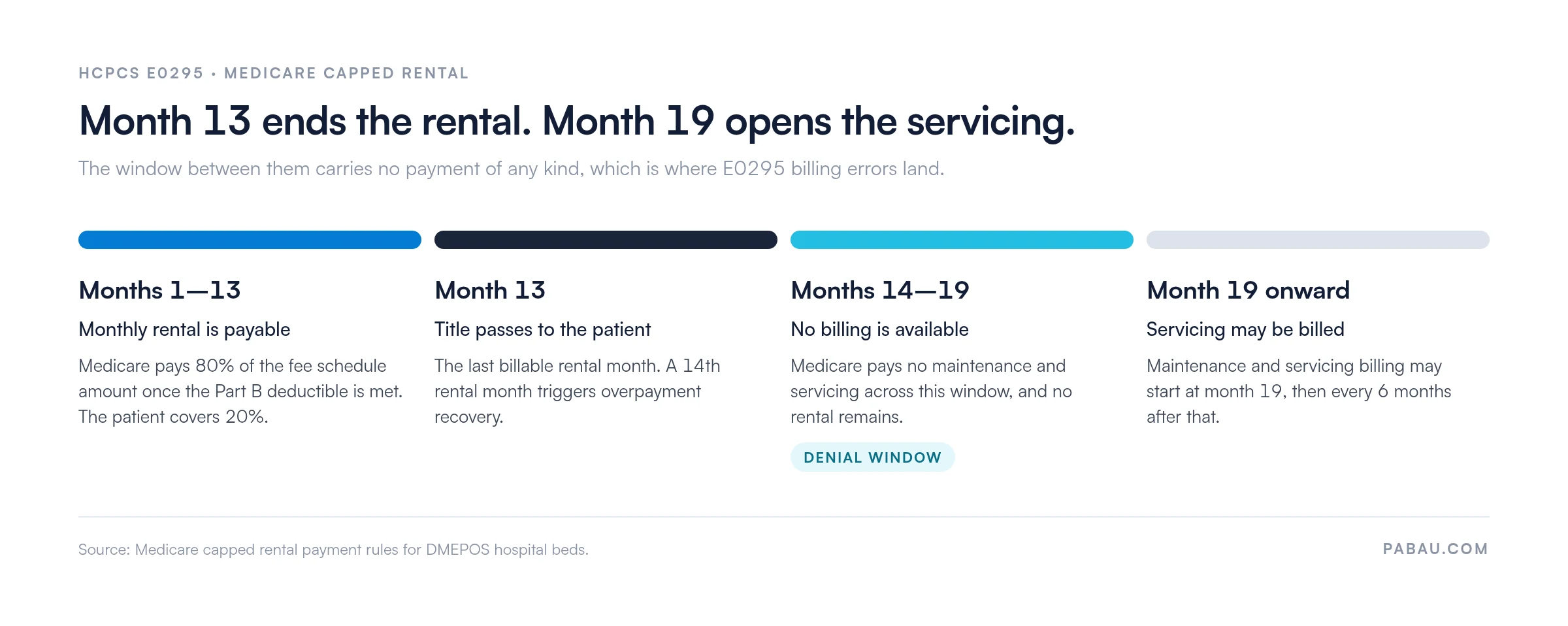
The practical billing implication is that month 13 is the last rental month, not month 14. Billing a 14th month triggers an automatic overpayment recovery. A rental-month counter tied to the code is the simplest guard against it.
E0295 carries a higher-than-average denial rate across DMEPOS categories, because its coverage criteria depend on clinical documentation many ordering workflows never capture systematically. The denial codes payers return on these claims follow a short list of patterns, and each one is preventable before submission.
Billing E0295 to Medicare requires active DMEPOS accreditation from a CMS-approved accreditation organization and an active National Supplier Clearinghouse (NSC) number. Neither is optional. A claim from an unaccredited supplier is rejected, and retroactive accreditation does not rescue claims already denied.
The DMEPOS supplier standards at 42 CFR § 424.57 carry operational obligations alongside the paperwork:
ICD-10-CM diagnosis codes linked to E0295 claims must match a condition listed in the covered indications section of LCD L33820. The codes below are examples commonly associated with semi-electric hospital bed claims. Coders must verify the current covered list in the CMS Coverage Database or the AAPC HCPCS reference, because L33820 is revised annually.
Specificity matters. A claim linking E0295 to J44.9 (COPD, unspecified) is weaker than one linking it to J44.1 with documented acute exacerbation notes in the record. Use the most specific ICD-10-CM code the documentation supports, and check it against the covered diagnosis list in L33820.
Review the L33820 covered diagnosis list every October, when CMS releases the annual ICD-10-CM update. Codes covered in FY2025 may be revised or deleted in FY2026. Update your E0295 billing templates before October 1 each year.
E0295 denials usually start days before anyone opens a claim form. The delivery ticket records one configuration, the written order names another, and the progress note never explains why a manual bed would not do. By the time the remittance comes back, the equipment is already in the patient’s home.
Practice management software like Pabau keeps that evidence in one patient record. The written order, the face-to-face note, the qualifying diagnosis, and proof of delivery sit against the same file. A coder can see whether the KX modifier is defensible before the claim goes out.
Pabau’s software for preventing denials then checks the submission itself. It holds documentation checklists per HCPCS code, counts rental months against the 13-month cap, and flags missing fields before a claim reaches the payer. Billers spend their time on the handful of orders that need attention rather than reworking denials.

Pabau’s claims management software tracks documentation requirements, modifier rules, prior authorization status, and rental-month counters for HCPCS codes including E0295. Book a demo to see how it reduces denial rates for DME suppliers and multi-specialty practices.

E0295 denials are almost always preventable. The descriptor is precise, the L33820 coverage criteria are well defined, and the documentation requirements have been stable since the CMN retired. Three failures account for most of them. E0294 gets billed for a frame that shipped without a mattress. The KX modifier goes on without the record to back it. Or the order never explains why a manual bed would not work.
Pabau’s builds pre-submission checklists against HCPCS code requirements, tracks rental-month counters, and flags missing documentation before claims reach the payer. To see how that applies to DMEPOS workflows, book a demo with the team.

Billing the same bed with a mattress? HCPCS Code E0294 covers the mattress-inclusive half of the pair, including when to split the mattress onto its own line.
Want to reduce denial rates across your billing operation? Denial management in healthcare covers the workflows and appeal strategies that recover the most revenue.
Looking for a complete overview of DMEPOS billing compliance? Medical billing compliance requirements outlines the CMS supplier standards that govern HCPCS code submission.
HCPCS Code E0295 covers a semi-electric hospital bed with motor-driven head and foot adjustment, supplied without side rails and without a mattress. The code pays for the bed frame and its motor mechanism only. The mattress is billed separately under E0271 or E0272. Side rails need their own code if they are delivered.
The mattress is the only difference. E0294 is a semi-electric bed, head and foot adjustment, without side rails, with mattress. E0295 is the same bed without the mattress. Bill E0294 when the mattress shipped with the frame. Bill E0295 plus a separate mattress code when it did not.
E0296 is a total electric bed, which adds motorized height adjustment to the head and foot movement, and it ships with a mattress. E0295 is semi-electric, so its height is fixed or adjusted by hand. Medicare does not cover E0296. It treats the powered height feature as a convenience rather than a medical need.
Yes, Medicare Part B covers E0295 when the LCD L33820 medical necessity criteria are met. The treating practitioner must document a qualifying condition. Severe COPD, a positioning need the patient cannot manage manually, and a clinically ordered pressure ulcer protocol all qualify. Coverage is never automatic, and the necessity must be established before delivery.
Billing E0295 requires a standard written order signed by the treating practitioner and progress notes documenting the qualifying condition under LCD L33820. You also need a face-to-face encounter note, matching ICD-10-CM diagnosis codes, and signed proof of delivery. The claim line carries the KX modifier to attest that the criteria are met. Certificates of Medical Necessity are no longer used and must not be submitted.
No. CMS discontinued every Certificate of Medical Necessity and DME Information Form for dates of service on or after January 1, 2023. A claim still carrying that data is rejected outright. Form CMS-484 was the oxygen CMN and was never the hospital bed form, which was CMS-841.
No. E0295 excludes the mattress from its descriptor, so the mattress is billed separately. Use E0271 for an innerspring mattress and E0272 for a foam rubber mattress. If the mattress was delivered with the frame, E0294 is the correct code instead. Treating the mattress as bundled into E0295 produces an underpayment. It is hard to recover once the claim is finalized.
Medicare does not currently list E0295 on its mandatory DMEPOS prior authorization program. Requirements change annually and vary by MAC jurisdiction. Commercial payers usually do require prior authorization. Confirm current requirements with the applicable MAC or payer before each delivery rather than assuming last year’s policy still holds.
Medicare reimburses E0295 under the capped rental model for up to 13 months, after which ownership transfers to the beneficiary. Medicare pays 80% of the fee schedule amount once the Part B deductible is met. The beneficiary covers the remaining 20% coinsurance. Exact 2026 amounts vary by region and competitive bidding status, so confirm them in the CMS DMEPOS fee schedule lookup tool.



