

HCPCS code E0198: Water pressure pad billing guide
HCPCS code E0198 is a water pad for a standard mattress HCPCS code E0198 is the ...

Last Updated: Oct 13, 2026
E0294 is the HCPCS Level II code for hospital bed, semi-electric (head and foot adjustment), without side rails, with mattress.
The bed has both head and foot electric adjustment, and it is supplied without side rails and with a mattress. Medicare Part B covers it as durable medical equipment (DME) when the criteria in Local Coverage Determination (LCD) L33820 are met.
E0260 and E0295 sit closest to E0294 in the code family. They differ from it only by side rails and mattress, so the wrong one is easy to pick.
Let Pabau's smart automation suggest the right codes, reduce claim denials, and keep your practice compliant—effortlessly.
Automate repetitive tasks and focus on what matters most—your patients.
Reduce coding errors and ensure compliance with the latest regulations.
Clean claims, fewer denials, and faster reimbursements.
Powerful insights and reporting to help your practice thrive.
HIPAA compliant SOC 2 certified GDPR-compliant Trusted by 4,000+ clinics worldwide

HCPCS Code E0294 describes a semi-electric hospital bed with head and foot adjustment, no side rails, and a mattress included.
E0260 is the same bed supplied with side rails, and E0295 is the same bed supplied without a mattress.
Medicare Part B covers E0294 as a capped rental item for up to 13 months when medical necessity is established per LCD L33820.
No Certificate of Medical Necessity applies. CMS retired all CMNs and DME Information Forms for dates of service on or after January 1, 2023.
The KX modifier attests that documentation on file supports medical necessity, and misusing it is an OIG audit risk.
Pabau’s claims management software helps DME practices track rental months, apply correct modifiers, and submit cleaner E0294 claims.
HCPCS Code E0294 is a Level II Healthcare Common Procedure Coding System code. It describes a semi-electric hospital bed with head and foot electric adjustment, supplied without side rails and with a mattress. The Centers for Medicare and Medicaid Services (CMS) classifies it under the Durable Medical Equipment (DME) category for home use billing.
The code sits within the E-series of HCPCS hospital bed codes. “Semi-electric” means the head and foot sections are motorized, while the height adjustment remains manual. The “without side rails” qualifier is what separates E0294 from its closest relatives in the code family.
Medicare Part B covers HCPCS Code E0294 under the DME benefit when medical necessity is documented. The treating physician must show that the criteria defined in LCD L33820 are met. Coverage is not automatic upon ordering. The clinical record must support the need for a semi-electric bed rather than a manual or fully electric model.
LCD L33820 is maintained by the DME MAC contractors, among them Noridian Healthcare Solutions in Jurisdiction D of the program. It sets out when a semi-electric hospital bed is medically necessary. A patient generally qualifies when a standard hospital bed cannot meet their clinical needs, because their condition calls for frequent repositioning.
Key medical necessity indicators under LCD L33820 include:
The treating physician must document how the patient’s condition meets one or more of these criteria, and why a standard bed is insufficient. CMS revises LCD L33820 periodically. Verify your claim against the current version in the CMS Medicare Coverage Database before you submit.
Claims for E0294 require a complete documentation package establishing medical necessity before the bed is delivered. Missing a single required element is a leading cause of claim denial and, in audit scenarios, of recoupment demands. A structured record built at the point of order protects both the supplier and the ordering physician.
All documentation must be in the supplier’s file before the claim is submitted. A claim submitted before the file is complete gets denied even if the paperwork arrives later.
Plenty of DME billing guidance still tells suppliers to file a Certificate of Medical Necessity with a hospital bed claim. That instruction is out of date, and following it now costs you the claim outright.
CMS discontinued every CMN and DME Information Form for dates of service on or after January 1, 2023. A claim carrying CMN or DIF information for one of those dates is rejected in full. The hospital bed form was CMS-841, and it retired with the rest of them.
CMS-484 deserves a separate mention, because it turns up in hospital bed checklists constantly. CMS-484 is the oxygen CMN. It was never the hospital bed form, and it is retired too. If a template in your practice names CMS-484 for an E0294 order, that template needs rewriting.
Dropping the form did not lighten the evidence burden. The clinical detail CMS used to collect on the CMN now has to sit in the treating practitioner’s own medical record. Your file needs the standard written order plus progress notes showing why a semi-electric bed is necessary under LCD L33820.
Medicare reimburses HCPCS Code E0294 as a capped rental item under the DME fee schedule. Rental payments are made monthly for up to 13 months of continuous use. After the 13-month rental cap, title to the equipment passes to the beneficiary and no further rental payments are made. Suppliers must track rental months carefully to avoid overbilling.
Reimbursement rates for E0294 vary by geographic payment locality. CMS publishes the DME fee schedule annually, and rates can differ significantly between high-cost and rural localities. The table below shows the billing structure. Confirm exact dollar amounts for your locality against the CMS DMEPOS fee schedule before quoting patients.
Never quote a specific dollar rate to patients without noting the applicable fee schedule year and locality. Rates depend on locality and are updated annually through the Federal Register.
Track E0294 rental months in your billing system from the first delivery date. At month 10, flag the account for a courtesy patient notification and confirm the beneficiary still meets medical necessity. Stopping at month 13 is not automatic. Your claims workflow has to enforce it.
A clean claim for HCPCS Code E0294 needs the right combination of modifiers, place of service codes, and rental billing frequency. The CMS HCPCS overview governs the coding structure, while the DME MAC’s billing instructions govern submission. DME billing also differs from professional fee billing, because the rental model and the modifier requirements are specific to equipment claims.
Key billing rules for E0294 include:
The Advance Beneficiary Notice process is compliance-sensitive. Issuing an ABN incorrectly, or failing to issue one when required, creates financial liability for the supplier. Review the CMS ABN instructions or consult your DME MAC before you set an ABN workflow for E0294.
Every E0294 claim must include at least one covered ICD-10 diagnosis code that establishes medical necessity per LCD L33820. Pairing E0294 with an uncovered diagnosis code is a primary denial trigger. An appeal will not fix it if the underlying condition genuinely does not meet coverage criteria.
LCD L33820 specifies covered ICD-10 diagnosis codes in its associated Billing and Coding Article. Pull the current version from the CMS Medicare Coverage Database. Checking each diagnosis against our ICD-10-CM code reference before the order is placed keeps uncovered codes off the claim. Common covered conditions and representative codes include:
This table is illustrative. Always confirm covered codes against the current LCD L33820 Billing and Coding Article before submission. A diagnosis that is not on the LCD list will not be covered, however severe the presentation.
E0294 and E0260 are both HCPCS codes for semi-electric hospital beds, but they describe different configurations. Billing the wrong one is the most common error in this code family. E0294 covers a semi-electric bed without side rails, and E0260 covers the equivalent bed with side rails. The claim is paid on that distinction, so the code must match the equipment delivered.
If side rails are added to an E0294 bed later as a separate accessory, they may be billed under the appropriate accessory code. They do not change the base equipment code retroactively. When side rails are delivered with the bed from the start, E0260 is the correct code, not E0294.
This pair catches more billers than the E0260 comparison does. The code numbers sit next to each other, both beds are semi-electric, and neither one ships with side rails.
E0295 is a semi-electric bed with head and foot adjustment, without side rails, and without a mattress. E0294 is that same bed with the mattress supplied. Side rails play no part in telling these two codes apart. Any guidance describing E0295 as the “with side rails” version of E0294 is wrong.
Use the delivery itself as the test. If you delivered the mattress with the frame, bill E0294. If the beneficiary already had a suitable mattress and you supplied the frame alone, bill E0295. The grid below lays the four semi-electric codes out on the two features that separate them.
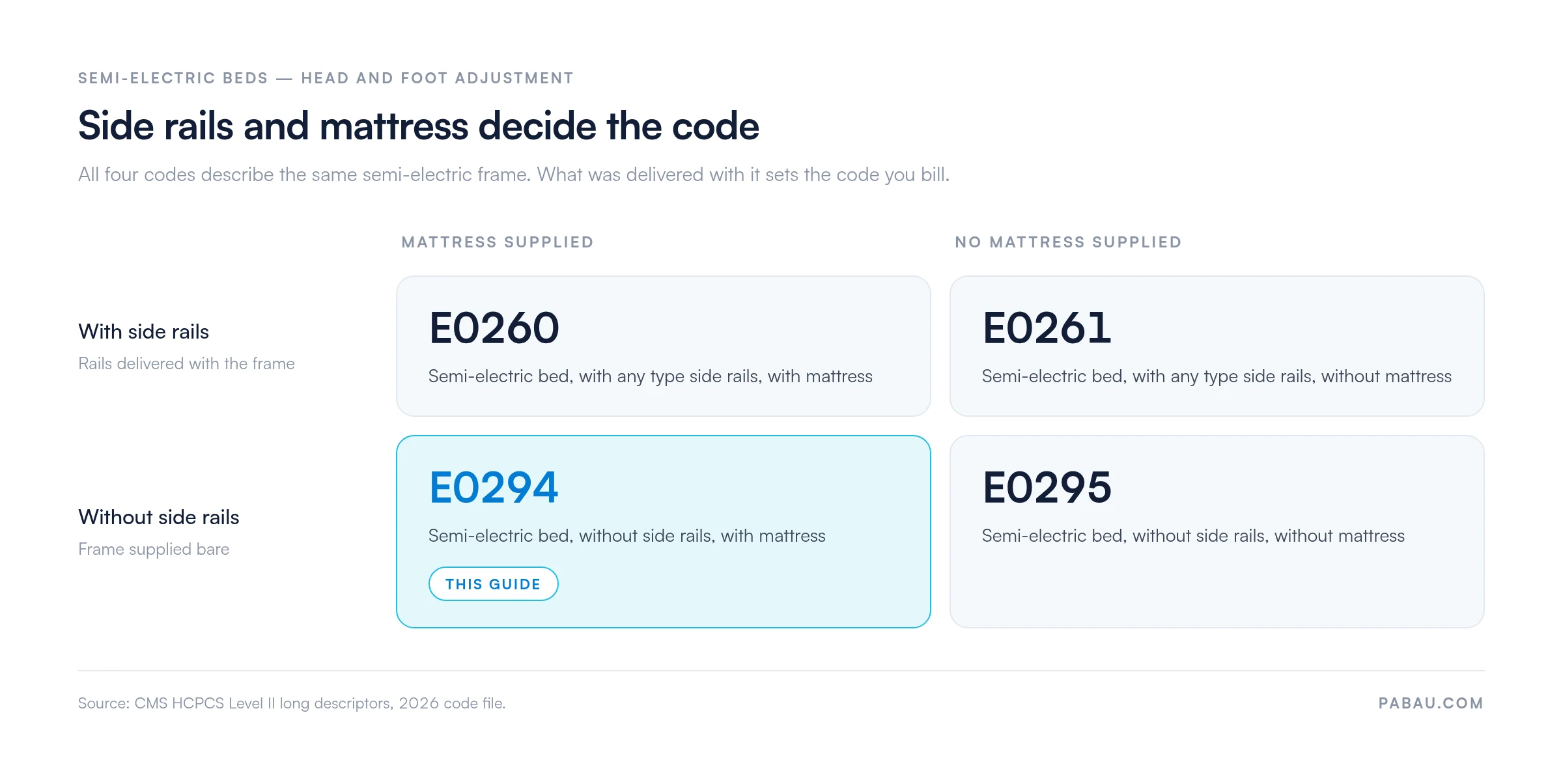
The E-series hospital bed codes cover a range of configurations from manual to fully electric. Selecting the right code depends on three variables: the type of electric adjustment, whether side rails are included, and whether a mattress is included. The AAPC HCPCS code reference is a quick way to confirm a descriptor before submission.
Descriptors above follow the current CMS HCPCS code file, with the heavy-duty weight ranges written in short form. Read the matrix as two blocks and the logic falls out. E0255 through E0266 covers beds supplied with side rails. E0292 through E0297 is the same set of configurations without them. Within the second block the pairs run variable height, semi-electric, then total electric. The first code of each pair includes a mattress, and the second does not.
E0260 and E0295 are not variants of one another. E0260 has side rails and a mattress, and E0295 has neither. Confirm the descriptor against the CMS file before you bill an unfamiliar configuration.
Most E0294 denials trace back to a short list of causes. Billers confuse the code with adjacent codes, miss modifier requirements, or submit without complete documentation. Strong denial management starts by preventing these errors at the point of claim creation. The rejection codes that come back on E0294 claims usually point to one of the causes below.
A pre-submission checklist that flags each of these points stops most denials before the claim leaves the practice. Practices using Pabau can build those checks into the billing workflow so they run at submission.
Run a quarterly audit of your E0294 claims. Pull every claim billed in the last 90 days, then check that each KX modifier has a signed standard written order behind it. Practitioner progress notes must sit in the same file, dated before the claim went out. This one check eliminates the most common OIG audit finding for DME hospital bed billing.
Most DME suppliers track capped rental months in a spreadsheet kept alongside the billing system. That spreadsheet is where month 13 gets missed. It is also where a KX modifier goes out on a claim whose order was never signed.
Practice management software like Pabau keeps the rental clock, the order status, and the claim in a single patient record. Billing teams can see which E0294 rentals are approaching the cap, and which files still lack a signed order before the claim goes out.
That turns the quarterly audit into a filter rather than a hunt through paperwork. Pabau’s claims management software surfaces the exceptions, so your team reviews only the handful of accounts that need attention.

Pabau’s claims management tools help DME suppliers track capped rental periods, apply correct modifiers, and submit cleaner E0294 claims. See how it works in a live demo.

HCPCS Code E0294 is straightforward once the equipment is documented and matched to the code. The side-rail and mattress distinctions within the E-series are where billers lose claims at the point of order.
Getting the code right starts before delivery. Confirm the diagnosis is covered under LCD L33820, then obtain the standard written order and supporting chart notes. Verify the equipment configuration, and apply the KX modifier only when the documentation supports it.
For suppliers running recurring rental claims across many patients, tracking 13-month caps and modifier requirements by hand stops scaling quickly. Pabau helps practices build these checks into their billing workflow, so E0294 claims go out clean the first time. To see how that works for a DME billing team, book a demo.

List Item #1
List Item #2
HCPCS Code E0294 is the billing code for a semi-electric hospital bed used at home. The bed has head and foot electric adjustment, and it is supplied without side rails and with a mattress. It is a Durable Medical Equipment (DME) code billed under Medicare Part B as a capped rental item.
E0260 includes side rails. E0294 does not. Both codes describe semi-electric hospital beds with head and foot adjustment and a mattress. The equipment delivered must match the code, so if side rails are supplied with the bed, E0260 is correct.
E0295 is a semi-electric hospital bed supplied without side rails and without a mattress. E0294 is that same bed with the mattress included. Side rails are not the difference between these two codes — the mattress is. The bed with side rails and a mattress is E0260.
E0294 is billed as a capped rental under Medicare, never as a purchase. Rental payments are made monthly for up to 13 continuous months, after which title transfers to the beneficiary. Billing beyond the 13-month cap is a billing error and is not payable.
You need a standard written order signed and dated by the treating practitioner, plus medical record documentation supporting a qualifying condition under LCD L33820. Add covered ICD-10 diagnosis codes and proof of delivery. All of it must be in the supplier’s file before the claim is submitted.
No. CMS discontinued all CMNs and DME Information Forms for dates of service on or after January 1, 2023. Claims that still carry that information for those dates are rejected. The retired hospital bed form was CMS-841. CMS-484 is the oxygen CMN and never applied to hospital beds.
LCD L33820, titled “Hospital Beds and Accessories,” is the Local Coverage Determination governing Medicare coverage for E0294. It defines medical necessity criteria, covered conditions, covered ICD-10 codes, and documentation requirements. Always reference the current version via the CMS Medicare Coverage Database.



