HCPCS code J3471: Hyaluronidase ovine injection billing guide
HCPCS code J3471: Descriptor, code type, and quick-reference data HCPCS code J34...

Last Updated: Oct 14, 2026
E0270 is the HCPCS Level II code for hospital bed, institutional type includes: oscillating, circulating and stryker frame, with mattress.
circulating, and Stryker frame configurations with mattress. These are specialty beds used in skilled nursing facilities and in qualifying home health cases, where a standard bed cannot meet the patient's positioning needs.
Let Pabau's smart automation suggest the right codes, reduce claim denials, and keep your practice compliant—effortlessly.
Automate repetitive tasks and focus on what matters most—your patients.
Reduce coding errors and ensure compliance with the latest regulations.
Clean claims, fewer denials, and faster reimbursements.
Powerful insights and reporting to help your practice thrive.
HIPAA compliant SOC 2 certified GDPR-compliant Trusted by 4,000+ clinics worldwide

HCPCS Code E0270 describes a hospital bed, institutional type — oscillating, circulating, or Stryker frame with mattress. It is permanent durable medical equipment under HCPCS Level II.
Medicare coverage requires documented medical necessity. The KX modifier signals that criteria in the applicable LCD have been met, while GY and GZ carry audit risk.
E0270 is billed as a rental with the RR modifier or a purchase with NU. That choice decides which fee schedule rate applies and how often you bill.
The face-to-face encounter must fall within 6 months before the order date. The physician order also has to name the bed type and the length of need.
Practice management software like Pabau submits DME claims through a clearinghouse, tracks their status, and reconciles payments in one record.
HCPCS Code E0270 is a permanent HCPCS Level II code describing a hospital bed of institutional type. It covers oscillating, circulating, and Stryker frame configurations, billed with the mattress included. The code is maintained by the Centers for Medicare and Medicaid Services (CMS) and sits in the E-series of durable medical equipment codes. DME suppliers, skilled nursing facilities, and home health providers use it to bill for institutional-grade beds.
It belongs to the wider set of HCPCS Level II codes, which cover supplies, equipment, and services that sit outside the CPT code set. Within that set, E0270 is one of the few bed codes tied to a specific mechanical function rather than a level of electric adjustment.
The three bed types under this single code share one clinical purpose. Each repositions a patient in a way a standard hospital bed cannot. An oscillating bed rocks or rotates the patient continuously to prevent pressure injuries in immobile patients. A circulating or turning bed performs similar lateral repositioning. A Stryker frame allows prone and supine positioning while immobilizing the spine, most often after spinal cord injuries or major orthopedic trauma. All three are billed under E0270 when dispensed with the included mattress.
The table below summarizes the key attributes of HCPCS Code E0270 as maintained in the CMS HCPCS code file.
E0270 is used when a patient’s condition requires continuous repositioning or immobilization that a semi-electric or full-electric hospital bed cannot provide. The three bed configurations each serve distinct patient populations, though all three fall under this one code.
Care settings matter for reimbursement. In skilled nursing facilities, E0270 is billable under the Part A consolidated billing rules during a qualifying stay. For home health settings, the DME supplier bills Medicare Part B directly. Knowing which of the two applies before the claim goes out prevents misrouted claims and avoidable rework.
Medicare coverage for E0270 requires documented medical necessity, supported by the treating physician’s order and the applicable Local Coverage Determination (LCD). Coverage is not automatic for any institutional-type hospital bed. The DME Medicare Administrative Contractor (DME MAC) reviews claims against the LCD criteria, and missing documentation is the most common reason for denial.
LCD criteria are set independently by each DME MAC jurisdiction and may differ from national coverage policy. Verify the LCD that applies to your region before claim submission, and re-check it whenever the contractor publishes a revision.
General medical necessity indicators for E0270 include:
Many payers require prior authorization for high-cost DME such as E0270. Confirm payer-specific authorization requirements before the equipment is dispensed. Checking the patient’s coverage at the point of order also prevents denials later, when a plan has lapsed or excludes high-cost DME outright.
E0270 reimbursement under Medicare Part B is calculated from the CMS DMEPOS fee schedule, which publishes separate rates for rental (RR) and purchase (NU) billing. Rates are geographically adjusted by DMEPOS pricing region, so the reimbursable amount varies by supplier location. The table below gives the rate basis; verify current figures against the live CMS DMEPOS file before billing.
Medicare typically covers 80% of the approved amount once the Part B deductible is met. The beneficiary or a secondary insurer covers the remaining 20%. Medicaid coverage for E0270 varies by state, and commercial payer rates are negotiated separately, so they may not follow the CMS DMEPOS schedule at all.
Modifier selection carries the most risk on an E0270 claim. Each modifier signals a different coverage and compliance position to the DME MAC. The wrong modifier risks more than a denial. It can trigger a post-payment audit or an overpayment demand when the attestation does not match the documentation.
Track modifier-specific denial rates separately, because the two common failures have different causes. A KX denial usually means supporting documentation never made it into the file. A GZ denial points further upstream, to a prior authorization or ABN step that was skipped before delivery.
Before submitting an E0270 claim with the KX modifier, check the physician order line by line. It must name the bed type (oscillating, circulating, or Stryker frame), document the clinical rationale, and carry a date inside the LCD’s ordering timeframe. A KX attestation unsupported by the file is the fastest route to a post-payment audit.
Clean claim submission for HCPCS Code E0270 means assembling documentation before the equipment is delivered, not after a denial arrives. The checklist below covers the core requirements across most DME MAC jurisdictions. Verify it against the applicable LCD for jurisdiction-specific additions.
What makes this list harder than it looks is the sequencing. Each item has its own deadline relative to the delivery date. The encounter requirement is the one that cannot be fixed after the fact.
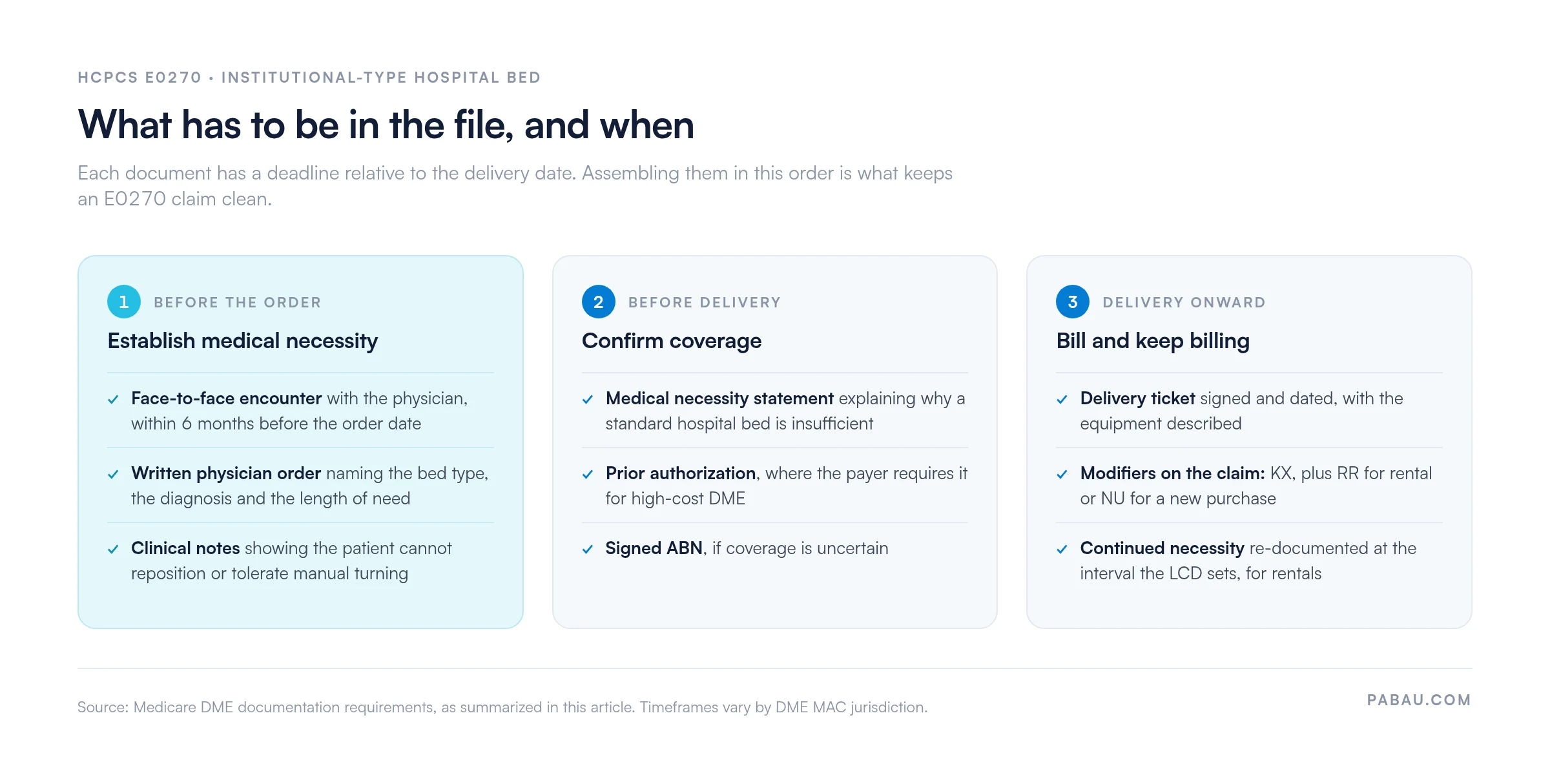
Confirming every item above before submission is what keeps DME denials down. Submitting a clean claim the first time removes the cost of appeals. It also protects cash flow that a rejected rental claim would delay by weeks.
For superbill documentation in DME-adjacent practice settings, include the E0270 code, the applicable modifiers, and the diagnosis code. Add the date of delivery and the ordering provider’s NPI. Some commercial payers also want the DME supplier’s NPI and PTAN on the claim form, listed separately from the ordering physician’s credentials.
Selecting the correct code from the E-series hospital bed family is a routine source of billing errors. The table below compares E0270 with its closest related codes. Clinical function is the differentiator: E0270 is the only code covering oscillating, circulating, and Stryker frame beds with mattress included. The other E-series beds serve lower-acuity positioning needs.
A common miscoding error is billing E0265 (full electric) when a rotating or oscillating bed is delivered. The functional distinction matters. E0265 covers beds that adjust height and head or foot position electrically, not beds that perform lateral rotation. If the clinical order specifies lateral rotation for pressure injury prevention or spinal immobilization, E0270 is the correct code.
DME suppliers and practice managers billing HCPCS codes like E0270 face a compounding documentation problem. The code set is extensive, modifier rules shift with LCD updates, and each payer applies its own prior authorization thresholds. Tracking that across spreadsheets and paper files is where a modifier error or a missing signature goes unnoticed until the denial arrives.
Pabau is practice management software with claims management software built in, so the billing record and the patient record are the same record. Claims are submitted through a clearinghouse, tracked as payers respond, and reconciled against the payments that come back. Billing staff can see where an E0270 claim stands without opening a separate portal or chasing a remittance file.
For high-cost DME like E0270, one claim can represent months of rental revenue. The downstream cost of a denial is what hurts: resubmission time, appeal preparation, and a possible write-off. Keeping submission, status, and reconciliation in one place shortens the distance between a rejected claim and a corrected one.
Set up a DME-specific checklist in your practice management system for E0270 orders. It should cover the physician order, the face-to-face encounter date, the medical necessity statement, delivery confirmation, and ABN status. Require checklist completion before any claim is released for submission. This single process change eliminates the most common clean claim failures for institutional-type hospital beds.

Pabau’s claims management software submits your claims through a clearinghouse, tracks each one as the payer responds, and reconciles payments against what you billed.

E0270 is a narrow code with a lot riding on it. Two decisions carry almost all of the risk. One is whether the KX attestation is supportable. The other is whether the claim goes out as a rental or a purchase. Get those right and the claim is routine. Get either wrong and you are in an appeal, or worse, a post-payment review.
The practical move is to shift the work earlier. Every requirement in this guide has a deadline that sits before delivery. A file assembled at order time is the version a denial cannot argue with. Build the checklist once, then apply it to every institutional bed you dispense.
Once the documentation is in order, the remaining work is keeping track of what you sent and what came back. Book a demo to see how Pabau submits, tracks, and reconciles DME claims from the same record that holds the patient’s file.

Wondering which modifiers apply across hospital bed codes? Our E0290 guide covers the rental modifiers and the top denial reasons that also apply to institutional-type claims.
Need the fully electric bed code instead? Our E0296 guide covers the total electric hospital bed, for patients whose condition doesn’t require the oscillating or Stryker frame E0270 describes.
First time billing Medicare for a hospital bed? Our E0293 guide walks through DMEPOS fee schedule basics and documentation requirements that carry over to every code in this family.
What about billing for repairs once the bed is in service? Our K0739 guide covers DME repair billing, relevant for institutional equipment that needs ongoing maintenance.
HCPCS Code E0270 is used to bill for a hospital bed of institutional type, including oscillating, circulating, and Stryker frame configurations with mattress. It applies when a patient’s condition requires continuous repositioning or spinal immobilization that a standard hospital bed cannot provide. Typical diagnoses include spinal cord injuries, severe burns, and acute conditions that leave an immobile patient at high risk of pressure injury.
Medicare reimburses E0270 at the DMEPOS fee schedule allowance. That allowance is geographically adjusted by DMEPOS pricing region and differs between rental (RR modifier) and purchase (NU modifier) billing. Medicare covers 80% of the approved amount after the Part B deductible. Verify current rates in the CMS DMEPOS fee schedule file for your supplier’s region before billing.
The primary modifiers for E0270 are KX, GA, GY, GZ, RR, NU, and UE. KX attests that medical necessity criteria are met and documentation is on file, GA signals a signed ABN, and GY and GZ flag expected denials. RR covers rental billing, NU a new purchase, and UE a used one. KX paired with RR or NU is the most common combination on covered claims.
An E0270 claim needs a written physician order specifying the bed type and diagnosis. It also needs documentation of a qualifying face-to-face encounter, and a medical necessity statement explaining why a standard bed is insufficient. A signed delivery confirmation is required too, plus an ABN if coverage is uncertain. Rental claims require ongoing documentation of continued medical necessity at the intervals the applicable LCD specifies.
Medicare’s face-to-face requirement for high-cost durable medical equipment looks backward from the order date only. The encounter with the physician or qualified non-physician practitioner must fall within the 6 months before the order is written. There is no window after the start of service, so an encounter arranged once the bed is already delivered will not support the claim.
E0265 covers a full-electric hospital bed that adjusts height, head, and foot position electrically, but it does not perform lateral rotation or spinal immobilization. E0270 covers institutional-type beds designed for continuous repositioning or prone and supine turns without spinal flexion. If the clinical order specifies lateral rotation or Stryker frame use, E0270 is the correct code, and billing E0265 instead is a miscoding error.
Yes. The Stryker frame bed is one of the configurations listed in the official E0270 code description. It is billable under this code when medical necessity is documented. Coverage requires a valid physician order, documented clinical necessity, and compliance with the applicable DME MAC Local Coverage Determination. Prior authorization may also apply, depending on the payer and the jurisdiction.