HCPCS code J3471: Hyaluronidase ovine injection billing guide
HCPCS code J3471: Descriptor, code type, and quick-reference data HCPCS code J34...

Last Updated: Oct 14, 2026
A4730 is the HCPCS Level II code for fistula cannulation set for hemodialysis, each.
Dialysis billing teams report it for the sterile needle set used to access an arteriovenous fistula at the start of a session.
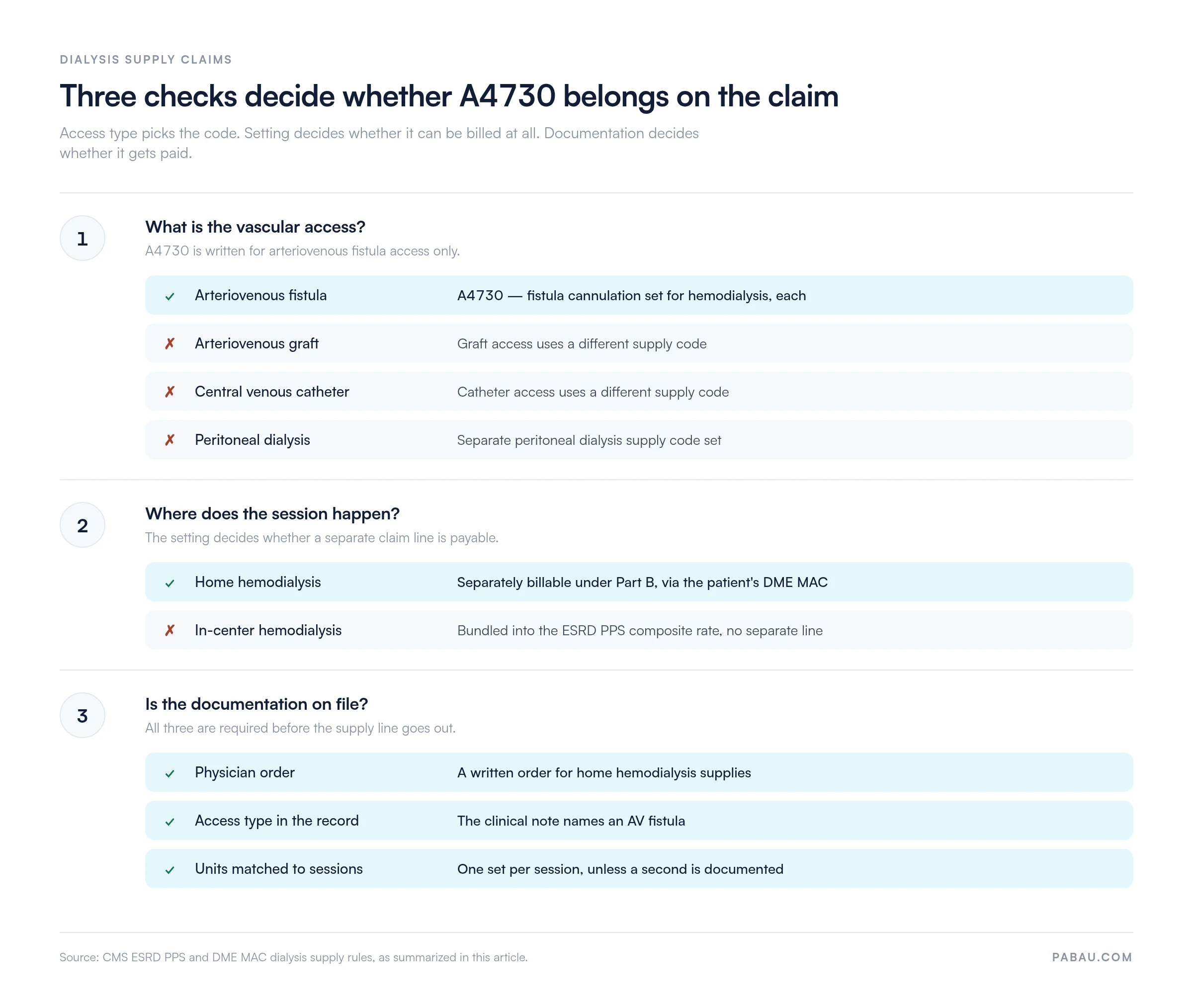
Whether the code can be billed at all depends on where the session happens. For in-center hemodialysis the supply cost sits inside the ESRD Prospective Payment System bundle. Home hemodialysis supplies are billed separately under Medicare Part B by the supplier.
Let Pabau's smart automation suggest the right codes, reduce claim denials, and keep your practice compliant—effortlessly.
Automate repetitive tasks and focus on what matters most—your patients.
Reduce coding errors and ensure compliance with the latest regulations.
Clean claims, fewer denials, and faster reimbursements.
Powerful insights and reporting to help your practice thrive.
HIPAA compliant SOC 2 certified GDPR-compliant Trusted by 4,000+ clinics worldwide

HCPCS Code A4730 covers a fistula cannulation set for hemodialysis, billed per each unit used.
The code is active in 2026 and applies to arteriovenous fistula access only, not to catheter or graft access.
The ESRD PPS bundles supply costs for in-center sessions, so only home hemodialysis supplies are billed separately.
A4728 covers non-dextrose dialysate solution, while A4913 is the miscellaneous dialysis supply catch-all.
Pabau’s claims management software supports HCPCS supply billing, so dialysis and nephrology practices can track per-unit usage and submit clean claims.
HCPCS Code A4730 describes a fistula cannulation set for hemodialysis, each. It belongs to HCPCS Level II, the code set the Centers for Medicare and Medicaid Services (CMS) maintains. Level II covers supplies, equipment, and non-physician services that CPT does not reach. A4730 sits in the A-series, which holds medical and surgical supplies, so it is a supply code and not a procedure code.
The table below shows the code attributes coders need to confirm before submitting a claim.
The “each” unit is what a payer counts against the session log. One fistula cannulation set covers one hemodialysis session on fistula access. Billing a second unit for the same session needs documentation showing that another set was consumed, which is uncommon and draws payer scrutiny.
A fistula cannulation set is the sterile supply package used to puncture and access an arteriovenous (AV) fistula before a hemodialysis session begins. A fistula is a surgically created connection between an artery and a vein, usually in the forearm or upper arm. It is the primary vascular access point for patients with end-stage renal disease (ESRD) on long-term dialysis.
The set typically contains two needles (arterial and venous), tubing, and associated connectors. Dialysis staff insert both needles into the fistula, connect them to the hemodialysis circuit, and remove them at the end of the session. HCPCS Code A4730 captures the cost of that set as a supply item, separate from the dialysis procedure itself.
A4730 applies only when the patient’s vascular access is an AV fistula. It does not apply to:
Confirming the vascular access method in the clinical record prevents the most common class of A4730 denials. Record it at the start of care, alongside ESRD program enrollment and the dialysis modality the payer holds on file. A note that says only “dialysis access” leaves the coder choosing between three different supply codes.
Repeated difficulty cannulating the same fistula can signal a stenosis in the access circuit. Medicare’s coverage policy for dialysis circuit angioplasty counts inability to cannulate as a sign of access dysfunction. The angioplasty itself is reported with 36902, on a claim separate from the A4730 supply line.
Medicare covers fistula cannulation sets under the ESRD program, but the coverage mechanics differ sharply between in-center and home hemodialysis. The setting decides which contractor sees the claim, and whether a separate supply line is payable at all.
In a Medicare-certified dialysis facility, the ESRD Prospective Payment System (PPS) bundles most supply costs. They go into the composite per-treatment rate paid to the facility. A4730 supply costs are generally part of that bundled payment, so facilities do not bill A4730 separately to Medicare. Billing it as a separate line on a facility claim can result in a denial or a request for repayment.
Under Medicare Part B, home hemodialysis patients may be eligible for separate supply billing. The Durable Medical Equipment Medicare Administrative Contractor (DME MAC) for the patient’s jurisdiction then processes the hemodialysis supply claims, A4730 included. The supplier or home dialysis program submits the claim using the patient’s home address, which determines the correct DME MAC.
Key documentation requirements for A4730 under home hemodialysis billing include:
Suppliers have to retain documentation supporting the medical necessity of each supply item. DME MAC jurisdictions can also issue Local Coverage Determinations (LCDs) that add their own coverage criteria. Check the applicable DME MAC’s LCD for dialysis supplies before submitting A4730 claims.
Three checks decide the outcome of an A4730 claim line, and they run in order.
Medicare reimburses HCPCS supply codes like A4730 through the DMEPOS (Durable Medical Equipment, Prosthetics, Orthotics, and Supplies) fee schedule rather than the Physician Fee Schedule. CMS updates allowable amounts annually. They also vary by whether the claim falls in a competitive bidding area (CBA) or outside one.
Because those rates change each calendar year, no dollar figure should be hardcoded into a billing workflow without cross-checking the current CMS release. The CMS Physician Fee Schedule and DMEPOS fee schedule lookup tool returns the current allowable for A4730. Coders search it by HCPCS code and geographic pricing locality.
The table below summarizes the fee schedule framework for A4730. Dollar amounts have to be verified against the current CMS DMEPOS fee schedule for the applicable year and jurisdiction.
For home dialysis programs the allowable per set is modest, so volume accuracy matters more to the program than the rate itself. Remittance advice on HCPCS supply codes repays a line-by-line read, because partial payments and adjustments tend to repeat on the same patient accounts.
Run a quarterly reconciliation of A4730 claims against patient dialysis session logs. Units billed above documented sessions are exactly what a DME MAC audit looks for. Find the mismatch before the payer does.
A4730 sits within a cluster of A4xxx hemodialysis supply codes. Selecting the wrong adjacent code is one of the most common causes of denial on dialysis supply claims. The table below lists the codes most often confused with A4730, along with their descriptions and key distinctions.
The AAPC HCPCS code lookup and the NLM’s HCPCS Level II API both give searchable access to the full A4xxx series with current descriptions. Cross-reference them against the patient’s access documentation before finalizing a dialysis supply claim line.
Pre-populating the supply code from the documented access type is what protects accuracy at volume. Selecting it by hand at the billing step is where the wrong A4xxx code tends to enter the claim.
Dialysis supply claims for A4730 attract denials from a short list of recurring mistakes. Recognizing these patterns before submission is faster than chasing remittance adjustments afterward. Pre-claim validation costs a fraction of a post-denial appeal.
Reviewing the denial codes that come back on A4xxx claims each quarter surfaces patterns. Repeated unit-count denials on one patient’s account point to a broken workflow rather than a one-off error. Matching billed A4730 units against dispensing logs before submission turns that pattern into a preventable event.
Building clean claim habits for HCPCS supply codes means confirming every field before the claim leaves the practice. That includes the place of service code, the patient’s ESRD identifier, and the correct DME MAC payer ID. One field error can hold up reimbursement for an entire patient account’s supply series.
Set up a two-step access-type confirmation in your dialysis intake workflow. The clinical team documents AV fistula in the session note, and the billing team verifies it against the claim before submission. Disconnects between those two records cause most A4730 denials.
Nephrology and home dialysis programs that bill HCPCS supply codes carry a documentation load that grows with patient volume. Tracking per-session supply usage, retaining physician orders, and matching billed units to dispensing records across dozens of patients needs a system rather than a spreadsheet.
Practice management software like Pabau holds that record-keeping in one place. Pabau’s claims software for dialysis keeps the physician order on the patient record and captures the HCPCS line at the point of supply. From there the claim routes to the correct DME MAC.
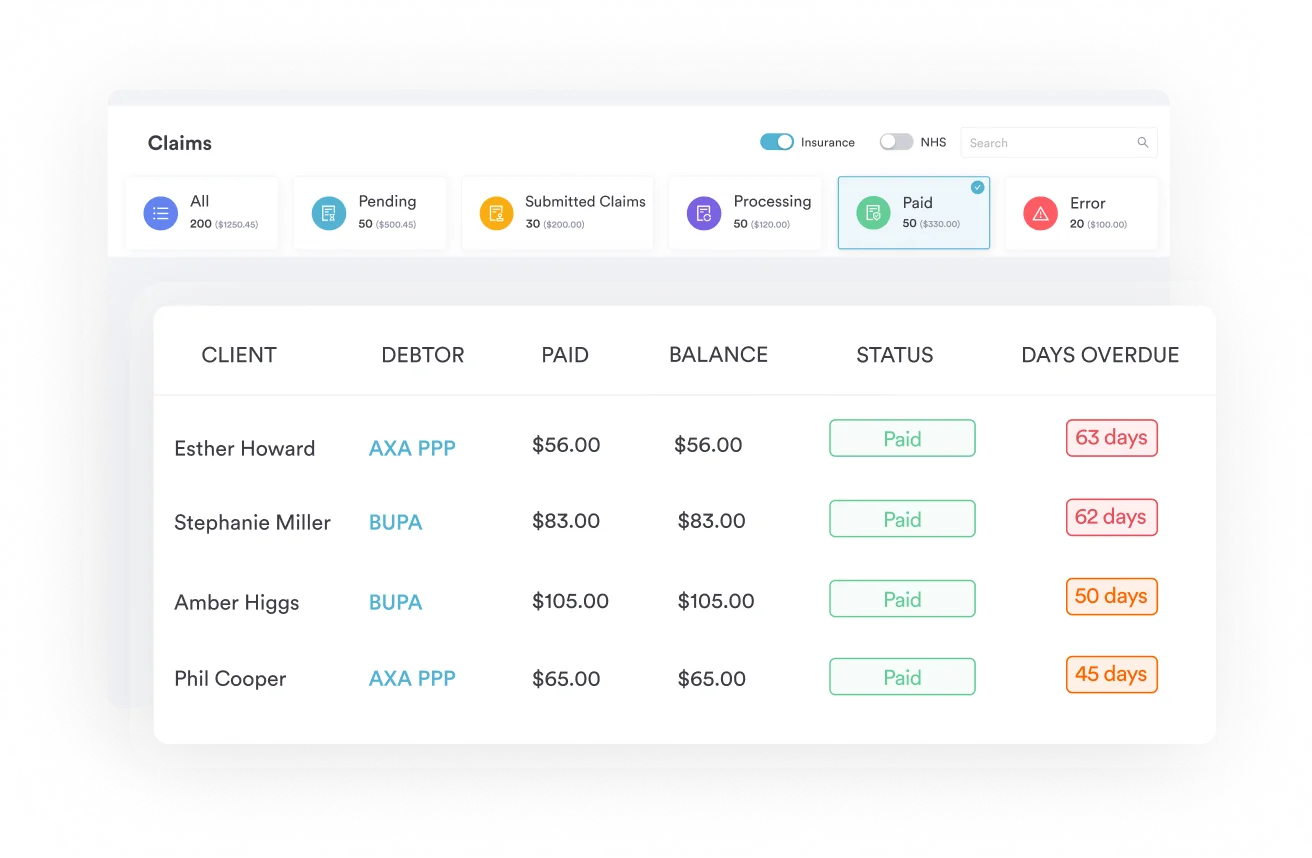
For a billing team the outcome is fewer manual re-keys, so the unit count on the claim matches what the dispensing log recorded. Denials caused by a mismatch between the clinical note and the claim stop being part of the monthly routine.

Track per-unit hemodialysis supply usage, attach the clinical documentation, and submit clean HCPCS claims. Pabau’s claims management tools cut denial rates and keep ESRD billing running smoothly.

Two checks carry most of the risk on an A4730 claim. Confirm the vascular access is an arteriovenous fistula, and confirm the session happened at home rather than in a facility. Get both right and the remaining documentation work is routine.
The trade-off worth remembering is that A4730 pays little per set. Getting it wrong costs an audit of the whole supply series rather than a single denied line, which makes quarterly reconciliation cheap insurance.
Pabau’s claims tools let dialysis and nephrology practices run those checks at the submission step instead of the appeal. Book a demo to see how it fits your billing workflow.

Billing the dialysate solution too? HCPCS code A4728 explains how non-dextrose dialysate is billed per 500 ml unit.
Charging for topical anesthetic before cannulation? HCPCS code A4736 covers the per-gram billing unit and the documentation a payer expects.
Supplying the blood tubing as well? HCPCS code A4750 sets out the arterial and venous tubing rules for hemodialysis claims.
Handling drainage supplies for home patients? HCPCS code A4911 covers the drain bag and bottle used in dialysis, per unit supplied.
Adding a tourniquet to the supply claim? HCPCS code A4929 covers dialysis tourniquets and how the supply line is billed.
HCPCS Code A4730 is a Level II supply code that describes a fistula cannulation set for hemodialysis, billed per each unit used. It reports the cost of the sterile needle set and associated components used to access an arteriovenous fistula during a hemodialysis session. It appears mainly in home hemodialysis billing under Medicare Part B.
Yes, Medicare covers A4730 for eligible ESRD patients, but coverage depends on the dialysis setting. For in-center hemodialysis the supply cost is bundled into the ESRD PPS composite payment and is not billed separately. For home hemodialysis, A4730 may be billed separately to the applicable DME MAC under Medicare Part B, subject to physician order and documentation requirements.
A4730 is listed as an active HCPCS Level II code for 2026 by multiple coding reference databases. Always verify active status against the current CMS HCPCS annual release file before submitting claims. CMS can add, revise, or terminate codes with each annual update.
Medicare DMEPOS fee schedule rates for A4730 change annually and vary by geographic locality and by whether the area is subject to competitive bidding. Verify specific dollar amounts against the current year’s CMS DMEPOS fee schedule, using the CMS lookup tool. Figures published in prior-year resources are not reliable.
A4728 is the code for dialysate solution, non-dextrose containing, 500 ml, so it describes a dialysis fluid rather than an access device. A4730 is the specific code for a fistula cannulation set. The miscellaneous dialysis supply catch-all is A4913, and it is appropriate only when no specific code describes what was supplied.
Medicaid may cover A4730 depending on the individual state Medicaid program’s fee schedule and coverage policies. Coverage and allowable amounts vary significantly by state. Check your state Medicaid portal or fee schedule file rather than assuming coverage mirrors Medicare’s ESRD rules.