A4422 is the HCPCS Level II code for ostomy absorbent material (sheet/pad/crystal packet) for use in ostomy pouch to thicken liquid stomal output, each.
The product sits inside the pouch and turns watery output into a gel, most often for a high-output ileostomy. Barrier rings and seals are billed as skin barriers, such as A4385 or A4362. Medicare covers A4422 under the Ostomy Supplies LCD, which sets no usual monthly maximum, so the notes must support every unit billed.
Related Information
Level
Level II
Category
A4206-A8004 Medical and Surgical Supplies
Code range
A4361-A4438 Ostomy pouches and supplies
Billable
No
Code also known as
ostomy gelling sachet, ostomy pouch thickener, absorbent gel packet
Save time. Improve accuracy. Get paid faster.
Automate coding with Pabau
Let Pabau's smart automation suggest the right codes, reduce claim denials, and keep your practice compliant—effortlessly.
Automate repetitive tasks and focus on what matters most—your patients.
Improve accuracy
Reduce coding errors and ensure compliance with the latest regulations.
Get paid faster
Clean claims, fewer denials, and faster reimbursements.
Grow with confidence
Powerful insights and reporting to help your practice thrive.
HIPAA compliant•SOC 2 certified•GDPR-compliant•Trusted by 4,000+ clinics worldwide
Key takeaways
A4422 covers absorbent sheets, pads, and crystal packets placed inside an ostomy pouch to thicken liquid stomal output, billed per piece.
Barrier rings and seals are not A4422 and are usually billed as skin barriers, such as A4385 or A4362.
Medicare covers A4422 under the Ostomy Supplies LCD (L33828), which lists no usual monthly maximum for it, so the record must justify every unit.
A Standard Written Order and notes describing liquid or high-volume output should be on file before the first claim goes out.
Pabau, the practice management platform we build, keeps the order, the output notes, and the claim on one patient record.
What HCPCS code A4422 covers
HCPCS code A4422 is the Level II supply code for ostomy absorbent material placed inside the pouch to thicken liquid stomal output. The official CMS descriptor reads: “Ostomy absorbent material (sheet/pad/crystal packet) for use in ostomy pouch to thicken liquid stomal output, each.”
The product works as a gelling agent. Once inside the pouch, the sheet, pad, or crystal packet absorbs fluid and turns watery output into a gel. A gelled pouch is easier to empty, sloshes less, and is less likely to leak at the seal.
A4422 never touches the skin or the stoma. It is not a barrier ring, a seal, or a skin barrier wafer, and none of those products bill under it. The code sits in the A-code range of the CMS HCPCS Level II code set, which CMS updates every quarter.
Attribute
Detail
Official descriptor
Ostomy absorbent material (sheet/pad/crystal packet) for use in ostomy pouch to thicken liquid stomal output, each
Code set
HCPCS Level II, A codes (medical and surgical supplies)
Code range
A4361-A4438, ostomy pouches and supplies
Product forms
Absorbent sheets, pads, and crystal (gelling) packets
Where it goes
Inside the ostomy pouch, never on the skin
Purpose
Thickens liquid stomal output into a gel
Billing unit
Each sheet, pad, or packet
Medicare policy
Ostomy Supplies LCD L33828 and policy article A52487
Which patients need A4422
A4422 is ordered for patients whose stoma produces loose or high-volume output. The typical case is an ileostomy, where stool reaches the stoma before the colon can absorb its water.
High-output ileostomy: frequent liquid output fills the pouch quickly and puts pressure on the seal.
New stomas: output is often watery in the weeks after surgery, before the bowel adapts.
Proximal colostomies: a transverse colostomy tends to pass looser stool than a sigmoid colostomy.
Small-bowel stomas: a jejunostomy usually produces liquid output that stays liquid.
A sigmoid colostomy with formed stool rarely needs a thickener. Billing A4422 for that patient without notes describing liquid output invites a medical necessity denial.
What A4422 covers and what it does not
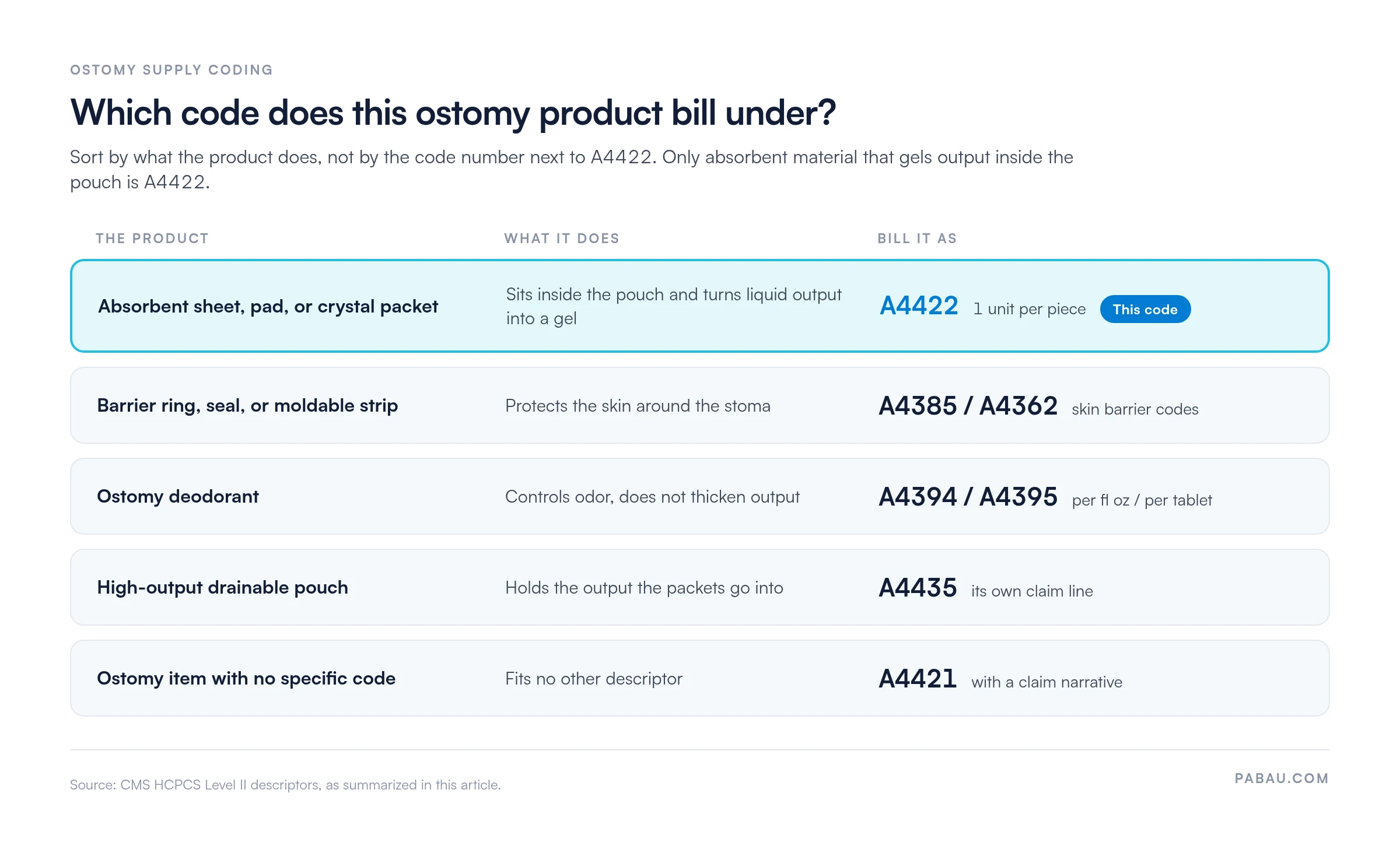
The descriptor draws a tight boundary around absorbent material that goes inside the pouch. The chart below sorts common ostomy products by what they do, and the lists after it give the detail.
Only material that gels output inside the pouch bills as A4422, so sort each product by its job before coding it. Descriptors follow the CMS HCPCS Level II code set.
Covered under A4422
Absorbent sheets or pads placed in the pouch to soak up liquid output
Crystal or powder gelling packets, often sold as sachets, that turn output into a gel inside the pouch
Each individual sheet, pad, or packet, counted as one unit
Not covered under A4422
Barrier rings, seals, and moldable strips, which are billed as skin barriers such as A4385 or A4362
Ostomy deodorants, billed as A4394 (liquid, per fluid ounce) or A4395 (solid, per tablet)
Pouches of any kind, including high-output drainable pouches such as A4435
Stoma absorptive covers for continent stomas (A5083) and gauze pads (A6216)
Pouch lubricant (A4402)
Fiber supplements or antidiarrheal drugs taken by mouth, which are not ostomy supplies
A4422 vs neighboring ostomy supply codes
The codes around A4422 describe very different products, so a nearby number is a poor guide. The table maps the codes most often confused with it.
Code
Descriptor (summary)
Use it when
A4421
Ostomy supply, miscellaneous
No specific ostomy code describes the item, and the claim carries a narrative
A4422
Ostomy absorbent material (sheet/pad/crystal packet) to thicken liquid stomal output, each
The product sits inside the pouch and gels liquid output
A4423
Ostomy pouch, closed, for use on barrier with locking flange, with filter (2-piece), each
You dispense a closed two-piece pouch with a filter
A4424
Ostomy pouch, drainable, with barrier attached, with filter (1-piece), each
You dispense a one-piece drainable pouch with a filter
A4394 / A4395
Ostomy deodorant, liquid per fluid ounce / solid per tablet
The product controls odor and does not thicken output
A4385 / A4362
Solid skin barrier, extended wear / standard, 4 x 4 or equivalent
You bill a barrier ring or seal that protects the skin around the stoma
A4435
Ostomy pouch, drainable, high output, with extended wear barrier (1-piece), each
You dispense the high-output pouch itself
A4422 goes on its own claim line, next to the pouch it is used in. A patient with a high-output ileostomy might have A4435 pouches and A4422 packets on the same claim. Each line needs its own units and its own support in the order.
Medicare coverage rules for A4422
Medicare Part B covers A4422 as an ostomy supply for patients with a surgically created stoma. The rules sit in the Ostomy Supplies LCD (L33828) and its policy article, A52487.
Two DME MACs apply the same LCD, so coverage criteria match nationwide. Noridian covers Jurisdictions A and D, and CGS covers B and C.
Qualifying stoma: the record shows a colostomy, ileostomy, or other surgically created opening that is in use.
Standard Written Order: the supplier has the order before submitting the claim.
Need for a thickener: notes describe liquid or high-volume output.
Supported quantity: the LCD’s usual-maximum table does not list A4422, so the record must support the full quantity billed.
Setting: ostomy supplies are not separately payable during a covered home health episode, because the agency provides them.
Refills: bill for expected use. Contact the patient no sooner than 14 days before delivery, and ship no sooner than 10 days before supply runs out.
Medicare pays 80% of the allowed amount after the Part B deductible. The patient or a secondary payer covers the remaining 20% coinsurance.
Documentation requirements for HCPCS code A4422
An A4422 claim can carry the right code and still fail an audit on missing paperwork. Medical billing compliance for this code means these items are on file before the first unit ships.
Standard Written Order: the patient’s name or Medicare ID, order date, item description, quantity, and the prescriber’s name or NPI and signature.
Notes on output: the stoma type, plus the consistency or volume of output that calls for a thickener.
Quantity rationale: how often the patient changes or empties the pouch, and how many pieces each time.
Proof of delivery: a signed delivery slip or shipping record for every order and refill.
Refill check: the patient’s confirmation of remaining supply, recorded before each refill ships.
Retention: keep the file for seven years from the date of service, or longer if state law requires it.
Supporting ICD-10-CM diagnosis codes
The diagnosis on the claim should describe the patient’s stoma. Add a complication code when a documented complication drives the need for a thickener.
ICD-10-CM code
Description
Notes
Z93.2
Ileostomy status
The most common primary code for A4422, since ileostomy output is often liquid
Z93.3
Colostomy status
Supports A4422 when notes describe loose output, such as from a transverse colostomy
Z93.4
Other artificial openings of gastrointestinal tract status
Covers a jejunostomy or other small-bowel stoma
K94.10-K94.19
Complications of enterostomy
Additional code alongside Z93.x when a complication is documented
K94.00-K94.09
Complications of colostomy
Additional code alongside Z93.3 when a complication is documented
Check the current LCD and policy article on the CMS Medicare Coverage Database before you rely on a diagnosis list. Both are revised over time.
Modifiers used with HCPCS code A4422
A4422 needs fewer modifiers than many DMEPOS codes. The Ostomy Supplies LCD lists AU and EY, and neither belongs on a routine A4422 line. KX is not part of the ostomy policy, so leave it off unless a payer asks for it.
The table covers the modifiers that do come up. Getting them right is part of submitting a clean claim the first time.
Modifier
Meaning
When it applies to A4422
AU
Item furnished in conjunction with a urological, ostomy, or tracheostomy supply
Required on tape and adhesive (A4450, A4452, A5120) used with ostomy supplies, not on A4422
EY
No physician or other licensed provider order for this item
The item was dispensed without a valid order, so Medicare denies the line
GA
Waiver of liability statement (ABN) on file
The quantity may exceed what the record supports, and the patient signed an ABN
GZ
Item expected to be denied as not reasonable and necessary, no ABN on file
The same situation without an ABN, so the supplier carries the liability
GW
Service not related to the hospice patient’s terminal condition
The patient is in hospice, and the ostomy is unrelated to the terminal diagnosis
Medicaid and commercial payers set their own modifier rules. Check each payer’s policy rather than copying Medicare logic.
Billing units and quantity for A4422
One unit of A4422 is one sheet, one pad, or one crystal packet. Bill the number of pieces dispensed, not the number of boxes.
LCD L33828 sets no usual monthly maximum for A4422, so there is no default ceiling to bill up to. The quantity has to follow the patient’s documented use. If a patient adds one packet to each fresh pouch, the order and the notes should show that pattern.
Scenario
Billing approach
Standard order
Bill the pieces dispensed for the refill period, matching the order and the documented pattern of use
Output increases
Update the notes and the order before the refill, and add GA with a signed ABN if coverage is in doubt
Box packaging
Convert boxes to pieces before billing, so a box of 30 packets is 30 units
First delivery
The order date comes before the ship date, and units do not exceed the quantity on the order
Refills
Contact the patient no sooner than 14 days before delivery, and ship no sooner than 10 days before supply runs out
Reimbursement rates and the A4422 fee schedule
Medicare pays A4422 from the DMEPOS fee schedule, which CMS updates each January and sometimes during the year. The allowed amount varies by state, so look up the current figure for your area before you set a price.
Medicare: 80% of the fee schedule allowable after the Part B deductible.
Medicaid: state fee schedules and quantity limits vary, so check the state DMEPOS schedule.
Commercial payers: usually a contracted rate or a percentage of the Medicare allowable, set in the payer contract.
Medicare Advantage: the plan’s network and prior authorization rules apply, so verify them before dispensing.
Common A4422 claim denial reasons and how to fix them
Most A4422 denials trace back to a handful of repeat causes. Spotting the pattern early is the core of denial management in healthcare.
Denial code
Root cause
Fix
CO-50
Not deemed medically necessary, often because no notes describe liquid output
Add notes on output consistency and volume, then request a redetermination
CO-151
The information submitted does not support this many units
Document the pattern of use, or bill only the supported quantity and use GA with an ABN for the rest
CO-16
The claim lacks information, such as an order detail
Correct the missing data and submit the claim again
CO-97
Payment is included in another service, usually a covered home health episode
Confirm the home health dates, since the agency supplies ostomy items during the episode
CO-4
A modifier does not fit the code, such as a stray AU
Remove the wrong modifier and request a reopening or resubmit
PR-B9
The patient is enrolled in a hospice
Confirm hospice status, then bill the hospice or add GW if the ostomy is unrelated to the terminal condition
How to appeal a denied A4422 claim
Medicare appeals for A4422 follow the standard five-level process. Most disputes settle at the first two levels, redetermination and reconsideration.
Redetermination (Level 1): submit to the DME MAC within 120 days of the denial notice. Include the remittance advice, the order, and the missing documentation. A decision usually follows within 60 days.
Reconsideration (Level 2): request it from a Qualified Independent Contractor within 180 days of the redetermination. Attach the Level 1 file plus any added clinical records.
ALJ hearing (Level 3): available when the amount in dispute meets the annual threshold. Request it within 60 days of the QIC decision.
Medicare Appeals Council (Level 4): request a review within 60 days of the ALJ decision.
Federal court review (Level 5): file within 60 days of the Council decision, subject to its own amount threshold.
Use a reopening for simple clerical errors, such as a wrong modifier. For CO-50 and CO-151 denials, send a short narrative that links the documented liquid output to the quantity billed. Attach the order and the progress notes.
Supplier enrollment and DMEPOS accreditation requirements
A supplier must be accredited and enrolled as a Medicare DMEPOS supplier before billing A4422. Medicare does not pay claims for dates of service before the enrollment takes effect.
Accreditation: from a CMS-approved organization such as The Joint Commission, ACHC, or BOC, kept current for every billing period.
Enrollment: Form CMS-855S, filed through PECOS and processed by the National Provider Enrollment contractor for your region.
Surety bond: a $50,000 bond for each enrolled NPI.
Revalidation: every three years, since a lapse stops payment for claims in that period.
Keep the supplier NPI and accreditation details with each claim file. DME MAC audits often ask for both.
Pro Tip
Before each refill, ask the patient how many packets they used and whether their output has thickened or loosened. Record the answer in the notes. That single line supports the quantity on the claim and gives a CO-151 appeal what it needs.
Related HCPCS codes
Three codes come up most often next to A4422 on an ostomy claim. Our HCPCS guides for billers cover other supply codes in the same depth.
A4435 is the high-output drainable pouch that the packets often go into, billed on its own line.
A4362 is a standard skin barrier code, where many rings and seals belong.
A4421 covers an ostomy item that no specific code describes, and the claim needs a narrative.
How Pabau helps practices bill A4422 correctly
Ostomy supply claims usually fail on paperwork spread across three places: the order, the clinical notes, and the claim. Pabau, the practice management platform we build, keeps all three on one patient record.
Insurer details sit on that record, so each claim starts with the right payer and member ID. Pabau’s claims software for practices catches missing details before submission and sends US claims through Claim.MD. A missing order date gets fixed before a DME MAC rejects the line.
Treatment notes and digital forms capture output consistency at each visit. Inventory tracking shows how many packets went home with each patient, so the billed quantity stays tied to the record.
Keep ostomy supply claims audit-ready
Pabau keeps orders, output notes, and insurer details on one patient record. It flags missing claim details before submission, so A4422 lines go out complete.
A4422 is a narrow code for a narrow product: absorbent material that gels liquid output inside the pouch. Most errors start when a biller sees “ostomy” and “each” and assumes a ring or a seal. Rings and seals belong to the skin barrier codes, and the pouch has its own line.
The bigger risk is quantity. With no usual maximum in the LCD, the notes have to explain why a patient uses the number of packets billed. A practice that records output at every visit has that answer ready before an auditor asks.
Book a demo to see how Pabau keeps ostomy supply orders, notes, and claims together on one record.
Continue your research
Need to understand the full DMEPOS claims workflow?What is medical billing walks through the end-to-end process from patient order to payment posting.
Frequently asked questions
What does HCPCS code A4422 cover?
HCPCS code A4422 covers ostomy absorbent material, such as sheets, pads, or crystal packets, placed inside the pouch to thicken liquid stomal output. It is billed per piece. Barrier rings, seals, deodorants, and pouches have their own codes.
Can barrier rings or seals be billed as A4422?
No. A4422 only describes absorbent material used inside the pouch. Barrier rings and seals are usually billed as skin barriers, such as A4385 or A4362, depending on the product.
Is A4422 covered by Medicare?
Yes. Medicare Part B covers A4422 under the Ostomy Supplies LCD (L33828) for patients with a qualifying stoma. The supplier needs a Standard Written Order and notes that describe liquid or high-volume output. It is not separately payable during a covered home health episode.
Does A4422 need a KX modifier?
No. The Ostomy Supplies LCD sets no KX requirement for A4422. The AU modifier applies to tape and adhesive used with ostomy supplies, not to A4422. Use GA or GZ only when billing a quantity the record may not support.
How many units of A4422 can be billed per month?
LCD L33828 does not list a usual monthly maximum for A4422. The billed quantity has to match the order and the patient’s documented use, such as one packet per pouch change. Each sheet, pad, or packet is one unit.
What is the difference between A4422 and A4394?
A4422 thickens liquid output inside the pouch. A4394 is a liquid ostomy deodorant billed per fluid ounce, and A4395 is a solid deodorant tablet. Bill the code that matches the product’s main purpose.
Why would a claim for A4422 be denied?
The most common causes are CO-50 for missing notes on liquid output and CO-151 for an unsupported quantity. CO-97 can appear during a home health episode. PR-B9 means the patient is enrolled in a hospice, so confirm hospice status before billing.