

HCPCS code E0198: Water pressure pad billing guide
HCPCS code E0198 is a water pad for a standard mattress HCPCS code E0198 is the ...

Last Updated: Oct 13, 2026
A4207 is the HCPCS Level II code for syringe with needle, sterile 2 cc, each.
Whether you can bill it as a separate line depends on the setting, the primary code, and the payer's coverage rules. Home dispensing and in-office administration are treated very differently.
Let Pabau's smart automation suggest the right codes, reduce claim denials, and keep your practice compliant—effortlessly.
Automate repetitive tasks and focus on what matters most—your patients.
Reduce coding errors and ensure compliance with the latest regulations.
Clean claims, fewer denials, and faster reimbursements.
Powerful insights and reporting to help your practice thrive.
HIPAA compliant SOC 2 certified GDPR-compliant Trusted by 4,000+ clinics worldwide

HCPCS code A4207 describes a sterile 2 cc syringe with needle, billed per each unit under HCPCS Level II supplies.
Medicare covers A4207 only when medical necessity is documented, and the coverage rules vary by MAC jurisdiction.
NCCI edits often bundle A4207 into the injection procedure code, so check the current edit table before billing it separately.
Practice management software like Pabau keeps the order, diagnosis, and claim on one record, so A4207 documentation is ready before submission.
A4207 sits in HCPCS Level II, the half of the code set that covers supplies, drugs, and equipment. Level I is CPT, which describes procedures rather than the items used to perform them. A4207 is billed one unit per syringe.
A4207 sits in the A-series of HCPCS Level II, which covers Medical and Surgical Supplies. That category is maintained by the Centers for Medicare and Medicaid Services, known as CMS. CMS reissues the code set every year, so the descriptor you coded from last January may no longer be current.
The “each” unit of measure means every syringe is billed as a single line item. Other supply codes count differently. You cannot bill a quantity of 10 on one A4207 line and assume all 10 process cleanly. Check the payer’s quantity limits first.
Billers at IV therapy practices and home health agencies use A4207 most frequently. The 2 cc capacity suits single-dose injectables, low-volume infusion preparations.
Knowing when A4207 applies, rather than A4206 at 1 cc or A4208 at 3 cc, prevents mis-coding and the denials that follow.
The table below shows the essential reference data for HCPCS code A4207 as maintained by CMS. Verify the effective date and termination date fields against the current-year CMS release before billing.
Use the AAPC HCPCS lookup to cross-reference A4207 against the current code set. It confirms whether the descriptor changed in the most recent annual update.
A4207 covers exactly one physical supply item: a sterile syringe with an attached needle, 2 cc barrel capacity. The code does not cover the drug or solution inside the syringe. It covers the delivery device only.
Clinical settings where A4207 is most commonly reported include DME suppliers, home health agencies, and outpatient infusion centers. Billers at new IV therapy practices typically bill A4207 alongside the drug J-code for the administered solution. The drug code covers the drug only, so the syringe stays on its own supply line.
The 2 cc capacity is the defining specification. If the clinical situation calls for a 1 cc syringe, use A4206. For a 3 cc syringe, use A4208. Billing the wrong capacity is a mis-code, and it invites a denial or an audit flag.
Billing supply codes accurately starts with inventory management software that knows what actually left the shelf.
Bill A4207 only when three conditions hold at the same time.
Billers managing injection supply HCPCS codes should check the NCCI bundling table before every submission. A4207 is frequently bundled with injection administration codes when the supply is considered integral to the procedure.
Some CPT administration codes already include the supply cost in their relative value units. That makes a separate A4207 line non-payable. The administration code you pair it with.
Before submitting A4207, run the primary procedure code through the CMS NCCI edit table. If A4207 appears as a column-2 code paired with your procedure, check whether modifier -59 or XS can legitimately override the bundle. Skipping that check is where most A4207 denials start.
Medicare covers HCPCS code A4207 under the DME benefit when the item is medically necessary and ordered by a treating physician. Coverage is not automatic. The claim needs a written order, plus documentation of why a 2 cc sterile syringe is required for the treatment plan. Medicare billing rules also set out the compliance steps a practice must follow before a payer will pay this claim.
Medicaid coverage varies by state program. Most state Medicaid fee schedules follow similar logic to Medicare for HCPCS A-series supply codes, but rates and documentation thresholds differ. Verify coverage with the state Medicaid agency before billing.
Medicare allowable rates for A4207 vary by MAC jurisdiction and come to a few dollars per unit at most. The table below shows the rate structure rather than fixed amounts. Verify current-year figures against the CMS DMEPOS fee schedule and your DME MAC’s published rates.
For A4207 the payment per unit is modest, so volume and bundling decisions drive billing strategy far more than the rate itself. A missed unit cap, or a bundle you did not check, costs more than any rate difference between jurisdictions.
Modifiers give the claim context that a bare code cannot. For A4207, modifier selection depends on the billing entity type, the care setting, and whether a bundling override is needed.
Never append -59 or -XS as a routine override. These modifiers must reflect a genuine clinical distinction. Payers audit modifier usage on supply codes closely, and applying them without documentation support is a compliance risk.
The NCCI edit tables govern whether A4207 can be billed alongside other procedure codes. CMS updates them quarterly, so a pairing that is payable today can change in the next release.
When an NCCI edit pairs A4207 as a column-2 code with a primary procedure, the syringe cost counts as integral to that procedure. Billing A4207 separately in that context results in a denial. The only route to separate payment is a valid modifier override with documentation behind it.
A4207 pays for the device, never the drug inside it. The drug is billed on its own line under HCPCS J codes. A triamcinolone acetonide injection carries HCPCS code J3301 for the drug.
J-code lines do not bundle A4207, but the administration CPT code often does. That pairing is where most A4207 bundling denials originate.
The A4206 through A4211 range covers injection and infusion supplies, including sterile syringes at four capacities. Picking the wrong code is a common mis-code, particularly when the ordering clinician documents the drug volume rather than the syringe capacity. Use the table below to map capacity to code, and note the billing quirk attached to each one. The CARC denial code list is short enough to learn, and most rework traces to a handful of entries.
Our HCPCS code A4206 and HCPCS code A4208 guides work through the same rules at 1 cc and 3 cc. The capacity changes. The bundling behavior does not.
At the top of the range, HCPCS code A4209 covers 5 cc and above. Confirm the descriptor before coding, especially when the order specifies a drug volume rather than a syringe size.
One carve-out catches DME billers out. Several state Medicaid programs route insulin syringes to S8490, which is priced per 100 syringes, rather than to the A-series. Check the state supply schedule before you default to A4206 or A4207 for an insulin patient.
Getting A4207 paid on the first submission takes six steps in sequence. Skipping the bundling check in step three is where most denials start.
The table below captures the most frequent denial triggers for HCPCS code A4207 claims and the corrective action for each. These patterns show up consistently in DME and home health billing workflows.
Medicare and most private payers expect an A4207 documentation file that can withstand a post-payment audit. A structured checklist inside the billing workflow prevents scrambling when a records request lands. Use digital intake forms to capture and store these items at the point of care.
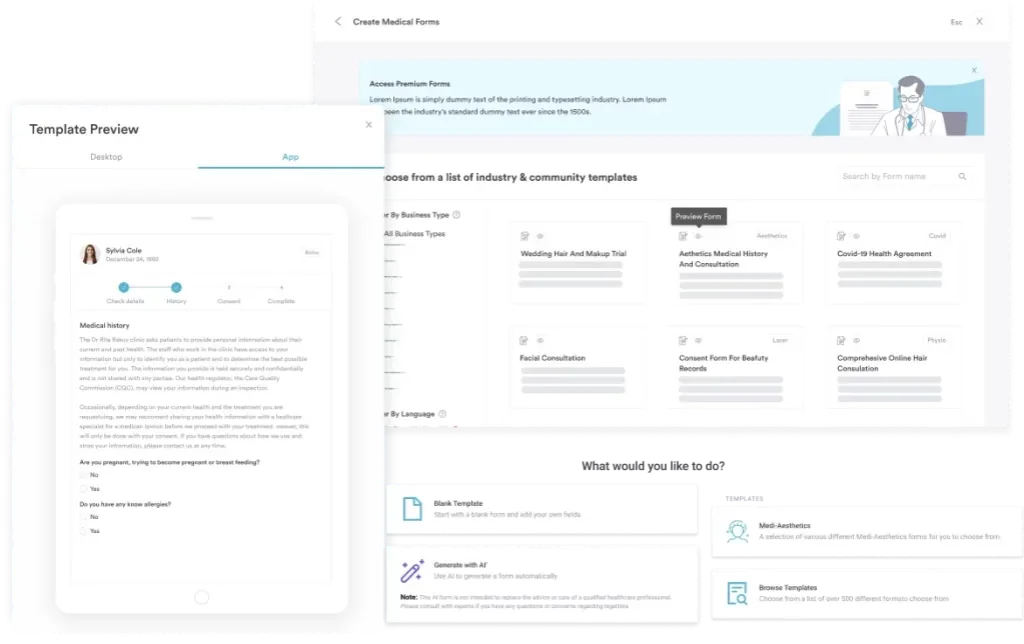
Practices using claims management software can attach documentation straight to the claim record. Answering a records request then means opening the claim, not digging through folders.
The IV therapy intake documentation template shows how to structure pre-service records that satisfy clinical and billing requirements at once. Our medical forms compliance guidance transfers directly to A4207 supply billing.
Build a pre-billing checklist tied to every A4207 line item. Check the physician order, the diagnosis code, and the NCCI edit table. Then confirm the quantity fits the MAC LCD cap and the modifier is chosen. Running the list before submission cuts A4207 denials at the source rather than after the EOB arrives.
The NCCI check usually happens outside the system that holds the claim. The edit table sits in one tab, the physician order in another, and the claim in a third. When the queue is long, that check is the step that gets dropped.
Practice management software like Pabau keeps those pieces on one record. The physician order, the signed intake form, the diagnosis code, and the invoice sit against the same patient. Whoever bills A4207 can see whether the documentation exists before the claim goes out.
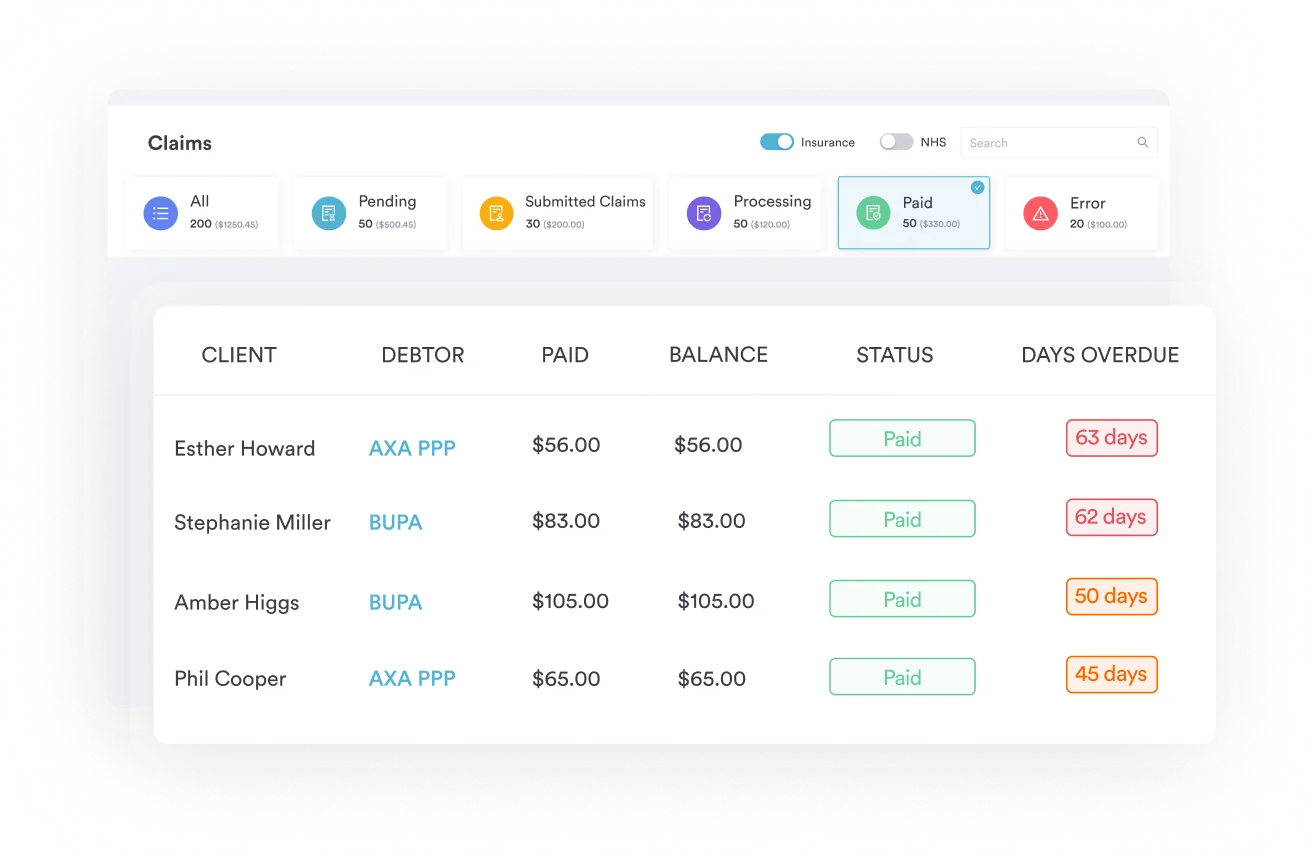
Pabau also runs validation checks in the background and keeps the send button locked until the required claim details are complete. After submission, every claim carries a status of pending, submitted, processing, paid, or error.
A rejected A4207 line therefore shows up on the claims dashboard rather than in a stack of EOBs weeks later. You can filter that dashboard by insurer, date, or invoice ID.
The biller working denials starts with a worklist instead of a filing cabinet. A repeat bundling problem on A4207 surfaces after one claim rather than twenty.

Pabau’s claims management software helps DME and injection supply billers document A4207 correctly, track modifiers, and catch bundling conflicts before submission.

A4207 pays a few dollars, so it rarely gets the attention a bigger line item would. That is why the denials on it accumulate quietly.
Treat the NCCI check as part of coding the line, rather than a step you take once a denial arrives. Pair it with a documented capacity in the order, and A4207 stops being a write-off you find at month end.
The trade-off is simple. A pre-billing check costs a minute per claim, and a rebill costs far more. Book a demo to see how Pabau keeps the order, the modifier, and the documentation on one claim record.

Billing the 1 cc version instead? HCPCS code A4206: sterile syringe supply billing guide covers the capacity most often dispensed for insulin injections.
Coding the drug as well as the syringe? HCPCS code J3301: triamcinolone acetonide billing guide shows how the drug line is billed beside a supply code.
Coding the injection procedure, not just the supply? CPT code 11950: subcutaneous injection of filling material works through an injection procedure code and what its valuation already includes.
Billing an injection under imaging guidance? CPT code 20604: ultrasound-guided small joint injection billing covers the guidance rules that decide whether a supply line survives.
Billing a non-high-risk screening colonoscopy? Screening colonoscopy billing guide Covers HCPCS code G0121, the screening colonoscopy code often mislabeled as a CPT code.
HCPCS code A4207 is a Level II HCPCS supply code that describes a syringe with needle, sterile, 2 cc capacity, billed per each unit. It falls under the Medical and Surgical Supplies (A-series) category and is maintained by CMS. Medicare, Medicaid, and private payers all recognize it on DME and injection supply claims.
Medicare covers A4207 under the DME benefit when medical necessity is established and supported by a physician’s written order. Coverage is not automatic. The claim needs a valid ICD-10-CM diagnosis code. Billing must also follow the applicable MAC’s local coverage determination (LCD), including any quantity limits.
The difference is syringe barrel capacity. A4206 covers a 1 cc or smaller sterile syringe, the usual choice for insulin injections. A4207 covers 2 cc and A4208 covers 3 cc. Each code is billed per unit. Select the code that matches the documented syringe capacity in the physician order.
Four modifiers come up most often on A4207 claims. Use -KX when the LCD criteria are met on a Medicare DME claim. Use -GA when medical necessity is uncertain and an ABN is on file. Use -GY for a statutorily excluded item billed for secondary payer coordination. Use -XS, or -59, only to override an NCCI bundling edit that documentation genuinely supports.
A4207 is billed per each individual syringe. The unit descriptor is “each,” meaning one unit equals one syringe. Do not bill a pack quantity as a single unit. Confirm the applicable MAC’s quantity reporting guidance first, since some LCDs specify how multi-unit dispensing is reported.
Required documentation starts with a signed physician order specifying the syringe and a medical necessity statement. You also need a valid ICD-10-CM diagnosis code and quantity justification within MAC limits. DME home supply claims add a proof-of-delivery record. An Advance Beneficiary Notice (ABN) is required if medical necessity is questionable, supporting use of the -GA modifier.
A code lookup tool is a searchable index of HCPCS Level II codes. For A4207 it returns the official descriptor, the code status, and the effective dates. Coders use one to confirm the descriptor has not changed in the latest annual CMS update. It also makes cross-referencing adjacent codes such as A4206 or A4208 quick before a claim goes out.



