

CCSD code G5100: Bypass of duodenum billing guide
CCSD code G5100 bills a bypass that leaves the duodenum in place CCSD code G5100...

Last Updated: Oct 16, 2026
99309 is the CPT code for subsequent nursing facility care, billed per day for the evaluation and management of a patient. It requires at least two of three key components: a detailed interval history, a detailed examination, and medical decision making of moderate complexity.
The code covers follow-up visits only, so the 99304-99306 admission codes apply on the day a patient enters the facility. Level selection turns on the medical decision making, and documentation that never spells out moderate complexity is what most 99309 denials come down to.
Let Pabau's smart automation suggest the right codes, reduce claim denials, and keep your practice compliant—effortlessly.
Automate repetitive tasks and focus on what matters most—your patients.
Reduce coding errors and ensure compliance with the latest regulations.
Clean claims, fewer denials, and faster reimbursements.
Powerful insights and reporting to help your practice thrive.
HIPAA compliant SOC 2 certified GDPR-compliant Trusted by 4,000+ clinics worldwide

CPT Code 99309 covers subsequent nursing facility care requiring at least 2 of 3 key components: detailed interval history, detailed exam, or moderate complexity MDM.
Medical decision making of moderate complexity is the component most often under-documented, causing the majority of 99309 denials.
Medicare pays roughly $100-$115 for 99309 at the non-facility rate, so confirm your own locality figure in the CMS fee schedule lookup.
NPs and PAs bill CPT Code 99309 independently at 85% of the physician fee schedule. Incident-to billing does not apply in SNF settings.
CPT Code 99309 is the subsequent nursing facility care code for a moderate-complexity follow-up visit. At least two of three key components must be documented: a detailed interval history, a detailed examination, and medical decision making of moderate complexity.
The CPT code set is maintained by the American Medical Association. Its official descriptor reads:
“Subsequent nursing facility care, per day, for the evaluation and management of a patient, which requires at least 2 of these 3 key components:”
The word “subsequent” is critical. Codes 99307-99310 apply only to follow-up visits after the initial nursing facility admission. Initial admissions use 99304-99306. If a provider bills CPT Code 99309 on the same day as admission, the claim will deny for incorrect code selection.
Eligible billing providers include physicians, nurse practitioners (NPs), physician assistants (PAs), and clinical nurse specialists (CNSs). Any of these providers may bill CPT Code 99309 independently, subject to payer rules and state scope-of-practice regulations.
CPT Code 99309 requires documentation of at least two of the following three key components on the date of service. All three are defined by the AMA E/M guidelines. A provider who documents MDM of moderate complexity plus a detailed examination meets the threshold even without a detailed interval history.
Medical decision making of moderate complexity for CPT Code 99309 requires satisfying the 2023 AMA MDM table criteria. The table scores three elements: number and complexity of problems, amount and complexity of data reviewed, and risk of complications. Meeting moderate complexity in two of those three elements is sufficient.
Typical qualifying scenarios are narrow. A patient with chronic conditions showing an acute exacerbation qualifies, as does one requiring a prescription medication change. So does a visit where the provider must review external records or order independent tests. Score every visit against the 2023 AMA guidelines, not the pre-2023 criteria.
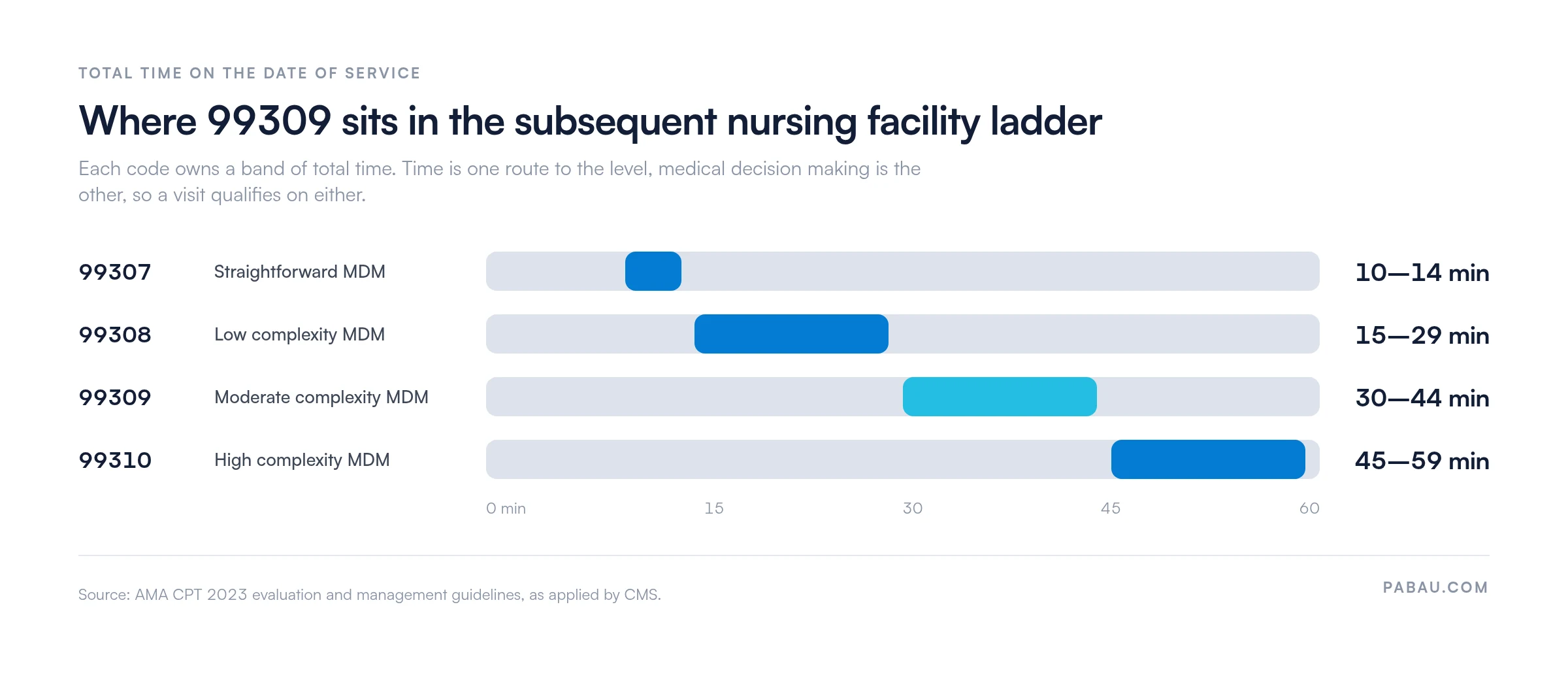
Since 2023, providers can select the E/M level from total time spent on the date of service. That total includes non-face-to-face activities such as reviewing records and coordinating care. The time threshold for CPT Code 99309 is 30-44 minutes of total time. Document that total explicitly. A note reading only “30 minutes” does not satisfy payer requirements unless it states that this is total time on the date of service.
The 99307-99310 family covers the full complexity range for subsequent nursing facility visits. Selecting the correct level depends on which key components are documented and at what level. A visit that falls one component short of the 99309 threshold usually belongs at 99308.
Upcoding from 99309 to 99310 without documented high-complexity MDM draws Recovery Audit Contractor attention to skilled nursing facility claims. If a claim for 99310 is selected for review and the documentation only supports moderate complexity, the payer will downcode and recoup the difference.
The time bands are narrower than most coders expect, and the four codes sit in an unbroken sequence from 10 to 59 minutes. Reading them side by side shows how few minutes separate one level from the next.
Medicare reimburses CPT Code 99309 through the Relative Value Unit (RVU) system. At the current conversion factor of roughly $32.35, the non-facility rate works out at approximately $100-$115 before geographic locality adjustments (GPCI). The final dollar amount varies by MAC jurisdiction, so verify your own figure with the CMS Physician Fee Schedule lookup tool and your locality code.
NPs and PAs billing independently under Medicare receive 85% of the physician fee schedule rate. That puts the effective Medicare reimbursement for CPT Code 99309 at roughly $85-$98 for non-physician practitioners, depending on locality. Budgeting an SNF panel at the physician rate when an NP covers most of the visits overstates expected collections by about 15%.
CMS billing rules for subsequent nursing facility care govern how CPT Code 99309 is placed on a claim. Getting these details wrong causes denials even when the clinical documentation is strong. The core rules:
For practices managing a high volume of SNF claims, a clearinghouse with built-in eligibility verification catches POS and coverage mismatches before claims reach the payer.
Run a monthly audit of your 99307-99310 utilization distribution. If more than 30% of your subsequent NF visits are billed at 99310, request a clinical documentation review. Most SNF practices should see a distribution weighted toward 99308 and 99309, with 99310 reserved for genuinely high-complexity visits.
CPT Code 99309 does not require a specific ICD-10 diagnosis code, but the diagnosis must support the level of MDM billed. A claim for moderate-complexity MDM paired with a single stable, routine problem is a medical necessity mismatch, and payers will deny or downcode it. The diagnoses that hold up on review are the ones that inherently require active clinical management.
Use specificity wherever it is available, and bill F02.A11 over F02.9 when the documentation supports it. A vague diagnosis with no documented active clinical problem is a primary medical necessity denial trigger. Browsing the ICD-10-CM code set before submission confirms that your chosen code carries the specificity the payer expects. The AAPC’s CPT code reference also includes crosswalk guidance for E/M pairing.
Most CPT Code 99309 denials follow predictable patterns. Each one has a straightforward prevention step when it is caught before submission.
A clearinghouse that scrubs claims against payer edits will flag a wrong POS code, a missing modifier, or a same-day duplicate before submission. That leaves the clinical note as the only thing standing between the visit and payment.
Physicians, nurse practitioners, physician assistants, and clinical nurse specialists are all eligible to bill CPT Code 99309. Each must hold the appropriate credentials and meet state scope-of-practice requirements, which vary by qualification and jurisdiction.
Pabau, our practice management software, handles medical claims management by linking each claim to the rendering provider’s NPI. It flags NP/PA claims for the correct 85% rate and routes SNF visits to the appropriate MAC. That prevents the billing-rate errors that follow when NP/PA claims are submitted at the physician rate.
When an NP or PA takes over a patient’s SNF panel from a physician, update the rendering provider on all subsequent claims immediately. Leaving the physician’s NPI in place after the NP takes over creates a credentialing mismatch. That triggers payer audits, and recoupment requests can reach back 12 months.
Most SNF practices document the visit in one system and build the claim in another. The interval history and the MDM narrative get typed once, then re-keyed or summarized by whoever codes the encounter. The level billed drifts from the level the note supports.
Pabau keeps both in one record. SNF visit templates capture interval history and examination findings in discrete fields, which cuts copy-forward errors. The system prompts providers through the three AMA MDM elements: problems addressed, data reviewed, and risk of management. That makes the moderate complexity behind a 99309 claim visible in the note itself.
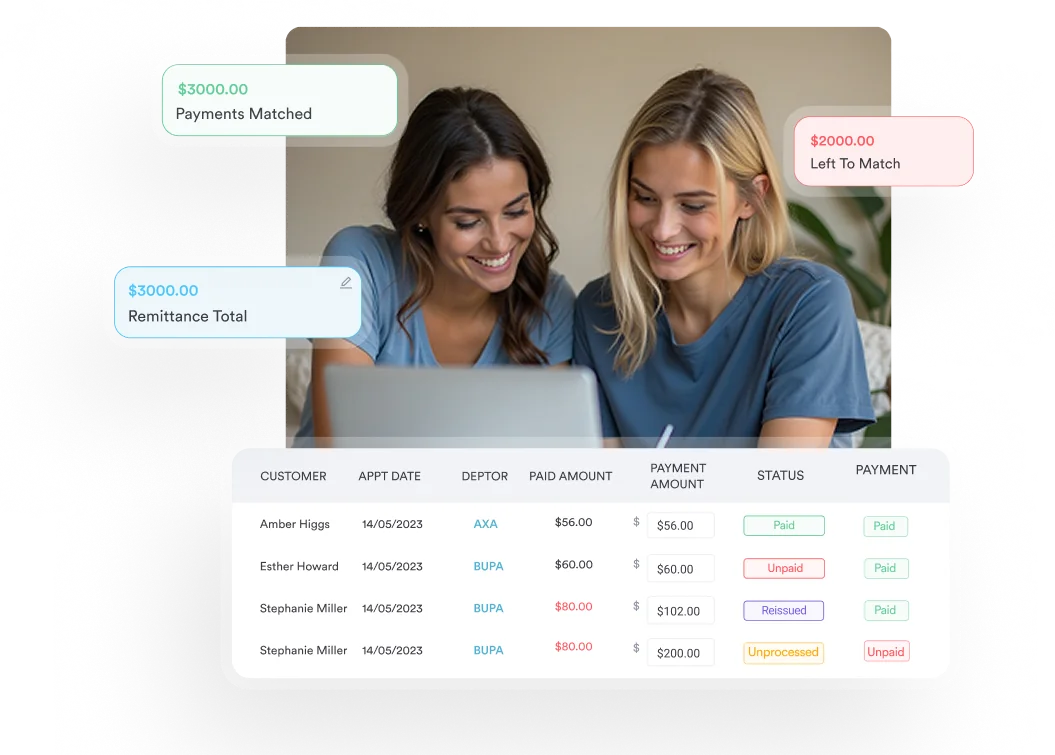
The built-in claim scrubber then checks POS codes, provider NPI assignments, and diagnosis-to-code medical necessity linkage before the claim leaves the practice. When Medicare pays or adjusts it, the remittance posts back to the patient record automatically, with underpayments and denial reason codes flagged for follow-up.
Practices covering several facilities get one more thing from this. Multi-location billing keeps each facility’s POS code, provider assignment, and claim routing separate, so one panel change does not contaminate the rest.

Pabau’s claims management tools check documentation and place-of-service details before submission, so your team bills 99309 accurately and gets paid faster.

CPT Code 99309 denials are almost always documentation problems rather than code selection problems. The two-of-three key component rule is straightforward. The harder task is writing notes that make the MDM complexity visible to a payer reviewer who never met the patient.
Start with the utilization distribution across 99307 to 99310. If it skews high, the documentation is being asked to justify a level it was never written to support. A downcoding recoupment is the predictable result, and fixing the note template costs less than appealing the claims.
Book a demo to see how Pabau makes the MDM complexity behind each 99309 claim legible before it reaches the payer.

Need to understand how claims move from your EHR to the payer? Medical claims clearinghouse guide explains the end-to-end claim submission workflow and what clearinghouses check before forwarding claims.
Getting denials back with CARC codes you don’t recognize? Denial codes in medical billing covers the most common adjustment reason codes and what each one requires for appeal.
Want to verify eligibility before the visit rather than after the denial? Insurance eligibility verification outlines the pre-visit check workflow that prevents coverage-related denials on SNF claims.
Deciding whether a visit really reaches the top level? CPT Code 99310 sets out the high-complexity threshold that separates it from 99309.
CPT Code 99309 covers follow-up visits in a nursing facility at a moderate level. At least two of three key components must be documented: a detailed interval history, a detailed examination, or medical decision making of moderate complexity. It applies only to patients already admitted, not to the day of admission.
99308 requires two of three key components at an expanded problem-focused, low-complexity level. 99309 requires those same components at a detailed, moderate-complexity level. The key distinction is MDM: 99308 supports low-complexity decision making, while 99309 requires moderate complexity. Time-based thresholds are 15-29 minutes for 99308 and 30-44 minutes for 99309.
The Medicare non-facility rate for CPT Code 99309 is approximately $100-$115 before geographic locality adjustments. NPs and PAs receive 85% of the physician rate, roughly $85-$98. Verify the exact current-year rate using the CMS Physician Fee Schedule lookup tool, as rates are updated annually and vary by MAC jurisdiction.
Yes, NPs and PAs can bill CPT Code 99309 independently under Medicare at 85% of the physician fee schedule. Incident-to billing does not apply in skilled nursing facility settings under Medicare Part A, so NPs and PAs must always bill under their own NPIs. State scope-of-practice rules may impose additional requirements depending on the provider’s jurisdiction.
Common pairings include dementia with behavioral disturbance (F02.A11), heart failure (I50.9), and type 2 diabetes with complications (E11.21). COPD with acute exacerbation (J44.1) and stage 3 pressure ulcers also qualify. The diagnosis must support moderate complexity MDM, so a vague or stable-only diagnosis will trigger a medical necessity denial.
Denials cluster around five causes. MDM documentation that doesn’t clearly articulate moderate complexity. Fewer than two key components documented at the required level. An incorrect place of service code, usually POS 31 against POS 32. Duplicate billing by two providers on the same date. And a medical necessity mismatch, where the diagnosis doesn’t support the level of MDM billed.



