HCPCS Code E0272: Foam rubber mattress billing guide
HCPCS Code E0272: official descriptor and code overview HCPCS Code E0272 is the ...

Last Updated: Nov 6, 2026
93318 is the CPT code for transesophageal echocardiography (TEE) for monitoring purposes. It covers probe placement, real-time 2D image acquisition and interpretation, and ongoing assessment of the heart's pumping function. That assessment drives immediate treatment decisions, most often during cardiac surgery or in critically ill patients.
When TEE guides a transcatheter structural intervention, such as TAVR or left atrial appendage occlusion, the code is 93355 instead. A complete diagnostic TEE study is 93312.
Let Pabau's smart automation suggest the right codes, reduce claim denials, and keep your practice compliant—effortlessly.
Automate repetitive tasks and focus on what matters most—your patients.
Reduce coding errors and ensure compliance with the latest regulations.
Clean claims, fewer denials, and faster reimbursements.
Powerful insights and reporting to help your practice thrive.
HIPAA compliant SOC 2 certified GDPR-compliant Trusted by 4,000+ clinics worldwide

CPT Code 93318 reports TEE used to monitor cardiac pumping function and steer immediate treatment, mainly during cardiac surgery or in critically ill patients.
TEE that guides a transcatheter structural intervention such as TAVR or left atrial appendage occlusion is reported with 93355, a standalone code, not 93318.
93355 is not reported with 93312-93318, so the two codes do not appear together for the same TEE service.
The physician’s professional component, 93318-26, carries 3.05 national RVUs in 2026, while the global and technical codes are contractor-priced.
The report must show ongoing monitoring that informed treatment decisions in real time, not a single diagnostic look.
CPT Code 93318 is the code for transesophageal echocardiography (TEE) performed for monitoring purposes. The physician places the probe, acquires real-time 2D images, and interprets them continuously. That ongoing assessment of the heart’s pumping function drives therapeutic decisions on an immediate time basis.
The American Medical Association (AMA) descriptor breaks into three parts. Read together, they describe hemodynamic monitoring rather than a diagnostic study or procedural guidance.
The key phrase is “for monitoring purposes.” It separates 93318 from 93312, a complete diagnostic TEE. It also separates 93318 from 93355, which covers TEE guidance of transcatheter structural heart interventions.
93318 covers TEE used to watch how the heart is pumping while the care team acts on what it sees. The images answer questions about filling, contractility and volume status. The answers change fluid, drug or ventilator management in the moment.
Clinical scenarios where 93318 typically applies include:
The supporting diagnosis should reflect why the patient’s cardiac function needed continuous watching. Examples include R57.0 (cardiogenic shock) and R65.21 (severe sepsis with septic shock). In cardiac surgery, coronary artery disease coded as I25.10 and aortic valve stenosis coded as I35.0 are common. The examples are illustrative rather than a coverage list, so check your contractor’s policy for accepted diagnoses.
93318 is narrow on purpose. Several common TEE services belong to other codes, and reporting them as 93318 is a frequent source of denials.
Each of those services has its own descriptor and documentation rules. Our procedure codes library carries billing guides across the CPT range, so check the neighboring code’s guide before you switch codes.
Both codes can involve TEE in a procedure room, but they describe different jobs. 93318 tracks how the heart is pumping so the team can treat the patient. 93355 guides the hands of the interventionalist placing a device or valve.
One caveat from the American Society of Anesthesiologists statement on TEE: 93318 can still be reported during a transcatheter procedure. It must describe hemodynamic monitoring of the patient, documented as monitoring. If the TEE’s job was to guide the device, the correct code is 93355.
The purpose of the TEE decides the code, and NCCI then decides which codes can share a claim. The diagram sets out both for the three TEE services above.
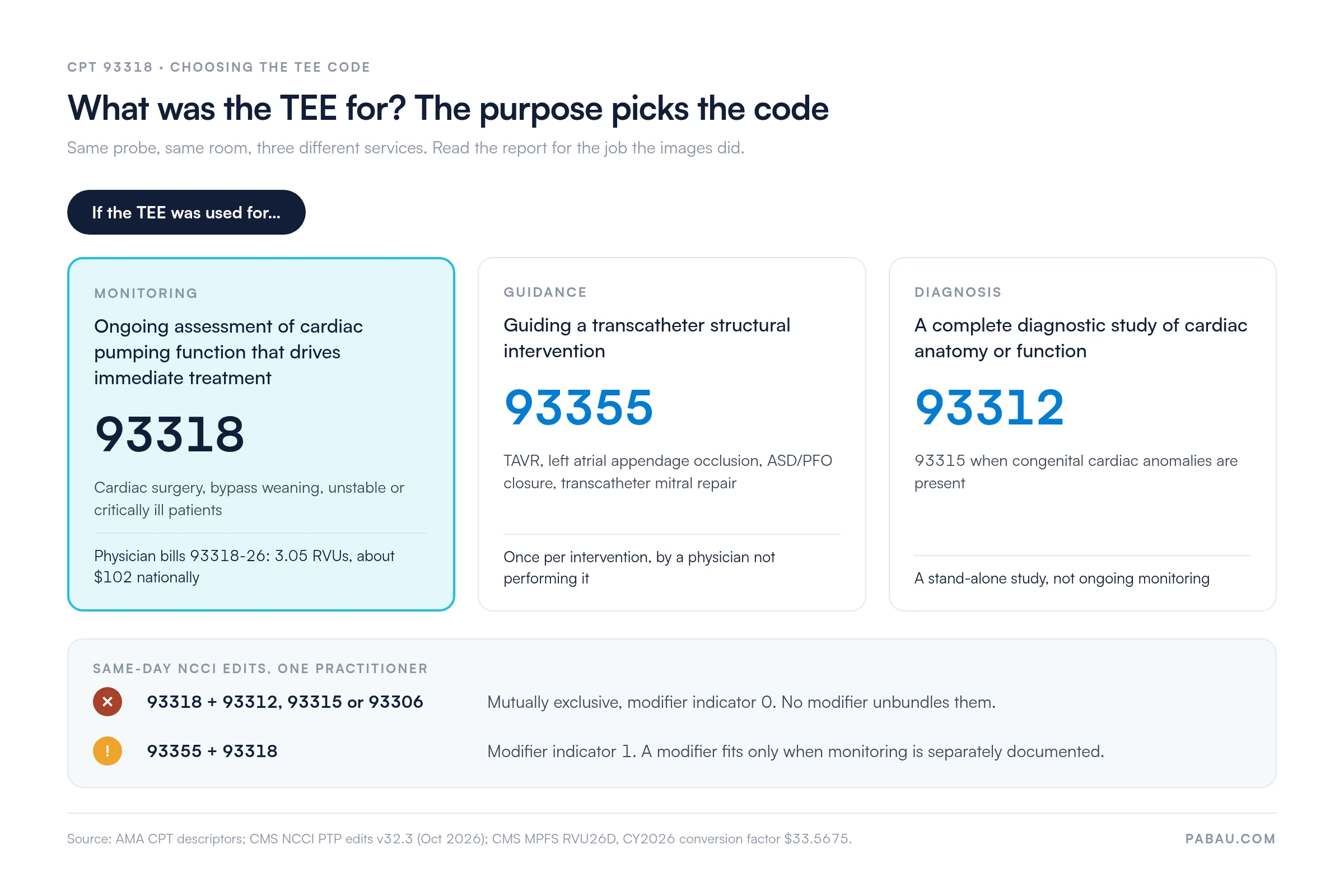
NCCI lists 93318 as mutually exclusive with 93306 and 93312-93317, with modifier indicator 0, so no modifier unbundles those pairs. Check the current quarter’s table anyway, because CMS updates the edits every quarter.
The report has to prove that monitoring happened over time and changed care. Payers look for the same few elements on every 93318 claim.
Anesthesiologists and cardiologists with TEE training most often perform and report 93318. Credentialing rules come from the hospital and each payer, so confirm local requirements before billing. Only one physician reports the interpretation for a given monitoring service.
Medicare pays the professional component of 93318 at a national rate. In the 2026 Medicare Physician Fee Schedule, 93318-26 has status A and 3.05 facility RVUs. The global code and the technical component have status C, so your Medicare Administrative Contractor (MAC) prices those.
The two 2026 conversion factors apply to different clinicians. Qualifying APM participants are paid at $33.5675, and everyone else at $33.4009. Your locality’s geographic adjustment then moves the figure, so reconcile each payment against your electronic remittance advice (ERA).
No national coverage determination is specific to 93318. Coverage is set contractor by contractor, and many policies restrict TEE monitoring to defined indications.
Cardiac surgery and critical care groups should audit 93318 claims against their contractor’s policy each year. Coverage drift is easier to catch in an audit than in a stack of denials.
TEE monitoring claims fail for a handful of predictable reasons. Each one has a fix that belongs before submission.
A clear denial management workflow turns these patterns into checklist items. Track each denial reason so you can see which fix your team needs most.
Most 93318 services happen in a hospital, where the facility owns the equipment. The physician then bills 93318-26, the one 93318 line Medicare prices nationally.
Pull a quarter’s 93318 denials and sort them by reason. If most cite medical necessity, start with how reports describe ongoing monitoring before you revisit code selection.
Most 93318 denials start in the record. The monitoring report, the diagnosis and the charge often live in separate systems, so mismatches slip through before anyone builds the claim. Pabau, our practice management and billing platform, keeps all three on one patient record.
Pabau’s clinical forms capture the TEE indication, findings and treatment changes in a consistent structure. Pabau’s claims management software then submits the claim through Claim.MD and tracks its status. ERA remittances come back into Pabau and are matched to the claims they settle. Your team can see what each payer paid and spot underpaid claims.
Coding decisions still sit with your coders. Pabau gives them a complete report to code from and a clear view of what each payer paid.

Pabau’s clinical forms and claims management keep the monitoring report, the diagnosis and the claim on one patient record. Claims go out through Claim.MD, and ERA remittances come back matched to each claim.

CPT Code 93318 pays for watching the heart and acting on what the images show. Guiding a valve or closure device belongs to 93355. Get that line right in the report, and most of the coding follows.
Write each report so a reviewer can see the ongoing assessments and the decisions they drove. Then bill the professional component with modifier 26, and keep 93312 and 93315 off the same claim.
Book a demo to see how Pabau keeps TEE documentation and claim tracking on one record.

Need a clearinghouse connection for cardiac procedure claims? Pabau’s Claim.MD integration submits claims and tracks their status and ERA remittances from inside Pabau.
Confused by denial codes on a 93318 remit? Denial codes in medical billing explains the most common CARC codes and how to map them back to corrective actions.
Looking for a broader reference on TEE billing compliance? Medical billing compliance covers payer audit triggers and documentation standards that apply across cardiology procedures.
CPT Code 93318 covers transesophageal echocardiography (TEE) for monitoring purposes. It includes probe placement and real-time 2D image acquisition and interpretation. The ongoing assessment of cardiac pumping function drives immediate treatment, usually during cardiac surgery or in critically ill patients. It does not cover guidance of structural interventions such as TAVR.
93318 is TEE monitoring of how the heart is pumping, so the team can treat the patient in real time. 93355 is TEE guidance of a transcatheter structural intervention, such as TAVR or left atrial appendage occlusion. 93355 is a standalone code reported once per intervention by a physician not performing it, and it is not reported with 93312-93318.
93312 is a complete diagnostic TEE study performed to evaluate cardiac anatomy or function. 93318 is ongoing TEE monitoring that informs treatment during surgery or critical care. NCCI treats the two as mutually exclusive on the same date, and no modifier overrides that edit.
The most common are reporting structural guidance as monitoring, and reports that show no ongoing assessment. Others are diagnoses that do not support monitoring, conflicting TEE codes on one claim, and the wrong place of service. Each can be fixed before submission.