HCPCS Code A4627: Spacer and valved holding chamber
HCPCS Code A4627: official descriptor and code definition HCPCS Code A4627 is th...

Last Updated: Oct 21, 2026
92593 is the deleted CPT code for hearing aid check; binaural. The AMA removed it from the CPT code set on January 1, 2026, so 2026 dates of service must not carry it.
A hearing aid check on one or both ears now bills as 92636 for the first 30 minutes of post-fitting follow-up. Add +92637 for each additional 15 minutes. Use 92593 only for dates of service before 2026.
Let Pabau's smart automation suggest the right codes, reduce claim denials, and keep your practice compliant—effortlessly.
Automate repetitive tasks and focus on what matters most—your patients.
Reduce coding errors and ensure compliance with the latest regulations.
Clean claims, fewer denials, and faster reimbursements.
Powerful insights and reporting to help your practice thrive.
HIPAA compliant SOC 2 certified GDPR-compliant Trusted by 4,000+ clinics worldwide

CPT 92593 was “Hearing aid check; binaural,” a post-fitting check of both hearing aids, not an exam or fitting code.
The AMA deleted 92593 and the rest of the 92590–92595 family on January 1, 2026.
For 2026 dates of service, bill 92636 for the first 30 minutes of hearing aid follow-up and +92637 for each extra 15 minutes.
The new codes cover one or both ears, so the old monaural and binaural split no longer applies.
Traditional Medicare still excludes hearing aid services, and CMS kept all 12 new codes non-payable for 2026.
CPT code 92593 was the code for a binaural hearing aid check, and the AMA deleted it on January 1, 2026. Its official descriptor read “Hearing aid check; binaural.” Binaural means the audiologist checked both of the patient’s hearing aids at the same visit.
A hearing aid check takes place after the fitting. The audiologist confirms the devices work as expected and makes adjustments when the patient needs them. 92593 was never the code for the exam and selection visit. That service belonged to 92590 for one ear and 92591 for both ears.
For a hearing aid check on or after January 1, 2026, bill 92636 for the first 30 minutes. Add +92637 for each additional 15 minutes.
No. CPT 92593 is not valid for dates of service on or after January 1, 2026. The American Speech-Language-Hearing Association (ASHA) confirmed the deletion in its November 17, 2025 letter to insurance providers. The letter lists all six legacy hearing aid codes, 92590 through 92595, as deleted and replaced by 12 new CPT codes.
The date of service decides which code set applies. A binaural check performed in December 2025 still bills as 92593, even when the claim goes out in 2026. A check performed on or after January 1, 2026 bills under the new codes.
The new codes, 92628 through 92642, are built around four stages of hearing device care:
Search your fee schedule and service list for 92590 through 92595 before you submit any 2026 claims. Retire each legacy code from your billing templates so no one can attach it to a new date of service.
Bill 92636 for a binaural hearing aid check on or after January 1, 2026. ASHA’s hearing device services codes crosswalk maps 92593 to its hearing aid follow-up and reprogramming row. That row holds 92636 and its add-on, +92637.
92636 is “Hearing aid post-fitting follow-up services, unilateral or bilateral,” for the first 30 minutes. Its descriptor includes these elements:
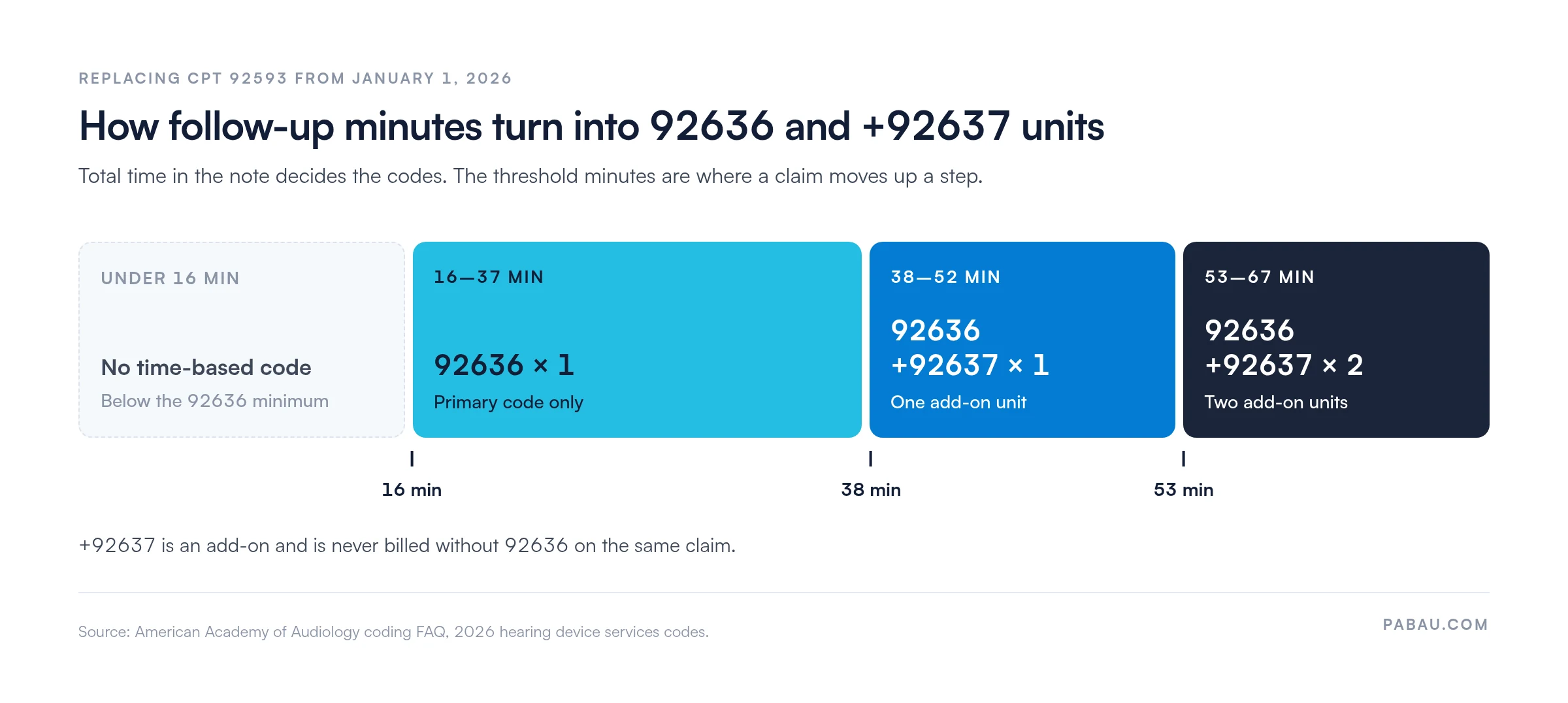
Report +92637 for each additional 15 minutes, and only together with 92636. Both codes are time-based. The American Academy of Audiology (AAA) coding FAQ sets the minimum for 92636 at 16 minutes, and the first +92637 unit starts at 38 minutes.
The old check code had no time element, so this is the biggest change for billing staff. Under 92636, the minutes in the note decide the units on the claim, as the ladder below shows.
Two other changes matter. The binaural distinction is gone, because 92636 covers one or both ears under the same code. Electroacoustic analysis of a hearing aid now bills on its own as 92641.
The descriptors also bar some pairings. Do not report 92636 in conjunction with 92628, 92629, 92631, 92632, 92634, 92635 or 92642.
The legacy hearing aid codes split services by ear count and by visit type. This table gives each code’s official descriptor and where ASHA’s crosswalk sends it.
Some older guidance told coders to bill 92594 for a binaural check after a bilateral fitting. That advice was wrong even before 2026. 92594 described a monaural electroacoustic evaluation, and the binaural check was always 92593.
The new set describes each stage of hearing device care, and each code covers one or both ears. Timed codes use a primary code plus 15-minute add-ons.
A claim that replaces 92593 stands or falls on the note. Payers that review 92636 claims look for these elements:
Building these fields into the note template means each claim leaves the practice complete. That is the first step toward submitting a clean claim.
Make total time a required field in your hearing aid follow-up template. The audiologist can’t sign the note without it, so every 92636 claim carries the minutes payers check for.
The diagnosis code has to support the hearing loss the devices treat. These are the codes used most often, but check coverage against the plan policy before billing.
92636 covers one or both ears, so the diagnosis now carries the laterality on the claim. Pair a bilateral code, such as H90.3, with a check on both hearing aids. Use a unilateral code, such as H90.41 for right-ear sensorineural loss, for a one-ear follow-up.
Most modifier logic that applied to 92593 no longer fits. The new codes cover one or both ears, so a one-ear check needs no modifier to set it apart from a two-ear check.
Use place of service 11 for a follow-up in the office. For telehealth, use the place of service code the payer specifies.
Traditional Medicare never paid for 92593, and it does not pay for its replacements. Section 1862(a)(7) of the Social Security Act excludes hearing aids and the exams to prescribe, fit or change them. In the CY 2026 Physician Fee Schedule final rule, CMS kept all 12 new codes non-payable.
In practice, the exclusion shapes three parts of the billing workflow:
Commercial payers and Medicaid programs set their own timelines for the new codes. ASHA notes that HCPCS V codes, such as V5020 for a conformity evaluation, remain available where payers use them.
Confirm which codes each plan accepts for 2026, and any hearing benefit limits, through insurance eligibility verification before the visit.
Most 92593 denials now come from the deletion itself. Effective denial management workflows watch for these patterns:
The denial codes in medical billing reference explains the CARC codes on your remittance advice. A medical claims clearinghouse surfaces those denials quickly, so staff can recode while the visit is still fresh.
A deleted code can sit in a billing template for months after January. Each claim built on it denies, and staff then recode those claims one at a time.
Pabau, the practice management and billing platform we build, stores the CPT code on each service. Update the hearing aid follow-up service to 92636 once, and every new visit carries the current code. Our audiology claims management then tracks each claim from submission to payment.
For US practices, our Claim.MD clearinghouse integration handles electronic claim submission, eligibility checks and ERA remittance. Your team spends less time recoding denied claims and more time with patients.

Pabau links CPT codes to your services, checks eligibility, and tracks each claim to payment. See how it fits your audiology billing.

CPT 92593 described one service, a hearing aid check on both ears, and it no longer exists. From January 1, 2026, that visit bills as 92636, with time-based units of +92637, whether the patient wears one hearing aid or two.
Practices adjust fastest when they treat the change as a template job. Retire the legacy codes, add a time field to the follow-up note, and confirm which codes each payer accepts.
To see how Pabau keeps audiology codes current from service setup to paid claim, book a demo with our team.

Want the full billing cycle in one place? What is medical billing covers the end-to-end billing cycle from claim creation through payment posting.
Looking to reduce claim denials across your audiology practice? What is revenue cycle management explains the workflow stages where denial prevention has the greatest impact.
Need a superbill template for audiology services? Superbill guide explains what a superbill must include so patients can claim out-of-network reimbursement.
No. The AMA deleted CPT 92593 on January 1, 2026, along with 92590, 92591, 92592, 92594 and 92595. Use it only for dates of service before 2026.
CPT 92593 was “Hearing aid check; binaural,” a post-fitting check of both hearing aids at one visit. It was never an exam, selection or fitting code.
ASHA’s crosswalk maps 92593 to 92636, hearing aid post-fitting follow-up services, unilateral or bilateral, for the first 30 minutes. Add +92637 for each additional 15 minutes of follow-up time.
Both were hearing aid check codes. 92592 covered one ear and 92593 covered both ears. Both were deleted in 2026 and now map to 92636, which covers one or both ears.
No. Traditional Medicare excludes hearing aids and the exams to fit or change them. CMS kept all 12 new hearing device codes, 92636 included, non-payable for 2026. Medicare Advantage plans may cover them.
No. 92636 covers unilateral or bilateral follow-up, so a one-ear check needs no modifier. Modifier 52 applies to a unilateral 92639 or 92641.