



CCSD code G5100: Bypass of duodenum billing guide
CCSD code G5100 bills a bypass that leaves the duodenum in place CCSD code G5100...

Last Updated: Oct 16, 2026

CPT code 83550 covers iron binding capacity, the chemistry test measuring how much iron transferrin can carry.
Medicare covers the test under NCD 190.18 when a documented diagnosis supports it, such as D50.9 or E83.111.
CPT 83540 and CPT 83550 are not bundled by NCCI, so both can be billed on the same date of service.
The test is priced on the Clinical Laboratory Fee Schedule, so a covered Medicare beneficiary usually owes nothing.
Practice management software like Pabau checks each CPT and ICD-10 pairing through its Claim.MD clearinghouse integration before the claim transmits.
CPT code 83550 is the procedure code for the iron binding capacity (TIBC) test. It sits in the Chemistry Procedures section of the CPT codebook published by the American Medical Association. The code covers a laboratory assay that quantifies the maximum amount of iron transferrin can carry in a blood sample.
Clinically, TIBC reflects how much transferrin is available to bind iron. It is one of the markers that separates iron deficiency anemia from other causes of low hemoglobin.
The test runs on a serum or plasma specimen, usually as part of a wider iron panel. Its usual companions are CPT 83540 (iron, total) and CPT 82728 (ferritin). What decides whether the claim pays is coverage, the fee schedule it sits on, and the diagnosis code attached to the line.
The code covers both total iron binding capacity (TIBC) and unsaturated iron binding capacity (UIBC), because either measurement satisfies the descriptor. When a provider orders TIBC, the lab bills CPT 83550. That holds whether the lab measures TIBC directly or derives it from UIBC plus serum iron.
CPT code 83550 is a clinical diagnostic laboratory test, so Medicare prices it on the Clinical Laboratory Fee Schedule (CLFS). Confirm the current amount against the CMS fee schedule look-up tools before you bill.
Important: These figures are estimates based on historical Medicare rates for CPT 83550. Verify the current amount in the official CMS fee schedule or your MAC’s published rates before you submit. CMS updates the schedule each January 1.
Patient cost sharing works differently here than on most Part B services. Clinical laboratory tests priced on the CLFS and billed on assignment are exempt from the Part B deductible and the 20% coinsurance. A Medicare beneficiary who receives a covered, medically necessary CPT 83550 typically owes $0. The ERA 835 still reports the allowed amount and any patient liability line by line.
Commercial payers set their own fee schedules for laboratory chemistry codes, and reimbursement for CPT 83550 spans a wider range than Medicare. The figures below describe the typical landscape. Your own contract rate always takes precedence.
At these amounts, a single rejected iron panel line costs more to rework than the line was ever going to pay. Volume this thin is what makes first-pass claims management worth paying for.
Practice management software like Pabau connects to the Claim.MD clearinghouse, which supports over 4,000 US payers. It checks CPT and ICD-10 codes against payer rules before the 837 file transmits.
Before you submit CPT 83550 to a commercial payer, ask for the lab fee schedule or the contract addendum that covers it. Some large insurers pay TIBC at a flat lab chemistry rate whatever you bill. Knowing the contracted amount upfront keeps accounts receivable predictable.
Medicare’s NCD 190.18 (Serum Iron Studies) defines which diagnosis codes support medical necessity for CPT 83550. A non-covered ICD-10 code will draw a denial however well the rest of the claim is prepared. The table below lists the codes most often paired with the test.
Always select the most specific code the record supports. Unspecified codes such as D50.9 and E83.10 are acceptable while the picture is still incomplete, but they carry more audit risk. Reach for D50.0 or E83.110 as soon as the chart backs them up.
NCD 190.18 is the Medicare coverage determination governing serum iron studies, CPT code 83550 included. Knowing what it covers, and what it excludes, removes most avoidable denials on lab chemistry claims.
Covered indications under NCD 190.18:
Non-covered indications:
Documentation requirements: The chart has to show the clinical reason for the order. It also needs the sign or symptom that prompted it, plus any prior result that informed the decision. A lab requisition on its own does not survive an audit without a supporting progress note.
Verify benefits before the appointment, particularly for Medicare beneficiaries. Confirm that the plan covers TIBC testing and that no prior authorization applies. Standard chemistry codes rarely need one, though a Medicare Advantage plan can add its own rule.
Transferrin is the body’s main iron transport protein, so TIBC moves with how much of it sits unsaturated. It rises in iron deficiency and falls in iron overload, malnutrition, and chronic disease. Ordering the test without a specific clinical question lowers its diagnostic value and invites payer scrutiny.
Common clinical scenarios that support ordering CPT 83550:
Each of those pictures points at a different diagnosis code, and Medicare’s coverage answer moves with it.
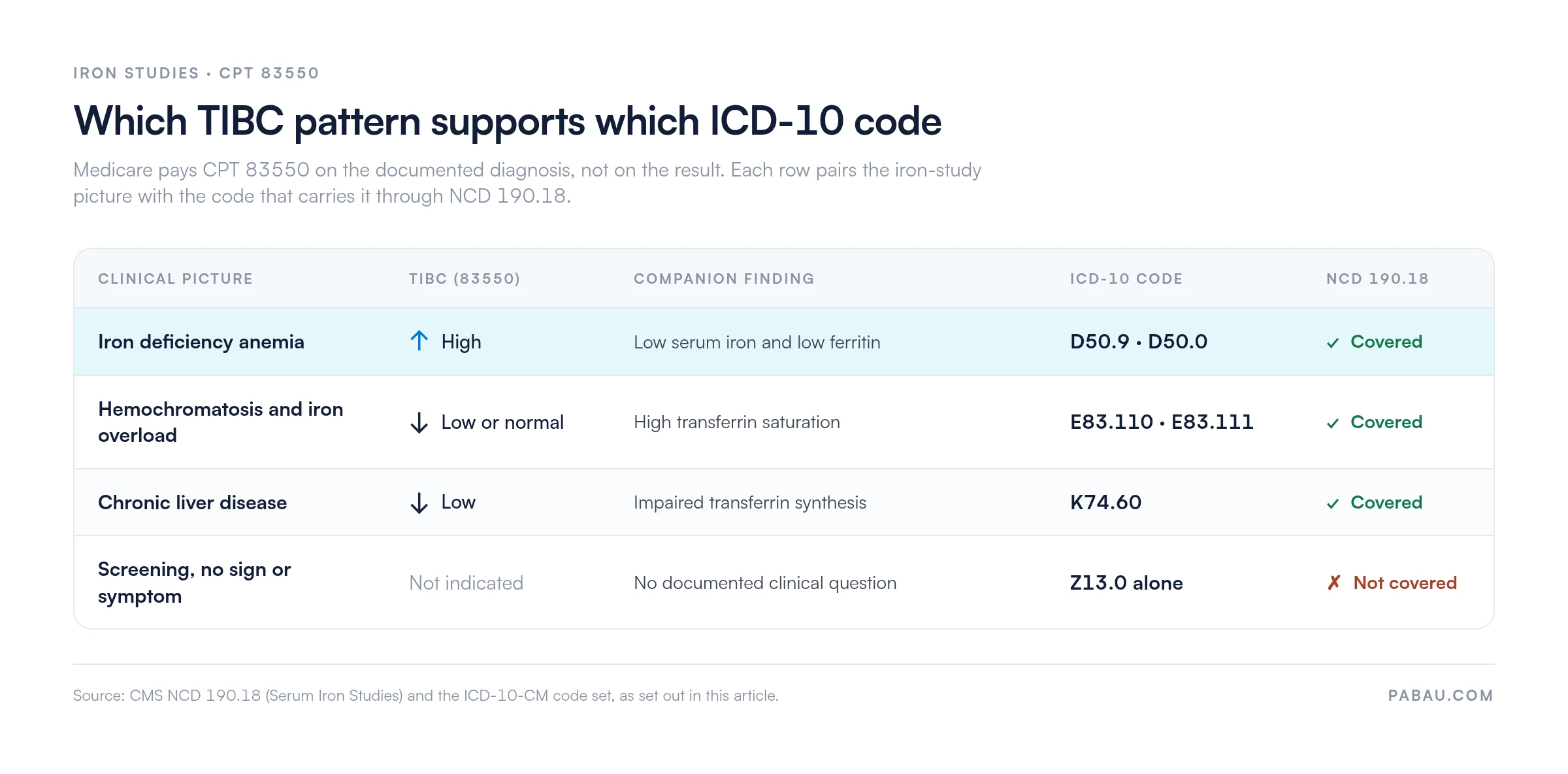
Write the specific scenario into the ordering note. “Evaluate low hemoglobin” is weaker than “microcytic anemia on CBC dated [date]; iron panel to separate iron deficiency from ACD.” The second version hands an auditor the diagnosis, the prior result, and the clinical question in one line.
CPT code 83550 is rarely ordered alone. The full iron panel and its companion chemistry codes build the clinical picture together. The AAPC CPT code reference lists each of them under Chemistry Procedures. Our own CPT code library carries the billing guidance for the individual codes below.
When you bill the full panel of 83540, 83550, and 82728, each code goes on the claim separately. There is no single panel code that replaces them. Each line needs its own ICD-10 pointer, though all three usually share a diagnosis when they come from one workup.
Can CPT 83550 and CPT 83540 go on the same date of service without a bundling denial? Yes, based on the current NCCI edit tables, with a few conditions attached.
NCCI status: Under the National Correct Coding Initiative, CPT 83550 and CPT 83540 carry no comprehensive edit pairing that blocks billing them together.
They describe distinct laboratory tests, and both are needed to calculate transferrin saturation. As of the current NCCI edition, separate billing is appropriate when the record supports ordering both.
What to verify before billing both together:
Keeping an NCCI reference current for your iron panel codes is one of the highest-return compliance habits available. Bundling denials are fully preventable. One staff member reviewing the quarterly updates for your most-billed lab codes costs far less than working the denials afterward.
Formatting matters as much as coding here. Grouping 83550 and 83540 on the same claim line is a common error, and it makes the payer process both codes as a single unit. That usually means payment for one of them. Put each code on its own line with its own ICD-10 pointer.
Check the NCCI edits for CPT 83540 and CPT 83550 at the start of each calendar quarter. CMS publishes updated tables on a quarterly schedule at cms.gov. Flag any new edit that touches your iron panel protocol and update the claim templates before its effective date.
Laboratory chemistry codes like CPT 83550 are high-volume and low-margin. The economics only work while the denial rate stays low, and the usual workflow works against that. A coder retypes the CPT and ICD-10 codes from the encounter note into the claim, and every retype is a chance to drop a digit.
Pabau builds the superbill from the encounter itself, so the codes a clinician documented are the codes on the claim. From there it routes to Claim.MD, our US clearinghouse partner, which supports over 4,000 payers through CMS-1500 and 837P formats. Secondary claims, corrected claims, and CARC-coded appeals travel the same path.
For an iron panel, that means 83550, 83540, and 82728 are each checked against payer edits before the file leaves your practice. Real-time eligibility checks confirm Part B status ahead of the visit. Your billers spend their time on the claims that genuinely need a person.

Pabau checks CPT and ICD-10 pairings against payer rules through the Claim.MD clearinghouse before your 837 file transmits. Fewer denials on lab lines, and less rework for your billing team.

Iron study denials are almost always preventable, and the work that prevents them happens before the claim goes out. Pair a covered diagnosis with a documented clinical question. Then put each code on its own line with its own pointer.
The trade-off worth holding onto is that CPT 83550 pays under $10. No single claim justifies a manual review at that value. The control has to live in the submission workflow rather than in a person checking each line.
That is where the billing system decides your margin on lab work. Book a demo to see how Pabau validates iron panel codes before your claims reach the payer.

Need the diagnosis side of the claim? ICD-10 code D50.0 sets out the documentation for iron deficiency anemia secondary to chronic blood loss.
Working an iron study rejection? Denial codes in medical billing explains how to read CARC codes and build a structured appeal.
Unsure what the clearinghouse actually does? Medical claims clearinghouse walks through electronic claim routing and what happens after the 837 transmits.
Turning an encounter into a clean claim? Superbill preparation explains which fields a payer needs and how the codes carry through to the claim.
CPT code 83550 is the laboratory procedure code for iron binding capacity (TIBC). The test measures the maximum amount of iron that transferrin can carry in a blood sample. It sits in the Chemistry Procedures section of the AMA CPT codebook. Clinicians use it to evaluate iron deficiency anemia, iron overload such as hemochromatosis, and liver disease with a suspected iron abnormality.
The 2026 Medicare rate for CPT 83550 is approximately $8 to $10. The test is priced on the Clinical Laboratory Fee Schedule rather than as a physician service. Verify the current amount through the official CMS fee schedule look-up before you bill, because CMS updates the schedule each January 1.
Usually not. Clinical laboratory tests priced on the Clinical Laboratory Fee Schedule and billed on assignment are exempt from the Part B deductible and the 20% coinsurance. A beneficiary receiving a covered, medically necessary TIBC test typically owes $0. Cost sharing can still apply under a Medicare Advantage plan with its own benefit design.
Four codes carry most CPT 83550 claims. D50.9 is unspecified iron deficiency anemia, and D50.0 is iron deficiency anemia secondary to chronic blood loss. E83.10 covers an unspecified disorder of iron metabolism, and E83.110 covers hereditary hemochromatosis. All four are covered under Medicare NCD 190.18. Avoid Z13.0 as a standalone diagnosis, because Medicare does not cover TIBC for screening alone.
CPT 83540 measures serum iron, the amount of iron circulating in the blood. CPT 83550 measures iron binding capacity, which reflects how much iron transferrin could carry if fully loaded. Together they allow you to calculate transferrin saturation. That ratio separates iron deficiency anemia, which runs low, from hemochromatosis, which runs high. They are distinct tests and NCCI does not bundle them.
CPT 82728 is the correct code for serum ferritin. It is frequently ordered alongside CPT 83550 and CPT 83540 as part of a complete iron panel. Ferritin reflects iron stores and is the most sensitive early marker of deficiency. It falls before TIBC rises and before serum iron drops.
Yes. CPT 83550 and CPT 83540 can be billed on the same date of service because they describe distinct laboratory tests. Current NCCI edit tables carry no comprehensive bundling edit between the two codes. Check the current quarterly NCCI table and document both tests in the clinical note. List each code on its own claim line with its own ICD-10 pointer.
There is no single CPT panel code for a complete iron panel. The three components bill separately as CPT 83540 for serum iron, CPT 83550 for TIBC, and CPT 82728 for ferritin. Each needs its own claim line with a supporting ICD-10 code. Some payers hold panel pricing agreements, but standard Medicare billing uses the three individual codes.



