CPT code 48152: Whipple procedure without pancreatojejunostomy
CPT code 48152: Official description and procedure overview CPT code 48152 descr...

Last Updated: Nov 13, 2026
76080 is the CPT code for radiologic examination, abscess, fistula or sinus tract, radiological supervision and interpretation. It covers the sinogram or fistulogram imaging and the radiologist's report, not the contrast injection.
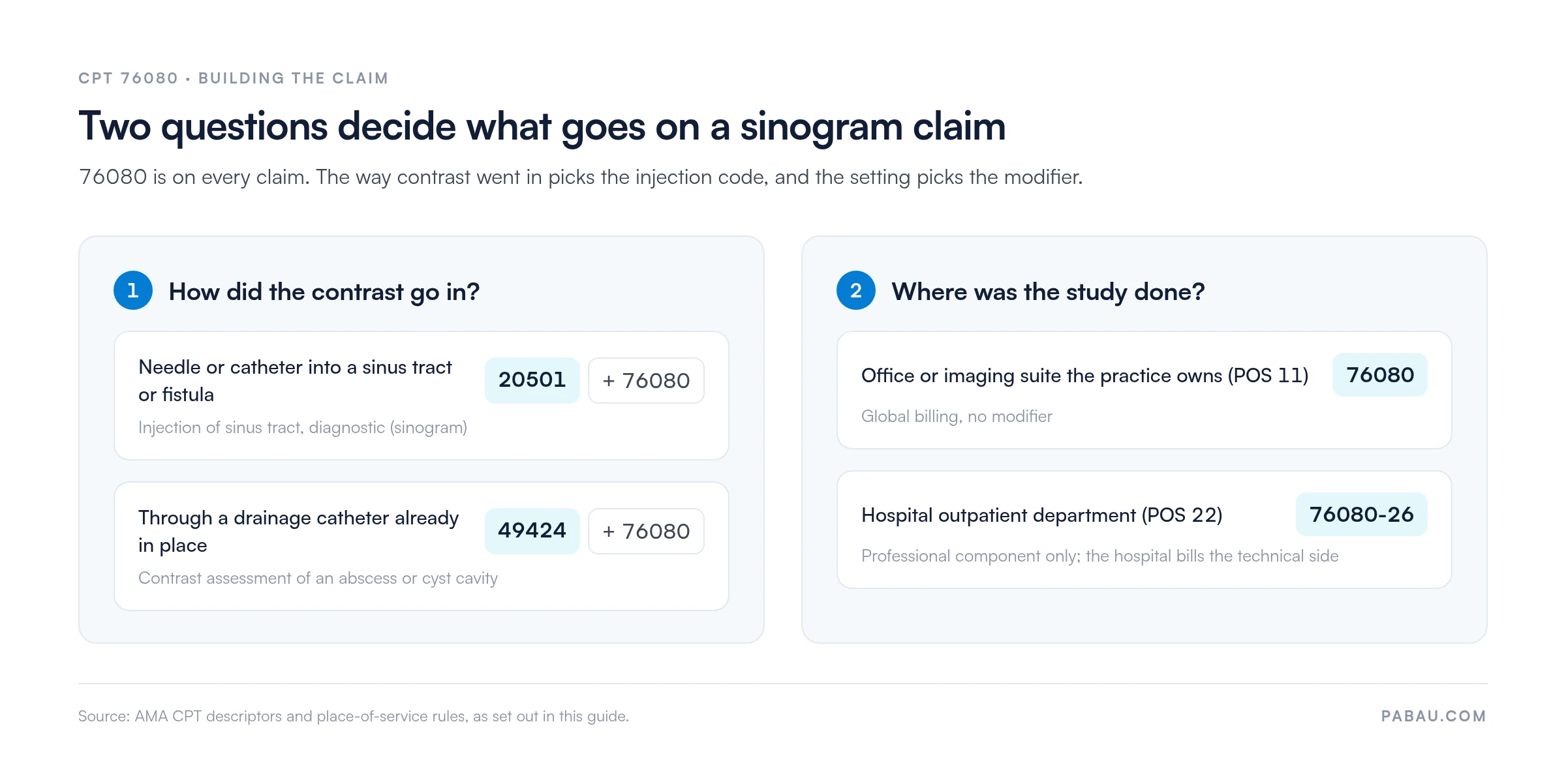
The injection is billed separately, with 20501 for a sinus tract or 49424 through an existing drainage catheter. In a hospital, the radiologist adds modifier 26 and the hospital bills the technical component.
Let Pabau's smart automation suggest the right codes, reduce claim denials, and keep your practice compliant—effortlessly.
Automate repetitive tasks and focus on what matters most—your patients.
Reduce coding errors and ensure compliance with the latest regulations.
Clean claims, fewer denials, and faster reimbursements.
Powerful insights and reporting to help your practice thrive.
HIPAA compliant SOC 2 certified GDPR-compliant Trusted by 4,000+ clinics worldwide

CPT code 76080 covers the imaging of an abscess, fistula or sinus tract after contrast injection, not the injection itself.
Always pair 76080 with an injection code: CPT 20501 for a sinus tract injection, or CPT 49424 for contrast through an existing drainage catheter.
Modifier 26 (professional component) is required when the radiologist interprets the study at a hospital that bills the technical component separately.
Missing medical necessity documentation, especially the clinical indication and tract description in the radiology report, is a leading cause of 76080 denials.
CPT code 76080 is the American Medical Association’s (AMA) code for a radiologic examination of an abscess, fistula, or sinus tract. The study is also called a sinogram or fistulogram. The official descriptor reads: Radiologic examination, abscess, fistula or sinus tract, radiological supervision and interpretation.
The key phrase in that descriptor is “radiological supervision and interpretation.” Code 76080 captures only the imaging component, meaning the radiologist’s real-time fluoroscopic guidance and the written interpretation. The injection of contrast into the cavity is a separate service billed under a companion injection code.
Clinically, the procedure involves introducing a water-soluble iodinated contrast medium into an abscess cavity, fistula, or wound sinus tract. The radiologist acquires fluoroscopic images in multiple projections.
They map the tract’s extent, show any internal communication (such as a fistula to bowel or bladder), and characterize the cavity for drainage planning. The findings shape the surgical or interventional plan.
The AMA coding resources place 76080 within the Diagnostic Radiology subsection of the Radiology chapter, specifically under “Other Procedures.” It is not a fluoroscopic guidance code and should not be confused with guidance add-on codes like 77002.
Understanding the scope of 76080 prevents the most common coding errors on radiology claims. The table below outlines included scenarios and explicit exclusions.
Coders who understand what happens during the procedure can identify every billable service and avoid bundling errors. A sinogram or fistulogram typically proceeds in five steps.
The injection (steps 2–3) and the imaging interpretation (steps 4–5) are always two separate CPT codes on the same date of service. Bill 76080 without the companion injection code and the injection work goes unpaid.
Thin documentation is one of the most common reasons payers deny 76080 claims. Every element below belongs in the radiology report or the medical record before the claim goes out.
CPT code 76080 captures only the radiological supervision and interpretation component. The injection of contrast into the cavity is separately reportable, and the choice of injection code depends on the access site and clinical context.
The medical billing logic is simple. 20501 or 49424 captures the hands-on injection work, and 76080 captures the radiologist’s imaging supervision and written interpretation. Both services are separately payable on the same date under most payers.
Check the current National Correct Coding Initiative (NCCI) edit tables before billing, because bundling edits can change with each quarterly update.
Always check the NCCI edit table for the 76080 and 20501 or 76080 and 49424 code pair before submitting. While these pairs are generally separately payable, NCCI edits change quarterly. A modifier 59 or XS may be needed if an edit exists and the services are distinct.
Several radiology codes describe contrast-based imaging of fluid collections or tracts. Picking the wrong one is one of the most common upcoding and downcoding errors in interventional radiology billing. The table below separates 76080 from its nearest neighbors.
The pivot question is what the radiologist is doing. Imaging a pathological cavity or tract is 76080, guiding a needle is 77002, and changing a drainage catheter is 75984. When in doubt, the code that most closely matches the documented procedure intent wins.
Per the AAPC Codify CPT lookup, 76080 is specifically indexed under “Sinogram” and “Fistulogram” in the CPT index. That indexing confirms its intended scope.
CPT 76080 is a global radiology service. When a radiologist and a facility both participate in the service, the global reimbursement is split using modifiers 26 and TC. Getting this wrong is a top audit trigger for radiology practices.
A single-entity practice that provides both components in its own office or imaging suite bills 76080 globally, with no modifier, and receives the combined rate. Billing 76080-26 when global billing applies underpays the claim by roughly 40–50% of the allowed amount.
Billing globally in a hospital setting duplicates the technical component the hospital already bills, and the claim is denied. Check the place of service before submission. POS 11 (office) supports global billing, while POS 22 (hospital outpatient) triggers the professional and technical split.
Put the injection code and the modifier together, and every 76080 claim comes down to the two questions below.
CPT code 76080 carries a moderate RVU value under the Medicare Physician Fee Schedule (MPFS). The global rate reflects the physician work of supervision, interpretation and the report.
Billed from an office, it also covers the practice expense of the fluoroscopy equipment and contrast supplies. Rather than publishing a specific dollar figure that changes annually, the most reliable approach is to query the current rate directly from CMS.
Use the CMS Physician Fee Schedule lookup tool and search for code 76080 with your geographic pricing locality. It returns the current year’s allowed amounts for the global, modifier 26 and TC components.
The PFS Search also shows the work RVU (wRVU), practice expense RVU, and malpractice RVU separately, which matters for revenue cycle projections.
Commercial payer rates for 76080 typically range from 100% to 150% of Medicare, depending on contract terms. Check each remittance against the contracted rate rather than the Medicare figure, because a short payment on a low-value imaging code is easy to miss.
Prior authorization requirements for 76080 vary substantially by payer. Medicare generally does not require prior auth for diagnostic radiology services, but many commercial plans and Medicare Advantage contracts do. Check the specific plan’s authorization requirements before scheduling, as a retroactive denial for missing auth is not typically overturnable on appeal.
Medical necessity for 76080 rests on demonstrating that the imaging changed or could change clinical management. These ICD-10-CM diagnosis codes most commonly support the claim:
Link the ICD-10 code to the documented pathology. A diagnosis of L02.011 (cutaneous abscess of face) paired with a sinogram of an abdominal fistula will generate a medical necessity mismatch denial.
Meeting billing compliance requirements means verifying that diagnosis and procedure are clinically consistent before submission.
Radiology claim denial patterns for 76080 are consistent enough that most can be anticipated and prevented at the charge entry stage. Each denial below has a specific fix that takes less time than an appeal.
Structured denial management workflows that track 76080 denial reasons apart from the wider radiology pool let billing teams spot patterns faster. If your 76080 denial rate runs above 5%, look first at the top two rows of the table. An incomplete report and an ICD-10 code that doesn’t match the procedure are the likeliest causes.
A report template that forces indication language fixes most of this before the claim leaves the practice. That is the clean claim principle at work: every required data element is in place before submission, not corrected after a denial.
For practices managing a high volume of radiology claims, reviewing medical billing denial codes by category helps prioritize which denial types to address first.
Run a quarterly audit of all 76080 claims where modifier 26 was not appended. Cross-reference against place of service codes. Any 76080 billed globally from POS 22 (hospital outpatient) is a duplicate billing risk and a potential overpayment liability. Catching this proactively is always cheaper than a payer audit.
A debated application of CPT code 76080 involves its use during SphenoCath sphenopalatine ganglia (SPG) block procedures. Some practices have billed 76080 for the fluoroscopic imaging in SPG block guidance. Their argument is that contrast is used and the radiologist supervises and interprets the images.
The problem is descriptor alignment. The AMA CPT code set indexes 76080 specifically under “Abscess,” “Fistula,” and “Sinus tract”, and all three describe pathological cavities or channels.
An SPG block targets a normal anatomical ganglion, not a pathological abscess, fistula, or sinus tract. The use of fluoroscopy for guidance on a nerve block is captured by fluoroscopic guidance add-on codes (such as 77002), not by 76080.
AAPC forum discussions have flagged this as a likely misuse of 76080, and billing it for SPG block guidance invites audit scrutiny. Before using an imaging code for an indication its CPT descriptor doesn’t name, review the payer’s local coverage determination (LCD).
Get a written policy position if you can. The AAPC Codify index is a useful first check for whether a procedure name maps to a code.
A rejected 76080 claim usually comes down to a detail rather than a coding judgment. The injection code was left off, the modifier didn’t match the place of service, or the authorization had lapsed.
Pabau, the practice management and billing platform we build, sends CMS-1500 (837P) claims through the Claim.MD clearinghouse, which reaches thousands of US payers. Its radiology claims management runs eligibility checks before the study, so a coverage problem surfaces before the patient arrives.
The prior authorization code, dates and sessions sit on the patient’s case, and Pabau warns you when one is missing. Electronic remittance advice (ERA) then posts against the same record, so you can check each 76080 payment against the contracted rate without a manual spreadsheet.

Pabau connects to thousands of US payers through Claim.MD, checks eligibility before the study, and posts remittances against the patient record. See how it handles sinogram and fistulogram billing.

Treat 76080 as one half of a pair. A claim without 20501 or 49424 leaves the injection unpaid, and a claim without the right modifier collides with the hospital’s technical billing.
Both fixes start before billing, in the report template. A report that states the indication, the contrast, the views and the tract anatomy supports the codes, the modifier and the diagnosis on its own. Keep 76080 for pathological cavities and tracts, and code nerve-block guidance with 77002.
Book a demo to see how Pabau sends paired radiology claims to thousands of US payers and matches each remittance to its code.

Need a clearinghouse that handles radiology claims? Claim.MD clearinghouse overview explains how the integration connects practices to US payers for 837P submission and ERA return.
Trying to reduce your overall radiology denial rate? Revenue cycle management fundamentals covers the end-to-end billing workflow from charge capture through payment posting.
Comparing medical billing clearinghouse options? Medical claims clearinghouse guide outlines how clearinghouses validate claims before payer submission and reduce rejection rates.
CPT code 76080 is the billing code for radiologic examination of an abscess, fistula or sinus tract. It covers only the radiological supervision and interpretation, meaning the imaging. The contrast injection is reported separately with CPT 20501 or CPT 49424.
The Medicare Physician Fee Schedule rate for CPT code 76080 changes every year. Search the CMS Physician Fee Schedule lookup tool for 76080 with your geographic pricing locality. It shows the current global, modifier 26 and TC allowed amounts.
Yes. 76080 (the imaging) and 20501 or 49424 (the injection) are separately payable on the same date under most payers. Check the NCCI edit tables each quarter, because bundling edits change. If an edit applies and the services are distinct, append modifier 59 or XS.
CPT 76080 is a standalone imaging study of a pathological cavity or tract (abscess, fistula, wound sinus tract). CPT 77002 is an add-on guidance code used when fluoroscopy guides needle placement during a separate procedure such as an injection or biopsy. The two serve different clinical purposes and are not interchangeable.
The leading reason is missing or vague medical necessity documentation in the radiology report. An ICD-10 code that doesn’t match the procedure site is another. So are global billing in a hospital setting where modifier 26 was required, and a missing prior authorization with a commercial or Medicare Advantage plan.
No. CPT 76080 is indexed specifically for abscess, fistula and sinus tract imaging. Fluoroscopic guidance during an SPG block fits a guidance add-on code such as 77002. Using 76080 for it carries audit exposure, so check the payer’s LCD before billing.