HCPCS code C1731: Catheter billing, OPPS reimbursement, and denial guide
HCPCS code C1731: Official descriptor and code series context HCPCS code C1731 i...

Last Updated: Oct 8, 2026
64520 is the CPT code for injection, anesthetic agent; lumbar or thoracic (paravertebral) sympathetic. It covers a sympathetic nerve block at the lumbar chain or the thoracic paravertebral ganglia, and it is unilateral by default.
Denials on this code come from three predictable sources. Imaging guidance gets billed without its own report. Laterality modifiers go missing on bilateral procedures. The ICD-10 diagnosis does not meet the payer's covered-indication criteria.
Let Pabau's smart automation suggest the right codes, reduce claim denials, and keep your practice compliant—effortlessly.
Automate repetitive tasks and focus on what matters most—your patients.
Reduce coding errors and ensure compliance with the latest regulations.
Clean claims, fewer denials, and faster reimbursements.
Powerful insights and reporting to help your practice thrive.
HIPAA compliant SOC 2 certified GDPR-compliant Trusted by 4,000+ clinics worldwide

CPT Code 64520 covers anesthetic injection into the lumbar or thoracic paravertebral sympathetic chain, not individual peripheral nerves.
Imaging guidance (fluoroscopy 77003 or ultrasound 76942) is never bundled into 64520 and must be documented and billed separately.
Bilateral procedures require modifier 50 with supporting documentation, and a missing laterality modifier is the most common denial trigger.
Medicare pays roughly $235 in a non-facility setting and roughly $74 in a facility, because practice expense RVUs differ.
Pabau’s claims management software embeds CPT and ICD-10 catalogs, so coding errors are flagged before claims reach the clearinghouse.
CPT Code 64520 describes “Injection, anesthetic agent; lumbar or thoracic (paravertebral) sympathetic.” The American Medical Association places the code in the Surgery section of the CPT manual, under Nervous System. The subsection is Introduction/Injection of Other Therapeutic Substance.
The procedure targets the lumbar sympathetic chain (typically L2-L4) or the thoracic paravertebral sympathetic ganglia. Clinicians inject a local anesthetic, a neurolytic substance, or a corticosteroid alongside the chain.
That interrupts pain signaling or reduces glandular output. The code is unilateral by default, so bilateral procedures require modifier 50.
Accepted indications for lumbar or thoracic sympathetic injection span several diagnostic categories. Payers require the medical record to show that conservative treatment was tried and failed first. The ICD-10 diagnosis code on the claim must also map to a covered indication in the applicable Local Coverage Determination (LCD).
Documentation must include the specific diagnosis, prior treatment history, and imaging or objective findings. It also needs the clinical rationale for choosing sympathetic blockade over other interventional options. Payers following CMS LCD Article 56034 have the most detailed covered-indication criteria for nerve blockade.
These are the most frequently paired ICD-10-CM diagnosis codes for claims submitted with CPT 64520. Using an unspecified code when a more specific one is available is a common reason for medical necessity denials. Select the code that most precisely reflects the documented diagnosis.
Always use the most specific laterality code available. Unspecified CRPS codes such as G90.50 and G90.59 raise denial risk, because payers cannot verify that the procedure site matches the documented diagnosis.
Reading the full descriptor in the ICD-10 code library before submission takes seconds and saves a rework cycle. The AAPC Codify CPT lookup offers crosswalk suggestions by indication.
Imaging guidance is not included in CPT Code 64520. Fluoroscopy and ultrasound guidance must each be documented in the operative note as a separately performed service.
Each is then reported with its own add-on code. Failing to document the guidance independently, or leaving it off the claim when it was used, are both compliance problems.
Most pain management practices use fluoroscopy (77003) for lumbar sympathetic blocks, given the retroperitoneal anatomy. Ultrasound guidance (76942) is less common at this level but acceptable with proper documentation. You cannot report both on the same session for the same procedure.
Medicare payment for CPT Code 64520 varies by place of service. The CMS Physician Fee Schedule publishes national rates annually. Geographic practice cost indices (GPCI) then adjust them by locality. Check the FastRVU 2026 lookup tool for your MAC locality rate. The figures below are 2026 national averages and are subject to annual adjustment.
The two columns diverge for one reason only. Work and malpractice RVUs are identical wherever you perform the block, so practice expense carries the entire difference in payment.
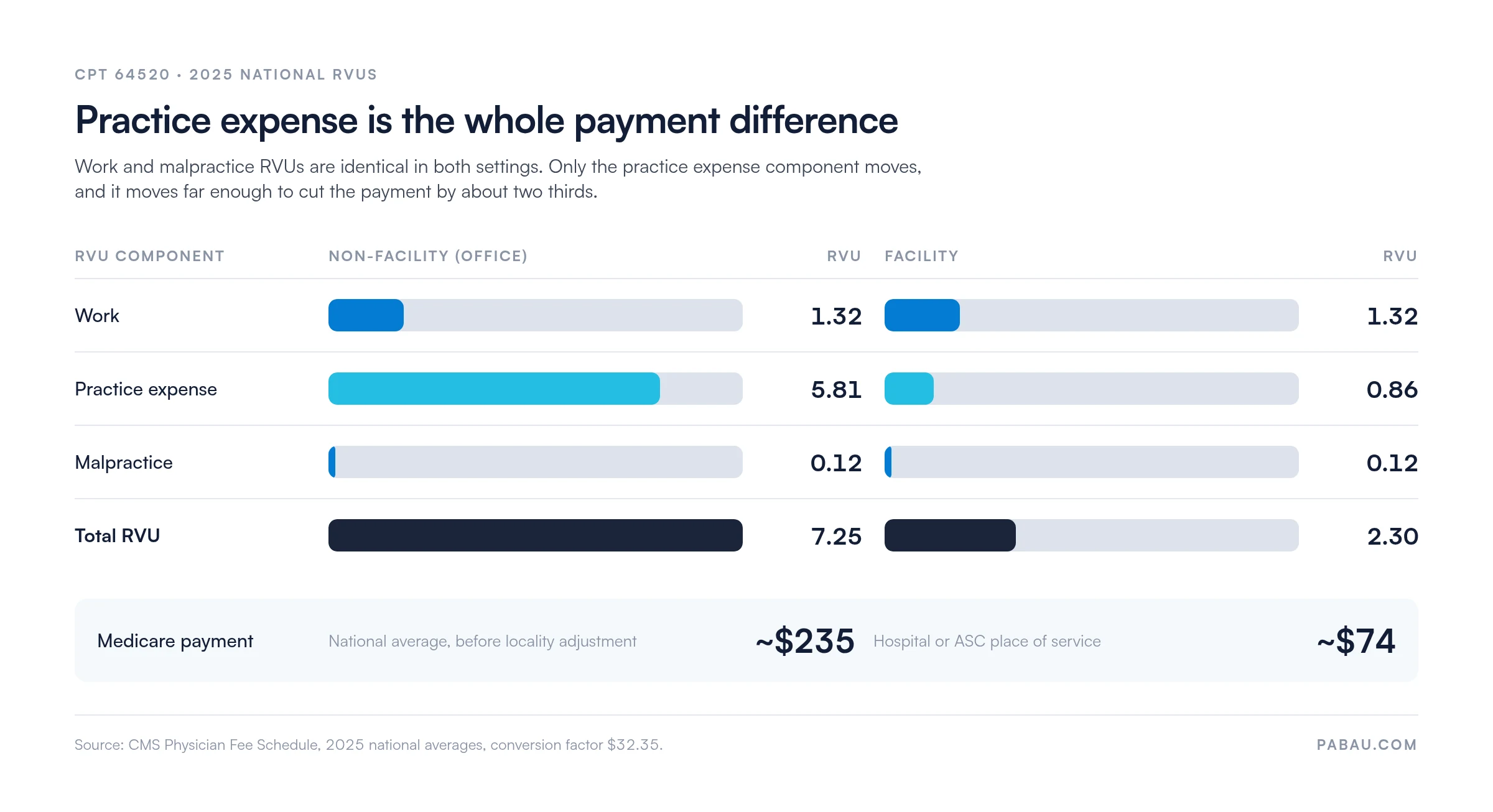
Commercial payer rates typically range from 110% to 160% of Medicare. Always verify the contracted rate in your own payer agreements, because the table above is a benchmark rather than a guaranteed payment. Check the remittance advice after each adjudication cycle to catch rate discrepancies early.
Medicare coverage for lumbar sympathetic nerve blocks is governed by Local Coverage Determinations issued by individual Medicare Administrative Contractors (MACs). CMS LCD Article 56034 is the primary reference for nerve blockade coverage criteria.
Verify the patient’s benefits before scheduling, particularly for Medicare patients, so you know the diagnosis will meet the criteria at that MAC.
Accurate billing on this code starts with thorough documentation. For CPT Code 64520, the operative note must cover six elements to support the claim and survive audit review.
Submit CPT Code 64520 claims on the CMS-1500 form or in the electronic 837 professional format. Practice management software like Pabau transmits both through its Claim.MD integration, which reaches thousands of US payers.
Built-in CPT and ICD-10 catalogs flag coding errors before the claim leaves the practice. Check the superbill against the operative note first, so the procedure codes, diagnosis codes, and modifiers all agree.
The National Correct Coding Initiative (NCCI) edits define which codes cannot be billed together without a supporting modifier.
CMS updates the edit pairs for CPT Code 64520 quarterly, so verify the current edits through the CMS NCCI tool before submitting. In practice that means running an NCCI check on every claim that pairs 64520 with another procedure code.
Denied claims involving NCCI edits go into a denial management workflow. Pull the operative note, confirm the distinct-service rationale, and resubmit a corrected claim with the right modifier.
Track the denial reason code on every 64520 remittance, so a systematic bundling problem surfaces before it compounds across hundreds of claims.
Four errors generate the majority of denials on CPT Code 64520 claims. Each has a straightforward fix once you can see it in your workflow.
Run a monthly audit of every 64520 claim denied in the previous 90 days, then group the denials by denial code. Laterality errors, bundling edits, and medical necessity rejections each need a different fix. Working through the most frequent pattern first usually clears the largest share of your denial volume on this code.
CPT Code 64520 sits within the sympathetic nerve block family, alongside two anatomically adjacent codes. Coders also reach for several pain injection codes on the same patient encounter. Knowing the scope of each one prevents both under-coding and unbundling errors. The CMS annual CPT/HCPCS code list confirms each code’s active status and descriptor every fiscal year.
What separates 64520 from its neighbors is the target. The code covers the sympathetic ganglionic chain, not the somatic nerve roots or peripheral branches. Billing 64450 for a lumbar sympathetic block is a significant coding error. Document the anatomical target precisely, because auditors compare the operative note against the code billed.
In most pain management practices the block is written up in free text, then handed to a coder days later. Laterality, imaging guidance and the injected agent get reconstructed from memory, and whatever nobody wrote down turns into a denial.
Practices billing 64520 at volume need accurate claims management software sitting under the clinical note, so the claim and the record never drift apart. Pabau holds clinical documentation, procedure coding, and clearinghouse submission in one workflow.
Clinical notes built in Pabau capture the six required operative note elements in structured fields rather than free text. Coding staff read the laterality, the imaging modality, the agent and the volume straight off the note. Built-in CPT and ICD-10 catalogs flag a mismatched diagnosis-to-procedure pairing before the claim reaches the clearinghouse.
The Claim.MD integration then handles eligibility verification, 837 submission, and ERA posting. It reaches thousands of US payers, including the MACs most pain management practices work with daily. The result is fewer 64520 claims coming back, and less of the billing team’s week spent on rework.

Pabau’s claims management software includes built-in CPT and ICD-10 catalogs, automated eligibility checks, and clearinghouse integration so 64520 claims submit correctly the first time.

CPT Code 64520 pays reasonably well and denies often, and the two facts are connected. Laterality modifiers, imaging guidance reports, and ICD-10 specificity decide almost every one of those denials. All three are documentation decisions made in the treatment room.
Capture them at the point of care rather than chasing them in the billing queue, and this code stops generating rework. Book a demo to see how Pabau handles interventional pain management billing from the note to the remittance.

Submitting your first 837 electronic claim? Medical billing fundamentals explains the CMS-1500 to 837 submission path and how payer adjudication works.
Want to see how other pain management codes compare? CPT coding for clinic procedures covers related injection and evaluation codes used alongside 64520.
CPT Code 64520 covers injection of an anesthetic agent into the lumbar or thoracic paravertebral sympathetic chain. It does not include imaging guidance, which must be reported separately using 77003 (fluoroscopy) or 76942 (ultrasound).
Medicare pays roughly $235 in a non-facility setting and roughly $74 in a facility setting for CPT Code 64520, based on 2026 national average rates. Actual payment varies by geographic locality. Use the CMS Physician Fee Schedule lookup or FastRVU to find your MAC-specific rate.
Yes, imaging guidance is always billed separately with CPT Code 64520. Fluoroscopy is reported with 77003 and ultrasound with 76942. Each needs its own report, with permanent image documentation stored in the patient record before the claim is submitted.
CPT 64510 covers stellate ganglion block, which targets the cervical sympathetic chain. CPT 64520 covers the lumbar or thoracic paravertebral sympathetic chain. The anatomical site of injection determines which code applies, so using 64510 for a lumbar sympathetic block is a coding error.
Yes, CPT Code 64520 can be billed bilaterally using modifier 50 when both sides are injected in the same session. The medical record has to document separate clinical justification for each side. Medicare typically reimburses bilateral procedures at 150% of the single-side fee.
Most Medicare Administrative Contractors limit lumbar sympathetic blocks to three or four per affected side per 12-month benefit period. The exact limit depends on your MAC’s Local Coverage Determination. Commercial payers set separate frequency policies, so verify before scheduling repeat injections.