HCPCS code J3471: Hyaluronidase ovine injection billing guide
HCPCS code J3471: Descriptor, code type, and quick-reference data HCPCS code J34...

Last Updated: Oct 14, 2026

CPT code 17314 describes Mohs micrographic surgery of the trunk, arms, or legs for each additional stage after the first stage — that means the second stage and every stage beyond it.
17314 is an add-on code: it can never be billed alone and always requires CPT 17313 as the primary code on the same claim.
Common denial triggers include billing 17314 without 17313, missing the stage diagram, and incorrectly appending modifier 51 (17314 is modifier 51 exempt).
Pabau helps dermatology practices document multi-stage Mohs encounters and flag missing documentation before a claim reaches the biller, reducing the risk of a CPT 17314 denial.
Most Mohs surgery denials trace back to a single mistake: billing the additional-stage code without understanding exactly when it applies. CPT code 17314 covers each additional stage of Mohs micrographic surgery performed on the trunk, arms, or legs, specifically the second stage and every stage after it. If a surgeon removes two or more stages on a trunk or extremity site in a single encounter, 17314 is what gets appended for every stage after the first.
The code sits within the CPT add-on code framework maintained by the American Medical Association (AMA), which publishes and controls the CPT code set. Add-on codes have ZZZ global periods, meaning they inherit the global period of the primary procedure they accompany. 17314 is no exception.
CPT code 17314 makes no sense in isolation. It is one piece of a five-code series that maps directly to the stages and anatomical sites of Mohs micrographic surgery (MMS). Understanding the whole series prevents the misrouting errors that are common when a coder handles Mohs for the first time.
The body site distinction is absolute. A lesion on the forearm uses 17313/17314. Mixing codes across site categories is one of the most common Mohs billing errors practices face. Billing staff using dermatology EMR software often set site-specific rules inside their billing workflow to prevent this cross-routing.
The add-on code rule for 17314 is strict and has no exceptions. The code requires CPT 17313 on the same claim, for the same patient, same date of service, and same surgical site. Miss any of those conditions and the claim is headed for a denial.
Because 17314 is an AMA-designated add-on code, modifier 51 must never be appended to it. The CMS PFS lookup tool lists 17314 with modifier 51 exempt status. Payers that receive a 17314 claim with modifier 51 attached will typically reject it outright. This is a correctable but avoidable error. The same add-on logic applies elsewhere in dermatology.
Surgeons comparing EMR options for plastic surgery practices should check how each handles operative notes and staged procedures.
Modifier selection for 17314 is a common source of confusion, especially when multiple lesions are treated or when a surgeon operates at both a facility and a non-facility site on the same day. The table below reflects standard guidance; individual payer contracts may impose additional requirements.
Modifier 59 warrants particular care. Use it only when the clinical documentation genuinely supports a distinct procedural service. Routine application without supporting notes is a known audit trigger under CMS. Strong compliance management workflows flag modifier overuse before claims leave the practice.
Reimbursement for 17314 varies by setting and geography. The national averages below are drawn from the 2026 Medicare Physician Fee Schedule. Rates are adjusted by Geographic Practice Cost Indices (GPCI), so a practice in Manhattan will see different payments than one in rural Mississippi. Always verify current figures using the CMS PFS lookup tool or the FastRVU 2026 RVU lookup before quoting expected reimbursement to practice leadership.
The non-facility rate is higher because the practice absorbs overhead costs (pathology equipment, staff, supplies) that a hospital or ambulatory surgery center (ASC) bills separately. Most Mohs surgery is performed in a physician office (POS 11), so the non-facility rate applies in the majority of cases. Billing with the wrong POS code is a common reason for underpayment, not just denial. Billing staff at skin care practices routinely cross-check POS against the physical location of service at claim creation.
RVU breakdown (indicative, verify against current MPFS): CPT 17314 carries work RVUs, practice expense RVUs, and malpractice RVUs. The total RVU value is multiplied by the Medicare conversion factor and the applicable GPCI to produce the final payment. Under the CY2026 Medicare Physician Fee Schedule final rule (CMS-1832-F), the conversion factor splits by participation status: $33.5675 for qualifying Alternative Payment Model (APM) participants and $33.4009 for everyone else, both subject to annual adjustment. Use the AAPC Codify CPT lookup for RVU reference values alongside the CMS PFS tool.
Before publishing your fee schedule for Mohs patients, verify 17314 rates directly in the CMS PFS look-up tool for your MAC locality. National averages can understate or overstate what your specific payer contracts allow by 15-30%. Build a rate verification step into your annual billing calendar, not just when denials spike.
Medicare’s Local Coverage Determinations (LCDs) for Mohs surgery specify which ICD-10-CM diagnosis codes satisfy medical necessity. Billing 17314 with an unsupported diagnosis code will generate a medical necessity denial even if the procedure itself was coded correctly. The most common pairings are nonmelanoma skin cancers under category C44.
Verify specific subcategory codes for FY2026 against the CrossCoder CPT-to-ICD crosswalk tool and your MAC’s LCD article. The CMS LCD articles for Mohs surgery (article IDs 53883, 57477, and 57767) list the full set of covered diagnosis codes. Body site must match between the ICD-10 code and the CPT code: a lower limb SCC diagnosis paired with a trunk procedure code will trigger a clinical edit. Coders who also bill skin biopsy codes like 11102 routinely use the same crosswalk tools to catch site mismatches before submission.
Incomplete documentation is the fastest path to a 17314 denial under a Medicare audit. CMS LCD requirements for Mohs surgery documentation are specific. The operative note can’t be a generic healthcare practitioner form; it has to capture the Mohs-specific elements of the procedure.
Practices using digital forms can build Mohs-specific operative note templates that prompt surgeons to complete all required fields before closing the encounter. This approach reduces documentation-related denials without adding chart review steps to the billing team’s workflow. Strong medical form management at the point of care is the most reliable way to close this gap.
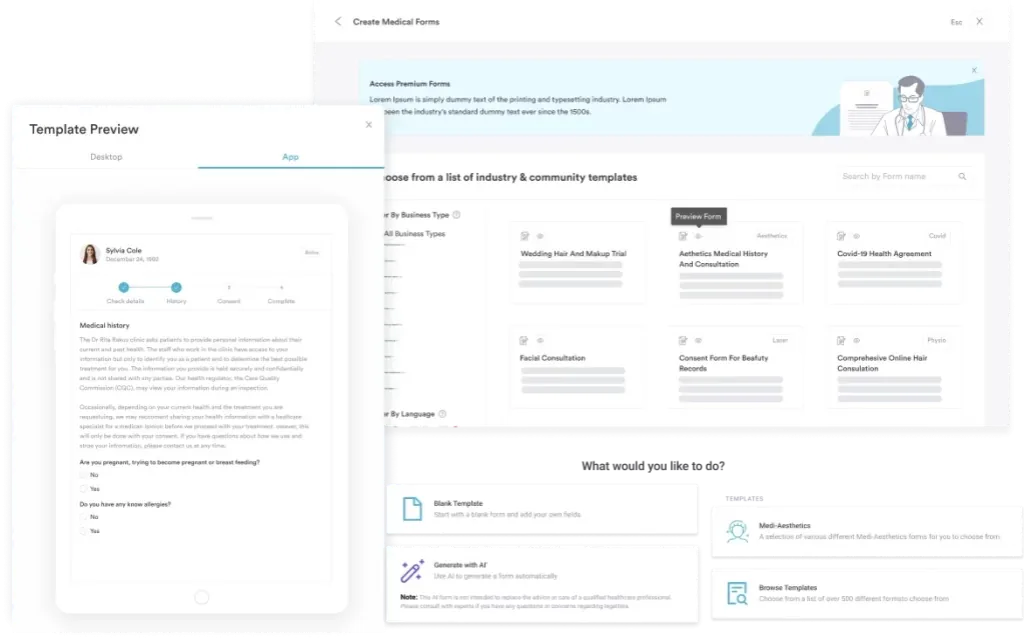

Pabau helps dermatology practices track multi-stage Mohs encounters, enforce documentation templates, and flag add-on code errors before your biller submits the claim. See how it works for your practice.

Traditional Medicare Part B generally does not require prior authorization for Mohs micrographic surgery CPT codes, including 17314. Coverage is determined by the applicable LCD criteria, meaning medical necessity documentation at the time of billing governs coverage, not a pre-procedure authorization step.
Medicare Advantage plans and commercial payers are a different matter. Authorization requirements vary significantly by plan and by state. Before scheduling a multi-stage Mohs procedure for a commercially insured patient, billing staff should verify authorization requirements directly with the payer. Some plans require authorization once a procedure extends beyond the first stage, which is exactly when 17314 becomes relevant. Checking payer portals or calling the plan’s provider line before the procedure is the standard of care in dermatology billing. Practices can build these verification steps into their automated workflows so that no appointment proceeds without a completed authorization check for flagged payer types. Auditors read the note before the code, so the documentation level has to support what was submitted.
The five errors below account for the majority of CPT 17314 claim denials. Most are preventable with the right pre-submission checks.
Catching these errors before claim submission is significantly cheaper than managing denials and appeals afterward. Practices using Pabau’s claims management software can build pre-submission checks that flag missing primary codes, banned modifier combinations, and site-code mismatches before a claim reaches the biller. The same principle applies when pairing 11104 with its own diagnosis codes: validate code relationships before the claim leaves the practice.
Multi-stage Mohs procedures create a billing complexity that single-encounter surgeries do not. Each additional stage requires its own documentation entry, and the number of 17314 units on a claim must reconcile exactly with the number of additional stages documented in the operative report. Between stages. A three-stage procedure generates 17313 x1 + 17314 x2, and a five-stage procedure generates 17313 x1 + 17314 x4 — manual reconciliation across a busy surgical day is where errors accumulate.
Pabau’s documentation tools address this by linking the clinical encounter record to the billing workflow. Stage count from the operative note flows through to the claim, so the unit count on 17314 is populated from the clinical record rather than entered separately by a biller. This removes the manual reconciliation step that creates mismatch errors.
Practices also use digital forms to enforce Mohs documentation templates, ensuring the stage diagram, margin status, and dual-role attestation fields are completed before the encounter closes. Some adapt a chemical peel aftercare template as a starting point for the wound-care instructions patients take home after each stage. The result is a billing packet that reaches the practice’s biller complete, with the clinical evidence already attached.
For dermatology groups running multiple Mohs surgeons across locations. This matters for groups that also bill routine dermatology codes.
Run a quarterly audit of all 17314 claims submitted in the previous 90 days. Check: (1) every 17314 has a paired 17313 on the same date of service, (2) unit count matches the stage count in the operative note, (3) no modifier 51 is present, (4) ICD-10 body site matches the CPT body site. This four-point check catches the majority of 17314 billing errors before they become write-offs.
CPT code 17314 is a straightforward add-on code with a narrow set of rules, but those rules are applied incorrectly often enough that Mohs billing denials remain a consistent problem for dermatology practices. Get the primary code pairing right, keep modifier 51 off the claim, document every stage with a Mohs map, and match the ICD-10 body site to the CPT body site. Those four steps resolve the majority of 17314 denial scenarios.
Pabau helps dermatology practices enforce these rules through documentation and forms, catching errors before a claim reaches the biller rather than after a denial arrives. To see how Pabau supports multi-stage surgical documentation for skin cancer practices.

Need to understand the rest of the Mohs code series? CPT code 17311 covers the same additional-stage logic for head, neck, hand, foot, and genital sites.
Billing skin tag removal alongside Mohs cases? CPT code 11201 is a separate add-on code with its own primary-code pairing rule.
Need the biopsy codes that often precede a Mohs diagnosis? CPT code 11102 covers tangential skin biopsy billing.
Documenting a skin condition as a differential? ICD-10 code L59.9 covers radiation-related skin disorders to rule out before Mohs.
CPT code 17314 is an add-on code used to report each additional stage of Mohs micrographic surgery on the trunk, arms, or legs, specifically the second stage and every stage after it. It is always billed alongside the primary code CPT 17313 and cannot be submitted as a standalone code.
Yes, CPT 17314 is an AMA-designated add-on code. It requires CPT 17313 as the primary code on the same claim, same date of service, and same surgical site. It carries a ZZZ global period and is modifier 51 exempt.
CPT 17313 is the primary code for the first stage only of Mohs surgery on the trunk, arms, or legs. CPT 17314 is the add-on code for the second stage and every stage after it. A three-stage procedure on the trunk is billed as 17313 x1 plus 17314 x2.
The Medicare payment for CPT 17314 varies by geographic location and practice setting (facility vs. non-facility). Verify the current rate for your MAC locality using the CMS Physician Fee Schedule look-up tool, as rates are adjusted annually and differ between office and hospital outpatient settings.
CPT 17314 can be billed once for each Mohs stage after the first, on the same day and same surgical site. A five-stage Mohs procedure on the trunk, for example, generates CPT 17313 x1 plus CPT 17314 x4 (covering stages two, three, four, and five).
Traditional Medicare Part B generally does not require prior authorization for Mohs CPT codes. However, Medicare Advantage and commercial payers vary; some plans require authorization once a procedure extends beyond the first stage. Verify prior authorization requirements with the specific payer before the procedure date.