



HCPCS code E0198: Water pressure pad billing guide
HCPCS code E0198 is a water pad for a standard mattress HCPCS code E0198 is the ...

Last Updated: Oct 13, 2026

CPT code 01732 covers anesthesia for diagnostic arthroscopic procedures of the elbow joint only, and it carries 3 base units
It is not a catch-all code. Open elbow surgery, humerus repairs, arthroplasty, and shoulder procedures each belong to a different code
Reimbursement follows the anesthesia formula: (base units + time units) x conversion factor, with base units set by the ASA Relative Value Guide
Required modifiers differ by provider type. Use AA for anesthesiologists personally performing the service, QX or QY for directed CRNAs, and QZ for independent CRNAs in opt-out states
Practice management software like Pabau keeps the anesthesia record, the code, and the claim on one patient record, which cuts re-keying errors at submission
Simply put, CPT code 01732 describes anesthesia for diagnostic arthroscopic procedures of the elbow joint. According to the American Medical Association (AMA), which maintains the CPT code set, the descriptor is: Anesthesia for diagnostic arthroscopic procedures of elbow joint. Notably, the code is deliberately narrow. It applies when the surgeon enters the elbow joint to look, not to repair.
That distinction matters more here than in most anesthesia codes. 01732 sits in the 01710-01782 range, “Anesthesia for Procedures on the Upper Arm and Elbow.” It is the only member of that range reserved for diagnostic arthroscopy. It is not a “not otherwise specified” code, nor does it stretch to cover whatever else happens in the elbow.
Generally speaking, a diagnostic elbow arthroscopy is short. The surgeon establishes portals, inspects the joint surfaces and capsule, and documents findings such as synovitis, chondral wear, or a loose body. If the surgeon then debrides, releases, removes, or repairs anything, the case is no longer diagnostic. At that point the correct code is 01740, anesthesia for open or surgical arthroscopic procedures of the elbow.
In practice, three procedure types are commonly and incorrectly folded into 01732. First, open reduction and internal fixation of a humerus fracture belongs to the humerus codes. Likewise, total elbow arthroplasty has its own code, 01760. Similarly, anything involving the humeral head and neck, the sternoclavicular joint, the acromioclavicular joint, or the shoulder joint sits in the shoulder section. There, 01630 carries the broad “not otherwise specified” descriptor.
In practice, Pabau puts the procedure code, the modifier, and the ICD-10 pairing on one patient record. Cleaner claims management starts there, because nobody has to toggle between a reference site and a separate billing system.
Notably, anesthesia reimbursement does not follow the standard RVU formula used for evaluation and management or surgical codes. Instead, per CMS guidance, payment is calculated as:
Total payment = (Base units + Time units) x Conversion factor
First, base units come from the American Society of Anesthesiologists (ASA) Relative Value Guide. In effect, they reflect the complexity and risk of the specific procedure and body region. CPT 01732 carries 3 base units, which is low, so that reflects a short diagnostic case on a peripheral joint.
Time units, meanwhile, are calculated by dividing total anesthesia time by 15 minutes per unit. Here, time runs from induction to the recovery handoff. Finally, the conversion factor is a dollar-per-unit value set by CMS for Medicare and negotiated separately by commercial payers.
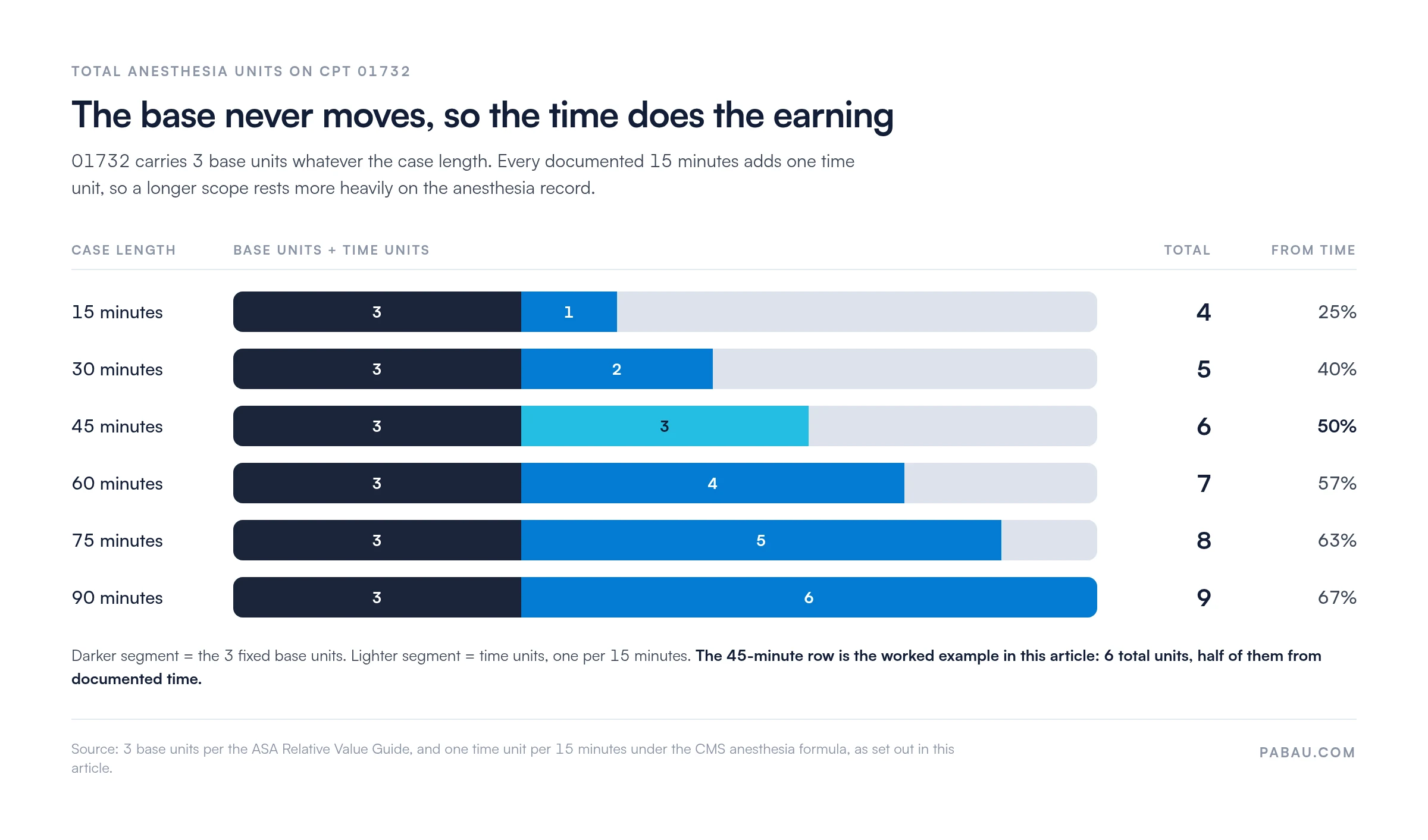
Here, a worked example shows how heavily time drives the payment on this code. For instance, a diagnostic elbow arthroscopy that runs 45 minutes generates 3 time units. So, added to the 3 base units, that is 6 total units. Multiply 6 by your conversion factor to reach the allowable, then apply the Geographic Adjustment Factor for your locality.
Because base units are only 3, every 15 minutes of documented time moves the payment by a third of the base. As a result, sloppy start and stop times cost more on 01732 than they do on a high-base-unit code. The chart below shows how far each case length leans on documented time.
RVU lookup tools do not help you model this, because anesthesia is not paid on RVUs. Use the current CMS anesthesia conversion factor for your locality instead.
Document anesthesia start and stop times to the minute. On a 3-base-unit code like 01732, time units usually make up most of the claim. Rounding errors and unsupported time are the fastest route to a post-payment audit.
As a rule, every anesthesia claim requires at least one provider-type modifier. In fact, missing that modifier is the leading cause of denial for 01732. The modifier tells the payer who gave the anesthesia and under what supervision, which then sets the reimbursement percentage.
Still, note the overlap that catches billers out on this code. Specifically, under modifier AD the payment is capped at 3 base units, which happens to equal 01732’s own base unit value. Miscoding AD as QK on a short diagnostic arthroscopy therefore looks harmless on the remittance and still creates a recoupment liability.
CRNAs can bill CPT code 01732 independently under modifier QZ only in states that have opted out of the Medicare physician supervision requirement. As of August 2026, 27 states have exercised that opt-out. Otherwise, in every other state a CRNA bills under QX with physician direction. So submitting QZ in a non-opt-out state is a compliance error that triggers overpayment recovery.
In turn, anesthesiologists billing medical direction under QK must document all seven required conditions for each concurrent case. CMS sets them out in 42 CFR 415.110:
So missing any one of the seven shifts the claim into the lower-paying AD category.
Diagnostic arthroscopy cases are short, so overlapping cases are easy to lose track of. For example, three 40-minute elbow scopes can overlap in ways a paper log will not capture accurately. So a timestamped electronic record is what makes the QK claim defensible.
When specific clinical conditions increase the complexity of anesthesia for a diagnostic elbow arthroscopy, qualifying circumstance codes may be reported in addition to 01732. In other words, these are add-on codes, never standalone codes.
Not all payers reimburse qualifying circumstance codes separately, though some bundle them into the base anesthesia payment. So verify payer contracts and check AAPC’s CPT code reference before you bill these add-ons routinely.
Medicare processes anesthesia claims through the anesthesia formula rather than the RBRVS system used for surgical codes. Specifically, the CMS Physician Fee Schedule lookup shows allowed amounts by procedure code, locality, and year. The conversion factor changes annually through CMS rulemaking, so verify the current calendar-year rate before you project revenue.
In addition, Geographic Adjustment Factors modify the Medicare payment based on where the service is performed. A practice in Manhattan carries far higher overhead than one in rural Missouri, and CMS adjusts accordingly. Two 01732 claims with identical base and time units can therefore pay differently by location.
By contrast, commercial payers negotiate their own conversion factors. Some follow the Medicare rate, though many pay above it. When you contract with a new payer, request their anesthesia conversion factor in writing rather than accepting “Medicare equivalent” language.
One caution applies specifically to low-base-unit codes: here, 01732 pays only 3 base units. As a result, a facility running several diagnostic scopes per list sees margins driven almost entirely by documented time and clean modifier use. Denials on this code hurt more than they should, because the appeal costs more staff time than the claim is worth.
Ultimately, clean claim submission for 01732 depends on a complete anesthesia record. Payers audit anesthesia claims at a higher rate than most CPT categories, because time-unit billing is self-reported. The requirements below are the Medicare minimum, and commercial payers often add fields.
In particular, the fourth item is the one auditors go after on this code. A note that says “arthroscopy with removal of loose body” will not support 01732, however the claim was coded. So read the operative report before you assign the code, not after the denial arrives.
Workflow matters here too. Here, digital anesthesia record templates can carry the start time, the stop time, and the provider identity straight onto the claim. As a result, that removes the transcription step, which is where most of these fields go wrong on a high-volume orthopedic list.
Importantly, every 01732 claim needs a diagnosis code supporting the medical necessity of the arthroscopy. The codes below cover the elbow presentations that most often lead a surgeon to scope for diagnosis. Code to the highest level of specificity, and always confirm laterality on the claim.
Likewise, shoulder and clavicle diagnoses do not belong on an 01732 claim. If the diagnosis names the shoulder joint, the acromioclavicular joint, or the sternoclavicular joint, the anesthesia code sits in the shoulder range instead.
The codes above are a starting point, not the whole list. In addition, the full ICD-10 code reference carries the rest of the elbow chapter, including the left-side and bilateral variants. Right elbow pain is the most common pairing here, and M25.521 sets out what a claim carrying it must support.
Overall, 01732 is one of several codes in the upper arm and elbow range. Every code in the 01710 to 01782 span covers the upper arm and elbow only, and none of them reaches the forearm, wrist, or hand.
So picking the wrong neighbor is a common source of denials and upcoding exposure. Instead, read the range as a set of anatomical boundaries, not a list of similar-sounding procedures.
One code outside this range deserves a mention, because it is the source of a persistent error. By comparison, CPT 01630 covers open or surgical arthroscopic procedures on the humeral head and neck, sternoclavicular joint, acromioclavicular joint, and shoulder joint, not otherwise specified. That broad descriptor belongs to 01630 and is, in fact, frequently misattributed to 01732 in online references.
These two adjacent codes are easy to confuse, and the distinction is surgical approach rather than anatomy:
Both codes carry 3 base units, so the financial difference on a single claim is small. But the compliance difference is not. Reporting a diagnostic scope as a closed procedure, or vice versa, makes the code contradict the operative report. So that mismatch is what audit software looks for.
When in doubt, read the operative report and match it against the AMA CPT codebook descriptor word for word. The descriptor decides the code, and the operative note decides the descriptor.
The errors below are the ones that consume a billing team’s week on 01732. Still, each is preventable at the point the code is assigned, not at the appeal.
In general, anesthesia billing rewards the same discipline as any other complex claim category. Build the check into the coding step rather than the appeal, because a 3-base-unit claim rarely repays the time an appeal takes.
Audit your 01732 claims monthly. Pull the last 30 days and read each operative report against the code, checking that no repair, release, or removal took place. Catching a scope-creep miscode internally costs far less than answering a payer audit.
In most practices, the anesthesia record, the operative note, and the claim live in three different places. Indeed, that holds on a hospital orthopedic list and in an outpatient musculoskeletal service alike.
Typically, a coder reads a scanned note, picks a code from a reference site, and types it into a billing system. So every one of those hops is a chance for 01732 to end up on a case that was never diagnostic.
Instead, Pabau closes those hops. There, the clinical note, the anesthesia times, the code, the modifier, and the ICD-10 pairing all sit on the same patient record. The coder works from the surgeon’s own words rather than a scan, and insurer claims go out from that same record.
The outcome is fewer denials that came from re-keying, and a shorter path from the operating room to payment. So on a 3-base-unit code, avoiding the denial costs far less than winning the appeal.
Likewise, smaller practices see the same effect, including the ones where the same person codes the case and submits the claim.

Pabau keeps your procedure codes, modifier rules, and anesthesia documentation in one platform, so your team submits cleaner claims without switching between systems.

CPT 01732 is narrow on purpose, and that is the whole lesson of the code. It covers anesthesia for a diagnostic arthroscopy of the elbow joint, carries 3 base units, and stops there. Once the surgeon repairs anything, or once the humerus or the shoulder is involved, a different code owns the claim.
Treat the operative report as the deciding document, keep anesthesia times exact, and attach the right provider-type modifier every time. So do those three things, and this code rarely causes trouble. To see how Pabau keeps the note, the code, and the claim in one record, book a demo with our team.

Need the closed-procedure code next door? CPT code 01730 covers anesthesia for closed humerus and elbow procedures, and shows where the diagnostic scope boundary sits.
Working out why an anesthesia claim came back? Denial codes in medical billing maps the remittance codes you will see on a rejected 01732 claim.
Want the pairing rules on one page? Medical coding cheat sheet collects the CPT and ICD-10 pairings coders reach for most often.
Building an audit trail for anesthesia claims? Medical billing compliance sets out the documentation standards that keep time-unit billing defensible.
CPT code 01732 covers anesthesia for diagnostic arthroscopic procedures of the elbow joint, and it carries 3 base units. It applies only when the surgeon inspects the joint without repairing, releasing, or removing anything. It is not a catch-all code for the humerus, the shoulder, or open elbow surgery.
CPT 01730 covers anesthesia for all closed procedures on the humerus and elbow, such as a closed fracture reduction. CPT 01732 covers anesthesia for diagnostic arthroscopy of the elbow joint, where portals are made and the joint is inspected. Both carry 3 base units, so the operative report decides which one is correct.
No. As soon as the surgeon debrides, releases, removes a loose body, or repairs any structure, the case is no longer diagnostic. The correct code is then 01740, anesthesia for open or surgical arthroscopic procedures of the elbow. Billing 01732 for that case contradicts the operative note and creates audit exposure.
CPT 01732 is assigned 3 base units in the ASA Relative Value Guide. Because that value is low, documented anesthesia time usually accounts for most of the payment on the claim. Confirm the figure against the current Relative Value Guide edition each year, since ASA can revise base units.
You can report 99100 for a patient under 1 or over 70, and 99116 for total body hypothermia. Report 99135 for controlled hypotension, and 99140 for emergency conditions. Each applies only when clinically documented. Many payers bundle these add-ons into the base anesthesia payment, so verify policy before billing them routinely.



