



HCPCS code E0198: Water pressure pad billing guide
HCPCS code E0198 is a water pad for a standard mattress HCPCS code E0198 is the ...

Last Updated: Oct 13, 2026

CPT Code 01490 describes anesthesia for cast application, removal, or repair on the lower leg, and it carries a base unit value of 3.
It is a procedure-specific code, not a catch-all. Anesthesia for a closed lower leg, ankle, or foot procedure belongs to CPT 01462 instead.
Reimbursement uses the formula (Base Units + Time Units + Modifying Units) x Conversion Factor, with time billed per 15-minute increment.
Modifiers AA, QZ, QK, and QX are the most commonly required anesthesia modifiers, and incorrect modifier assignment is a top OIG audit trigger.
Practice management software like Pabau helps anesthesia billing teams track procedure codes, modifiers, and documentation requirements in one workflow.
CPT Code 01490 is the anesthesia code for lower leg cast application, removal, or repair. It carries 3 base units, and it applies only when the casting work itself is the procedure the anesthesia supported. As a result, claims on this code are usually denied for a wrong modifier, missing time entries, or a diagnosis that does not support the casting.
This reference covers the official code description, the (B+T+M) x CF reimbursement formula with a worked example, and modifier requirements. It also covers qualifying circumstance add-ons, ICD-10 pairings, related codes, documentation requirements, and the billing errors most likely to trigger an OIG audit.
Denials for this code often trace back to a misreading of the descriptor. Specifically, CPT Code 01490 is defined by the American Medical Association as: Anesthesia for lower leg cast application, removal, or repair. The scope is limited to casting work on the lower leg. It is not a general-purpose code for anything performed below the knee.
That distinction matters because the surrounding codes in the lower extremity section are organized by procedure type rather than by setting. If the anesthesia supported a closed reduction, an open bone procedure, or a nerve procedure, a different code applies. Billing 01490 for those services is a miscoding error, even though the anatomy matches.
Billing staff in orthopedic and general surgery practices see CPT Code 01490 in three situations. In particular, each one involves a cast on the lower leg and a patient who cannot tolerate the work without anesthesia.
The test is always the procedure, not the room it happened in. Anesthesia for a closed reduction, an arthroscopy, or an open fracture repair does not become 01490 because a cast was applied afterward. In those cases the code follows the primary procedure, and the casting is part of the same anesthesia session.
Pediatric cases dominate the removal category. A child who cannot hold still for an oscillating saw needs sedation, and the anesthesia record has to show why. By contrast, adult cases skew toward repair, where a loosened or cracked cast is rebuilt on a limb that is still painful.
The base unit value for CPT 01490 is 3, as published in the CMS anesthesia base units file. That figure is fixed regardless of the payer or locality. However, what varies is the conversion factor and the time units added to each claim.
Anesthesia reimbursement does not follow the standard RVU formula used for evaluation and management codes. Instead, it uses the CMS anesthesia formula:
The 15-minute time unit interval is the Medicare standard. For example, some private payers use different intervals, such as 10 minutes in certain commercial contracts. Therefore, billing staff should verify payer-specific rules before calculating time units. The conversion factor changes annually with CMS fee schedule updates, so reference the CMS Physician Fee Schedule for the current locality figure before estimating payment.
Casting cases are usually short, which makes time documentation unusually important here. With only 3 base units, therefore, a single missing time unit moves the payment by roughly a fifth. The chart below shows how far the balance tips toward time as a case runs longer.
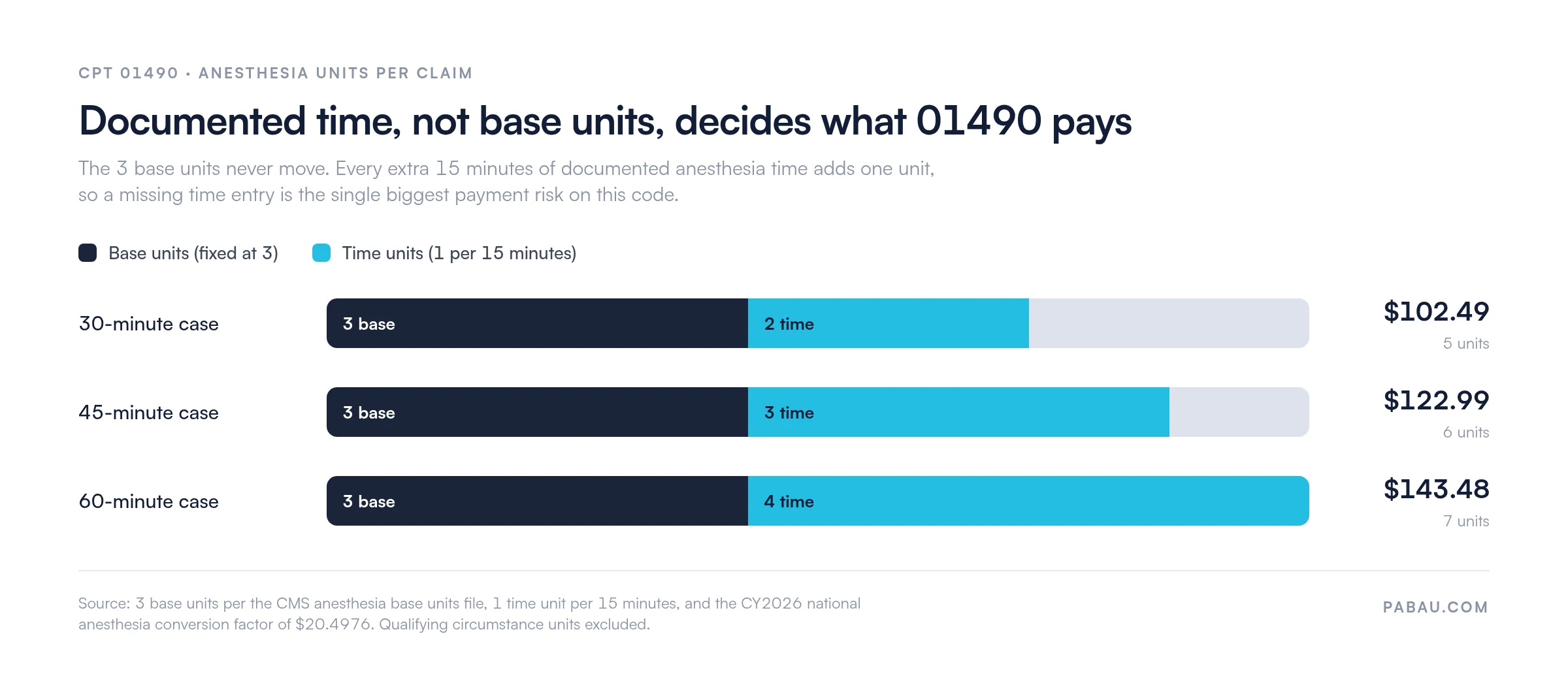
Modifier assignment is where most 01490 claims run into trouble. Each modifier signals who administered the anesthesia and under what level of supervision. Consequently, choosing the wrong one draws payer scrutiny, and a repeated pattern flags the practice for an OIG compliance review.
CRNA billing rules vary by state. In states that have opted out of Medicare’s physician supervision requirement, a CRNA may use modifier QZ and bill at 100% of the allowable. In states that have not opted out, the CRNA uses QX and the supervising anesthesiologist uses QK or QY. Billing QZ in a non-opt-out state is a compliance error, so verify your state’s current opt-out status before coding CRNA claims.
These add-on codes report extraordinary circumstances that increase the complexity of anesthesia administration. Each one carries its own modifying unit value in the ASA Relative Value Guide. For instance, code 99100 adds 1 unit, 99116 adds 5, 99135 adds 5, and 99140 adds 2. Age is handled here, through 99100, rather than through the choice of anesthesia code.
Misuse of qualifying circumstance codes is an audit trigger. Code 99100 applies on age alone, so it cannot be added for a 65-year-old patient because the case felt difficult. Document the clinical justification for each qualifying circumstance in the anesthesia record before billing it.
Medicare reimbursement for CPT Code 01490 is locality-based, and there is no single national rate. The payment calculation uses the formula above. First, take 3 base units, add time units and any modifying units, then multiply by the locality’s anesthesia conversion factor.
For current conversion factor figures, use the CMS Physician Fee Schedule lookup linked above, which publishes locality-specific anesthesia conversion factors each January. Therefore, verifying the current-year figure before building fee schedule templates is essential. Using last year’s conversion factor in projections pushes revenue estimates away from actual payments.
Private payer rates follow different logic. Many commercial insurers negotiate their anesthesia conversion factor separately from Medicare, and some apply a flat per-unit rate instead of the (B+T+M) x CF formula. Pull the specific contract language for each payer before calculating expected reimbursement. As a result, a revenue projection that treats Medicare and commercial rates as equivalent will consistently underperform.
Every claim for CPT Code 01490 needs a supporting ICD-10-CM diagnosis code that justifies the anesthesia. For example, the codes below are the ones most often paired with lower leg casting work. For an authoritative crosswalk tool, the AAPC Codify CPT lookup includes ICD-10 medical necessity data alongside code descriptors.
Select the ICD-10 code that reflects the diagnosis documented in the patient record, including laterality. The seventh character must match the visit type. For example, use A for an initial encounter, D for a subsequent one, and S for sequela. As a result, a wrong seventh character on a fracture code is a common rejection trigger. The ICD-10-CM code index holds the full S82 fracture range that most 01490 claims draw on.
The most common miscoding error with CPT 01490 is choosing it when CPT 01462 is correct, or the reverse. Both cover anesthesia below the knee and both carry 3 base units, so the payment looks identical. However, the difference is the procedure the anesthesia supported.
Neither code is a setting-based or age-based choice, and neither is a catch-all. Place of service does not decide between them, and patient age is reported separately with 99100. If the surgeon reduced a fracture and then casted it, the case is 01462 and the casting is included.
Other codes in the same anatomic section are worth knowing. CPT 01464 covers arthroscopic procedures of the ankle or foot. Similarly, CPT 01470 covers procedures on nerves, muscles, tendons, fascia, and bursae of the lower leg, ankle, and foot. In addition, CPT 01480 covers open procedures on the bones of the lower leg, ankle, and foot.
Incomplete documentation is the second most common reason anesthesia claims are denied or clawed back during audit. Specifically, for CPT Code 01490, the anesthesia record has to capture specific data elements before the claim is submitted.
A digital anesthesia record turns these required elements into mandatory fields, which makes an incomplete record much harder to submit. The same structure pays off at audit, because every element the auditor asks for sits in a fixed place on the form.

Audit your anesthesia start and stop time entries quarterly. A pattern of rounded times, where every case ends on a 0 or a 5, is a known red flag. OIG auditors look for it in anesthesia reviews. Add a clock-in and clock-out field to your anesthesia record form and require exact times to be captured in real time.
The Office of Inspector General reviews anesthesia billing for pattern-based errors. For example, the mistakes below are the most frequent audit triggers for codes in the anesthesia section, including CPT Code 01490.
Most anesthesia billing teams catch these errors after the fact. The claim goes out, the payer denies it, and someone reworks it weeks later with the original anesthesia record already closed. As a result, every rework costs staff time that the 3 base units on this code never repay.
Practice management software like Pabau moves that check to the point of entry. Pabau’s anesthesia claims software lets you build modifier validation rules into the billing workflow. As a result, a mismatched modifier combination is flagged before submission rather than after a denial. In addition, custom clinical forms hold the anesthesia record fields as required entries, which keeps exact start and stop times attached to the case.
Automated billing workflows cut the manual checking a high-volume anesthesia service would otherwise absorb. The result is a shorter denial list, faster payment, and billers who spend their day on submission instead of appeals.

Pabau helps surgical and anesthesia billing teams validate modifiers, enforce documentation requirements, and track claim status in one place. See how it works for your practice.

CPT Code 01490 is narrower than its reputation suggests. Specifically, it pays for anesthesia during lower leg cast application, removal, or repair, and nothing else. Get that scope right and the remaining work is mechanical. In short, you need the correct modifier, exact times, a supporting diagnosis, and a record showing why sedation was needed.
Those checks are easy to describe and hard to sustain by hand across a busy billing team. As a result, Pabau brings modifier validation, documentation requirements, and claim tracking into one workflow. To see how it handles anesthesia and procedure code billing for your practice, book a demo.

Coding the closed procedure rather than the cast? CPT 01462 covers anesthesia for closed procedures on the lower leg, ankle, and foot.
The case involved tendons or fascia rather than bone? CPT 01470 covers anesthesia for nerve, muscle, tendon, and bursa work below the knee.
Billing an open fracture repair instead? CPT 01480 covers anesthesia for open procedures on the bones of the lower leg.
Training a coder who is new to the anesthesia section? Medical coding cheat sheet puts the modifier and time-unit rules on one printable page.
Need the denial reason before you rework a claim? Denial codes in medical billing explains what each remittance code is telling your billing team.
CPT Code 01490 is an anesthesia code for lower leg cast application, removal, or repair. Specifically, it covers the anesthesia provided while a below-knee cast is applied, taken off, or repaired, when the patient cannot tolerate that work awake. In addition, the code carries a base unit value of 3 and sits in the CPT anesthesia section (00100-01999) maintained by the American Medical Association.
There is no single national Medicare rate for CPT 01490. Instead, payment is calculated as 3 base units plus time units plus modifying units, multiplied by the locality anesthesia conversion factor. CMS publishes that factor and updates it annually. As a result, rates vary by Medicare Administrative Contractor locality. Use the CMS Physician Fee Schedule lookup tool with the current year’s data to find the applicable conversion factor for your geographic area.
A CRNA can bill CPT 01490 independently using modifier QZ in states that have opted out of Medicare’s physician supervision requirement. However, in states that have not opted out, the CRNA bills with modifier QX under physician medical direction. The supervising anesthesiologist bills separately with modifier QK or QY. CRNA billing rules also vary by commercial payer, so always verify the specific payer policy before billing.
Yes, qualifying circumstance codes 99100-99140 can be billed alongside CPT 01490 when the circumstances genuinely apply. For example, code 99100 covers extreme age (under 1 year or over 70), 99116 total body hypothermia, 99135 controlled hypotension, and 99140 emergency conditions. Instead, age is reported here rather than through the choice of anesthesia code. Document the clinical justification for each one, since unsupported use is an OIG audit trigger.



