CCSD Code V1730: Extraoral fixation of mandible
What is CCSD code V1730? CCSD code V1730 is the UK private medical insurance cod...

Last Updated: Nov 24, 2026
V1423 is the CCSD (Clinical Coding & Schedule Development) code for extensive excision of mandible with disarticulation. The surgeon removes a large part of the lower jaw and separates the condyle from the temporomandibular joint. UK private medical insurers such as Bupa and AXA Health use the code to assess consultants' invoices.
Bupa's February 2026 schedule places V1423 in band CMO 2. When the condyle stays in the joint, the code is V1422, extensive segmental excision of mandible, instead.
Let Pabau's smart automation suggest the right codes, reduce claim denials, and keep your practice compliant—effortlessly.
Automate repetitive tasks and focus on what matters most—your patients.
Reduce coding errors and ensure compliance with the latest regulations.
Clean claims, fewer denials, and faster reimbursements.
Powerful insights and reporting to help your practice thrive.
HIPAA compliant SOC 2 certified GDPR-compliant Trusted by 4,000+ clinics worldwide

CCSD code V1423 covers an extensive resection of the mandible that includes disarticulation of the condyle at the temporomandibular joint.
The code sits in CCSD chapter 6, section 6.1 Face and jaws, and UK private medical insurers such as Bupa and AXA Health use it.
Bupa’s February 2026 schedule places V1423 in band CMO 2 at £1,144, above V1422 at MAJOR+ 2 and V1400 at MAJOR+ 1.
The operative note must state that the condyle was disarticulated; without it, an insurer will treat the claim as V1422.
AXA Health lists 14 codes that can’t be billed with V1423, including V1910 non-vascularised jaw reconstruction and V1422.
CCSD code V1423 is “Extensive excision of mandible with disarticulation”. AXA Health’s specialist code schedule lists it under that exact descriptor, in chapter 6. CCSD stands for Clinical Coding & Schedule Development, the group that maintains the procedure code schedule for UK private healthcare.
Consultants quote these codes on invoices to private medical insurers such as Bupa, AXA Health, Vitality, WPA and Freedom Health Insurance. Pabau’s reference to CCSD codes covers the rest of the schedule.
V1423 sits in chapter 6 of the schedule, Face, mouth, salivary and thyroid, under section 6.1, Face and jaws. It is the most complex code in the mandible excision series. The descriptor has two parts, and both must happen for the code to apply.
An extensive mandibulectomy with disarticulation removes a large part of the lower jaw and frees it at the joint. The surgeon divides the joint capsule and lifts the condylar head out of the glenoid fossa. The condyle then comes away with the specimen.
An operative report that supports V1423 usually describes these steps:
V1423 is easy to confuse with the other mandible codes in section 6.1. The table shows the codes a maxillofacial surgeon is most likely to weigh against it. Bands are from Bupa’s February 2026 schedule of procedures. Section 6.1 also holds the facial fracture codes, such as V0980 for open reduction of the zygomatic complex. A fractured mandible held with pins and a frame outside the mouth is coded V1730 instead.
There are no codes V1420 or V1421 in the schedule. If a fee estimate or a template quotes them, check it against the insurer’s current schedule before the patient seeks authorisation.
In practice, three questions about the operative note separate these codes. The chart below takes them in the order a coder would.
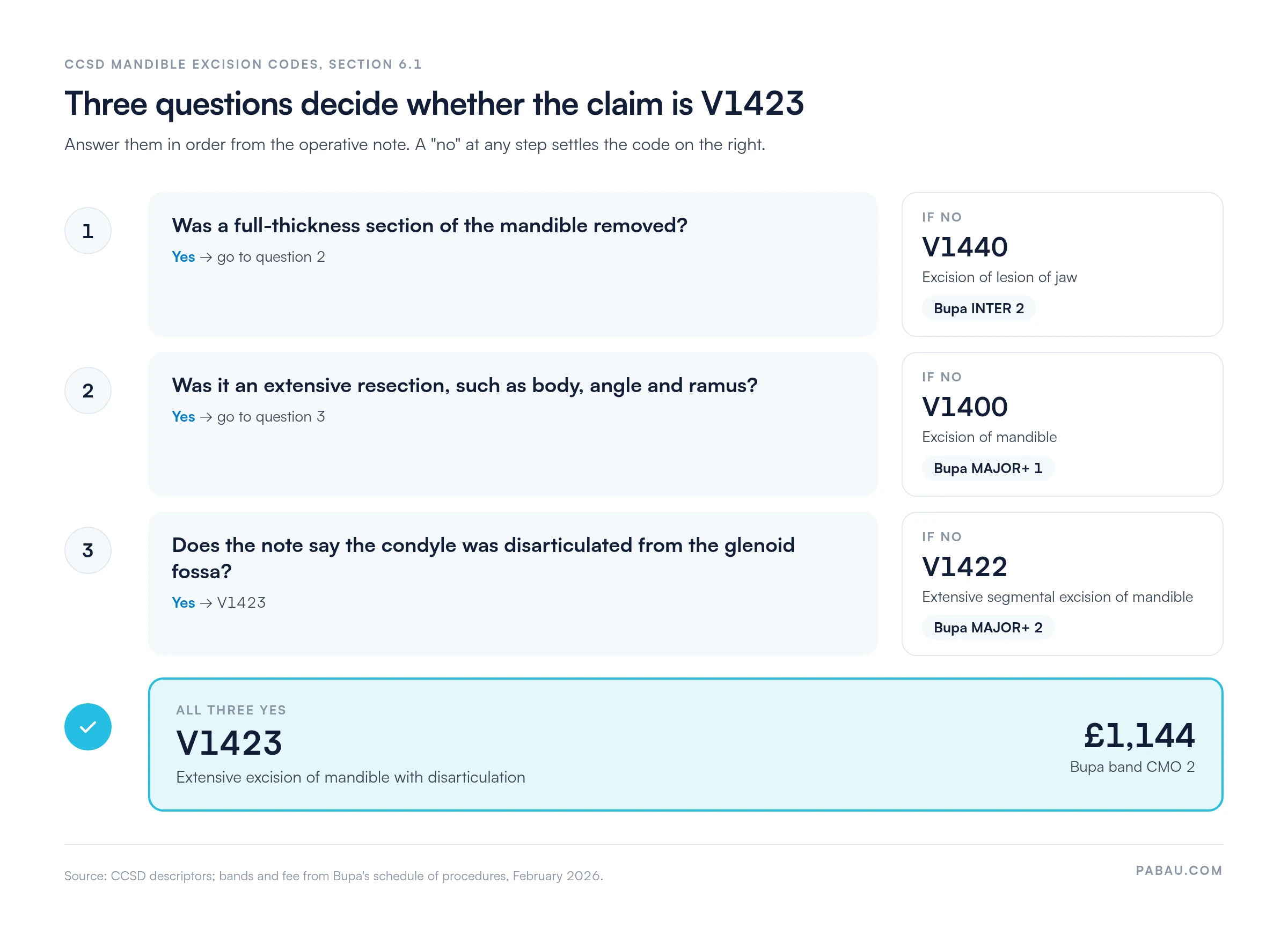
V1423 is correct when the resection takes the condyle out of the joint. It is not correct when the condyle is preserved, however much of the mandibular body is removed. In that case V1422 or V1400 applies.
Typical indications include:
A diagnostic biopsy done before the resection, on an earlier date, is coded separately as V1330. AXA Health lists V1330 as an unacceptable combination with V1423 on the same occasion.
UK private medical insurers code diagnoses with WHO ICD-10, not the US ICD-10-CM. The codes below are the usual pairings for V1423. The histopathology report decides the final code for a tumour.
The WHO ICD-10 browser gives the authoritative title for each code.
Code the diagnosis from the final histopathology report, not the pre-operative working diagnosis. A mismatch between the two is a common reason an insurer queries a high-value maxillofacial invoice.
The CCSD Group publishes codes, not fees. Each insurer sets its own fee or band for the surgeon and the anaesthetist.
Pabau’s Bupa CCSD codes reference lists the bands for every code in the Bupa schedule.
Insured patients need pre-authorisation from their insurer before an elective procedure like V1423. In practice the patient calls the insurer with the CCSD code and the consultant’s details. The insurer then issues an authorisation number for the claim.
Give the patient the exact code in writing, along with any reconstruction codes you plan to bill. If the operation changes in theatre, tell the insurer before you invoice. A claim for a different code from the one authorised is likely to be queried.
The operative report carries the claim. A note that says “extensive mandible excision” without describing the joint supports V1422 at most. It must state plainly that the condyle was disarticulated from the glenoid fossa.
A complete V1423 file includes:
Mandibular reconstruction often follows V1423 in the same operation, so check combinations before you invoice. AXA Health’s schedule lists these codes as unacceptable combinations with V1423:
AXA’s list does not name the skin flap codes, which surgeons use for free tissue transfer. Even so, confirm a flap code with the insurer at pre-authorisation. Rules differ between insurers, so a combination one insurer pays may be refused by another.
The anaesthetist invoices separately, under the same procedure code, against the insurer’s anaesthetist fee. Don’t include anaesthetic time in the surgeon’s invoice.
Check four details before you send a V1423 invoice. The note mentions disarticulation, and the code matches the authorisation. No unacceptable combination is on the invoice, and the ICD-10 code matches the pathology report.
A V1423 claim depends on documents that sit in different places: the operative note, the pathology report, the imaging and the authorisation number. When one is missing, the invoice stalls with the insurer. Keeping them on one patient record removes most of that delay.
In Pabau, practice software built for private practices, the clinical record and the invoice sit on the same patient file. You attach operative reports, imaging and pathology to that file before the invoice goes out.
Pabau’s claims management software then sends UK insurance claims through Healthcode and Bupa, and tracks each claim’s status.
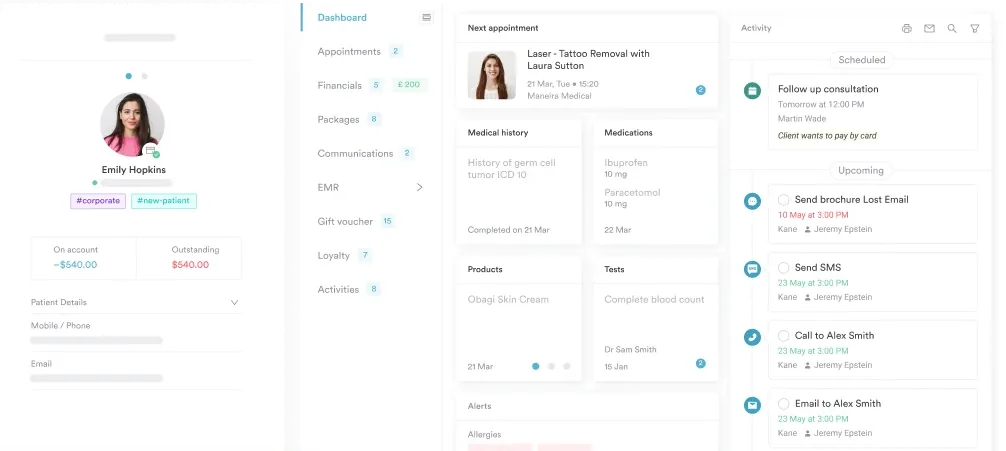

Pabau helps UK maxillofacial practices record authorisation numbers, attach operative and pathology reports to the patient file, and send insurer claims through Healthcode and Bupa.

V1423 turns on one clinical fact: the condyle came out of the joint. Write that in the operative note, in plain words, and the code is defensible. Leave it out, and the insurer has every reason to pay V1422 instead.
The rest is preparation. Quote the code at pre-authorisation, check the insurer’s unacceptable combinations, and send the pathology with the invoice. Book a demo to see how Pabau keeps the clinical record and the insurer claim in one workflow.

CCSD code V1423 covers extensive excision of the mandible with disarticulation. A large part of the lower jaw is removed, and the condyle is separated from the temporomandibular joint. Both parts must be performed for the code to apply.
V1422 is extensive segmental excision of the mandible, where the condyle stays in the joint. V1423 adds disarticulation of the condyle from the glenoid fossa. If the operative note does not confirm disarticulation, the insurer will usually treat the claim as V1422.
Yes. UK private medical insurers expect the patient to get pre-authorisation before an elective procedure like V1423. The patient gives the insurer the CCSD code and the consultant’s details, and the insurer issues an authorisation number for the claim.
Bupa’s February 2026 schedule of procedures places V1423 in band CMO 2, with a surgeon’s fee of £1,144. Other insurers, such as AXA Health, Vitality and WPA, set their own fees, so check the patient’s insurer.
Not always. AXA Health lists V1910, non-vascularised reconstruction of jaw, as an unacceptable combination with V1423, along with V1422, V1400 and several TMJ codes. Confirm any reconstruction or flap code with the insurer at pre-authorisation.
UK insurers use WHO ICD-10. Common pairings are C41.1, malignant neoplasm of the mandible, and C03.1, malignant neoplasm of the lower gum. Osteoradionecrosis is coded K10.2, and benign tumours of the lower jaw bone D16.5.