HCPCS code P9058: Red blood cells, leukocytes reduced, CMV-negative, irradiated
HCPCS code P9058: Official descriptor and key attributes HCPCS code P9058 report...

Last Updated: Oct 26, 2026
CCSD code F4410 is the UK private billing code for total excision of parotid gland and preservation of facial nerve. It covers removal of the whole parotid gland, both the superficial and the deep lobe, with the facial nerve identified and kept intact.
F4410 sits in CCSD Chapter 6 (Face, mouth, salivary and thyroid), section 6.6.0 Salivary Glands. UK private medical insurers pay against it. Its partial-excision counterpart is F4430, and parotid excision that fits neither descriptor, including nerve sacrifice, falls under F4400.
Let Pabau's smart automation suggest the right codes, reduce claim denials, and keep your practice compliant—effortlessly.
Automate repetitive tasks and focus on what matters most—your patients.
Reduce coding errors and ensure compliance with the latest regulations.
Clean claims, fewer denials, and faster reimbursements.
Powerful insights and reporting to help your practice thrive.
HIPAA compliant SOC 2 certified GDPR-compliant Trusted by 4,000+ clinics worldwide

CCSD code F4410 covers total excision of the parotid gland, both lobes, with the facial nerve identified and preserved.
Partial excision with the nerve preserved is F4430, and parotid excision that fits neither descriptor, including nerve sacrifice, falls under F4400.
Pair F4410 with a specific WHO ICD-10 code, such as D11.0 for a benign parotid tumour or C07 for a malignant one.
UK private medical insurers generally expect planned surgery to be pre-authorised, so record the authorisation number before the operation.
Pabau, the practice software we build, keeps the operative note, histology and consent on one patient record and sends CCSD-coded claims through Healthcode.
CCSD code F4410 is the UK private billing code for total excision of parotid gland and preservation of facial nerve. The surgeon removes the whole parotid gland, both the superficial and the deep lobe. The facial nerve, cranial nerve VII, is identified, dissected free and kept intact.
Both conditions must hold for F4410. If only part of the gland is removed with the nerve preserved, the code is F4430. A parotid excision that fits neither descriptor, including one where the nerve is sacrificed, falls under F4400.
CCSD stands for Clinical Coding & Schedule Development. The CCSD group maintains the schedule of CCSD codes used by UK private medical insurers. Bupa, AXA Health, Aviva and Vitality all use it to identify procedures and pay for them. Practices submit claims electronically through Healthcode, and insurers settle them in pounds sterling.
Use the reference details below to check that the code on the claim matches the operation booked.
Three CCSD codes describe parotid excision, and two questions decide between them. Was the facial nerve preserved, and how much of the gland came out? The diagram below sets them in the order to ask them.
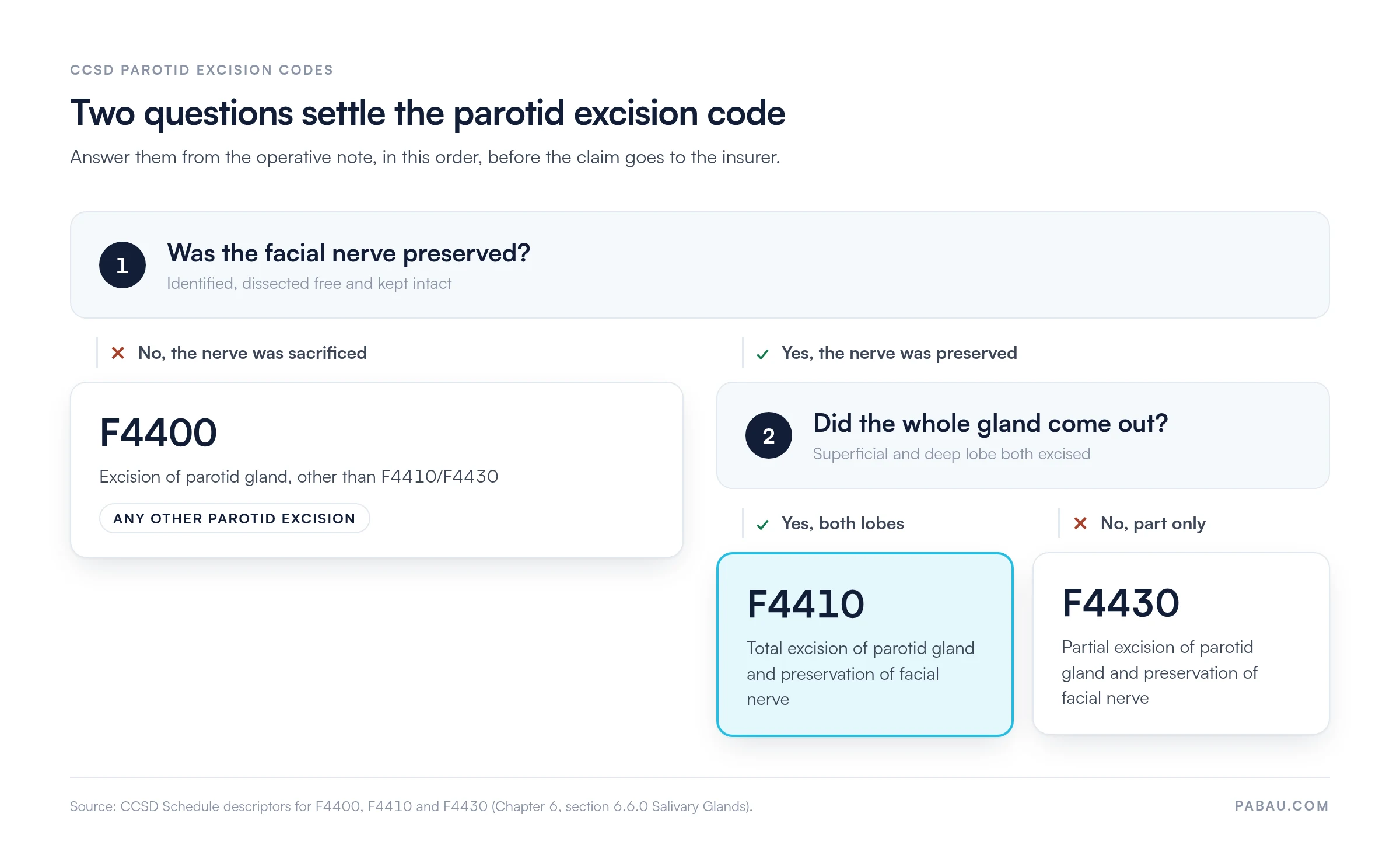
A frequent error is billing F4410 when the note describes a superficial parotidectomy. That operation is a partial excision, so it belongs under CCSD code F4430. Nerve sacrifice moves the claim the other way, to CCSD code F4400, because neither nerve-preserving descriptor applies.
F4410 is for the parotid only. Excision of the submandibular gland is billed as F4440, and excision of the sublingual gland as F4450.
Total parotidectomy with facial nerve preservation usually begins with a preauricular incision extended into the neck. The surgeon finds the main trunk of the facial nerve near the stylomastoid foramen. Each branch is then followed forward through the gland.
The superficial lobe is lifted off the nerve branches first. The deep lobe is then freed from between the branches and removed. Haemostasis, drain placement and closure complete the operation.
Insurers compare the operative note with the billed code. A defensible F4410 note records:
Intraoperative findings sometimes force the surgeon to sacrifice the nerve. Code the operation that was performed, even when it differs from the one booked. Record the reason in the note and bill F4400 instead.
Insurers pay for total parotidectomy when the record shows why the whole gland had to come out. The indication should match across the referral letter, the operative note and the claim.
Common indications include a pleomorphic adenoma involving the deep lobe and a recurrent pleomorphic adenoma. A malignant tumour that spares the nerve is another. End-stage chronic sialadenitis occasionally leads to removal of the whole gland after conservative treatment fails.
Cite codes from the WHO ICD-10 (5th edition) tabular list. The codes most often paired with F4410 are:
Final histology can change the diagnosis after surgery. A tumour thought benign before the operation may come back malignant, which moves the claim from D11.0 to C07. Update the diagnosis code on the claim once the pathology report confirms it.
Intraoperative facial nerve monitoring uses electromyography to warn the surgeon of traction or heat injury to the nerve branches. How it is billed depends on who performs it.
When the operating surgeon runs and interprets the monitoring, treat it as part of the operation. Record it in the operative note, but don’t add a separate code.
A neurophysiologist who attends only to run the monitoring bills their own fee, where the insurer recognises one. Name that practitioner in the operative note, so the two claims can be matched.
UK private medical insurers generally expect planned surgery to be pre-authorised. Get the authorisation number before the operation and record it with the booking. Each insurer sets its own process, so check its current requirements rather than another insurer’s.
Ask for authorisation against F4410 specifically. If the insurer authorises a different parotid code, resolve it before surgery. Send imaging or clinical notes that show why the whole gland must come out.
Have these documents ready before you submit the claim:
Insurer fees for F4410 vary, and CCSD fee and benefit details sit behind a login. Look up the current figure in each insurer’s own schedule, such as the Bupa CCSD codes list, before you quote the patient.
F4410 covers the operating surgeon’s fee. The anaesthetist bills separately for the same operation, under the insurer’s rules for anaesthetic fees. Check that the anaesthetist has the authorisation details too.
Insurer rules on assistant surgeon fees differ. Check the policy before an assistant bills, and keep the surgeon’s reason for needing one with the record.
CPT codes belong to the US billing system and play no part in a UK private insurer claim. The crosswalk below is for education, peer review and international audit comparison only. It draws on the AMA CPT code set.
CPT 42426 adds a unilateral radical neck dissection to total parotidectomy, so it is not an F4410 equivalent. CPT 42440 describes submandibular gland excision, which CCSD codes as F4440. The two systems were built independently, so check the current AMA manual before a formal comparison.
Complications after total parotidectomy are separate billing events, never re-billed under F4410. Each one that needs further treatment takes its own procedure code and an ICD-10 complication code.
These are the common mistakes behind a rejected F4410 claim, each paired with its fix.
Run through this checklist before the claim leaves the practice. Each item maps to one of the rejection reasons above.
A parotid surgery claim depends on documents that arrive at different times. The referral letter, imaging, consent and pathology report often sit in different places, and the claim waits while someone finds them.
Pabau holds those documents on one patient record. Its claims software for practices connects to Healthcode and pulls the details already on that record into the CCSD-coded claim. You then send the claim and track its status without leaving Pabau.
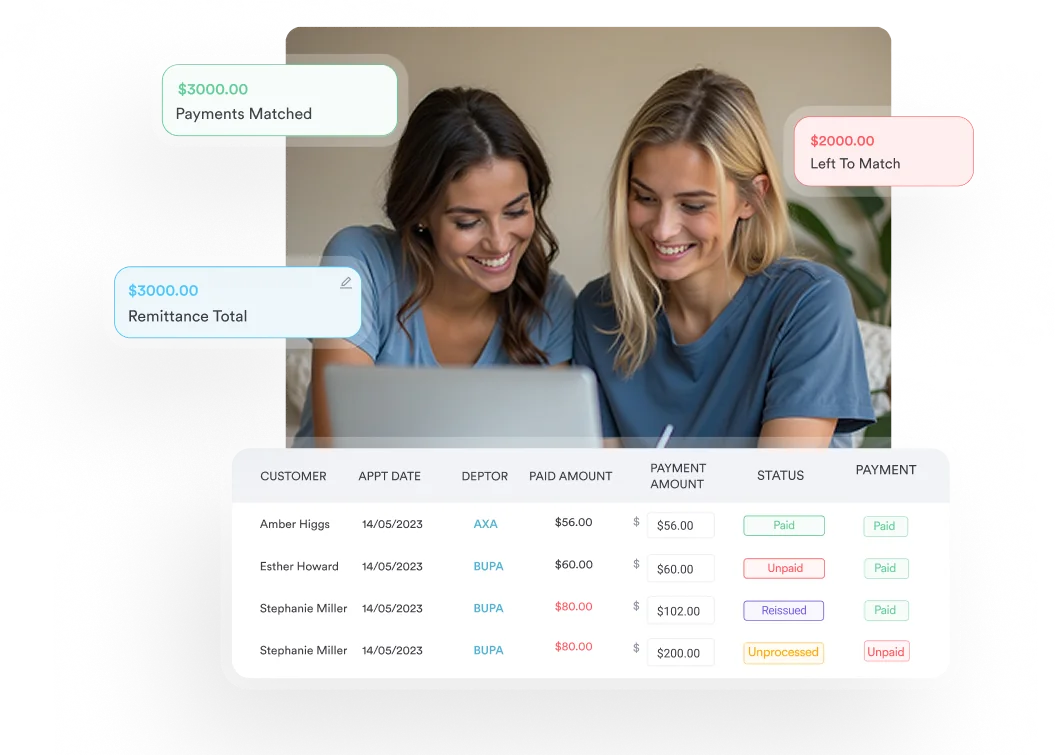
Coding decisions stay with the surgeon and the practice’s billing team. Pabau keeps the evidence for those decisions on hand when the insurer asks.

Pabau keeps the operative note, consent and pathology report on one patient record, then sends CCSD-coded claims through Healthcode. See how it fits your practice.

F4410 asks two questions of the operative note. Did the whole gland come out, and was the facial nerve preserved? A yes to both supports the code, and a no to either moves the claim to F4430 or F4400.
Settle the code against the note and the histology before submission, and the claim reaches the insurer with its evidence attached. To see how Pabau keeps that evidence on one record, book a demo.

Billing a partial parotidectomy? CCSD code F4430 covers partial excision of the parotid gland with the facial nerve preserved.
Was the facial nerve sacrificed? CCSD code F4400 covers parotid excision that fits neither F4410 nor F4430.
Coding a malignant parotid tumour? ICD-10 code C07 explains the diagnosis code for a malignant neoplasm of the parotid gland.
Billing a salivary biopsy before surgery? CCSD code F4810 covers open salivary gland biopsy and the records insurers expect for it.
Checking fees across the Bupa schedule? Bupa CCSD codes lists the procedure codes Bupa recognises and how to use them.
CCSD code F4410 covers total excision of parotid gland and preservation of facial nerve. The surgeon removes both the superficial and the deep lobe and keeps the facial nerve intact. It sits in Chapter 6, section 6.6.0 Salivary Glands.
F4410 is total excision of the parotid gland with the facial nerve preserved. F4430 is partial excision with the nerve preserved. F4400 covers parotid excision that fits neither descriptor, including cases where the nerve is sacrificed.
Common WHO ICD-10 pairings are D11.0 for a benign parotid tumour, such as pleomorphic adenoma, and C07 for a malignant one. K11.2 covers chronic sialoadenitis, and K11.5 covers sialolithiasis. Use D11.0 rather than the category D11.
The closest CPT code is 42420, total parotidectomy with dissection and preservation of the facial nerve. The crosswalk is for reference only. UK private medical insurers take CCSD codes, never CPT codes.
Only where the insurer’s policy allows an assistant surgeon fee. Rules differ between insurers, so check the policy before the operation. Keep the surgeon’s reason for needing an assistant with the record.
No. CCSD codes are used to bill UK private medical insurers. NHS hospitals record procedures with OPCS-4 codes instead.