

CCSD code G5100: Bypass of duodenum billing guide
CCSD code G5100 bills a bypass that leaves the duodenum in place CCSD code G5100...

Last Updated: Oct 16, 2026
E3180 is the CCSD code for thyroplasty (Isshiki type 1), a medialization operation for unilateral vocal fold paralysis. The surgeon cuts a window in the thyroid cartilage and inserts an implant that pushes the paralysed fold toward the midline.
Surgeons usually operate under local anaesthesia so the patient can voice while they adjust the implant. UK private insurers use the code for the surgical episode, and the anaesthetist bills separately.
Let Pabau's smart automation suggest the right codes, reduce claim denials, and keep your practice compliant—effortlessly.
Automate repetitive tasks and focus on what matters most—your patients.
Reduce coding errors and ensure compliance with the latest regulations.
Clean claims, fewer denials, and faster reimbursements.
Powerful insights and reporting to help your practice thrive.
HIPAA compliant SOC 2 certified GDPR-compliant Trusted by 4,000+ clinics worldwide

CCSD Code E3180 covers Isshiki type 1 thyroplasty only, not types II, III or IV, which are different operations.
The procedure is typically performed under local anaesthesia so the patient can vocalise during implant placement.
Most UK private insurers typically require pre-authorisation before E3180 is performed, so check each insurer’s current rules before the operation is booked.
Arytenoid adduction is a separate procedure, so check the current CCSD schedule and each insurer’s own rules before billing it alongside E3180.
In Pabau’s practice management software, the operative note, authorisation number and approved codes sit on one patient record before the insurer invoice goes out.
CCSD Code E3180 has the official descriptor “Thyroplasty (Isshiki type 1).” It sits in the ear, nose and throat chapter of the CCSD schedule of procedures. That schedule is the coding standard UK private insurers such as Bupa, AXA Health, Aviva and Vitality use.
The code covers the complete surgical episode: creation of a cartilage window, implant insertion and intraoperative voice assessment. It does not bundle the anaesthetic fee, which the anaesthetist bills separately. Nearby larynx procedures sit alongside it in our index of UK CCSD codes.
Type 1 is the most often performed Isshiki thyroplasty. It is a medialization procedure for glottic insufficiency caused by unilateral vocal fold paralysis. The other Isshiki types are distinct operations for different laryngeal conditions, and each has its own code. Submitting E3180 for a type II, III or IV procedure is a coding error that will trigger a review.
Isshiki type 1 thyroplasty is a medialization procedure that permanently repositions a paralysed vocal fold toward the midline. The fold can then meet the mobile fold on the other side during phonation.
The surgeon cuts a small rectangular window in the thyroid cartilage (the thyroid ala) on the affected side. A shaped implant goes through the window to push the vocal fold medially. The surgeon adjusts its position while the patient phonates under local anaesthesia. Once the voice sounds right, the surgeon secures the implant and closes the wound.
Implant materials vary with the surgeon’s choice, and the CCSD descriptor does not specify them. Accepted materials include Gore-Tex, silastic block, silicone and hydroxyapatite prostheses. The choice of material does not change the code, but it should be documented in the operative note for insurer review.
Most surgeons perform E3180 under local anaesthesia with sedation because it allows intraoperative flexible nasendoscopy and live voice assessment. The patient counts or sustains a vowel sound while the implant position is adjusted.
The operative note should record this assessment: the laryngoscopy findings, the voice improvement achieved and any adjustments made before closure. Insurers reviewing E3180 claims more often look for this record as evidence that the procedure was completed as described.
The primary indication for E3180 is unilateral vocal fold paralysis causing symptomatic glottic incompetence. Dysphonia (hoarse or breathy voice) is the most common presenting complaint. Aspiration risk and dysphagia are equally valid surgical indications, especially in patients with a posterior glottic gap.
Aspiration and dysphagia indications carry more weight with insurers at pre-authorisation because they cross into medical necessity. Clinical documentation should make the indication explicit. Compare a letter noting “dysphonia following thyroid surgery with stable left vocal fold paralysis at eight months” with one listing only “voice disorder.” The first makes a far stronger claim.
The four Isshiki types address different mechanical problems of the laryngeal framework. E3180 describes only type 1. The table below summarises all four so coders can confirm the correct code before submission.
Knowing the operative steps shows billing staff what the operative note must contain and what a claim reviewer will look for. The sequence below reflects standard practice in laryngeal framework surgery.
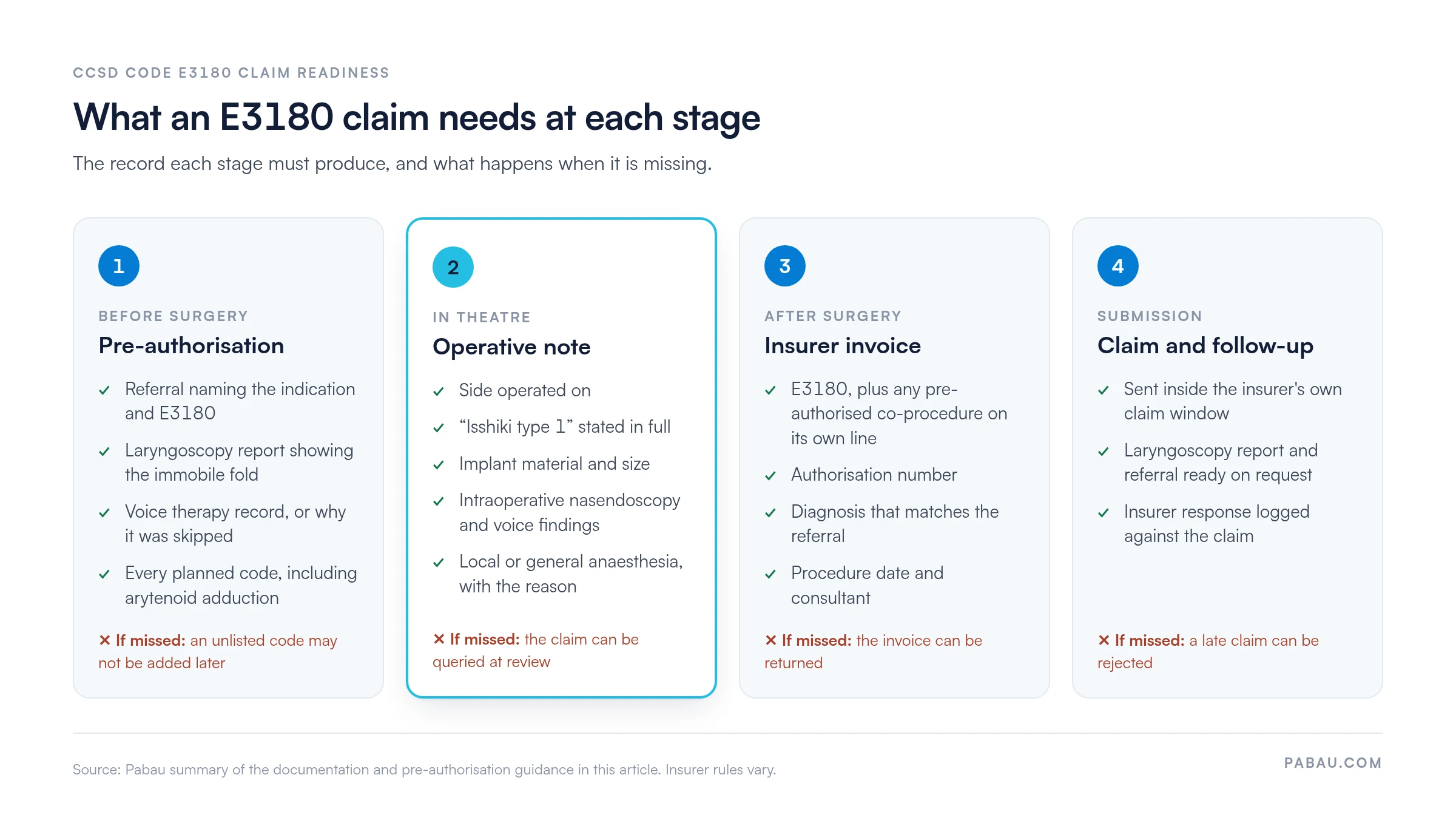
Document implant type, size, and the specific cartilage window dimensions in the operative note. Insurers often query E3180 claims where the note describes ‘thyroplasty’ without specifying the Isshiki type, the implant material, or whether intraoperative laryngoscopy was performed. A one-paragraph procedural summary is not enough: the note should confirm laterality, technique, implant, and intraoperative findings.
Billers often submit several codes alongside or instead of CCSD Code E3180. Knowing how each one relates to E3180 prevents both under-coding and unbundling errors. The Bupa CCSD code schedule is a useful reference for current fee levels and insurer-specific bundling restrictions.
A pre-operative scope done at a separate outpatient visit is its own claim. When the scope is the only procedure that day, it may fall under E3680, the code for endoscopic laryngopharyngoscopy as a sole out-patient procedure.
Vocal fold injection augmentation is a different procedure that uses E3810, the CCSD code for injection into the larynx. A bulking agent (fat, hyaluronic acid or calcium hydroxylapatite) goes into the paralysed fold transorally or transcervically. Surgeons usually do it under general anaesthesia, or under local anaesthesia with sedation.
The key clinical difference is durability. Injection augmentation typically lasts months, whereas surgeons consider medialization thyroplasty long-lasting, and most patients keep the benefit for years. Surgeons often use injection as a temporary measure while awaiting spontaneous recovery. It can also act as a diagnostic test of medialization benefit before committing to surgery.
Do not bill both procedures on the same episode. When injection augmentation was performed earlier and the patient then undergoes E3180, the earlier injection claim is a separate historic episode, not a bundling risk.
Surgeons perform arytenoid adduction when the paralysed vocal fold sits at a different height from the mobile fold (level mismatch). They also use it when a posterior glottic gap is too wide for medialization alone to close. A suture repositions the arytenoid to improve posterior glottic contact.
It addresses a different anatomical problem from the implant placed in E3180, so check the current CCSD schedule for how to code it. Whether both procedures can be claimed on the same episode depends on that schedule and each insurer’s own rules. Check both before the operation, and get written pre-authorisation that names every planned procedure.
A valid E3180 claim needs documentation that confirms the surgeon performed the procedure as coded. Insurers often query or reject claims at audit when any item below is missing. The flow below shows which stage produces each record, from pre-authorisation to submission.
Most UK private insurers typically treat CCSD Code E3180 as an elective ENT procedure that needs pre-authorisation. Approval after the event may not be available, so a claim without an authorisation number risks rejection whatever the clinical need. Requirements vary, so check each insurer’s current rules. Most follow a broadly similar pattern.
Each insurer publishes its own fees and criteria. Check Bupa’s code lookup portal or the Aviva procedure fee schedule. For the other two, use the AXA Health procedure codes portal and the Vitality fee finder. Benefit levels can differ even within one insurer’s product range. Check the patient’s specific policy before you submit the authorisation request.
Submit the pre-authorisation request with all planned CCSD codes listed, including any concurrent procedure you might only perform if intraoperative findings warrant it. It is easier to not use an authorised code than to add one after the event. Insurers vary on whether they will amend authorisations post-operatively, and some will not.
Denials for CCSD Code E3180 follow a predictable pattern, and you can prevent each reason below before submission.
UK ENT practices often hold the authorisation letter, the operative note and the insurer invoice in different places. Someone then has to match them up by hand before each claim goes out.
In Pabau, all three sit on the patient record. A typical E3180 workflow runs in five steps:
The claim reaches the insurer with its authorisation, operative note and codes already matched. When a query comes back, the answer sits on one record instead of three systems.

Keep the operative note, authorisation number and approved CCSD codes on one patient record, then send the insurer claim through Healthcode from the same system.

For CCSD Code E3180, choosing the code is the easy part. Claims come back when the operative note leaves out the Isshiki type, the side or the implant, or when a co-procedure was never authorised.
So build each claim backwards from the insurer’s review. Agree every planned code at pre-authorisation, and use one operative note template that records those details every time. Then check each insurer’s current rules before submission, while you can still fix a missing item.
Book a demo to see how Pabau keeps the authorisation, operative note and insurer invoice for each ENT claim on one patient record.

Billing CCSD codes for other ENT or surgical procedures? Bupa CCSD code schedule provides a reference guide to Bupa-recognised CCSD codes and their current fee levels.
Coding the scope before surgery? CCSD Code E3680 explains endoscopic laryngopharyngoscopy billed as a sole out-patient procedure.
Treating laryngectomy patients too? CCSD Code E4100 covers insertion of a voice prosthesis after total laryngectomy.
Want fewer queried insurer claims? Pabau’s claims management software brings claim submission and follow-up into the same system as the patient record.
CCSD Code E3180 covers thyroplasty (Isshiki type 1), a medialization procedure for a paralysed vocal fold. The surgeon inserts an implant through a window in the thyroid cartilage to push the fold toward the midline. The code covers the complete surgical episode including intraoperative laryngoscopy; the anaesthetist bills anaesthetic fees separately.
An Isshiki type 1 thyroplasty is laryngeal framework surgery that medialises a paralysed vocal fold. The surgeon cuts a rectangular window in the thyroid cartilage and inserts a shaped implant. Surgeons typically use local anaesthesia so the patient can vocalise during surgery, which lets the surgeon fine-tune implant position in real time.
Often, yes, if both procedures appear in the pre-authorisation request and the operative note records each as a distinct step. Coding and payment rules differ, so check the current CCSD schedule and each insurer’s own rules before the operation.
Broadly, no, but E3180 attracts more documentation scrutiny than routine ENT codes because of its cost and the difficulty of the operative technique. Insurers reviewing phonosurgery billing expect an operative note that names the Isshiki type, implant material and intraoperative laryngoscopy findings. A summary that only says the surgeon performed the procedure is not enough.



