

HCPCS code E0198: Water pressure pad billing guide
HCPCS code E0198 is a water pad for a standard mattress HCPCS code E0198 is the ...

Last Updated: Oct 13, 2026
E1441 is the CCSD code for insertion of a biodegradable stent into the ethmoid sinus. The surgeon places the dissolving stent at the end of endoscopic sinus surgery to hold the newly opened ethmoid cavity open while it heals.
CCSD added E1441 to Chapter 5, Ear, nose and throat, in June 2024. It usually sits on the claim beside the code for the main sinus operation, such as E1432. Some insurers don't list a fee for it yet, so confirm cover before surgery.
Let Pabau's smart automation suggest the right codes, reduce claim denials, and keep your practice compliant—effortlessly.
Automate repetitive tasks and focus on what matters most—your patients.
Reduce coding errors and ensure compliance with the latest regulations.
Clean claims, fewer denials, and faster reimbursements.
Powerful insights and reporting to help your practice thrive.
HIPAA compliant SOC 2 certified GDPR-compliant Trusted by 4,000+ clinics worldwide

CCSD code E1441 covers inserting a biodegradable stent into the ethmoid sinus, and CCSD added it to the schedule in June 2024.
The stent goes in at the end of sinus surgery, so E1441 normally sits on the claim beside the main operation code, such as E1432.
A stent in the frontal sinus has its own code, E1490, so the note has to say which sinus received it.
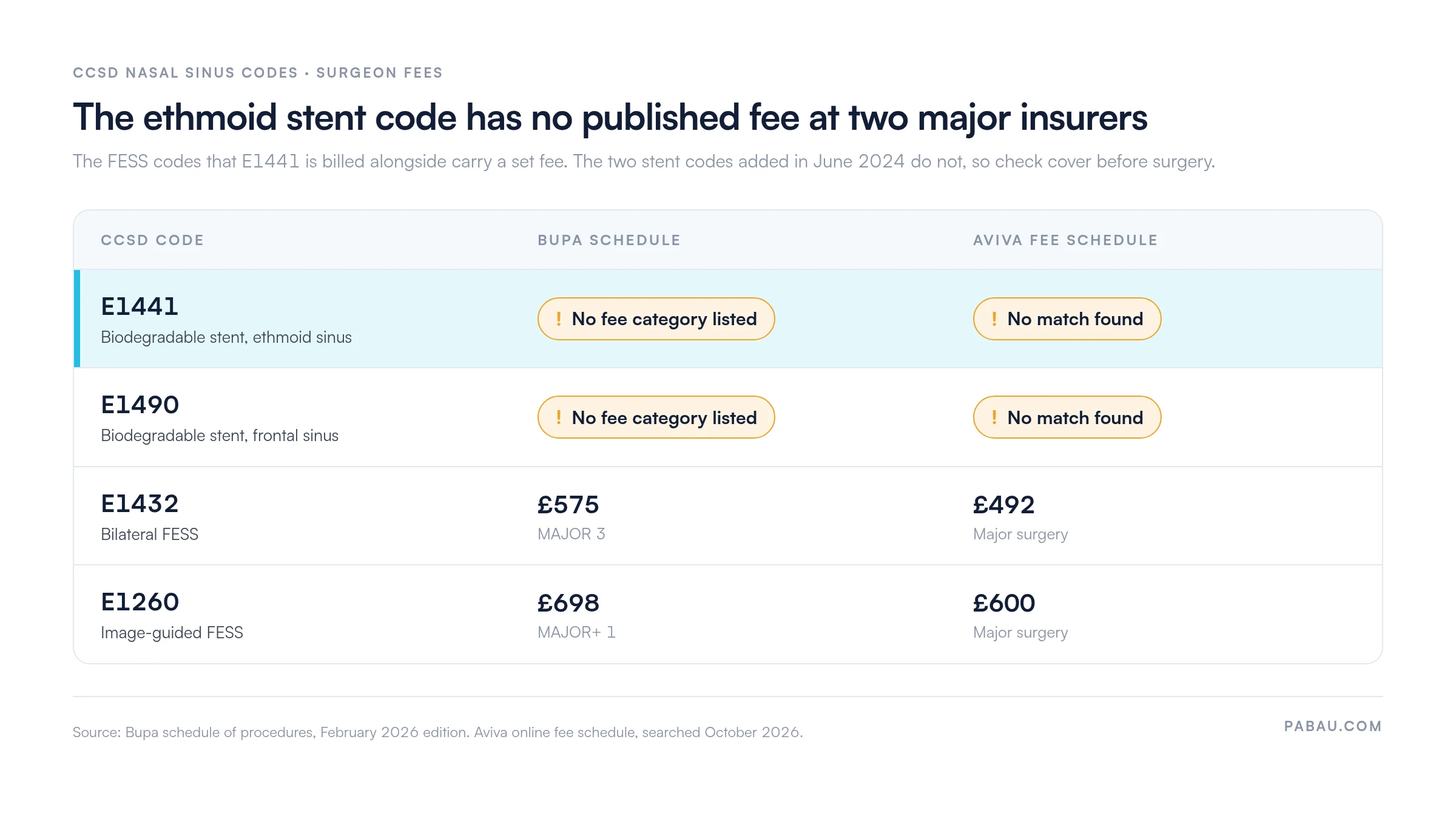
Bupa’s schedule lists no fee category for E1441, and Aviva’s online fee schedule returned no match for it in October 2026.
Ask the patient to quote E1441 as well as the surgery code when they request pre-authorization, and agree the stent fee before surgery.
CCSD code E1441 is the code for placing a biodegradable stent in the ethmoid sinus. The official descriptor reads: Insertion of biodegradable stent into paranasal sinus (ethmoid).
The surgeon places the stent through the nose under endoscopic guidance, at the end of endoscopic sinus surgery. It holds the newly opened ethmoid cavity open while the lining heals, then dissolves. According to NICE, the best-known device, PROPEL, also releases a corticosteroid over about 30 days.
E1441 sits in Chapter 5 of the CCSD schedule, Ear, nose and throat, under 5.5.0 Nasal Sinuses. The Clinical Coding and Schedule Development (CCSD) Group maintains the code wording. UK private medical insurers such as Bupa, AXA Health, Aviva, Vitality and WPA bill with CCSD codes, and each insurer sets its own fee.
The code is new. CCSD added E1441 in June 2024, together with E1490 for the frontal sinus. That matters for billing, because not every insurer’s fee schedule lists it yet. Our CCSD billing guides cover the older sinus codes in the same chapter.
E1441 rarely appears on a claim alone. Its descriptor names the stent insertion only, and the operation that opened the ethmoid has its own code. These are the codes you’re most likely to see next to it.
Read the stent line against the anatomy in the note. A stent placed in the frontal sinus is E1490, even when the main operation was ethmoid surgery. If stents went into both the ethmoid and the frontal sinus, each site has its own code. Check with the insurer that it accepts both lines on one claim.
Because the stent goes in at the end of the main operation, an E1441 claim normally carries at least two procedure lines. The first is the sinus surgery code, such as bilateral FESS under E1432. The second is E1441 for the stent.
Unlike E1432 and most of its neighbors, the E1441 descriptor doesn’t mention bilateral. If the surgeon stents both ethmoid sinuses, ask the insurer how many E1441 lines it expects before you submit.
The public CCSD record for E1441 doesn’t list any coding principles yet, such as unacceptable combinations. Aviva’s entry for E1432 doesn’t list E1441 as an unbillable combination either. Schedules change, so recheck both when you set up the claim.
Ask the surgeon to name the sinus on the stent line of the operative note. A note that only says “sinus stent” leaves the coder guessing between E1441 and E1490.
For an established sinus code, the fee is a quick lookup. E1441 is different. When we checked in October 2026, Aviva’s online fee schedule returned no match for E1441 or E1490. Bupa’s schedule of procedures (February 2026 edition) lists both codes without a fee category or fee.
The FESS codes billed alongside them carry set fees at both insurers, as the comparison below shows.
Clinical guidance gives you a second reason to ask first. NICE’s interventional procedures guidance says corticosteroid-eluting bioabsorbable stents should only be used with special arrangements for clinical governance, consent, and audit or research. Have that context ready when the insurer asks why the stent is needed.
The device has a cost of its own, too. A NICE medtech briefing put the PROPEL implant at £580 per unit, excluding VAT, in 2021. Ask the insurer whether the policy covers the device, and whether the hospital or the surgeon should bill it.
UK private medical insurers generally ask members to get pre-authorization before planned surgery. For a sinus operation with a stent, the request should list E1441 as well as the main operation code.
Usually, the patient calls their insurer and quotes the codes the consultant gives them. If E1441 is missing from that call, the authorization may cover the surgery and leave the stent out. Ask the patient to confirm both codes were accepted, and keep the authorization number on file.
If the insurer won’t cover the stent, tell the patient before surgery. They can then choose to pay for it themselves or go ahead without one. Record that decision in the patient record.
Insurers check the claim against the note, so the note should describe the stent in the descriptor’s own terms. A complete E1441 note records:
NICE asks clinicians to make sure patients understand the uncertainty about how well the procedure works. It also asks them to give patients clear written information. Keep the signed consent form with the claim file.
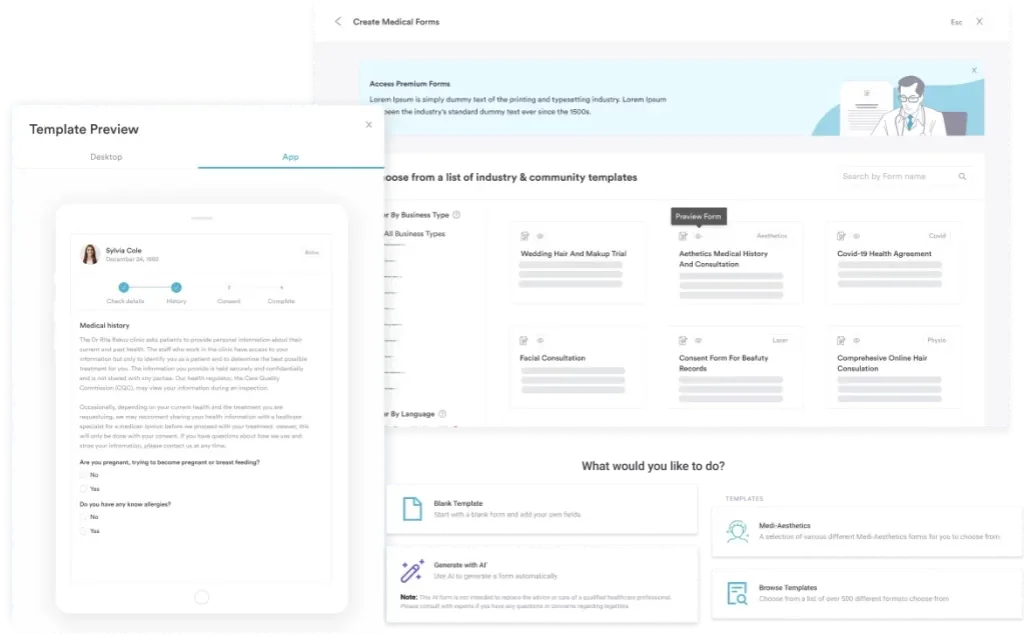
Here is the usual path for an insured sinus case with a stent, from the first consultation to payment.
Take a worked example. A consultant performs bilateral FESS for chronic rhinosinusitis without navigation, then places a stent in one ethmoid sinus. Your team bills E1432 for the surgery and one E1441 line for the stent. Had the note recorded image guidance, the surgery line would be E1260 instead.
Most E1441 queries trace back to a handful of avoidable errors:
On a stent case, the paperwork splits easily. The authorization sits in an email, the consent sits in a paper file, and someone types the claim into Healthcode by hand.
Pabau connects to Healthcode, so the claim builds from the patient record instead. With error-checked claims management, the CCSD codes, membership number and authorization reference carry across to the claim. Pabau checks the required fields before the claim can be sent.
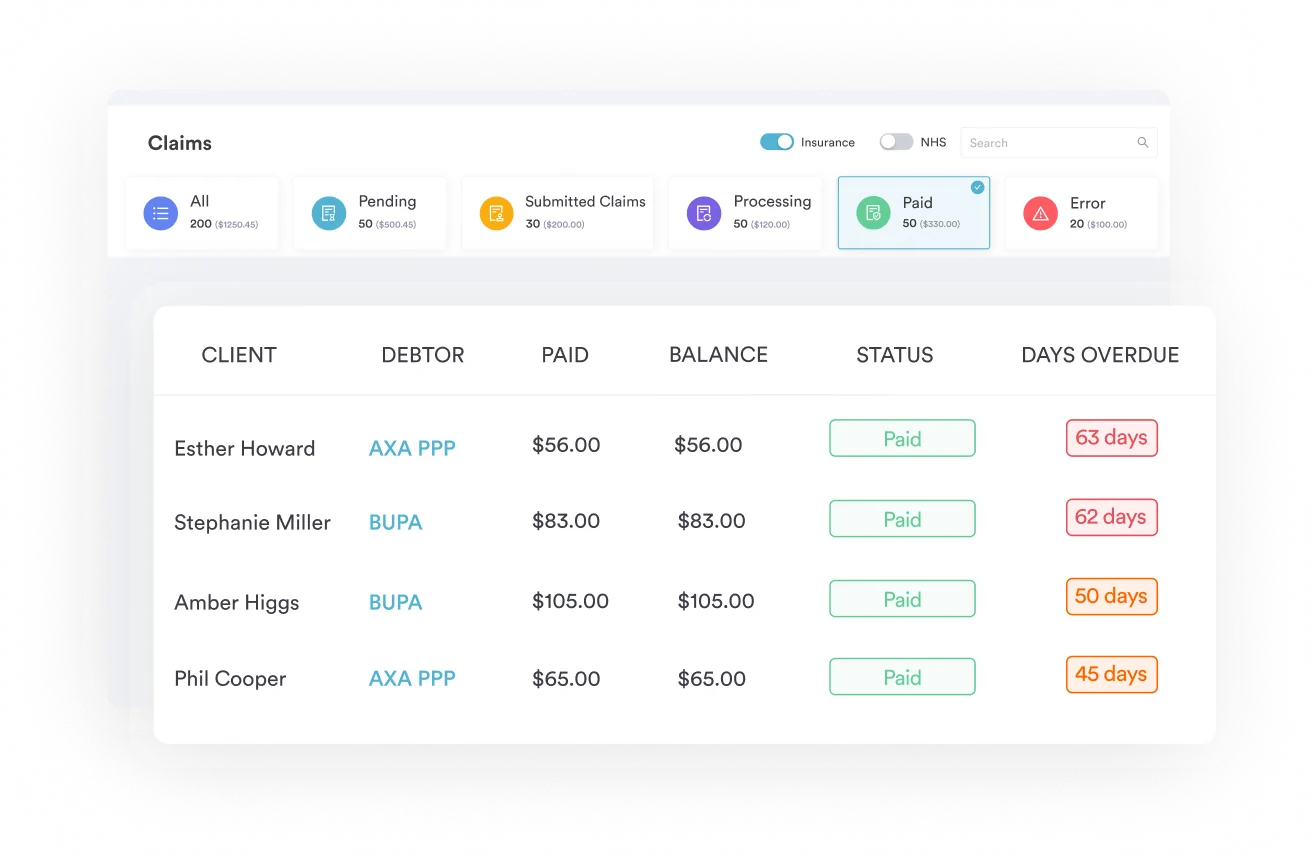
You then follow the surgery line and the stent line side by side. A short payment on either one shows up quickly, while the authorization is still on hand.

Pabau builds CCSD claims like E1441 from the patient record and checks required fields before they reach the insurer. You can then track every claim line in one place.

E1441 is simple to code and harder to get paid for. The descriptor is short, but two major insurers still publish no fee for it.
So treat the stent as its own authorization question. Name E1441 in the pre-authorization, record the sinus in the note, and agree the fee before surgery. The stent line then goes out with the same paperwork as the surgery line.
Book a demo to see how Pabau carries an E1441 claim from the operative note to the insurer without retyping.

Billing other Bupa procedures? Bupa CCSD codes guide explains how the schedule is organized and how Bupa fee bands work.
Coding the FESS that came first? CCSD code E1432 covers bilateral FESS and what its descriptor already includes.
Did the surgeon use navigation? CCSD code E1260 covers image-guided FESS and how it bills.
Surgery reached the frontal sinus? CCSD code E1480 walks through endoscopic frontal sinus exploration claims.
Want fewer queried claims? Pabau claims management sends CCSD claims to insurers from the patient record.
E1441 is the CCSD code for inserting a biodegradable stent into the ethmoid sinus. The stent goes in at the end of sinus surgery and dissolves over the following weeks. CCSD added the code in June 2024.
Not automatically. Bupa’s schedule lists no fee category for E1441, and Aviva’s online fee schedule had no match for it in October 2026. Cover then depends on the policy, so the patient should get pre-authorization that names E1441 before surgery.
Both codes cover a biodegradable stent in a paranasal sinus. E1441 is for the ethmoid sinus, and E1490 is for the frontal sinus. CCSD added both codes in June 2024.
Usually, yes. E1432 covers the FESS operation, and E1441 covers the stent placed at the end of it. Neither the CCSD record for E1441 nor Aviva’s E1432 entry lists the pair as an unacceptable combination, but confirm with the insurer.
According to NICE, the PROPEL implant is designed to dissolve within 30 to 45 days. It releases its corticosteroid over about 30 days. Other devices may differ, so record the device name in the note.



