

HCPCS code E0198: Water pressure pad billing guide
HCPCS code E0198 is a water pad for a standard mattress HCPCS code E0198 is the ...

Last Updated: Oct 13, 2026
A0380 is the CCSD code for stereotactic radiotherapy (SRT) using GammaKnife or similar SRT technology. It covers the treatment delivery session, and it sits in Chapter 20, Radiotherapy, of the CCSD schedule.
Planning supervision carries its own CCSD code, X6950, so the two never share a line item. A0380 has no second-to-fifth-session entry either, which is where fractionated courses trip billing teams up.
Let Pabau's smart automation suggest the right codes, reduce claim denials, and keep your practice compliant—effortlessly.
Automate repetitive tasks and focus on what matters most—your patients.
Reduce coding errors and ensure compliance with the latest regulations.
Clean claims, fewer denials, and faster reimbursements.
Powerful insights and reporting to help your practice thrive.
HIPAA compliant SOC 2 certified GDPR-compliant Trusted by 4,000+ clinics worldwide

CCSD code A0380 covers stereotactic radiotherapy delivered with GammaKnife or similar SRT technology, and it sits in Chapter 20, Radiotherapy.
The descriptor names a technology rather than an anatomical site, so the procedure note has to say which unit delivered the treatment.
A0380 has no second-to-fifth-session entry, so a fractionated course needs a policy check before anyone invoices it.
Planning supervision carries its own code, X6950, and it never belongs on the same line item as A0380.
Practice management software like Pabau ties the clinical record to the invoice, so A0380 claims leave with their evidence attached.
CCSD code A0380 is the schedule entry for stereotactic radiotherapy (SRT) using GammaKnife or similar SRT technology. CCSD stands for Clinical Coding and Schedule Development, the group that maintains the procedure schedule behind UK private medical insurance billing.
The code pays for the treatment delivery session itself. Everything that surrounds that session, from planning supervision to imaging preparation, is coded elsewhere.
Two details in that descriptor do most of the work. It names a technology rather than an anatomical site, so the procedure note has to record which unit delivered the treatment.
It also says “or similar SRT technology”, which stops A0380 from being a GammaKnife-branded code in the narrow sense. Insurers still read that phrase against their own policy, so check before you assume a comparable platform qualifies.
Before you code anything, rule out the naming collision. A0380 also exists in the US HCPCS system, where it means basic life support mileage per mile. The two schedules share a string of characters and nothing else.
If your search results start talking about ambulance transport, you have landed in the wrong system. The rest of the CCSD codes follow the same UK-only logic.
Within the schedule, A0380 sits in Chapter 20, Radiotherapy. It is filed beside the preparation and delivery codes for external beam treatment.
The brain and intracranial chapter does not carry it, even though GammaKnife units are built for cranial targets. That placement catches coders who search the schedule chapter by chapter.
Stereotactic radiotherapy delivers a focused dose of ionizing radiation to a precisely targeted site. No incision is made.
A GammaKnife unit converges beams of cobalt-60 radiation on the target using stereotactic coordinates, which limits the dose reaching surrounding brain tissue. A session runs through four stages, and each one leaves a document an insurer may later ask to see.
Eligibility comes from multidisciplinary team (MDT) review, not from the treating surgeon alone. These are the indications that most often carry an SRT case through an insurer’s clinical review:
Treat that list as a starting point rather than a coverage rule. Individual insurers publish narrower criteria for high-cost neurological treatment, and several ask for supporting evidence beyond the MDT outcome.
Not every arteriovenous malformation on that list goes to SRT. Where the neurosurgeon excises the malformation through a craniotomy instead, the procedure falls outside A0380 and the claim carries CCSD code A0260.
Several procedures sit close enough to A0380 to be confused with it, and each has its own entry in the schedule. The table below pairs the neighbor with the code that actually applies, so a claim goes out on the right line the first time.
Note what is missing from that list. The schedule carries no separate entry for LINAC-based cranial SRT as a category. It describes these treatments by named platform and session count instead.
So the question to answer before coding is not “which machine is this” but “which schedule entry describes this course”.
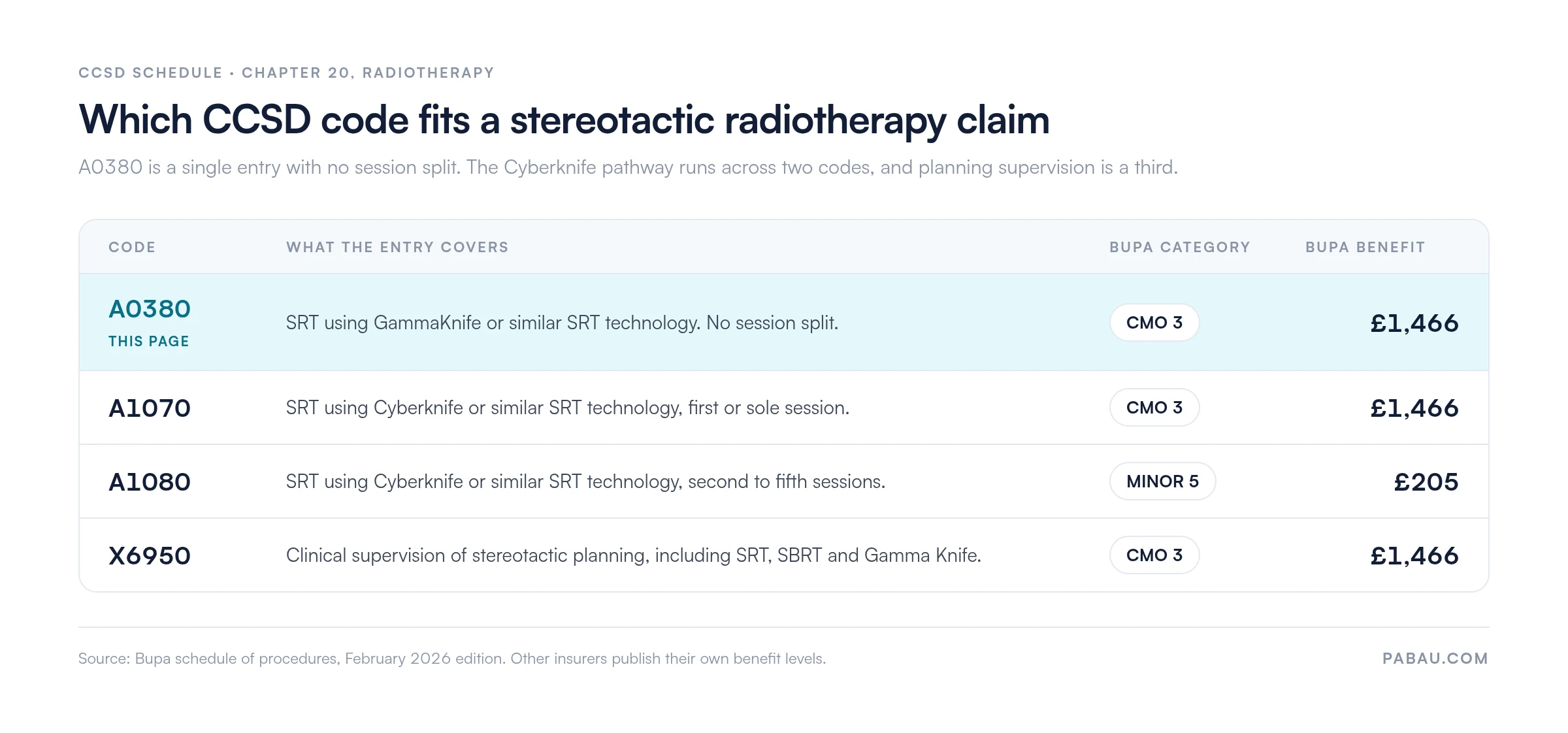
Compare A0380 with its Cyberknife neighbors and an asymmetry shows up immediately. The Cyberknife pathway is split in two. One entry covers the first or sole session, and a much smaller one covers sessions two to five.
A0380 has no such pair. It is a single entry, and the schedule offers nothing to bill for a second GammaKnife fraction.
Take a worked example. A patient has a three-fraction GammaKnife course on a mask-based unit. Session one codes cleanly as A0380. Sessions two and three have no obvious home, and repeating A0380 three times usually reads to the insurer as a duplicate submission.
Raise it with the payer at the authorization stage, get the answer in writing, and record the reference against the episode.
Benefit levels vary by insurer, but the shape of the problem does not. A fractionated course multiplies the delivery work without multiplying the codes available to describe it. That conversation belongs before treatment, not after the invoice bounces.
Stereotactic planning happens hours or days before the session. The physicist, the neurosurgeon and often the radiation oncologist define the target volume, choose collimator settings, calculate the dose distribution and sign off the plan.
The schedule codes the clinical supervision of that work as X6950, which covers SRT, SBRT and Gamma Knife planning.
So the two activities never share a line. Bundling planning into A0380 is among the most common billing errors on stereotactic claims, and it produces either a query or a rejection.
Both items draw on the same evidence, which is the imaging report, the MDT record and the signed dose prescription. Submitting them together as one charge simply hides one of them.
Insurers reviewing an A0380 claim want to see a complete clinical picture: the diagnosis, the MDT decision, the delivery itself and the technology used.
Assembling that after the fact is slow and error-prone, so most well-run teams capture it as the patient moves through the pathway.

Run this list before the claim leaves. Any one of these missing is enough for an insurer to request more information or refuse outright:
Run a two-person check on every A0380 claim. One person works the document list above. The second confirms that the authorization reference is on the claim form and that planning is on its own line. A missing reference number is the hardest refusal to appeal, because there is no clinical argument to make.
Most UK private medical insurers want written authorization before a stereotactic radiotherapy session goes ahead. This is expensive, specialized treatment, so payers assess the clinical case before committing to a benefit.
A claim submitted for a procedure carried out without that approval is usually refused, however sound the clinical reasoning was.
An authorization request usually has to carry five things:
List A0380 and X6950 separately at this stage. Agreeing the split up front removes the argument later.
Lead times differ. Bupa, AXA Health, Aviva, VitalityHealth and Cigna UK each publish their own clinical policies for high-cost neurological treatment. Some ask for five to ten working days’ notice. Policy years change too, so verify with the payer rather than relying on what worked last year.
Refusals on this code follow a short and predictable list. Teams that work the list before submission, backed by claims management software that tracks outstanding documents, avoid most of them.
Benefit levels for A0380 are set by each insurer, not by CCSD. The group publishes the codes and their descriptors; the payer decides what it will pay against them.
Bupa’s February 2026 schedule places A0380 in its CMO 3 category with a benefit of £1,466, the same level it gives A1070 and X6950. Other insurers publish their own figures, and they move between policy years.
Two sources are worth keeping open while you work. The CCSD schedule is authoritative for the code and its descriptor. Bupa’s code search gives current fee levels for recognized consultants. For a wider view of how the schedule is applied, the Bupa CCSD codes reference walks through the structure chapter by chapter.
Reimbursement also depends on the consultant’s recognized fee level with that insurer. A treatment banded at CMO 3 will not pay at that level if the clinician sits outside the payer’s recognition panel. Confirm both before the treatment date.
Recheck recognition status with each insurer once a year, and diarize it. Panels change quietly. A consultant whose recognition lapses mid-year can find that claims for later procedures are refused, even where the authorization was granted before the lapse.
On most stereotactic pathways the evidence is created in the right order and then scattered. The MDT outcome sits in a meeting folder, the dose prescription is signed on paper, and the authorization reference lives in someone’s inbox. Assembling that at invoicing is where the days go.
Pabau, our practice management software, keeps those pieces on the patient record instead. Referral letters, imaging reports, MDT outcomes and signed prescriptions attach to the episode as they happen.
The A0380 and X6950 line items sit on the invoice built from that same record, so the claim and its evidence never drift apart. For UK private medical insurance, submission runs through our Healthcode integration.
The outcome your billing team feels is a shorter pre-submission check. Instead of chasing seven documents across three systems, they confirm what the record already holds and send the claim. Every subscription includes every feature, so claims tracking is not something you upgrade into later.

Pabau keeps referral letters, MDT outcomes, dose prescriptions and authorization references on the patient record, then builds the invoice from it. Your billing team checks one place instead of three before a stereotactic claim goes out.

A0380 is a straightforward code wrapped in three habits that decide whether it gets paid. Name the delivery unit in the procedure note. Keep planning supervision on its own line under X6950. Settle the authorization, and the fractionation question behind it, before the patient is booked.
The third one is the trade-off worth remembering. Raising a coding question with a payer before treatment feels slower than sending the claim and seeing what happens. On a treatment banded at this level, a single refused course costs more than a year of those conversations.
Pabau keeps stereotactic claim files complete from referral through to remittance. Book a demo to see it running on your own pathway.

Need the whole CCSD schedule in context? Bupa CCSD codes walks through the chapter structure and how Bupa applies the schedule to a claim.
Checking what a procedure should pay? Bupa procedure codes fee schedule sets out how benefit levels are banded and where to look them up.
Working through a refusal? Denial codes in medical billing explains what the common refusal reasons mean and which ones can be appealed.
New to the billing side? What is medical billing covers the claim lifecycle from coding through to payment posting.
Tightening up your process? Medical billing compliance sets out the controls that keep documentation and coding defensible under audit.
No. The UK CCSD entry covers stereotactic radiotherapy using GammaKnife or similar SRT technology. The US HCPCS code with the same characters covers basic life support ambulance mileage. The two schedules are unrelated, so confirm which system your payer uses.
The CCSD Group is made up of Aviva, AXA Health, Bupa and VitalityHealth, and its schedule is used widely across UK private medical insurance. Each insurer still sets its own benefit levels and policies, so the payer prices an A0380 claim, not CCSD.
They bill different things. The CCSD schedule sets the consultant’s professional fee, while the hospital invoices its facility and equipment charges under its own agreement with the insurer. Submitting A0380 twice for one session, once from each party, usually triggers a query.
It is reissued periodically, and payer reference guides carry an edition date. Bupa’s current reference is dated February 2026. Check the edition you are coding against before you invoice, because descriptors and benefit levels both move between editions.
Ask the insurer for the refusal reason in writing first. A missing authorization reference is rarely reversible, but a documentation refusal often is. Resubmit with the MDT record, the dose prescription and the procedure note naming the delivery unit.



