

CCSD code G5100: Bypass of duodenum billing guide
CCSD code G5100 bills a bypass that leaves the duodenum in place CCSD code G5100...

Last Updated: Oct 16, 2026
64300 is the CCSD code for echocardiography (including reporting) as sole procedure. It covers one complete resting transthoracic echo, including 2D imaging, M-mode, colour and spectral Doppler, chamber and valve assessment, and the written report.
The code sits in chapter 1 of the CCSD procedural schedule, with the other investigation codes. As a sole-procedure code, it is not billed in addition to another procedure in the same session. Transoesophageal echo bills as 64302 instead.
Let Pabau's smart automation suggest the right codes, reduce claim denials, and keep your practice compliant—effortlessly.
Automate repetitive tasks and focus on what matters most—your patients.
Reduce coding errors and ensure compliance with the latest regulations.
Clean claims, fewer denials, and faster reimbursements.
Powerful insights and reporting to help your practice thrive.
HIPAA compliant SOC 2 certified GDPR-compliant Trusted by 4,000+ clinics worldwide

CCSD code 64300 covers a complete resting transthoracic echo, including 2D, M-mode and Doppler assessment, together with the written report.
Every 64300 claim needs a signed echo report and a documented clinical indication. Missing either is a leading cause of insurer rejection.
Bupa, AXA Health, Aviva and Cigna each set their own pre-authorisation rules, so check the insurer’s provider portal before the appointment.
64300 and 64302 (transoesophageal echo) are not billed for the same session without explicit insurer agreement.
Practice management software like Pabau checks membership numbers and authorisation codes before an echo claim goes to Healthcode.
CCSD code 64300 is the procedure code for echocardiography (including reporting) as sole procedure, which in practice means a standard transthoracic echo (TTE). The code is maintained by the Clinical Coding and Schedule Development (CCSD) Group. UK private medical insurers use its schedule to recognise and pay for procedures.
Cardiologists submit 64300 for a cardiac ultrasound performed from the chest wall. The transducer stays outside the body, no sedation is needed, and the study produces a structured report on cardiac anatomy and function. The code sits in chapter 1 of the CCSD procedural schedule, alongside the other CCSD codes for investigations and consultations.
“As sole procedure” means 64300 is not coded in addition to another procedure in the same session. The descriptor is also deliberately broad. It covers the complete echo examination rather than its individual technical components. Billing Doppler studies or chamber assessments as separate lines unbundles work the code already pays for.
Consultants moving from NHS cardiology into private practice sometimes expect private billing to follow NHS tariff logic. It does not. Under the CCSD schedule, 64300 is one code for one complete procedure, with no sub-codes to build up.
A correctly billed 64300 claim covers a complete transthoracic echocardiographic examination. The table below sets out what is bundled within the code and what falls outside it.
Stress echocardiography assesses cardiac function during exercise or pharmacological stress. It bills as 20132 and never under 64300. If a cardiologist performs a resting TTE and a stress study in the same episode, each needs its own code. That combination usually needs insurer pre-authorisation before submission.
Insurers do not pay for procedures that the clinical record cannot substantiate. A 64300 claim needs the five elements below. A missing one leads to rejection, or to an information request that delays payment.
Most claims go electronically through Healthcode, the UK clearing house for private medical billing. Healthcode validates the pre-auth reference and GMC number against insurer records before the claim reaches the payment team. Errors at this stage return an immediate electronic rejection, so capture the clinical indication during the consultation rather than after the scan.
Audit your echo report template against the BSE minimum dataset before billing season. If a report lacks LVEF, Doppler measurements or a clear clinical indication, the insurer will request medical records. That adds weeks to your payment cycle. Build the minimum dataset fields directly into your standard report structure.
Pre-authorisation rules differ by insurer and can change without public notice. The table below reflects general guidance from provider portals and known insurer practice at the time of publication. Always check the relevant provider portal before submitting a 64300 claim.
As a general rule, an echo that follows a GP or consultant referral for a new cardiac symptom needs authorisation before the scan. Retrospective authorisation requests are routinely declined. Build the pre-auth step into the patient pathway at booking, rather than chasing it after the appointment.
CCSD code 64300 covers transthoracic echocardiography, and 64302 covers transoesophageal echocardiography (TOE). In a TTE the transducer sits on the chest wall. In a TOE it is passed into the oesophagus under sedation or general anaesthesia to get closer images of the heart.
Billing 64300 for a TOE exposes the practice to claim recoupment, because the fees and procedural complexity differ materially.
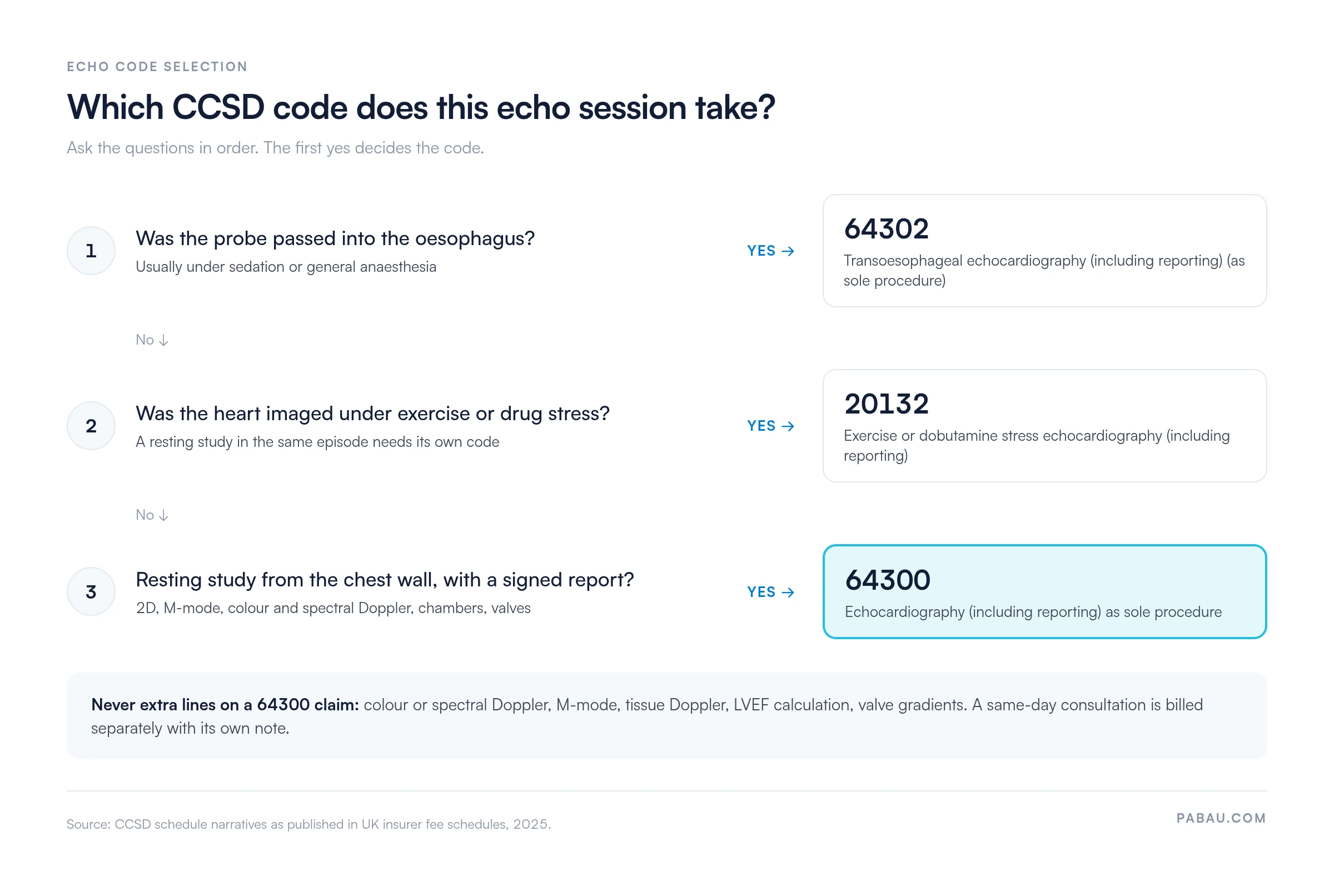
If the clinical record shows a TOE probe was used, submit the claim as 64302. Choosing 64300 to make the bill look smaller is still a code selection error, and insurers treat it as one. Review the procedure note before coding. The chart below runs the same check as three questions, in the order a coder should ask them.
Several CCSD codes regularly appear in the same episode as an echocardiogram. Knowing how each relates to 64300 prevents both under-billing and improper unbundling. The table below covers the most common neighbours in a private cardiology workflow.
A cardiology consultation on the same day as a TTE is among the most common same-day combinations in UK private cardiology. Both are billable as separate items, provided each is documented with its own clinical notes. The echo report does not replace consultation documentation, and the consultation note does not substitute for a written echo report.
The CCSD schedule bundles echocardiography, so the 64300 fee covers the complete examination as one billable unit. Billing individual technical components separately is unbundling. It breaches insurer billing terms and can lead to claim recovery or exclusion from insurer recognition schemes.
These components are bundled within 64300 and must not be billed as separate line items alongside it:
Audit echo invoices periodically to confirm that no Doppler or sub-component line has been added to a 64300 claim. This is a known audit trigger for Bupa and AXA Health. The CCSD Technical Guide is the authoritative reference wherever bundling is ambiguous.
Echo claims fail for a small number of recurring reasons, and each has a specific corrective action. The table below maps each denial trigger to its fix, based on patterns reported across UK private medical billing. Missing pre-authorisation is among the most common triggers, though no published insurer data ranks denial reasons definitively.
Review denial patterns quarterly. When the same rejection reason keeps returning, fix the workflow step that causes it instead of appealing each claim.
Most UK private cardiology claims go electronically through Healthcode, the clearing house used by Bupa, AXA Health, Aviva, Cigna and other private medical insurers. The submission sequence is the same whichever insurer pays.
If a claim is denied, find the specific reason on the insurer’s remittance or rejection notice. Gather the corrective documentation and resubmit within the appeal window. Most UK private medical insurers allow 90 days from the denial date for a formal appeal. Appeals that include a cover letter from the treating cardiologist, explaining the indication and procedure type, succeed more often than bare resubmissions.
For persistent denials on a correctly coded and documented claim, the BMA’s private practice team gives guidance on escalation, including insurer dispute resolution. GMC guidance on private practice also sets out the consultant’s responsibilities for accurate invoicing.
In many private cardiology practices, billing staff still copy membership numbers and pre-auth references from emails onto invoices by hand. Each retyped field is a chance for one of the rejections described above. Pabau’s claims software for cardiologists works from the patient record instead.
Add the patient’s insurer and policy to their record, and each invoice routes to the correct insurer automatically. Before submission, Pabau checks that membership numbers and authorisation codes are filled in correctly. That catches the most common 64300 rejection, where pre-auth was obtained but never recorded on the invoice.
Claims go directly to Healthcode with the invoice attached, so nobody enters the same claim twice. The claims dashboard then shows each claim’s live status, from submitted and processing through to paid or error. Your billing team can see which echo claims need attention before an insurer deadline passes.
List every insurer that requires pre-authorisation for cardiac investigations, and add a pre-auth check to your booking script for those patients. If the reference is on the patient record before the scan, it is on the invoice after it. That one step removes the most common reason 64300 claims are rejected.

Pabau checks membership numbers and authorisation codes before your echo claims go to Healthcode, then tracks each claim through to payment. See how it works in a live demo.

Getting 64300 paid depends on decisions made before the invoice exists. Confirm the probe route and any stress component before choosing the code. Secure pre-authorisation at booking, and check that the signed report meets the BSE dataset before billing.
Practices that build those checks into the patient pathway spend far less time on resubmissions and appeals. The cost is a few extra minutes at booking and reporting, and the return is echo claims that clear the first time.
Book a demo to see how Pabau keeps pre-auth references and membership numbers on every echo claim you send to Healthcode.

Checking whether a transoesophageal study bills differently? CCSD code 64302 covers TOE billing, sedation and the same-session rules that separate it from 64300.
Need a full reference for Bupa CCSD codes? Bupa CCSD codes guide covers the schedule of codes Bupa recognises for UK private practice billing.
Want to check what Bupa pays for a procedure? Bupa procedure codes fee schedule explains how Bupa sets and publishes its recognised consultant fees.
Billing other cardiac investigations too? CCSD code 20143 covers removal of an implantable ECG loop recorder, another chapter 1 investigation code.
CCSD code 64300 covers a complete transthoracic echocardiographic examination with its written report. That includes 2D imaging, M-mode, colour and spectral Doppler, left ventricular function, and chamber and valve assessment. It does not cover transoesophageal echocardiography, stress echocardiography, or paediatric echo protocols.
Pre-authorisation is likely required for cardiac investigations under Bupa. Check the current requirements on the Bupa provider portal before the appointment, as retrospective authorisation requests are routinely declined. Record the authorisation reference number at the time it is issued.
A successful 64300 claim needs a written echo report meeting the BSE minimum dataset and a referral letter documenting the clinical indication. It also needs the pre-authorisation reference, the treating consultant’s GMC number and the correct date of service. Missing any of these elements is grounds for rejection.
Yes. A cardiology consultation and a transthoracic echocardiogram on the same day are separately billable. Each must be documented with its own clinical note or echo report. The consultation note alone does not substitute for a written echo report.



