CPT Code 69610: Tympanic membrane patch repair (myringoplasty)
CPT code 69610: official descriptor and procedure overview CPT code 69610 descri...

Last Updated: Oct 19, 2026
Billable Code
Found our content helpful?What is CCSD code 22028? CCSD code 22028 is the code in the CCSD (Clinical Coding and Schedule Development) schedule for an inpatient sleep study (polysomnography). The CCSD Group publishes and maintains the schedule, which UK private healthcare uses to link clinical procedures to insurer reimbursement rates. Every UK private medical insurer […]
Let Pabau's smart automation suggest the right codes, reduce claim denials, and keep your practice compliant—effortlessly.
Automate repetitive tasks and focus on what matters most—your patients.
Reduce coding errors and ensure compliance with the latest regulations.
Clean claims, fewer denials, and faster reimbursements.
Powerful insights and reporting to help your practice thrive.
HIPAA compliant SOC 2 certified GDPR-compliant Trusted by 4,000+ clinics worldwide

CCSD code 22028 covers inpatient polysomnography only, and home sleep studies are billed under CCSD code 22029.
All major UK private medical insurers require pre-authorization before the study, and a retrospective request rarely succeeds.
Most rejections trace back to a missing pre-authorization reference, a mismatched ICD-10 G47 diagnosis code, or an incomplete PSG report.
Practice management software like Pabau raises CCSD-coded insurer invoices and submits them through Healthcode, which cuts manual re-keying errors.
CCSD code 22028 is the code in the CCSD (Clinical Coding and Schedule Development) schedule for an inpatient sleep study (polysomnography). The CCSD Group publishes and maintains the schedule, which UK private healthcare uses to link clinical procedures to insurer reimbursement rates.
Every UK private medical insurer in the Association of British Insurers (ABI) requires CCSD codes on submitted invoices. Without them, the insurer cannot process the claim or apply its agreed fee schedule.
CCSD lists 22028 in its Schedule of Diagnostic Tests, and a February 2026 bulletin duplicated it into the Procedural Schedule with a matching narrative. Its official descriptor is: Inpatient sleep study (polysomnography) including reporting. The code applies only to studies performed in an inpatient setting, with the patient admitted overnight to a recognized sleep facility or hospital ward.
Home sleep studies carry their own codes, including 22029 (Home sleep study including reporting), and cannot be substituted for 22028 on a claim.
Inpatient polysomnography is an overnight diagnostic study that records several physiological signals at once while the patient sleeps in a controlled clinical environment. A registered sleep technician or polysomnographic technologist must be present throughout to monitor signal quality, respond to clinical events, and document the study.
The parameters recorded during a standard inpatient PSG covered by CCSD code 22028 include:
The inpatient setting distinguishes CCSD 22028 from ambulatory studies. Admission allows technician supervision throughout the night, an immediate clinical response to adverse events, and CPAP titration in the same session if clinically indicated. A home environment cannot meet these requirements, which is why the code is setting-specific.
CCSD code 22028 is appropriate when a consultant physician has determined that an inpatient sleep study is clinically necessary. The British Thoracic Society and British Sleep Society both recognize inpatient polysomnography as the diagnostic standard for complex sleep presentations. Common indications include:
Insurers expect claims for CCSD code 22028 to be supported by an ICD-10 diagnosis code from the G47 family (Sleep disorders). The most common pairings are:
Understanding the bundling rules for CCSD code 22028 prevents the two most expensive billing errors: Either under-claiming or over-claiming. Under-claiming means omitting a legitimately separate code. Over-claiming means billing separately for services already bundled inside 22028.
Whether CPAP titration performed during the same overnight admission can be billed alongside CCSD code 22028 varies by payer. Always verify current bundling policy directly with each insurer before submitting a split-night claim.
The CCSD schedule includes several codes near 22028 that cover related but distinct sleep diagnostic procedures. Selecting the wrong one is a frequent source of claim rejection, particularly when ambulatory studies are billed as inpatient. The table below summarizes the key neighboring codes, so verify current descriptors and fees against the official CCSD schedule before billing.
CCSD confirmed the 22029 narrative in its January 2026 diagnostic schedule bulletin, and 22030 has been listed since January 2025. The oximetry and CPAP titration rows describe study types rather than official narratives, so check their current codes against the published schedule. Guides to other diagnostic test codes, such as 20130 for exercise ECG, sit in our CCSD codes hub.
A complete documentation set is the single most reliable way to prevent rejection of an inpatient sleep study claim. Billing compliance in UK private practice requires a chain of clinical and administrative evidence that an insurer can audit.
Every CCSD code 22028 claim submission should include:
Missing any one of these elements is enough to trigger rejection by most major PMIs. Retain all supporting documentation for a minimum of eight years, in line with the NHS Records Management Code of Practice for adult health records. Apply UK GDPR data protection standards throughout storage and transmission.
Practices operating under CQC registration in England should also make sure their billing workflows align with their registered activity scope. CQC oversight covers how clinical services are documented and reported, which overlaps with the record-keeping a sleep study claim depends on.
Pre-authorization for inpatient sleep study billing is effectively mandatory across all major UK private medical insurers. Performing the study without a valid pre-authorization reference and then requesting retrospective authorization almost always ends in rejection.
The table below summarizes the positions of the principal PMIs. Always verify current requirements with each insurer’s provider line, as policies change. For Bupa-specific lookups, our Bupa CCSD codes guide covers the major procedure categories in detail. You can also check current Bupa code information through the Bupa code search portal.
The standard process for obtaining pre-authorization for a CCSD 22028 study runs in three steps:
Request pre-authorization at least five working days before the planned study date. Most major UK PMIs process standard inpatient authorization requests within 48–72 hours, but complex presentations or international members can take longer. Build the pre-authorization step into your booking workflow so the reference number is confirmed before the patient arrives.
Claim rejection rates for inpatient sleep studies are higher than for outpatient procedures, largely because the documentation burden is greater. Knowing the specific failure modes helps billing teams build checks before submission instead of managing appeals afterward.
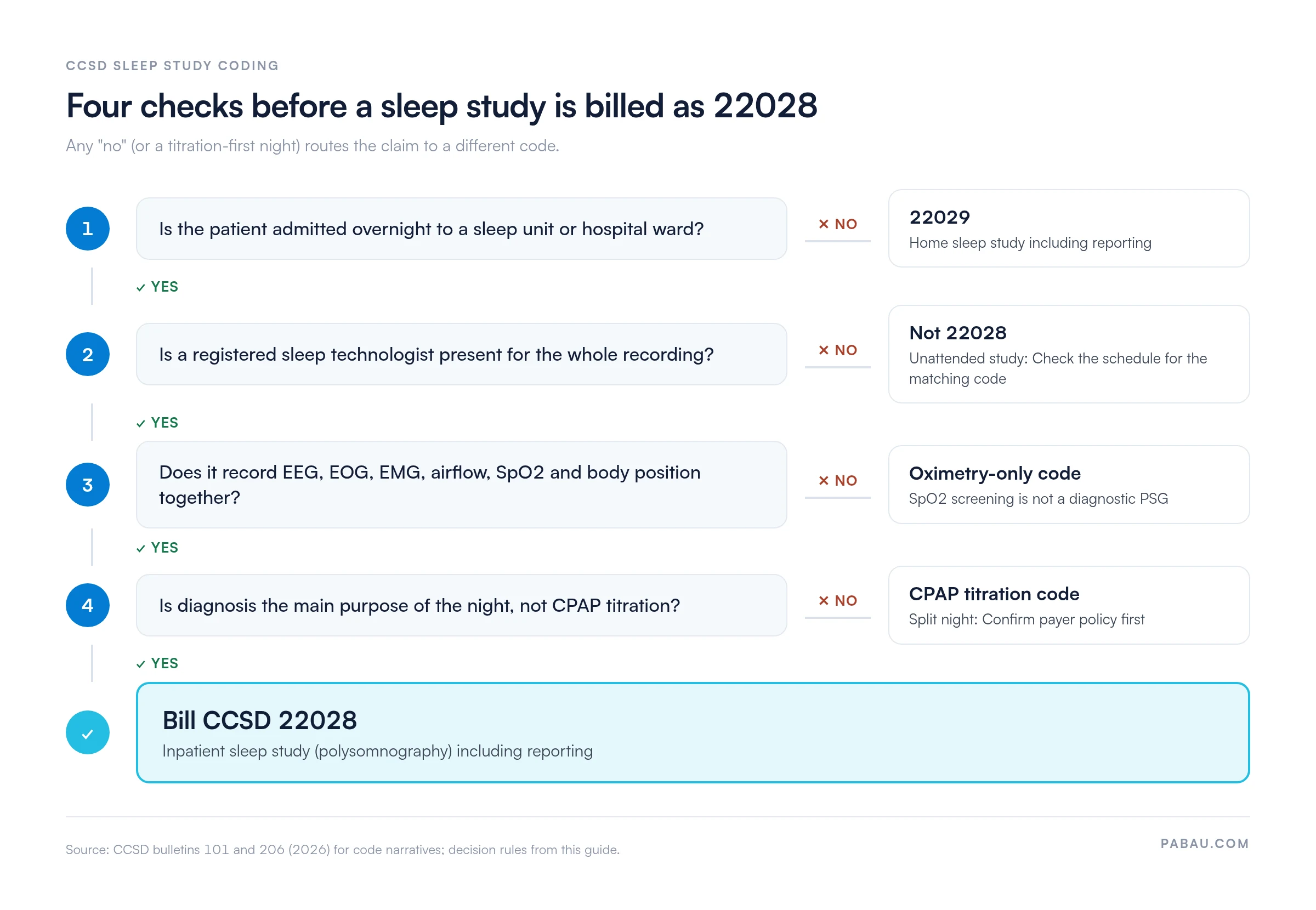
Code lists show the neighboring sleep codes side by side, but they rarely say which one a given night calls for. The rule below settles that before a code is selected, which removes the most common coding errors at source.
Use CCSD code 22028 only when all three conditions hold:
Do not use CCSD code 22028 in any of these cases:
Each of these scenarios requires a different CCSD code. The flow below runs the checks in order and shows where each failed check sends the claim.
Billing inpatient sleep study claims through practice management software cuts manual data-entry errors and speeds up submission through Healthcode. Look for software that handles CCSD code entry, pre-authorization references, and direct electronic submission in one place.
The workflow for billing CCSD code 22028 through Pabau’s claims management software follows these steps:
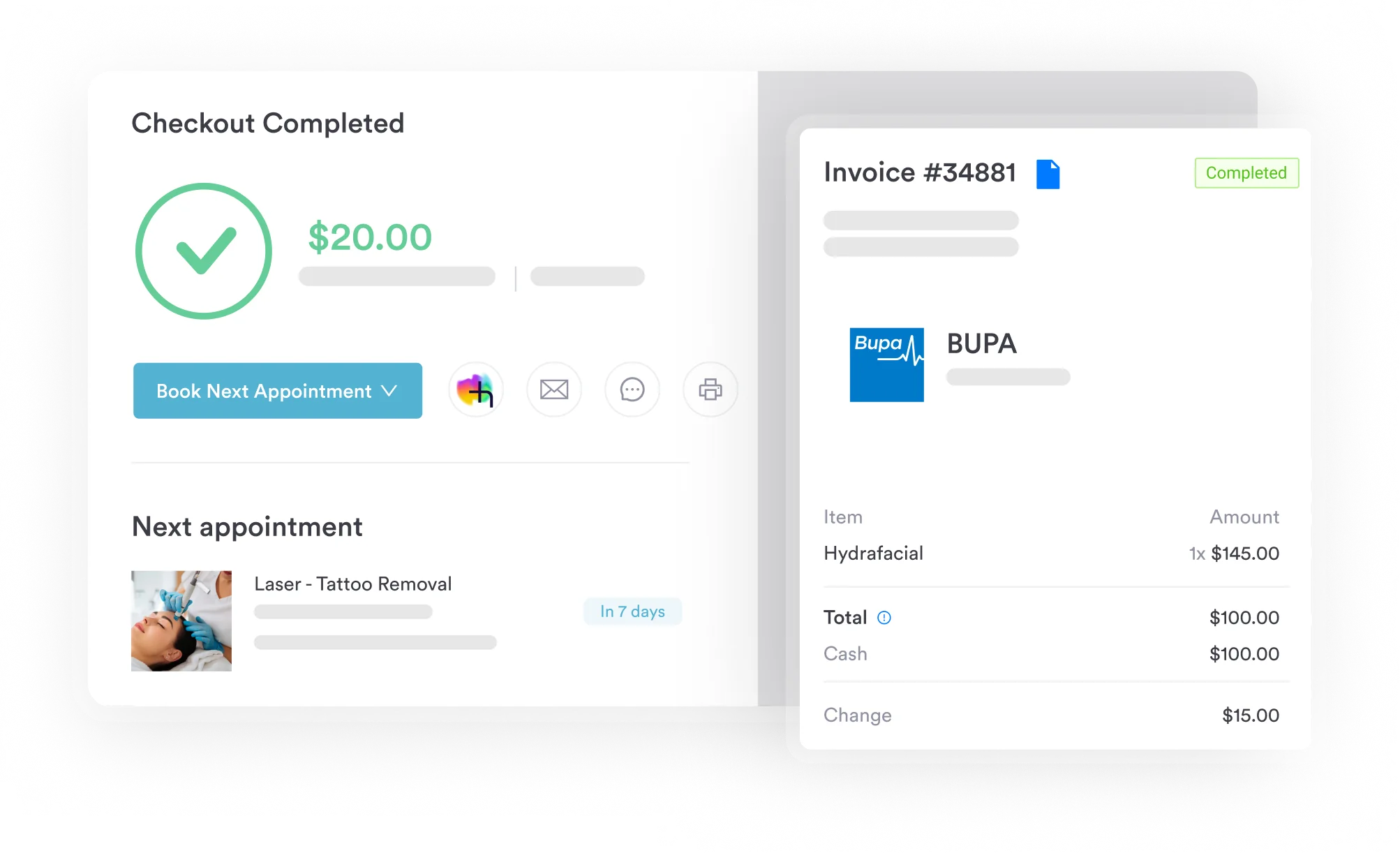
Because Pabau keeps insurer-specific price lists, 22028 is invoiced at the rate agreed with each PMI. The Healthcode connection also removes manual re-keying of invoice data, and the same platform runs scheduling, clinical records, and reporting alongside CCSD invoicing.
Before invoicing, check the negotiated rate for 22028 against each insurer’s own fee schedule, such as those published by Healix and Bupa.

Pabau raises CCSD-coded insurer invoices from the patient record and submits them through Healthcode. UK sleep services and specialist practices stop re-keying claims. See how it works in your setting.

Most money lost on CCSD code 22028 is lost before the study night. A study booked without a pre-authorization reference, or a home study coded as inpatient, rarely gets paid, however clean the paperwork looks afterward.
So move the checks upstream. Confirm the setting, the channel set, and the pre-authorization reference at booking, and let the invoice inherit them. The signed PSG report is then the only item left to add before submission.
To see how Pabau carries a 22028 claim from booking to Healthcode submission for sleep services and specialist practices, book a demo.

Managing multiple CCSD codes across a specialist practice? Bupa CCSD codes guide covers the most frequently used procedure codes for Bupa-insured patients in UK private healthcare.
Billing a sleep EEG rather than a full PSG? CCSD code 22003 explains sleep EEG billing and the pre-authorization it needs.
Need to understand how UK private healthcare billing works end to end? Medical billing fundamentals explains how invoicing, coding, and insurer payment interact across UK and international private practice.
Concerned about claim denials across your specialist invoicing? Denial management in healthcare covers how to identify, appeal, and prevent rejection patterns across private medical insurer claims.
Billing other diagnostic tests in the same schedule? CCSD code 20130 covers exercise ECG billing for UK private practice.
CCSD code 22028 covers an inpatient sleep study (polysomnography), including reporting. It is a full-night, multi-channel diagnostic recording made in a clinical inpatient setting, with a registered sleep technician present throughout. The code includes the overnight monitoring, technician attendance, all equipment, and the final scored PSG report. Home sleep studies are billed under a separate code, 22029.
All major UK private medical insurers that use the CCSD schedule accept CCSD code 22028. That includes Bupa, AXA Health, Vitality Health, Aviva Health, and Cigna Global. Each insurer has its own pre-authorization requirements and fee schedule. Verify current policies with the insurer’s provider line before performing the study.
Yes. Both Bupa and AXA Health treat pre-authorization as mandatory for CCSD code 22028 inpatient sleep studies. Retrospective authorization is rarely approved by either insurer. Obtain the pre-authorization reference number before the study date and include it on every invoice submitted for that patient episode.
A valid claim needs a consultant referral letter, the insurer’s pre-authorization reference number, and inpatient admission records. It also needs a fully scored and signed PSG report with the channel list, the sleep technologist’s credentials, and the paired ICD-10 G47 diagnosis code. All elements must be in place before submission through Healthcode.
An inpatient sleep study (CCSD code 22028) requires overnight admission to a recognized clinical facility with a technician present throughout. A home study uses portable equipment without technician supervision and is billed under 22029. These are distinct clinical episodes, and billing a home study as inpatient is the most frequent reason for CCSD 22028 claim rejection.
It depends on the insurer’s bundling and unbundling rules, which decide whether 22028 can sit alongside codes such as CPAP titration or consultation. Do not assume codes can be combined without checking the payer’s current schedule, because duplicate billing is a common rejection reason. Verify bundling permissions with each insurer before submitting multi-code invoices.