CCSD code G7100: Bypass of ileum billing guide
CCSD code G7100 covers a bypass that leaves the ileum in place CCSD code G7100 i...

Last Updated: Oct 19, 2026
22003 is the CCSD code for sleep electroencephalography, an EEG recorded while the patient sleeps naturally or after sleep deprivation. It sits in chapter 3 of the CCSD schedule, under section 3.9, Neurophysiological procedures, and carries a Minor complexity rating.
A recording on its own does not satisfy the code. The claim also needs an interpreted report signed by the supervising consultant, plus an insurer pre-authorisation reference obtained before the study. Those two requirements, and the neighbouring EEG codes people confuse with 22003, account for most rejected claims.
Let Pabau's smart automation suggest the right codes, reduce claim denials, and keep your practice compliant—effortlessly.
Automate repetitive tasks and focus on what matters most—your patients.
Reduce coding errors and ensure compliance with the latest regulations.
Clean claims, fewer denials, and faster reimbursements.
Powerful insights and reporting to help your practice thrive.
HIPAA compliant SOC 2 certified GDPR-compliant Trusted by 4,000+ clinics worldwide

CCSD code 22003 covers sleep EEG, which is a different code from routine EEG (22000), ambulatory EEG (22004) and video telemetry (22005).
A recording on its own is not billable, so the claim needs an interpreted report signed by the supervising consultant.
Bupa, AXA Health and Vitality all expect pre-authorisation before the study, and a missing reference number is the top denial trigger.
Polysomnography is a separate investigation with its own code, so a sleep EEG should never go out under a PSG code.
Pabau stores your CCSD code library and insurer-specific fees, then checks a claim for missing fields before you submit it.
CCSD code 22003 is the schedule code for sleep electroencephalography, the neurophysiological investigation that records brain electrical activity during sleep.
The schedule itself is owned and maintained by the CCSD Group, a board representing Bupa, AXA Health, Aviva and Vitality. It assigns 22003 to EEG performed under sleep conditions, which separates it from waking EEG and from overnight polysomnography.
Within the schedule, the code sits in chapter 3 under section 3.9, Neurophysiological procedures, and carries a Minor complexity rating. That chapter covers spine, spinal cord and peripheral nerve work, and the wider set of CCSD codes shows what else sits alongside it.
The code applies when a consultant neurophysiologist or neurologist orders and supervises the recording. They also produce the formal interpreted report and carry clinical responsibility for the findings. Without that report, there is no claim.
A sleep EEG uses the standard 10-20 electrode placement system, with 19 to 32 scalp electrodes capturing brain wave patterns across multiple channels.
The patient rests in a darkened room and falls asleep naturally, or sleep is brought on by prior sleep deprivation. Recording runs from about 20 minutes to several hours, depending on the clinical question.
Afterwards, the neurophysiologist reviews the trace, identifies sleep stages and any abnormal discharges, and produces a signed clinical report. That interpreted report is what makes the study billable under the CCSD technical guide. It must carry the supervising consultant’s name and signature.
Insurers reimburse 22003 only when the indication documented in the referral supports the investigation. These are the indications UK private practice sees accepted most often:
Each of those needs a matching ICD-10 diagnosis code on the record. A vague referral description with no supporting diagnosis code is one of the most common triggers for an insurer query.
Guidance from the Association of British Neurologists and the British Society for Clinical Neurophysiology shapes what counts as accepted practice here.
Picking the wrong code from the neurophysiology section is the most frequent coding error on sleep studies. The four codes below look adjacent on the schedule and describe genuinely different investigations. A waking study bills under 22000, a code limited to adults and children aged over five.
Polysomnography and sleep EEG are distinct investigations with distinct codes. PSG captures respiratory, cardiac and limb-movement channels alongside the EEG trace. That makes it the right choice for suspected sleep apnoea or a multi-system sleep disorder.
Send a sleep EEG under a PSG code, or the reverse, and most insurers will raise a clinical query or reject it outright. Inpatient polysomnography has its own CCSD code, 22028, so an overnight hospital study is billed there rather than under 22003.
The CCSD technical guide defines what the published fee is meant to cover. Knowing the boundary prevents under-billing on one side and unbundling errors on the other.
Interpretation and recording cannot be split for billing purposes. Where a physiologist runs the study and a consultant reports it later, the claim still goes out under the consultant’s provider number. Clinical responsibility sits with them.
Splitting one investigation across two EEG codes is the other side of the same rule. Say a routine waking EEG and a sleep EEG were genuinely performed as separate studies on the same day. Document each with its own indication before submitting both.
Check whether your practice management system records electrode count and recording duration in the clinical note. Insurers occasionally ask for that detail when querying a sleep EEG claim. Storing it at the point of care removes a retrieval step if a query arrives weeks later.
Seven items make up a complete claim. If any of them is missing, the payer has grounds to query or reject the submission.
Several insurers also ask for the referral letter as a supporting document at the claims stage, particularly on a first sleep EEG for that patient. Capturing all seven at the point of care, rather than reassembling them later, is what keeps a query from turning into a write-off. The sequence below shows where each one has to exist.
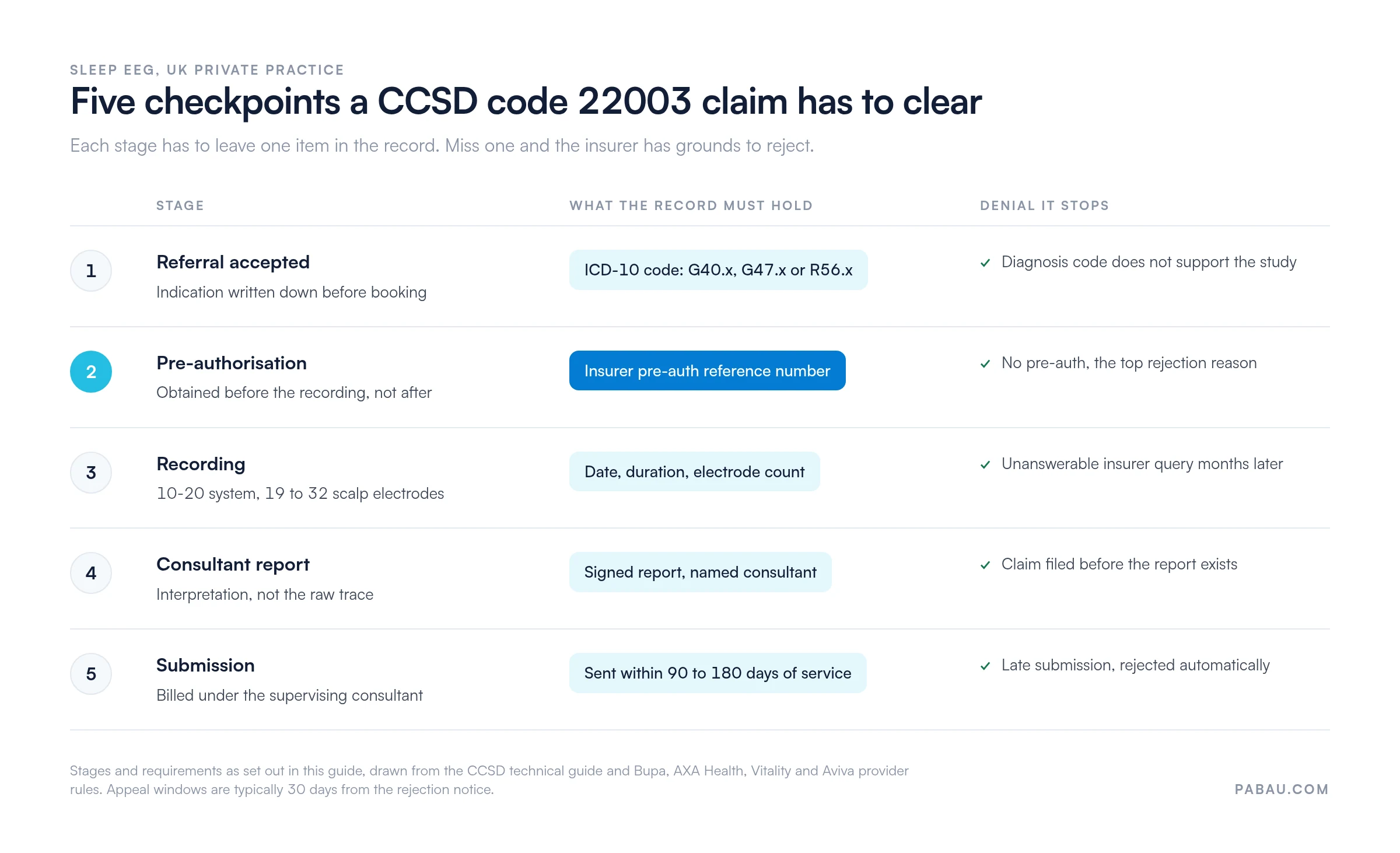
UK private medical insurers treat sleep EEG as a diagnostic investigation that needs approval in advance. Submitting without a valid pre-auth reference is the most common reason a 22003 claim comes back.
The table reflects general insurer policy, so verify against each provider portal before you book, because requirements change.
Each insurer’s process asks for the same three things: the code number, the diagnosis or clinical indication, and the name of the ordering consultant.
Getting authorisation before the investigation removes the single most controllable denial risk on a 22003 claim. Record the reference against the appointment as soon as it arrives, so the biller is not hunting through an inbox weeks later.
The CCSD fee guide publishes a suggested fee for each code, 22003 included. Treat it as a benchmark. Individual insurers apply their own uplifts, caps, or percentage relationships to the published schedule, so what lands in the practice account varies by contract.
Pull the current figure from the CCSD website rather than a saved copy, since the schedule is revised periodically. The Bupa fee schedule sets out insurer-specific figures for Bupa-recognised providers.
Hold the correct fee per insurer in your billing system. That stops you under-billing a payer who pays above schedule, and over-billing one who applies a cap.
Sleep EEG is rejected more often than most neurophysiology investigations, for two structural reasons. The code sits next to both ambulatory EEG and polysomnography, and nearly every insurer requires prior approval.
These are the triggers that show up most:
An illustrative case makes the sequence easier to hold. A patient is referred in March with unexplained nocturnal events, and the practice is billing Bupa.
The consultant accepts the referral and records R56.9 as the working diagnosis that day. The practice requests pre-authorisation through the Bupa provider portal, quoting 22003, the indication and the ordering consultant. A reference number comes back two working days later and goes straight onto the appointment.
The study runs the following week: 24 scalp electrodes, 90 minutes of recording, physiologist present throughout. The consultant reports it four days later and documents focal nocturnal seizure activity. The diagnosis on the claim is updated to the specific G40 subcode. The report is signed and filed the same day.
The biller then raises the invoice under the consultant’s provider number, attaches the pre-auth reference and the updated diagnosis code, and submits inside the month. Nothing in that run is unusual. It pays first time because each step left its evidence behind before the next one started.
Run these six questions over the claim before it leaves the practice. Any answer of “no” is a claim you will be chasing in six weeks.
A rejection is rarely final. UK private medical insurers run formal appeals or reconsideration processes, and a well-prepared appeal overturns a good proportion of first denials, especially the administrative ones.
Work through these five steps in order:
If a medical necessity denial survives the first appeal, escalate through the insurer’s own dispute resolution process. The route and its deadlines are set out in that insurer’s provider manual, so read it before the second submission rather than after.
The diagnosis code submitted with 22003 has to reflect the indication in the referral and the clinical record. These are the ICD-10 codes UK neurophysiology practices use most often on sleep EEG claims.
The NHS Classifications Browser carries the ICD-10 mapping guidance used in UK practice. Check that your chosen code is valid for the current coding year before you submit. Annual updates occasionally retire or restructure codes inside chapters G40 and G47.
Capture the ICD-10 code when the referral is accepted, not at the billing stage. A diagnosis documented before the investigation shows the indication was established in advance. That strengthens both the pre-auth application and the claim that follows.
In most neurophysiology practices, the CCSD code lives in one spreadsheet and the insurer fee lives in another. The pre-auth reference sits in somebody’s inbox. The biller reassembles all three at invoicing, usually days after the study. That reassembly step is where references get missed and the wrong EEG code gets typed.
Practice management software like Pabau keeps those pieces attached to the appointment instead. Add 22003 to the procedure library once, with its exact descriptor, and it populates invoices without re-keying. Store the contracted fee per insurer against the code, and the right amount applies automatically for that patient’s payer.
Pabau’s streamlined claims management then pre-fills the claim from the patient record and checks it for missing required fields. Claim status is tracked from submission through to payment.
For UK practices, claims route out through Healthcode. The pre-auth reference and the diagnosis code still come from your team, and the completeness check is what stops a claim going out without them.
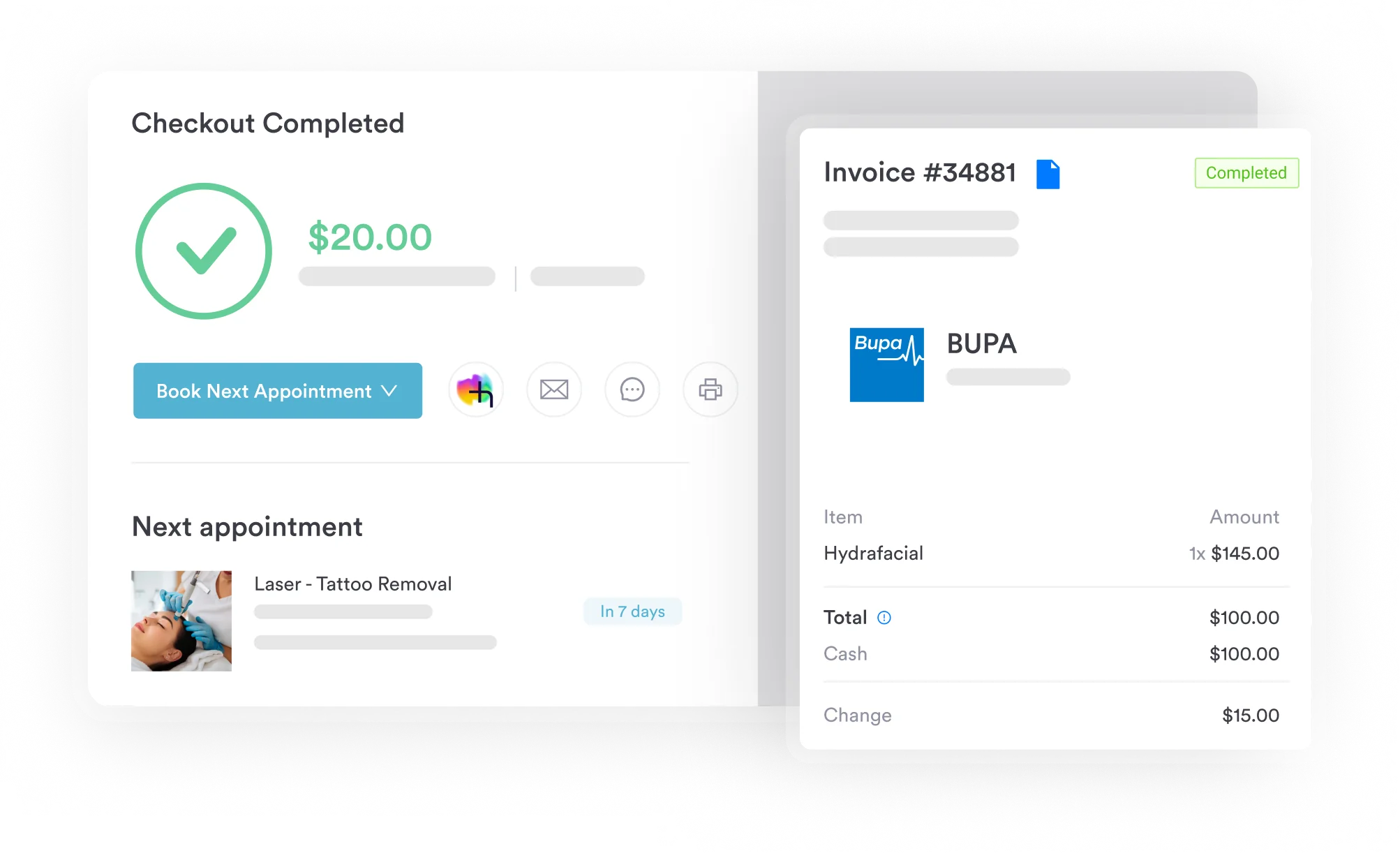

Pabau holds insurer-specific CCSD fee schedules against each code and pre-fills claims from the patient record. Missing fields get flagged before submission. See how it works for neurophysiology and neurology teams.

22003 is an easy code to get right, and an easy one to lose money on. Three things decide it. The indication needs a matching ICD-10 code. Pre-authorisation has to be obtained before the study. The signed interpreted report has to be in the record before the claim goes out. Almost every rejection traces back to one of those three.
The trade-off worth remembering is timing. Each of those three is cheap to do at the point of care. Reconstructing them at appeal is expensive. The work belongs at the front of the pathway.
If the reassembly step is where your claims keep stalling, that is a systems problem rather than a coding one. Book a demo to see how Pabau holds CCSD codes, insurer fees and claim status in one place for UK private practice.

Need the Bupa view of the schedule? Bupa CCSD codes covers how Bupa applies the CCSD schedule, including recognition requirements and code-specific billing rules.
Billing another neurophysiology study? CCSD code 22024 sets out the documentation and pre-auth rules for EMG and nerve conduction studies.
Billing the consultation alongside the test? CCSD code 20300 explains how an initial face-to-face outpatient consultation is coded and when it can be claimed.
Working through a rejection? Denial codes in medical billing decodes the rejection reasons payers return and what each one asks you to fix.
Comparing UK billing systems? Best medical billing software in the UK reviews the platforms UK private practices use to submit and track insurer claims.
Usually, yes. Insurers authorise a specific procedure, consultant and date range, so a second study on a new date needs its own reference. Check the original authorisation’s expiry before you rebook.
No. CCSD code 22003 covers both natural sleep and sleep brought on by prior deprivation. The distinction belongs in the report, where the method used should be recorded, rather than in the code you bill.
Yes. CCSD codes describe the procedure, not the payer, so a self-pay invoice can carry 22003 for consistency across your records. The suggested schedule fee has no bearing on what you charge a private patient.
No. The code covers the investigation whatever the patient’s age. Sedation used to induce sleep is billed separately where it applies, and the clinical indication still drives which diagnosis code goes on the claim.
Yes. The fee pays for the investigation and its interpretation, not for a positive finding. A normal or inconclusive study with a signed consultant report is a valid claim.