ICD-10 Code Y76.0: Diagnostic obstetric and gynecological devices
ICD-10 Code Y76.0: Definition and billable status ICD-10 Code Y76.0 is a valid, ...

Last Updated: Oct 23, 2026
Billable Code Specific Code
Z95.9 is the billable ICD-10-CM code for presence of cardiac and vascular implant and graft, unspecified.
Medicare, Medicaid, and most commercial payers accept Z95.9 on submitted claims. It is the fallback inside a category that also holds specific codes for pacemakers, bypass grafts, prosthetic valves, and coronary stents. Reaching for it when the note names the device is a coding error.
Let Pabau's smart automation suggest the right codes, reduce claim denials, and keep your practice compliant—effortlessly.
Automate repetitive tasks and focus on what matters most—your patients.
Reduce coding errors and ensure compliance with the latest regulations.
Clean claims, fewer denials, and faster reimbursements.
Powerful insights and reporting to help your practice thrive.
HIPAA compliant SOC 2 certified GDPR-compliant Trusted by 4,000+ clinics worldwide

Z95.9 is a billable ICD-10-CM code for an unspecified cardiac or vascular implant, valid when the record confirms a device but never names it.
The parent code Z95 is non-billable, so Z95.9 applies only when no more specific child code fits.
Z95.9 is almost always a secondary diagnosis rather than the reason for the encounter, and sequencing it first invites payer rejection.
A clinician query is the right move whenever clinical context points to a device the encounter note never names.
Pabau’s built-in ICD-10 code search and structured notes prompt clinicians to record the device type before the claim is built.
ICD-10 code Z95.9 describes the presence of a cardiac or vascular implant or graft when the record does not say which device the patient has. The CDC/NCHS ICD-10-CM web tool lists it under the Z95 category, “Presence of cardiac and vascular implants and grafts”. It became valid for submission on October 1, 2025, for the 2026 fiscal year.
The code covers cardiac implants such as pacemakers, defibrillators, prosthetic heart valves, and bypass grafts. It also covers vascular devices such as angioplasty implants, peripheral stents, and other vascular grafts. Either way, it applies only while the clinical record leaves the device type unnamed.
Z-codes in this section are status codes rather than condition codes. They record a patient’s standing with a device, not an active disease process. Z95.9 does not stand for the implantation procedure, and it does not cover ongoing device management. Those scenarios call for procedure or management codes from the appropriate chapter.
The table below summarizes the reference data coders need when working with ICD-10 code Z95.9. All of it reflects the 2026 ICD-10-CM edition published by the Centers for Medicare and Medicaid Services (CMS).
The Z95 parent code is non-billable. Coders must select one of its child codes to generate a valid claim line. Knowing where Z95.9 sits in the hierarchy prevents two opposite errors. One is reaching for Z95.9 while the record supports a specific code. The other is skipping it when the documentation honestly stops short.
The category covers the range of cardiac implants and vascular devices a patient carries after a prior intervention. These are status codes, so they communicate a fact about the patient’s current physiology that bears on ongoing care. Z95 is one family within the wider ICD-10-CM code set, and the specificity rule governs all of them alike.
Z95.9 applies only when documentation confirms a device is present but never identifies its type. If the record names the device, the more specific code always takes precedence. Coding guidance from the AAPC ICD-10-CM code reference is consistent on the point. An unspecified code is wrong wherever the documentation supports specificity.
At the desk, that judgment runs as a short sequence of questions. Read the progress note or operative report, decide whether the device type is named, and take the branch the record supports. The diagram below traces all three branches and shows where Z95.9 lands.
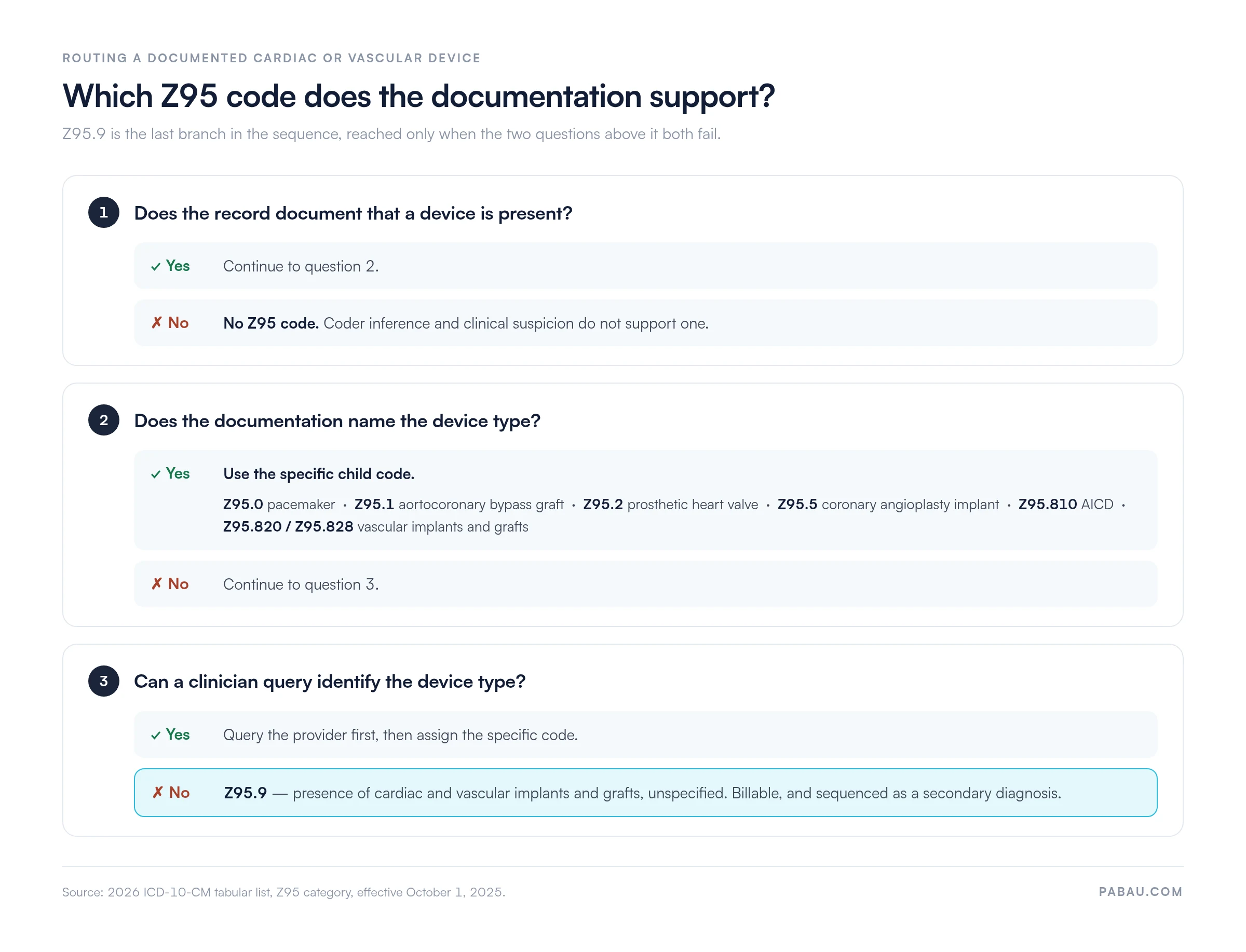
Z95.0 is the pacemaker status code, and Z95.810 covers an automatic implantable cardiac defibrillator (AICD). Using Z95.9 for a patient documented with either device is a coding error. Payers, quality reporting programs, and risk-adjustment models all handle the specific codes differently.
A note that says “patient with cardiac device” and stops there is a genuine Z95.9 scenario. A note that says “pacemaker present” or “defibrillator implanted” has already answered the question, however convenient the unspecified code feels.
Z95.9 requires that a physician or another qualified clinician has documented the implant or graft in the patient’s record. The code cannot be inferred from clinical context, and it cannot be assumed from a device-related order.
The documentation must establish two facts: That a device is present, and that its type is not specified in this encounter’s record. When both hold, Z95.9 is appropriate. When the device type appears anywhere in the record for the current encounter, the specific code wins. That includes the history section and prior notes incorporated by reference.
A clinician query is warranted when clinical context points to a specific device, such as an EKG showing paced rhythm. The note itself still names no device type. Querying before coding beats using Z95.9 as a shortcut. Structured digital documentation surfaces the missing detail earlier in the workflow.
The ICD-10-CM Official Guidelines for Coding and Reporting govern how Z-status codes are applied. Z95.9 falls under the status-code rules in Section I.C.21, which cover Z-codes reporting a patient’s history, status, or exposure relevant to their care.
Key guideline points coders must know when working with ICD-10 code Z95.9:
For a payer, a claim carrying Z95.9 signals that the patient has a device history relevant to clinical decision-making. Risk-adjustment and quality programs weight the specific device codes differently, so the unspecified code returns less of that credit to the practice.
Run a monthly audit of your Z95.9 claims against the encounter notes. Where a paced rhythm, device check, or device-management order appears in the same encounter, verify whether Z95.0 or Z95.810 was the correct code. Catching those before resubmission is faster than working post-adjudication denials.
Most Z95.9 errors come from time pressure rather than from a misreading of the tabular list. The record is ambiguous, the encounter still has to be coded, and the unspecified code closes the line. A short review step catches almost all of them before the claim leaves.
Effective claim denial management starts with catching these errors before submission rather than resolving them afterward.
Clinical documentation rarely uses ICD-10 code language verbatim. Coders have to recognize the phrases providers write and map them to the right code. The terms below are commonly accepted as mapping to Z95.9 whenever the device type cannot be specified from the encounter record.
When a provider writes any of these phrases without specifying the device type, Z95.9 is the appropriate code. When other context narrows the device to a pacemaker, AICD, bypass graft, or stent, the coder must use the sibling code. Checking the phrase against the official tabular list settles any synonym the note leaves ambiguous.
The usual reason a coder assigns Z95.9 when a specific code exists is what the note leaves out. The provider knows the patient has a pacemaker, and the encounter note never says so. Practice management software like Pabau moves that prompt forward to the point of documentation.
Pabau embeds diagnostic code lookup inside the clinical workflow, so clinicians and coders stay in the record instead of switching to an external reference site. Structured notes keep the device type in a field the coder can find, and every entry leaves an audit-ready trail for the encounter.
Pabau’s claims management software reviews each claim before it goes out, so a Z95.9 line can be questioned while a query still costs nothing. For practices carrying cardiac and vascular caseloads, that review shortens revenue cycle turnaround and keeps denial rates down.

Pabau’s integrated ICD-10 code search and structured clinical notes help your team capture the device detail a specific code needs. Book a demo to see how Pabau supports cardiac and vascular coding.

ICD-10 code Z95.9 is valid and billable, and in a well-documented practice it should be rare. Its legitimate use is narrow. The device is confirmed present, and no further detail can be found in the encounter record. Every other scenario has a Z95 child code that fits better.
Practices that capture the device type at the point of care rarely need the unspecified code at all. Pabau’s built-in ICD-10 search and pre-submission claim review give coding teams what they need to make that call before a claim goes out. To see how it handles cardiac and vascular documentation, book a demo.

Need guidance on how claim submissions work end to end? What is revenue cycle management covers the full billing workflow from patient encounter to payment posting.
Want to understand how a superbill supports ICD-10 code specificity? Superbill documentation guide explains how a well-structured superbill captures the device details coders need.
Exploring how Pabau connects to the clearinghouse? Claim.MD clearinghouse overview details how claims move from Pabau to payers via the Claim.MD integration.
ICD-10 code Z95.9 is the billable diagnosis code for presence of cardiac and vascular implants and grafts, unspecified. It belongs to the Z95 category. Coders assign it when a patient has a cardiac or vascular device confirmed in their record, but the encounter never documents the device type. It is a status code, not a condition code, and is typically used as a secondary or additional diagnosis.
Yes, Z95.9 is a billable and specific ICD-10-CM code valid for submission and reimbursement as of the 2026 edition (effective October 1, 2025). Its parent code Z95 is non-billable. Coders must always use one of the child codes, such as Z95.9 or a more specific sibling, to generate a valid claim line.
Use Z95.9 only when documentation confirms a cardiac or vascular implant is present but does not identify the device type anywhere in the encounter record. If the note names the device (pacemaker, bypass graft, stent, AICD, prosthetic valve), use the appropriate specific child code. Z95.9 is the last choice, not the default when documentation is inconvenient to locate.
Z95.0 is the specific code for presence of a cardiac pacemaker, while Z95.9 is the unspecified code used when the device type is unknown. If a provider documents a pacemaker, Z95.0 is correct and Z95.9 is a coding error. Assigning Z95.9 for a patient with a documented pacemaker understates specificity, may affect risk-adjustment calculations, and creates audit exposure.
No, Z95.9 is almost never appropriate as a principal diagnosis. It is a status code that describes context about the patient, not the reason for the encounter. ICD-10-CM coding guidelines require the reason for the visit to be sequenced first. Using Z95.9 as a principal diagnosis typically results in payer rejection or audit scrutiny.
Z95.9 can apply to any cardiac or vascular device when the type is unspecified, including pacemakers, stents, bypass grafts, prosthetic valves, and vascular angioplasty implants. However, if documentation identifies the specific device, Z95.9 should not be used. Pacemakers map to Z95.0, AICDs to Z95.810, coronary stents to Z95.5, and bypass grafts to Z95.1.