

ICD-10 Code S42.444P: Medial epicondyle fracture, right humerus
ICD-10 Code S42.444P: full descriptor and code validity ICD-10 Code S42.444P car...

Last Updated: Oct 13, 2026
Billable Code Specific Code
Z93.1 is the billable ICD-10-CM code for gastrostomy status.
One note decides whether you can use it at all. The Z93 category prints an Excludes1 instruction, so Z93.1 never shares a claim with Z43.1 or a K94.2- complication code for the same tube.
Report both and a payer edit can send the claim back.
Let Pabau's smart automation suggest the right codes, reduce claim denials, and keep your practice compliant—effortlessly.
Automate repetitive tasks and focus on what matters most—your patients.
Reduce coding errors and ensure compliance with the latest regulations.
Clean claims, fewer denials, and faster reimbursements.
Powerful insights and reporting to help your practice thrive.
HIPAA compliant SOC 2 certified GDPR-compliant Trusted by 4,000+ clinics worldwide

Z93.1 is a billable ICD-10-CM diagnosis code for gastrostomy status, and it covers G-tube and PEG tube status alike.
The Z93 category carries Excludes1 notes, so Z93.1 is never reported with Z43.1 or with a K94.2- complication code for the same gastrostomy.
Report Z93.1 only when the tube is present, no complication is documented, and the encounter is about something else.
Z93.1 is exempt from Present on Admission reporting, and CMS edits reject it as a principal or first-listed diagnosis.
Z93.1 covers a gastrostomy only, so a nasogastric tube never takes this code.
Z93.1 is a billable, specific ICD-10-CM code valid for reimbursement purposes. It classifies a patient who has an established gastrostomy and is currently managed with a gastrostomy tube.
According to the CMS ICD-10-CM code files, Z93.1 sits inside the Z93 parent category (Artificial opening status).
Z93.1 is a status code, so it records the patient’s current anatomy rather than a surgical encounter. It also carries no “use additional code” instruction of its own, which means it pulls no complication code along behind it.
Z93.1 is wrong whenever the same gastrostomy is being tended or is causing a problem. The Z93 category prints two Excludes1 notes, and they govern every code beneath it, Z93.1 included:
Excludes1 is a pure exclude. Section I.A.12.a of the ICD-10-CM Official Guidelines states that an excluded code is never reported together with the code it sits under. For one gastrostomy at one encounter, Z93.1, Z43.1 and K94.2- are three answers to the same question.
The guidelines do allow one narrow exception, for two conditions unrelated to each other. Gastrostomy status and a gastrostomy complication describe the same stoma, so that exception does not rescue the pairing. Read against the documentation, the choice comes down to three branches.
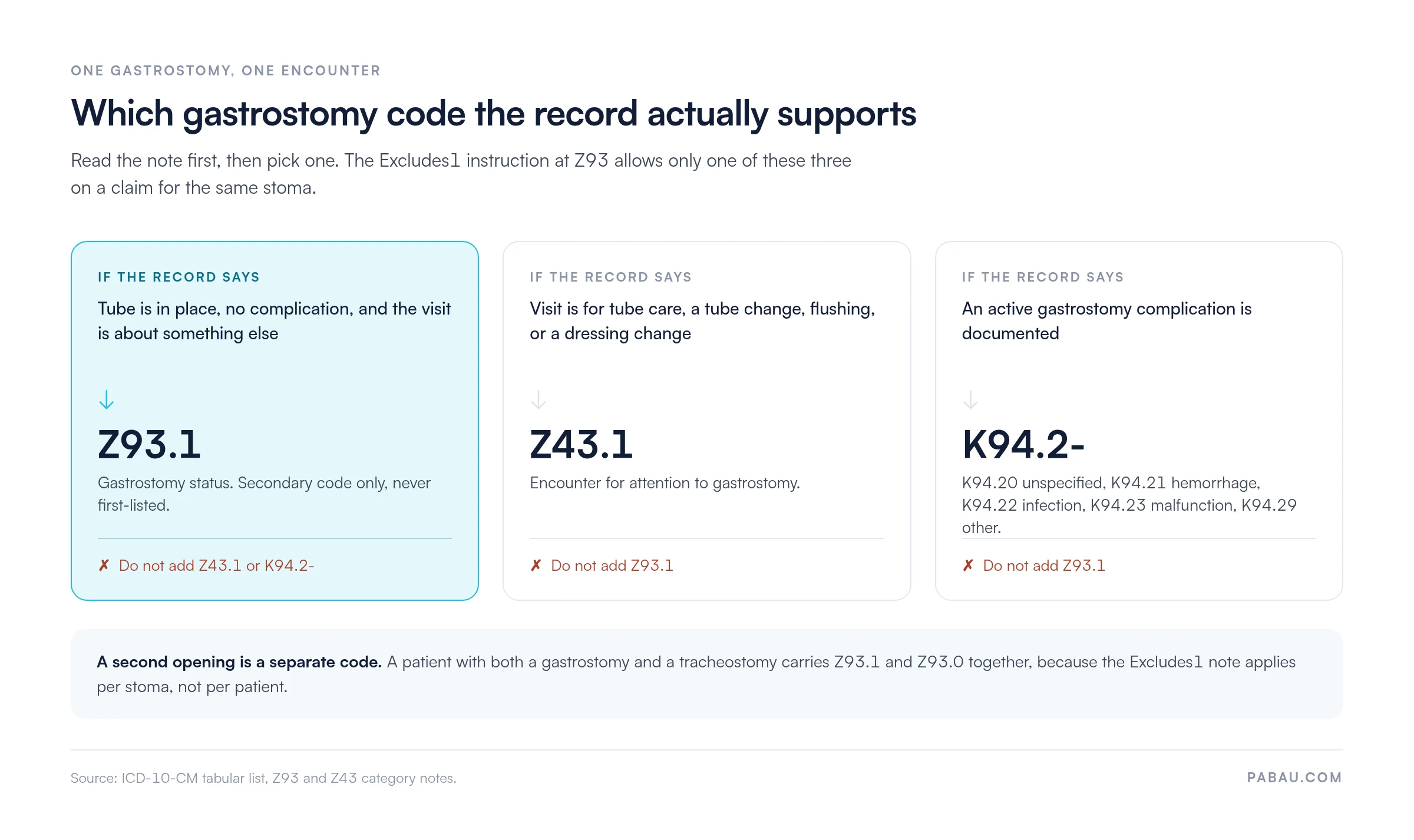
Z43 carries the mirror-image instruction, an Excludes2 note for artificial opening status only, without need for care (Z93.-). Read the two notes together and the division of labor is clear. Z43.1 covers the encounter that tends the stoma, and Z93.1 covers the stoma nobody touched.
Four phrases all resolve to Z93.1, and none of them is printed under the code. The tabular list carries no inclusion terms at Z93.1, so the mapping happens through the alphabetic index and through code lookup tools.
Each term below lands on Z93.1 when the tube is in place and the note describes no care of the stoma.
The insertion method does not change the status code. Open surgical placement and endoscopic PEG placement both land on Z93.1, once the encounter only records that the tube exists. Device wording in a note is a distraction here, so read for care and complications instead.
When the record documents an active gastrostomy complication, the specific K94.2- code carries the encounter and Z93.1 comes off the claim.
The complication code already establishes that the gastrostomy is there, so the payer loses no clinical context. Keeping Z93.1 alongside it creates an Excludes1 conflict instead of adding detail.
The K94.2- subcategory breaks down as follows:
A worked example. A patient with a PEG tube arrives with redness, warmth and discharge around the stoma. The clinician documents peristomal cellulitis.
The complication is what brought the patient in, so K94.22 is first-listed. K94.22 carries its own “use additional code” instruction, so cellulitis of the abdominal wall (L03.311) follows behind it. Z93.1 stays off the claim, and the extra-code instruction belongs to K94.22 rather than to Z93.1.
Reach for K94.20 only when the note names a complication without specifying it. Bleeding, infection and mechanical failure each have their own code, so the unspecified option should stay rare.
Before you settle on Z93.1, read the note for tube malfunction, peristomal irritation, infection signs, or leakage. Any of those moves the encounter to a K94.2- code, and Z93.1 comes off the claim. The reverse trap is just as common. Adding Z93.1 back next to K94.22 for context creates an Excludes1 conflict a payer edit can catch.
A surgically placed G-tube and an endoscopically placed PEG tube take the same status code. According to the CDC/NCHS ICD-10-CM official tool, both map to Z93.1 when status is all that is being documented.
Placement method decides the procedure code at insertion instead, and a laparoscopic placement is billed under CPT 43653.
The nasogastric distinction matters here. Z93.1 applies to a gastrostomy, meaning a semi-permanent opening into the stomach through the abdominal wall. Nasogastric tubes are transnasal and temporary, so they sit outside that definition.
Reaching for Z93.1 on an NG tube patient creates a specificity error. It survives claim edits and then resurfaces in an audit.
Each artificial opening gets its own code, so a second stoma adds a second Z93 code rather than replacing the first. Z93.1 sits within the Z93 parent category, which covers every artificial opening status code.
The full hierarchy matters when a patient has more than one stoma.
A patient with both a gastrostomy and a tracheostomy carries Z93.1 and Z93.0 together. Each opening is coded on its own, because the Excludes1 notes at the top of Z93 do not stand between two different sites.
A gastrojejunostomy follows the same principle, with Z93.4 for the jejunal opening. Reading the parent category before the code is a habit worth keeping, and our ICD-10-CM code reference groups the neighboring categories in one place.
Z93.1 appears on the CMS list of codes exempt from Present on Admission reporting. Three questions follow from that on inpatient claims, so here they are in order.
Does an inpatient claim need a POA indicator for Z93.1? No. The code is POA exempt, so it carries no Y, N, U or W value.
Does Z93.1 affect a hospital-acquired condition penalty? It cannot. POA exempt codes are left out of hospital-acquired condition (HAC) calculations, so Z93.1 never contributes to one.
Does any of this reach outpatient claims? Not at all. POA reporting belongs to Inpatient Prospective Payment System (IPPS) claims only. Outpatient and professional claims carry no POA indicators.
A POA indicator attached to Z93.1 is therefore unnecessary data. Some clearinghouse systems flag it as a claim format warning.
Three things have to be in the record before Z93.1 holds up under review. Missing any one of them can produce a documentation edit request or, after payment, a recoupment.
Run through these before the claim goes out:
Practices that build this check into a pre-bill audit for Z-code encounters catch the mismatch before the payer does. For an outpatient practice managing tube-dependent patients at volume, that check pays for itself quickly.
Four errors account for most Z93.1 claim problems, and a clearer documentation policy corrects each one.
That fourth row is a hard edit rather than a preference. CMS designates Z93.1 as unacceptable as a principal or first-listed diagnosis, so an inpatient claim that leads with it fails the Medicare Code Editor check.
When the visit is about the tube, Z93.1 does not belong on the claim at all. When the tube is incidental, the condition that brought the patient in is first-listed and Z93.1 follows behind it. Auditing that sequence across a tube-dependent patient panel is a sensible first move.
Plenty of gastrostomy encounters resolve to a code other than Z93.1. The table below covers what to report instead of it. It also covers what can sit beside it when a second site or an underlying condition is involved.
The AAPC ICD-10-CM lookup is worth a check before submission. The Excludes1 instruction lives at the category level, not on the code itself.
Practice management software like Pabau handles medical claims management from the patient record itself. That way the code the coder chose is the one that reaches the payer. Choosing between Z93.1, Z43.1 and K94.2- stays a judgment call on the documentation.
The clean use of Z93.1 is the incidental one. A patient with a gastrostomy admitted for pneumonia gets the pneumonia code first, with Z93.1 added as a secondary code. The tabular list does not force you to report it there. Reporting it does tell the payer why enteral feeding orders and dietitian input appear in the chart.
In most practices the coder settles the Z93.1 question inside the clinical note, then retypes the result into a claim form in another system. That second pass is where the wrong code, the missing member number, and the stale eligibility check creep in.
Pabau keeps the record and the claim in one place. The CPT code attached to the service lands on the charge line. ICD-10 fields are seeded from the patient’s recorded problem list. The claim will not send until its required fields are filled in.
On the US pipeline, Claim.MD handles real-time eligibility checks, claim status tracking, and electronic remittance posting. A gastrostomy claim that comes back rejected surfaces within days, while the note is still fresh enough to correct.
What Pabau will not do is choose the code for you. Excludes1 calls belong to the coder and to what the clinician documented. What you get back is the time that used to go into re-keying claim data, plus fewer claims returned for an incomplete field.

Pabau’s claims management keeps the record and the claim in one system. It pre-fills the claim form from the patient’s chart and submits through Claim.MD in the US.

Z93.1 is straightforward once you read the note printed above it. The tabular list treats gastrostomy status, attention to the gastrostomy, and complications of the gastrostomy as three separate encounters. Pick the one the documentation supports and leave the other two off.
The habit worth building is a small one. Before the claim goes out, ask whether the visit touched the stoma at all. That single question settles Z93.1 against Z43.1 and K94.2- almost every time.
Practices billing tube-dependent patients at volume feel the Excludes1 problem as rework rather than as coding time. If claim accuracy is where your denials start, book a demo. You will see how Pabau keeps the code, the note and the claim on one record.

Need to understand how clearinghouse validation catches code errors before submission? Claim.MD clearinghouse overview explains how real-time claim scrubbing works with Pabau’s billing workflow.
Want a reference guide for denial prevention across diagnosis codes? Denial codes in medical billing covers the most common CARC codes and how to address them at source.
Exploring how electronic remittances connect back to your ICD-10 claims? Electronic remittance advice (ERA) walks through how 835 remittance data maps to claim adjudication outcomes.
No. The placement encounter is coded to the condition that made the tube necessary, alongside the procedure code. Z93.1 describes an established opening, so it starts earning its place at later visits.
Yes. The code reports the opening, not whether feeding runs through it. A capped gastrostomy still takes the status code when the visit is about something else.
Z93.1 comes off, and no other Z93 code replaces it. The category covers openings that are present, so a healed site has no status code. Code the reason for the current visit instead.
Not on its own. Medicare decides enteral nutrition coverage under its own policy, LCD L38955, which turns on the condition behind the tube feeding. Z93.1 records only that the opening exists.
The clinician’s note decides it, and the coder reads it. When the note says nothing about the stoma, query the clinician rather than assuming the tube needed no attention.




