ICD-10 Code Y76.0: Diagnostic obstetric and gynecological devices
ICD-10 Code Y76.0: Definition and billable status ICD-10 Code Y76.0 is a valid, ...

Last Updated: Oct 23, 2026
Billable Code Specific Code
T85.631A is the billable ICD-10-CM code for leakage of intraperitoneal dialysis catheter, initial encounter.
Report it with Z99.2 for dialysis dependence and the underlying CKD or ESRD code. The code took effect on October 1, 2025 and is valid for FY2026 HIPAA-covered transactions.
Let Pabau's smart automation suggest the right codes, reduce claim denials, and keep your practice compliant—effortlessly.
Automate repetitive tasks and focus on what matters most—your patients.
Reduce coding errors and ensure compliance with the latest regulations.
Clean claims, fewer denials, and faster reimbursements.
Powerful insights and reporting to help your practice thrive.
HIPAA compliant SOC 2 certified GDPR-compliant Trusted by 4,000+ clinics worldwide

T85.631A is a billable ICD-10-CM code for leakage of intraperitoneal dialysis catheter, initial encounter, valid for HIPAA-covered transactions in FY2026.
The 7th character suffix A (initial), D (subsequent), or S (sequela) sets the encounter type. Choosing the wrong one is a common denial trigger.
Z99.2 (dependence on renal dialysis) and the underlying CKD or ESRD code should be reported alongside T85.631A per use-additional-code instructions.
An infection of the same catheter is coded to T85.71, not to T85.631A or the T80-T82 range.
Pabau’s claims management software integrates with Claim.MD to support accurate ICD-10 submission and real-time eligibility checks for dialysis encounters.
ICD-10 code T85.631A became effective on October 1, 2025 as part of the FY2026 ICD-10-CM release. It is a billable, specific code valid for submission on HIPAA-covered transactions. The table below captures the administrative facts coders need at a glance.
Peritoneal dialysis catheter leakage occurs when the catheter used to deliver and drain dialysate in the peritoneal cavity develops a breach. Fluid escapes from the intended circuit into adjacent tissues, the subcutaneous space, or externally at the exit site.
The complication is mechanical rather than infectious, so it sits in the T85.6 mechanical range. An infection of the same catheter is coded to T85.71 instead, not to the T80-T82 range.
Almost every patient affected has end-stage renal disease (ESRD, N18.6) or advanced chronic kidney disease (CKD). They rely on peritoneal dialysis because their kidneys can no longer filter waste adequately.
PD uses the peritoneum as a semipermeable membrane. Dialysate is instilled through the catheter, waste diffuses across the membrane, and the spent fluid is drained. A leaking catheter disrupts that cycle, which can compromise dialysis adequacy and needs urgent clinical attention.
Knowing where T85.631A sits in the hierarchy helps coders reach the right level of specificity and avoid non-billable parent codes. The code falls under the broad T85 category for complications of other internal prosthetic devices.
Within that category, the device involved decides the subcategory. A mechanical breakdown of a gastrointestinal prosthetic device is coded T85.518A under T85.51, not in the T85.6 range.
Only the 7th-character codes (T85.631A, T85.631D, T85.631S) are billable. Submitting T85.631 or T85.63 on a claim will result in rejection, because these parent codes lack the specificity a HIPAA-covered transaction requires.
The 7th character extension is one of the most common sources of claim errors on T85.631-series codes. Each suffix signals a distinct phase of care and must match the clinical context documented in the record.
A key rule: The suffix A does not mean “first visit to this provider.” It means the patient is still receiving active treatment for the condition.
If the leakage has been treated and the patient returns for a wound check, suffix D is correct even with the same provider. Misapplying A where D belongs is a top source of inpatient claim errors on device complication codes.
ICD-10-CM recognizes several alternate descriptions for this condition. Coders may meet any of these terms in clinical documentation and should map them to T85.631A for initial-encounter claims.
Clinical notes may say “pericatheter leak,” “dialysate leak,” or “catheter egress site drainage.” Coders should confirm the documentation names the intraperitoneal catheter as the device involved. If it does, T85.631A is the correct code for an initial-encounter claim. For a leak in a different internal device, use T85.638A.
T85.631A sits within a broader family of codes covering mechanical complications of the peritoneal dialysis catheter and other internal devices. Knowing the sibling codes helps coders pick the right one when the complication type is not leakage.
Use T85.691A when the catheter complication does not fit the leakage, displacement, or obstruction categories. For infection-related complications such as PD catheter peritonitis, code T85.71 (Infection and inflammatory reaction due to peritoneal dialysis catheter) rather than T85.631A. T85.631A is strictly for mechanical leakage.
When the record names a sterile precaution failure during the exchange as the cause of that infection, add external cause code Y62.2 after T85.71XA. An external cause code never leads the claim, so it stays after the complication it explains.
The panel below maps both decisions a coder makes on these claims: Which complication code applies, and which encounter suffix goes with it.
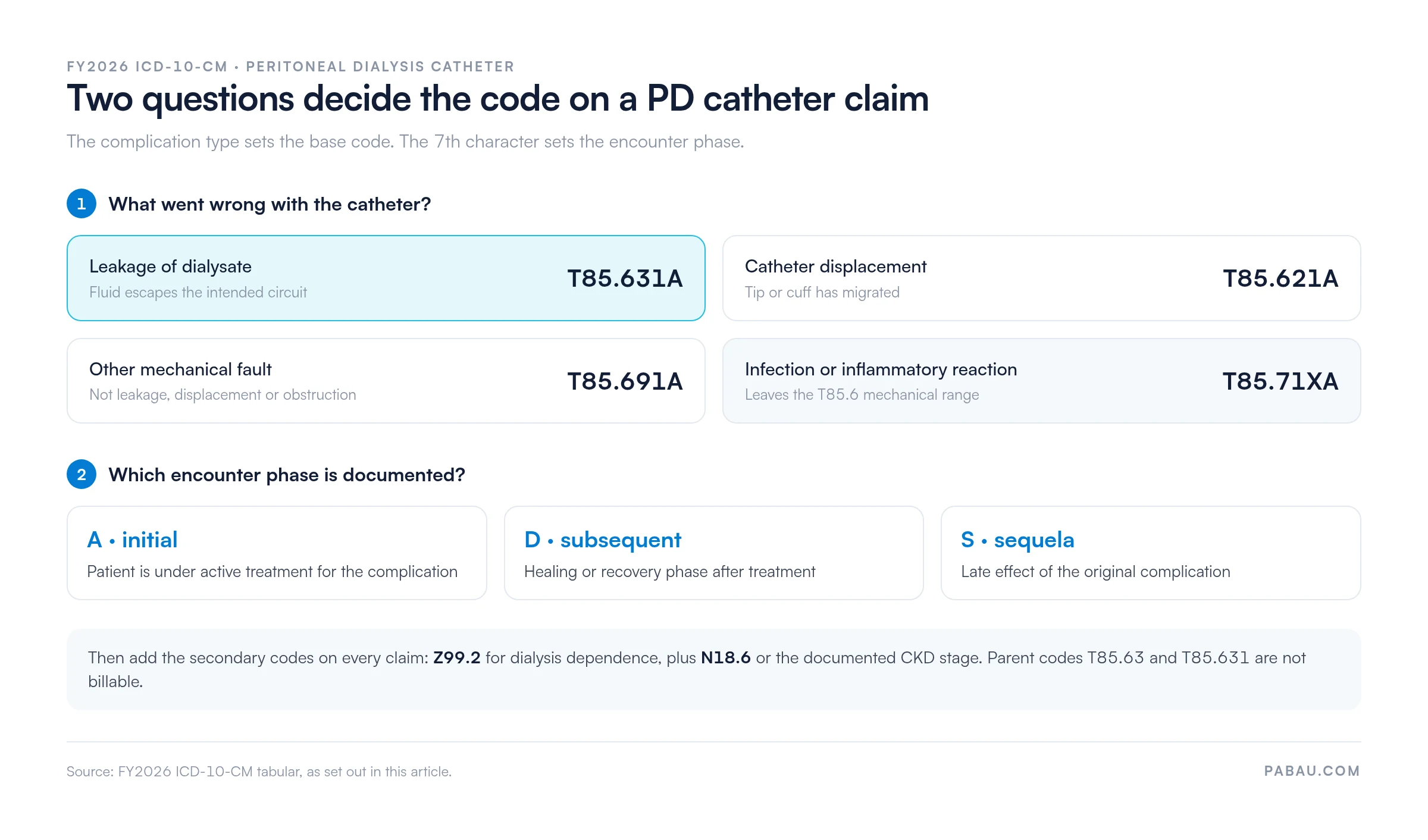
When coding peritoneal dialysis catheter complications, always verify whether the complication is mechanical (T85.6) or infection-related (T85.71). A note that says ‘catheter site drainage’ could indicate leakage (T85.631A) or an exit-site infection (T85.71XA). Query the physician before assigning if the documentation is ambiguous.
The ICD-10-CM Official Guidelines for Coding and Reporting, maintained by CMS and NCHS, carry specific instructions that apply to T85.631A. Getting these right prevents the most common billing errors on dialysis complication claims.
ICD-10-CM includes use-additional-code instructions for T85.631A. Coders should report the following secondary codes alongside it where documented and applicable:
Confirm the use-additional-code notation in your FY2026 ICD-10-CM tabular before relying on it. A pre-submission check that flags missing secondary codes costs far less than an appeal after rejection.
For inpatient claims, T85.631A requires a Present on Admission (POA) indicator. The indicator tells the payer whether the catheter leakage was present when the patient was admitted or developed during the hospital stay.
POA indicators apply to inpatient facility claims only. Outpatient and physician claims do not require one. An inpatient claim carrying T85.631A without a valid POA indicator may pend or reject, depending on the payer. Build a POA review step into the pre-submission check for every inpatient device complication code.
Insufficient documentation is the most common reason a correct code assignment still gets denied. The record must support each element of T85.631A at the specificity the code demands.
The medical record should document all of the following to support T85.631A on a claim:
Coders who receive a note saying only “dialysis catheter problem” should query the treating physician. A charge-capture form that requires the device name and the encounter phase before sign-off cuts that query volume.
Legacy system integrations, payer crosswalk tools, and historical records may still reference ICD-9-CM codes. The approximate ICD-9-CM equivalent for T85.631A is shown below. ICD-9-CM did not capture the same device-and-complication specificity as ICD-10-CM, so a one-to-one equivalence does not exist.
Always label ICD-9-CM crosswalks as approximate when documenting or communicating them. ICD-9 code 996.56 covered obstruction, leakage, and displacement under one code, whereas ICD-10-CM separates them into distinct billable codes. Per ResDAC’s guidance on ICD codes in Medicare files, the transition to ICD-10 added clinical specificity that backward crosswalks cannot fully capture.
Clean claim submission for ICD-10 code T85.631A depends on correct sequencing, complete secondary codes, and a compliant claim format. Each of the three is a separate check before the claim goes out.
T85.631A is typically sequenced as an additional diagnosis when the patient presents primarily for dialysis management. Where the leakage is the principal reason for the admission or encounter, it may sequence as the principal diagnosis. Follow the official ICD-10-CM sequencing rules and confirm with your compliance team.
Practice management software like Pabau integrates with Claim.MD, our US clearinghouse partner, to support clean claim submission for codes like T85.631A. The integration covers real-time eligibility verification, electronic claims to thousands of US payers, and electronic remittance advice (ERA) processing.
Built-in ICD-10 and CPT code catalogues let billing teams check code specificity before submission, so a parent code like T85.631 never reaches the payer. For practices with ongoing peritoneal dialysis patients, clearinghouse claims submission workflows also validate secondary code completeness before transmission.
When a claim does reject, the remittance returns CARC reason codes that name the failure. Matching those denial codes to the missing element shows whether to fix a code or add documentation.
Before submitting T85.631A on an inpatient claim, run a secondary code completeness check. Confirm that Z99.2 and the appropriate N18.x code are both on the claim. Missing either secondary code is a common denial reason for dialysis complication encounters and is easier to catch pre-submission than to appeal post-rejection.
Nephrology and dialysis billing teams handle a high volume of device complication codes. Documentation quality and code specificity decide the claim outcome on almost all of them. Pabau’s claims software for practices cuts the manual steps between the clinical note and a clean claim.
For dialysis practices juggling ESRD patients with several device complications, structured documentation and automated claim validation together lower the per-claim error rate.

Pabau integrates with Claim.MD to support clean claim submission for dialysis catheter complication codes. Real-time eligibility checks, built-in ICD-10 code catalogues, and automated ERA processing help nephrology billing teams reduce denials and get paid faster.

The code itself is the easy part of a T85.631A claim. The note behind it decides the outcome, because it has to name the device, describe the leakage, and fix the encounter phase.
Build the secondary codes into the check rather than the appeal. A coder who confirms Z99.2 and the CKD stage before transmission removes the two most common rejection reasons on these encounters.
Book a demo to see how Pabau validates ICD-10 specificity and submits dialysis complication claims in one workflow.

Need to understand how clearinghouse submission works end to end? Medical claims clearinghouse guide covers how clearinghouses validate, route, and track electronic claims for US practices.
Want to reduce ICD-10 denial rates across your billing team? Denial management in healthcare outlines the systematic approach to identifying, appealing, and preventing common claim denials.
Looking for a structured billing compliance checklist? Medical billing compliance guide covers the documentation, coding, and submission standards that reduce audit and denial risk.
ICD-10 code T85.631A is a billable ICD-10-CM diagnosis code for leakage of an intraperitoneal dialysis catheter at the initial encounter. It falls under category T85 (complications of other internal prosthetic devices, implants and grafts) and is valid for FY2026 HIPAA-covered transactions, effective October 1, 2025. Use it when a peritoneal dialysis catheter develops a breach and fluid escapes the intended circuit, while the patient is receiving active treatment.
Yes, T85.631A is a billable and specific ICD-10-CM code valid for submission on HIPAA-covered transactions. The parent codes T85.631 and T85.63 are not billable because they lack the required 7th character specificity. Only the complete codes T85.631A (initial), T85.631D (subsequent), and T85.631S (sequela) are valid for claim submission.
T85.631A is used when the patient is receiving active treatment for the dialysis catheter leakage. T85.631D applies to follow-up visits once the active treatment phase is complete and the patient is healing. T85.631S is used for a sequela, meaning a late effect that developed as a direct result of the catheter leakage. The suffix must match the clinical phase documented in the record, not the visit sequence.
Coders should report Z99.2 (dependence on renal dialysis) alongside T85.631A per use-additional-code instructions in the ICD-10-CM tabular. The underlying kidney disease code should also be reported, typically N18.6 for ESRD or the appropriate N18.x stage for CKD. If the CKD has a documented etiology such as diabetic nephropathy, that condition code may also be appropriate per sequencing guidance.
Yes, T85.631A requires a Present on Admission (POA) indicator on inpatient facility claims. Report Y if the catheter leakage was documented as present at the time of admission, and N if it developed or was identified after admission. Report U if POA status is genuinely unknown after clinical review, and W if the physician documents that it cannot be clinically determined. POA indicators are not required for outpatient or professional claims.
Use T85.631A specifically when the leaking device is an intraperitoneal dialysis catheter. Use T85.638A when the leaking internal device is a different prosthetic device, implant, or graft. That applies only where no more specific code exists in the T85.63x range. Always check whether a specific code exists for the device in question before defaulting to the “other specified” category code.
An infection or inflammatory reaction caused by a peritoneal dialysis catheter is coded to T85.71, not to T85.631A and not to the T80-T82 range. For an initial encounter, the complete code is T85.71XA. T85.631A stays reserved for mechanical leakage, so a note describing exit-site drainage needs a physician query when it does not distinguish leakage from infection.
The approximate ICD-9-CM equivalent of T85.631A is 996.56 (mechanical complication due to peritoneal dialysis catheter). This crosswalk is approximate, because ICD-9 code 996.56 covered several complication types under one code. ICD-10-CM separates leakage, displacement, and other mechanical complications into distinct codes. Always label ICD-9-CM crosswalks as approximate when using them for legacy system reference.