ICD-10 code S61.201A: Open wound of left index finger without nail damage
ICD-10 code S61.201A covers a left index finger wound of unstated type ICD-10 co...

Last Updated: Oct 16, 2026
Billable Code Specific Code
S85.172S is the billable ICD-10-CM code for laceration of posterior tibial artery, left leg, sequela.
The seventh character S is what marks that stage, and it is the character coders get wrong most often on this code. Use it too early and the claim describes active treatment the record no longer supports.
The table below summarizes every attribute a coder needs for S85.172S.
Let Pabau's smart automation suggest the right codes, reduce claim denials, and keep your practice compliant—effortlessly.
Automate repetitive tasks and focus on what matters most—your patients.
Reduce coding errors and ensure compliance with the latest regulations.
Clean claims, fewer denials, and faster reimbursements.
Powerful insights and reporting to help your practice thrive.
HIPAA compliant SOC 2 certified GDPR-compliant Trusted by 4,000+ clinics worldwide

S85.172S identifies laceration of the posterior tibial artery, left leg, as a sequela (late effect) of a prior injury.
This is a billable ICD-10-CM code valid for FY2026 (October 1, 2025 through September 30, 2026) for HIPAA-covered transactions.
The seventh character ‘S’ is only correct after the acute injury phase has resolved. Using it during active treatment is a coding error.
S85.172S never travels alone, because the sequela condition itself needs its own diagnosis code.
Practice management software like Pabau validates ICD-10-CM codes before submission and files them through the Claim.MD clearinghouse.
Every character in S85.172S carries clinical meaning. Misreading any segment leads to laterality errors, wrong encounter-type codes, or claim denials.
Together these five elements fix the vessel, the side, and the phase of care. No other code in the S85 family carries that combination.
Three seventh characters are valid on S85.172, and they are not interchangeable. Each one tells the payer which phase of the injury the visit belongs to, per CMS ICD-10-CM guidelines.
The sequela code (S) is only appropriate once the original injury has healed. The patient must now present with a condition caused directly by that earlier laceration. Using S85.172S during active wound management is a compliance error, and the same rule holds across every sequela code in the S and T chapters.
Two questions settle which character the encounter takes, and only one of the answers pulls a second code with it.
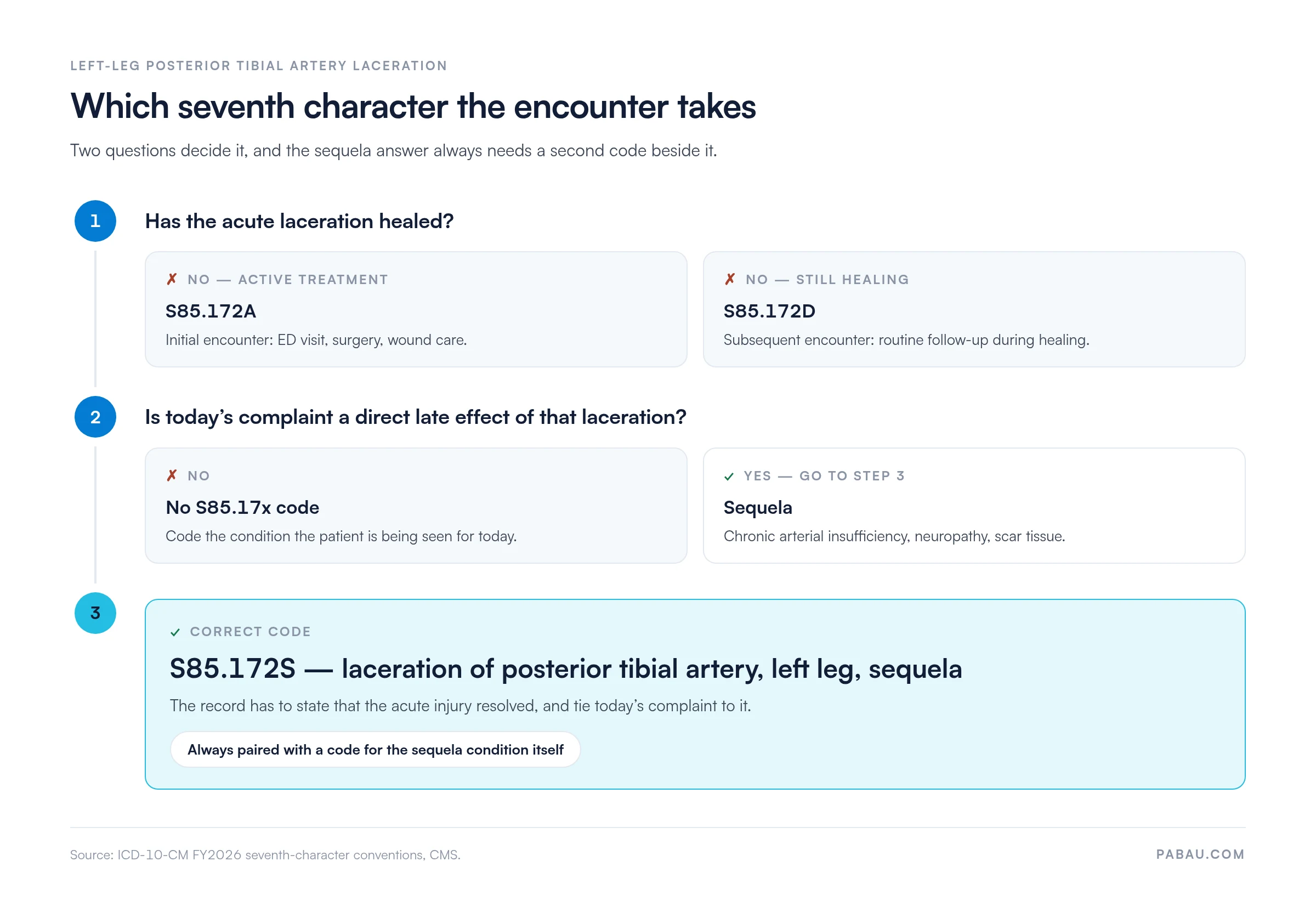
When assigning the sequela seventh character, the record must explicitly state that the acute injury has resolved. It also has to name the current condition as a direct consequence of the original laceration. Documentation that says only ‘history of laceration’ without linking the current complaint to it will not support S85.172S at audit.
Understanding the parent chain clarifies billing context and helps coders locate related codes quickly. Per the CDC/NCHS ICD-10-CM tabular tool, S85.172S sits within the following hierarchy.
Each level narrows the anatomical site, the mechanism, and the laterality. Coders who stop at S85.1 leave both laterality and mechanism unspecified. Only S85.172S carries the full picture a compliant claim needs.
The posterior tibial artery is a terminal branch of the popliteal artery. It runs along the posterior compartment of the lower leg and supplies the plantar surface of the foot. A laceration to this vessel can result in significant limb-threatening ischemia during the acute phase.
Late effects are what S85.172S captures. They may include chronic arterial insufficiency in the foot and lower leg, nerve damage from ischemia, or scar tissue restricting flow.
These sequelae need their own diagnosis code alongside S85.172S. The sequela code alone does not tell the payer what the patient is being seen for today.
That second code is an ordinary diagnosis code, chosen from the same book. The ICD-10-CM code index is where you look up the ischemia, neuropathy, or wound-complication code that names today’s problem.
The table below shows the S85.17x sibling codes for posterior tibial artery laceration and selected closely related S85 codes. Laterality is the most common source of sibling-code confusion.
Legacy billing systems and historical record reviews sometimes require mapping ICD-10-CM codes back to ICD-9-CM equivalents. The crosswalk below is approximate. ICD-9 to ICD-10 conversions are rarely one-to-one, and the sequela specificity of S85.172S did not exist in the older classification system.
The ICD-9-CM code 904.53 named the posterior tibial artery specifically. It did not distinguish left leg from right, or an acute encounter from a sequela encounter. The official CMS crosswalk files remain the authoritative source for any mapping you have to defend.
S85.172S is billable for HIPAA-covered transactions in FY2026. Payer-specific coverage criteria still apply, and code validity does not guarantee reimbursement. The following documentation elements are required to support this code at audit.
Practices running medical claims management software can validate ICD-10-CM codes against payer edits before submission. Practice management software like Pabau files electronic claims through Claim.MD, our US clearinghouse partner. That route runs eligibility and clean claim checks across 4,000+ US payers before a claim leaves your system.
Documentation that ties the sequela visit back to the original injury is a standard audit requirement. Write the D-to-S transition rule into your coding policy, so the team knows when the switch is due.
Vascular injury sequela codes generate specific patterns of error. Recognizing them before submission prevents claim rejections and audit exposure.
Strong denial management workflows should flag these patterns automatically. When a claim for S85.172S returns a code-specificity denial, check the seventh character first. Then confirm the sequela condition was coded alongside it.
Log sequela-related denials separately from acute-encounter denials. That split shows you where the A-to-S transition is breaking down, rather than burying it in a single denial rate.
Run a quarterly audit on all S85.17xS claims. Pull the original encounter records and confirm the seventh character moved from A or D to S after documented healing, not before. A transition made too early is a compliance risk. One made too late inflates subsequent-encounter counts.
Without a pre-submission check, a seventh-character error surfaces only after the payer sends the claim back. The coder corrects S85.172S, resubmits, and the visit stays unpaid until the correction clears.
Pabau keeps the diagnosis codes on the encounter record, so the sequela code and the condition code stay attached to the same visit. Claims then leave through Claim.MD, which runs eligibility and clean claim checks before submission.
A missing laterality or a seventh character the record cannot support surfaces at that check, not weeks later in a denial letter. Your coders spend the time on the notes instead of on rework.

Pabau files ICD-10-CM claims through Claim.MD, our US clearinghouse partner, with eligibility and clean claim checks across 4,000+ payers. Coding errors surface before submission, so fewer claims come back for a seventh character.

S85.172S is a narrow code, and its narrowness is the point. Once the record shows the left-leg laceration healed and today’s problem traces back to it, this is the only code that fits.
The part worth remembering is the second code. A sequela code says what happened. Only the condition code says what you are treating today. Build both into the coding step and you stop losing claims to something the record already proves.
Pabau validates ICD-10-CM codes and submits clean claims across US payers. Book a demo to see how a sequela code and its condition code reach the payer together.

Need to understand how ICD-10 coding connects to claim filing? Claim.MD clearinghouse overview explains how electronic claims reach US payers through a clearinghouse.
Managing denials from vascular injury claims? Denial management in healthcare covers the workflows that catch and resolve claim rejections before they age.
Unsure when a claim qualifies as a clean submission? What makes a clean claim outlines the documentation and coding standards payers apply at adjudication.
ICD-10 code S85.172S is a billable ICD-10-CM diagnosis code. It identifies a laceration of the posterior tibial artery, left leg, as a sequela of a prior injury. Use it once the acute phase has resolved and the patient presents for a condition that laceration caused.
Yes. S85.172S is a billable, specific ICD-10-CM code valid for HIPAA-covered transactions during FY2026 (October 1, 2025 through September 30, 2026). Payer-specific coverage criteria and documentation requirements still apply. Code validity alone does not guarantee reimbursement.
Use the S seventh character once the acute injury has fully resolved. The patient must be presenting with a condition that is a direct late effect of that injury. Do not use it during active treatment or routine follow-up while healing continues. Those encounters take A (initial) or D (subsequent) instead.
The immediate parent code is S85.172, laceration of posterior tibial artery, left leg, without a seventh character. Above it sit S85.17, S85.1, S85, and Chapter 19 (S00-T88). Those levels cover laceration of the posterior tibial artery, injury of the tibial artery, and injury of blood vessels at lower leg level.
The approximate ICD-9-CM crosswalk for S85.172S is code 904.53 (Injury to posterior tibial artery). The mapping is approximate, because 904.53 does not capture laterality or encounter type. Use the official CMS crosswalk files for authoritative mapping.
Common sequela conditions coded alongside S85.172S include chronic peripheral arterial disease, foot ischemia, peripheral neuropathy, or scar tissue complications resulting from the original laceration. The nature of the sequela must be coded separately from S85.172S to describe what the patient is being treated for at the current encounter.