ICD-10 Code Y76.0: Diagnostic obstetric and gynecological devices
ICD-10 Code Y76.0: Definition and billable status ICD-10 Code Y76.0 is a valid, ...

Last Updated: Oct 23, 2026
Billable Code Specific Code
S61.340D is the billable ICD-10-CM code for puncture wound with foreign body of right index finger with damage to nail, subsequent encounter.
Let Pabau's smart automation suggest the right codes, reduce claim denials, and keep your practice compliant—effortlessly.
Automate repetitive tasks and focus on what matters most—your patients.
Reduce coding errors and ensure compliance with the latest regulations.
Clean claims, fewer denials, and faster reimbursements.
Powerful insights and reporting to help your practice thrive.
HIPAA compliant SOC 2 certified GDPR-compliant Trusted by 4,000+ clinics worldwide

ICD-10 Code S61.340D describes a puncture wound with foreign body of the right index finger, with damage to the nail, at a follow-up encounter
Nail status sits in the 4th character, so S61.240D is the sibling to rule out first. S61.3- codes mean the nail was damaged, and S61.2- codes cover the same wound with the nail intact
This is a billable, specific ICD-10-CM code valid for FY2026 HIPAA-covered transactions, effective October 1, 2025
The 7th character D is required for a subsequent encounter. Using A or S at a follow-up visit is a common and costly miscoding error
Pabau’s built-in ICD-10 code library helps clinicians select the correct encounter-specific code at the point of documentation
ICD-10 Code S61.340D is the billable code for a follow-up visit after a puncture wound of the right index finger. The wound involved a foreign body, and the injury also damaged the nail. Using S61.340A at that follow-up visit is the coding error that generates the rejection.
This reference covers the official description, billable status, 7th character rules, code hierarchy, sibling codes, and documentation requirements. It also covers the nail-damage distinction that separates the S61.34- codes from their nail-intact S61.24- counterparts. All information reflects the CMS ICD-10-CM FY2026 update, effective October 1, 2025.
The table below covers every field a coder or biller needs before submitting a claim with ICD-10 Code S61.340D.
The CDC/NCHS ICD-10-CM Official Guidelines define three encounter types for injury codes, each controlled by the 7th character. Choosing the wrong one at the wrong visit is the most common reason finger wound claims are rejected.
“Subsequent encounter” does not mean a second visit to the same clinician. It means the injury has passed the initial acute-treatment phase. A patient seen at urgent care on Monday takes A. The same patient seen for a wound check on Wednesday takes D.
Every element of the ICD-10 Code S61.340D description must be supported by the clinical record. Missing any one element gives a payer grounds for a query or a denial.
A note that names only a hand wound at follow-up cannot support S61.340D. The claim goes to ICD-10 code S61.409D, which keeps the same 7th character D.
The nail-damage distinction is carried by the 4th character, so it decides whether the claim sits in the S61.2 or the S61.3 subcategory. Payers also check that choice against the wound care procedure codes on the same claim.
If the initial encounter note documents subungual hematoma, nail avulsion, or splitting, the S61.34x codes apply across the whole episode of care. If the nail was never involved, S61.240D is the correct subsequent-encounter code and S61.340D will not be supported by the record. S61.350D is not the alternative here. That code covers an open bite of the right index finger with damage to nail, a different wound mechanism.
When the note names no wound type at all, a nail-intact left index finger wound takes S61.201A at the initial encounter.
Read the initial encounter note before choosing between the S61.24x and S61.34x families. Nail status is set by what the injury did, not by what the nail looks like at the follow-up visit. A nail that has since grown back does not move the episode to S61.240D.
Understanding the full code tree helps coders navigate sibling codes quickly. It also prevents assignment of a non-specific parent code when a billable child code exists.
The parent code S61.340 is not billable on its own. A 7th character is always required. Submitting S61.340 without the encounter suffix will be rejected by payers and clearinghouses as an invalid code.
The S61.340 family covers puncture wounds with foreign body of the right index finger with damage to the nail. Each sibling code differs from S61.340D at exactly one character position, and the map below shows which position carries which clinical fact.
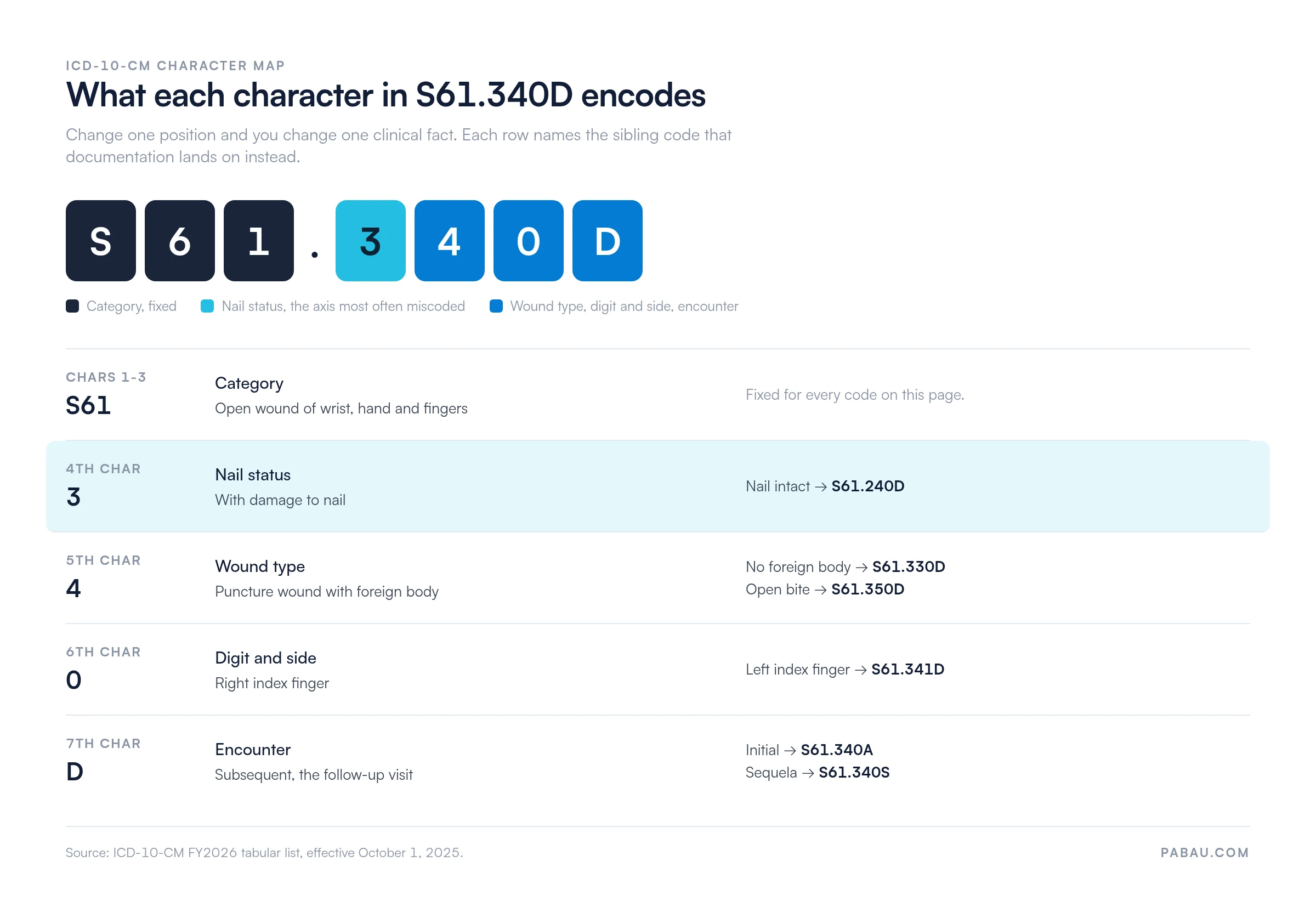
Coders working across a patient episode, across lateralities, or across nail status need the sibling codes below. Our ICD-10-CM code library indexes the wider S61 range, and the AAPC Codify ICD-10-CM lookup carries the official descriptions.
The following clinical terms and index references map to ICD-10 Code S61.340D in the ICD-10-CM Alphabetic Index. Documenting any of these in the clinical note supports code selection:
Wrong-encounter-type errors account for a disproportionate share of injury code denials. A documentation checklist built into the pre-claim workflow catches them before the claim goes out.
Practices managing a high volume of hand injury follow-ups benefit from coding templates that enforce 7th character selection before the claim leaves the system. Catching the pattern at documentation is faster and cheaper than working the denial afterwards.
S61.340D is a diagnosis code, not a procedure code. It supplies the medical necessity for the service billed at the follow-up visit. It carries no RVU or payment amount of its own.
Key billing considerations for S61.340D claims:
Claims carrying S61.340D go out on the standard 837P professional transaction. Running real-time eligibility checks before the follow-up visit reduces post-service billing disputes. That matters most on injury episodes that span several encounters.
ICD-9-CM was retired in the US on October 1, 2015. Crosswalk lookups still matter for legacy data analysis, audits of pre-2015 claims, and reporting that spans the transition.
ICD-9-CM had no axis for laterality, for the digit injured, or for nail involvement. Every mapping between S61.340D and an ICD-9 code is therefore an approximation. The reverse direction does not return S61.340D either, since 883.1 maps back to a far less specific S61 code. Treat these rows as analysis aids rather than billing equivalents.
Most ICD-10 reference pages stop at the descriptor. Coders using a static lookup still cross-check the encounter type, laterality, and nail status by hand. That check happens against a separate clinical note, before the claim is built.
Practice management software like Pabau keeps the ICD-10 code library inside the clinical documentation workflow. When a clinician documents the follow-up visit, the code search returns encounter-specific options with the 7th character visible. That reduces the chance of picking S61.340A for a visit that should carry S61.340D. The claims management software then checks the claim for required fields before submission.
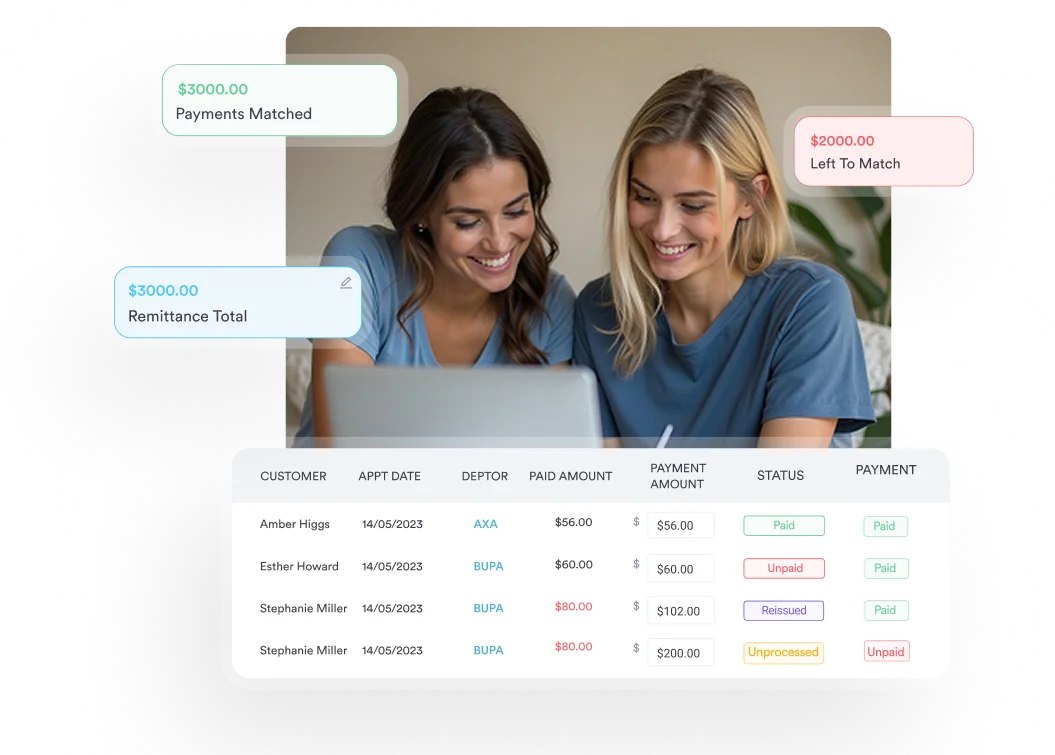
For US practices billing through insurance, Pabau’s Claim.MD clearinghouse integration connects to thousands of US payers. Claims carrying S61.340D run through real-time eligibility checks before they reach the payer. Electronic remittance advice returns with CARC denial reason codes, so a denial that traces to the wrong encounter suffix is easy to spot.
The audit trail Pabau creates links the clinical note, the selected ICD-10 code, and the submitted claim. That record supports both internal review and external audits. A billing workflow that runs through one system is harder to misconfigure. The alternative spreads the same job across a clinical note, a manual lookup, and a separate billing platform.

Pabau’s built-in ICD-10 code library surfaces 7th character options at the point of documentation. Your team picks the right encounter suffix before the claim is built.

Two fields decide whether an S61.340D claim survives. One is the 7th character, and the other is the nail finding recorded at the initial encounter. Confirm both before the claim leaves the practice.
A nail-intact record belongs to S61.240D, and a follow-up visit never takes S61.340A. Get those two calls right and the rest of the S61.34x family follows from the note you already have.
Pabau keeps the encounter suffix visible while the note is being written. Book a demo to see how that fits your practice’s follow-up workflow.

Need to understand the full claims submission process? Medical billing workflows explained covers the end-to-end process from documentation to payment posting.
Dealing with rejected claims after the fact? Denial management in healthcare outlines how to track, appeal, and prevent denials by root cause.
Want to understand how clearinghouses validate your claims? How a medical claims clearinghouse works explains the role Claim.MD plays in claim routing to payers.
ICD-10 Code S61.340D is a billable ICD-10-CM diagnosis code. It describes a puncture wound with a foreign body of the right index finger, with damage to the nail, at a follow-up encounter. It is valid for FY2026 HIPAA-covered transactions, effective October 1, 2025.
Yes. S61.340D is a fully billable, specific ICD-10-CM code. It is valid for submission in HIPAA-covered electronic transactions for fiscal year 2026. The parent code S61.340 without a 7th character is not billable and will be rejected.
S61.340A is used at the initial encounter, when the patient receives active treatment for the puncture wound. S61.340D is used at subsequent visits such as wound checks, suture removal, or aftercare. Using S61.340A at a follow-up visit is a common denial trigger.
Yes. S61.340D is valid for FY2026 HIPAA-covered transactions. It became effective October 1, 2025 under the annual ICD-10-CM update cycle maintained by CMS and NCHS. Confirm current-year validity with the CDC/NCHS ICD-10-CM web tool for any code used beyond FY2026.
The clinical note must confirm five elements. Those are the puncture wound type, a foreign body present or previously removed, and right-hand laterality with index finger specificity. The note must also confirm damage to the nail and a follow-up or aftercare visit purpose. All five must be explicit, because implied or assumed documentation will not support the claim.