ICD-10 Code S82.242H: Displaced spiral tibial shaft fracture, delayed healing
ICD-10 Code S82.242H: Definition and code details ICD-10 Code S82.242H designate...

Last Updated: Oct 15, 2026
Billable Code Specific Code
S52.121R is the billable ICD-10-CM code for displaced fracture of head of right radius, subsequent encounter for open fracture type IIIA, IIIB, or IIIC with malunion.
Three documentation problems account for most denials on this code. In fact, the operative note has no Gustilo classification, no clinician confirms malunion, or the 7th character was carried over from the initial visit.
Let Pabau's smart automation suggest the right codes, reduce claim denials, and keep your practice compliant—effortlessly.
Automate repetitive tasks and focus on what matters most—your patients.
Reduce coding errors and ensure compliance with the latest regulations.
Clean claims, fewer denials, and faster reimbursements.
Powerful insights and reporting to help your practice thrive.
HIPAA compliant SOC 2 certified GDPR-compliant Trusted by 4,000+ clinics worldwide

S52.121R is a billable ICD-10-CM code for a displaced fracture of the head of the right radius. It is coded at a subsequent encounter for an open type IIIA, IIIB, or IIIC fracture that healed with malunion.
The 7th character R is only valid for an open fracture classified as Gustilo type III. Malunion must also be confirmed on imaging or by clinical assessment.
Missing Gustilo detail in the operative or clinic note is the leading cause of denials on this code.
Pabau’s claims management software submits CMS-1500 claims through Claim.MD, checks patient eligibility, and tracks claim status and ERA returns.
ICD-10 Code S52.121R is a valid, billable ICD-10-CM diagnosis code effective October 1, 2025 for fiscal year 2026. In short, it describes a displaced fracture of the head of the right radius at a subsequent encounter. The original injury was an open fracture classified as Gustilo type IIIA, IIIB, or IIIC that healed with malunion.
As a leaf-level code in the tabular list, it needs no further specification before submission. So, it is valid on HIPAA-covered transactions for Medicare, Medicaid, and commercial payer claims. The CDC/NCHS ICD-10-CM web tool confirms its FY2026 validity and full clinical description.
The code sits in a precise hierarchy. Its parent is S52.12 (fracture of head of radius), which falls under S52 (fracture of forearm). S52 belongs to chapter 19, covering injury, poisoning and certain other consequences of external causes (S00-T88).
The table below summarizes the key administrative and billing attributes of S52.121R. Therefore, coders submitting the code for the first time should verify each field against their payer contract.
The 7th character turns a base fracture code into a claim-ready code. For S52.121x, the valid set covers initial encounters, subsequent encounters, and sequelae.
Getting it wrong is the most common error on radial head fracture claims. In practice, coders reach for an initial-encounter character when the patient is presenting for follow-up care. Two axes decide the answer, shown below.
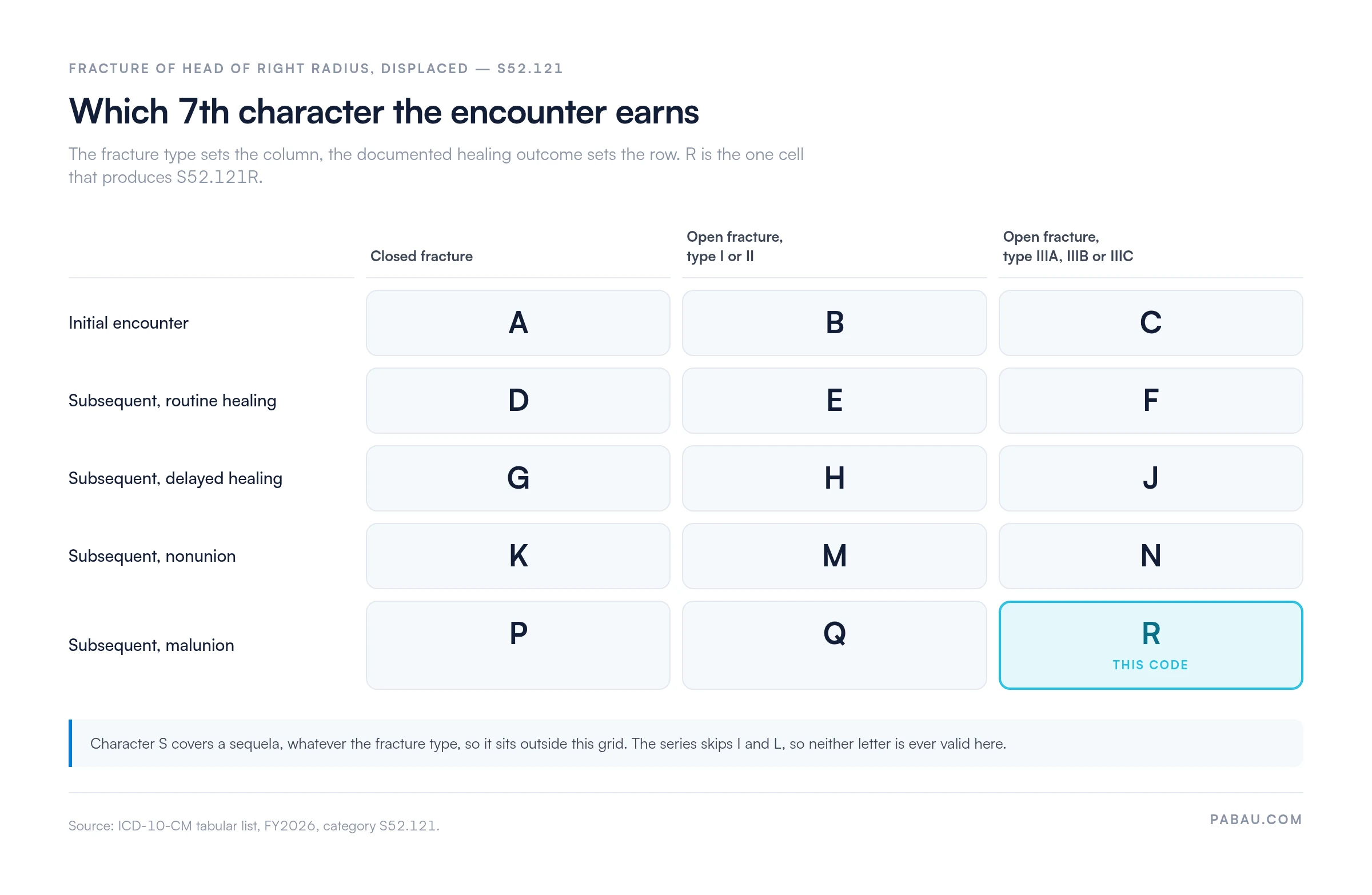
Two patterns create the most denials. The first is using character C, the initial-encounter character for open type IIIA to IIIC, at a return visit. In other words, that character is reserved for the encounter where active treatment begins.
The second is using R before malunion has been established on imaging or by clinical assessment. Instead, the 7th character must match the documented healing status, not the coder’s expectation of the outcome.
The Gustilo-Anderson classification is the clinical framework that drives 7th character selection for every open fracture in ICD-10-CM. Without an open-fracture classification in the note, the coder cannot choose between character B and character C.
The 7th character groups all three type III subtypes together, so type III versus type I or II is the distinction that changes the code. Even so, recording the exact subtype still matters. Payers and auditors ask for it on high-severity open fracture claims, and the operative note is the only place it exists.
Clinicians should record the Gustilo type in the operative note at the time of initial treatment. At subsequent encounters, the treating provider’s note should reference the classification from the original operative record.
Coders who see only “open fracture” with no type should query the provider before assigning a character from the type III group.
Malunion and nonunion are not interchangeable. They are clinically distinct healing outcomes, and they map to different 7th characters. Thus, confusing them on a claim can result in medical necessity denials or audit findings.
Above all, the clinical note must explicitly state which outcome applies. Coders should not infer malunion from imaging language like “healing in slight angulation” without a physician statement confirming malunion. When in doubt, query the provider. In sum, the burden of proof rests on clinical documentation, not on coder interpretation.
S52.121R specifies a displaced fracture. Displacement refers to the alignment of fracture fragments at the time of injury, not at the subsequent encounter. The displacement status is documented at the initial encounter and carries forward into subsequent encounter coding unless the operative note documents anatomical reduction.
Subsequent encounter codes apply once active treatment has concluded and the patient is receiving routine care. That covers follow-up visits to monitor healing, physical therapy referrals, and visits to assess complications such as malunion. For instance, coders running medical claims clearinghouse workflows for orthopedic practices meet these scenarios every month after surgery.
Use the R suffix only when three conditions are met. The encounter is a subsequent visit, not the initial treatment episode. The fracture was open and classified as Gustilo type IIIA, IIIB, or IIIC at the time of injury. Malunion has been confirmed by the treating clinician. If any of these elements is missing from the documentation, R is not supportable.
Document the Gustilo classification in the operative note using the exact ICD-10 language: ‘open fracture type IIIA,’ ‘type IIIB,’ or ‘type IIIC.’ At subsequent encounters, reference the original classification by date and operative note number. This creates the audit trail that supports 7th character R without requiring a provider query at billing time.
Every element of this code must be traceable to a specific statement in the clinical record. So, the checklist below names each required item and what happens to the claim when it is missing.
Work through it at the point of documentation. Indeed, a provider query raised at billing time costs days that a single sentence in the note would have saved.
Device codes answer to a different checklist. Billing a hand orthosis as HCPCS code L3923 requires a fitting note naming the customization performed and the credential of the person performing it. Without a physical modification at fitting, the off-the-shelf code L3924 applies instead.
The AAPC Codify ICD-10-CM lookup lists the complete S52.121x series alongside its left-side equivalents. Then, the table below gives the siblings and adjacent codes a coder is most likely to need.
For how these codes group into MS-DRGs for inpatient reimbursement, CMS publishes the MS-DRG classifications and software files each fiscal year.
Five errors account for most claim rejections and audit findings on S52.121R. Practices with a high denial rate on open fracture codes should start with the common denial codes they are receiving. Then, match each one back to the documentation item below that would have prevented it.
ICD-9-CM crosswalks give approximate equivalents for legacy billing, historical record review, and payer systems that still reference older codes. S52.121R maps roughly to ICD-9-CM 813.05 (closed fracture of radial head) and 813.15 (open fracture of radial head).
Neither is an exact match, because ICD-9-CM did not carry Gustilo classification, displacement status, or malunion at this level of detail. For this reason, the CMS ICD-10 codes page hosts the General Equivalence Mappings, and coders should work from those files rather than from memory.
Also, the AAPC crosswalk tool handles reverse lookup for practices reviewing historical records.
In most orthopedic practices the note lives in one system and the claim gets rebuilt in another. A coder reads the operative report, retypes the diagnosis and encounter details into a billing screen, and trusts the two still match. As a result, every extra hop is another chance for laterality or an encounter character to arrive wrong.
Practice management software like Pabau holds the appointment, the clinical note and the invoice in one patient record. Also, its claims tools for practices build the CMS-1500 from that record. The claim goes out through Claim.MD, a clearinghouse supporting more than 4,000 US payers.
From there the practice checks patient eligibility before the visit and watches claim status without calling the payer. The ERA comes back against the invoice it was raised from. Even so, choosing the 7th character is still the coder’s judgment call. Instead, what changes is that the submission carries what the record already says.
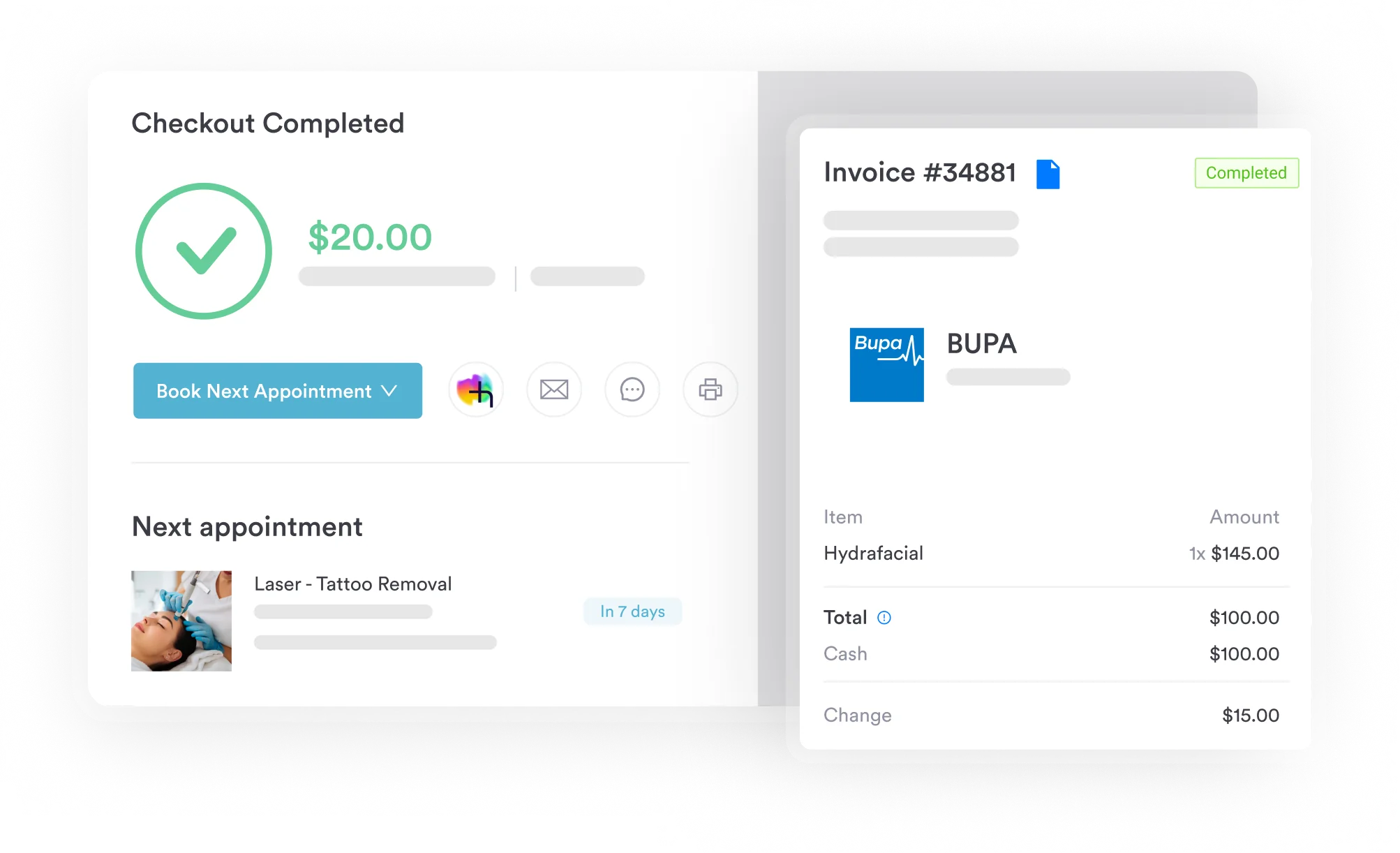

Pabau builds the CMS-1500 from the patient record and submits it through Claim.MD. Check eligibility before the visit, follow claim status without calling the payer, and match every ERA back to its invoice.

Denials on S52.121R come back to the note, not to the code. If the operative report establishes an open type III fracture and a later note states malunion, the R character is defensible. Still, no amount of billing rework makes it stick.
So the work sits upstream. Get the Gustilo classification into the operative note on the day of surgery. Then get an explicit malunion statement into the follow-up note before the claim goes out.
Querying the provider six weeks later costs far more than writing one sentence at the time. Pabau checks the administrative fields a CMS-1500 needs before submission, then tracks the claim and the remittance in the same record as the visit. Book a demo to see how that shortens the loop between an orthopedic note and a paid claim.

Managing denial codes after a rejected fracture claim? Denial codes in medical billing explains the most common CARC denial codes and how to respond to each one.
Need a clearinghouse that handles open fracture claims end to end? The Claim.MD clearinghouse guide covers how Claim.MD processes 837P claims and returns ERA data for orthopedic and trauma practices.
Building a cleaner billing workflow for your orthopedic or PT practice? Revenue cycle management fundamentals walks through the full RCM cycle from intake to payment posting.
S52.121R is a billable ICD-10-CM code for a displaced fracture of the head of the right radius. It is used at a subsequent encounter, after an open fracture of Gustilo type IIIA, IIIB, or IIIC healed with malunion. It became effective October 1, 2025 for fiscal year 2026 and is valid for submission on all HIPAA-covered transactions.
The 7th character R indicates a subsequent encounter for an open fracture classified as Gustilo type IIIA, IIIB, or IIIC. In fact, the fracture must have healed with malunion. It applies when the patient is presenting for follow-up care after the initial treatment episode. The fracture must have been an open injury of the highest Gustilo severity. The treating clinician must also have confirmed malunion on imaging or by clinical assessment.
Six elements must be present in the record. They are right-sided laterality, displaced fracture, and open fracture type. The Gustilo classification of IIIA, IIIB, or IIIC must come from the operative note. The record also needs subsequent encounter notation and a clinician statement confirming malunion. So, missing any one of these makes the code unsupportable and creates payer audit exposure.
Yes. S52.121R is a valid, billable, and specific ICD-10-CM code for fiscal year 2026, effective October 1, 2025. It can be submitted on HIPAA-covered claims for Medicare, Medicaid, and commercial payers without any additional code extension or parent code substitution.