ICD-10 Code S66.308A: Extensor muscle injury, other finger
ICD-10 Code S66.308A: Definition and code hierarchy ICD-10 Code S66.308A is the ...

Last Updated: Oct 14, 2026
Billable Code Specific Code
S39.092S is the billable ICD-10-CM code for other injury of muscle, fascia and tendon of lower back, sequela.
ICD-10 Code S39.092S catches a surprisingly broad set of lower back soft-tissue injuries at the sequela stage, yet it sits just two digits from the codes coders actually use most, and that proximity is exactly where denials happen. The sequela 7th character 'S' signals that the acute injury has already resolved and the patient now presents with a residual condition directly caused by that original episode. Miss that clinical distinction and you are either billing the wrong encounter type or submitting a code with no documented causal link to a prior injury, which is the second most common reason sequela claims bounce on first submission.
Physical therapists, chiropractors, and spine specialists treating patients with chronic lower back complaints after a documented acute injury encounter this code regularly. Getting the documentation right before the claim leaves the practice is what separates a clean first-pass submission from a denial cycle that can stretch several weeks.
Let Pabau's smart automation suggest the right codes, reduce claim denials, and keep your practice compliant—effortlessly.
Automate repetitive tasks and focus on what matters most—your patients.
Reduce coding errors and ensure compliance with the latest regulations.
Clean claims, fewer denials, and faster reimbursements.
Powerful insights and reporting to help your practice thrive.
HIPAA compliant SOC 2 certified GDPR-compliant Trusted by 4,000+ clinics worldwide

S39.092S is the billable ICD-10-CM code for other injury of muscle, fascia and tendon of lower back, sequela.
The site is fixed at the lower back, so abdomen and pelvis sequela use S39.091S and S39.093S instead.
The 7th character ‘S’ needs documented proof of the original acute injury and its causal link to the current residual condition.
Confusing sequela (S) with subsequent encounter (D) is the most common coding error in the S39 category.
Pabau’s claims management and clearinghouse integration support ICD-10 lookup and clean electronic claim submission for musculoskeletal sequela codes.
ICD-10 Code S39.092S is the billable ICD-10-CM diagnosis code for other injury of muscle, fascia and tendon of lower back, sequela.
It applies once the acute injury has resolved and a residual condition remains. The code is valid for the FY 2026 code year, and it is not a new addition. The CMS ICD-10-CM code files have carried S39.092 and its 7th characters since well before FY 2026.
Verify current payer acceptance before submitting. Plan-level medical policy can impose documentation requirements beyond what ICD-10-CM guidelines specify. The CDC/NCHS ICD-10-CM web tool is the authoritative lookup for confirming a code’s billable status each fiscal year.
S39.092S follows the standard ICD-10-CM alphanumeric structure. Every character position carries a specific meaning, and misreading even one position leads to a code that describes a different clinical encounter.
The sixth character position is where confusion with strain codes most often occurs. S39.01x codes capture strains, while S39.09x covers other injuries at the same anatomical sites. If the original acute diagnosis was a strain (S39.01xA), the sequela follow-on should also trace to the strain branch.
The 7th character in S39.092S determines the clinical story the code tells a payer. Choosing the wrong one is the fastest route to a medical necessity denial. The three options are A (initial encounter), D (subsequent encounter), and S (sequela). They are not interchangeable.
The distinction between D and S is the status of the original injury, not the timing. A patient can still be in the subsequent-encounter (D) phase years after an injury if healing is ongoing. Sequela (S) coding begins the moment the acute injury is documented as resolved and a residual condition has been separately identified.
According to the ICD-10-CM Official Guidelines for Coding and Reporting (Section I.C.19.a), sequela coding requires the residual condition to be sequenced first. The injury code that caused it follows. This is the reverse of what many coders expect, and it accounts for a large share of sequencing errors on first submission.
“Other injury” in ICD-10-CM means the soft-tissue damage does not meet the definition of a strain and is not a rupture. Strains have their own dedicated S39.01x codes. What remains is contusion, compression, or blunt-force trauma to the muscle fibers, fascia sheaths, or tendon attachments of the lower back.
At the sequela stage, this code captures chronic myofascial pain, persistent muscle weakness, or post-traumatic connective tissue dysfunction in the lower back. A clinician must have documented the causal link to a prior injury. It does not capture:
The site is fixed at the lower back, which makes this code narrower than the S39 category name suggests. Soft-tissue sequela at the abdomen belongs to S39.091S, and at the pelvis to S39.093S. A patient with post-traumatic gluteal tendon dysfunction after a documented pelvic injury is coded S39.093S, not S39.092S.
S39.092S sits within a closely spaced family of codes. Selecting the wrong sibling is a common reason claims are returned for code correction. The risk rises when the acute episode and the sequela visit use codes from different branches. The grid below maps the whole S39.0 branch by injury type and anatomical site.
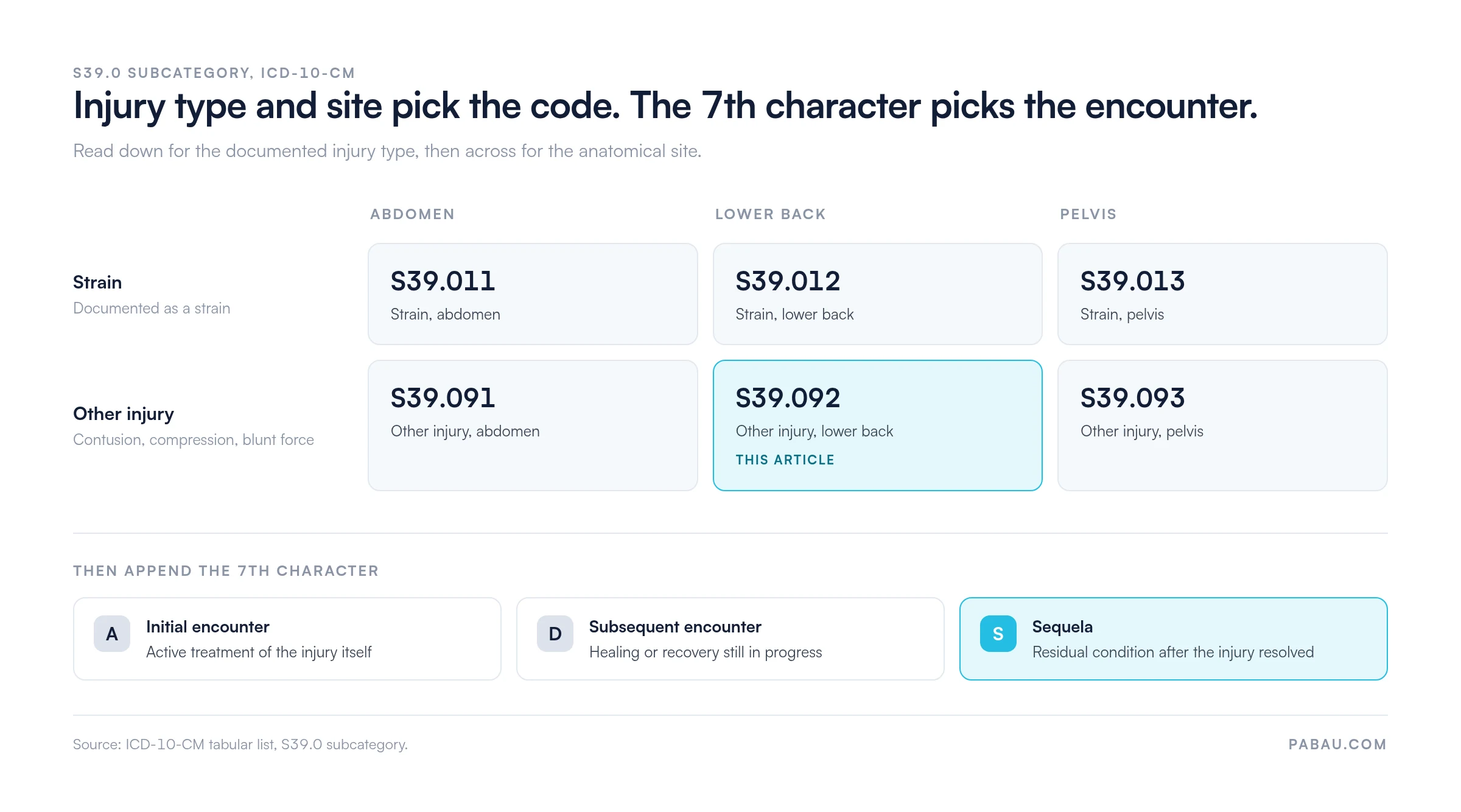
None of those base codes is billable on its own. Each becomes billable only once the 7th character is added, and the full descriptors below show how the S39.092 family reads on a claim form.
The AAPC Codify ICD-10-CM lookup is useful for browsing the full S39 family alongside clinical guidance notes. Always trace the code path back to the original acute-episode code. Injury type and anatomical site have to match between that code and the sequela code, or the claim runs into payer medical necessity edits. Pabau’s ICD-10-CM code index lists the neighboring chapters if you need to check a sibling code first.
Run a code consistency check before submitting sequela claims. Pull the patient’s prior claims history. Confirm the original acute code (S39.092A or S39.092D) was billed under the same injury type and the same anatomical site. A sequela claim that doesn’t trace to a consistent prior acute episode is the first thing a payer’s audit algorithm flags.
Documentation for S39.092S is more demanding than for an acute injury code. The sequela designation asks the record to support two facts at once. The original injury occurred and has resolved, and the current condition is a direct residual of that episode.
Structured note templates lower the risk of missing these sequela-specific requirements at the point of care. They prompt the clinician to address causal language, prior injury history, and physical findings as discrete fields rather than free-text narrative. That makes each record easier to defend when a payer asks for it.
S39.092S can also appear on a claim that includes a same-day preventive service. If the visit also bills HCPCS code S0613, that line carries its own screening diagnosis, and S39.092S supports only the problem-oriented evaluation.
S39.092S sits in a cluster of similar codes where small selection mistakes produce large billing consequences. These are the errors that appear most often in claim edits and payer audits for this code group.
This is the most common error in the group. A patient still receiving physical therapy for an unresolved injury is in the subsequent encounter (D) phase. Assigning S39.092S there creates a mismatch between what the visit notes describe and what the code signals. Payers whose systems flag that inconsistency deny the claim and request medical records. Sound denial management starts by catching the mismatch before submission rather than after.
If the original acute episode was coded S39.012A as a strain, the sequela should trace to S39.012S. Using the “other injury” sequela code when the prior history shows a strain creates a code pathway inconsistency. Check the original acute diagnosis code before selecting any sequela code.
ICD-10-CM sequencing rules for sequela codes require the residual condition to appear first on the claim. The causative injury code follows as an additional diagnosis. Placing S39.092S as the principal diagnosis reverses that order and can trigger a sequencing edit.
Billing S39.092S without documentation that explicitly links the current condition to the prior injury gives a payer grounds to reject the sequela designation. The claim then gets reclassified under a non-injury diagnosis code, usually at a lower value. The clinical note is the audit trail, so the causal language has to be stated rather than implied.
Practices billing musculoskeletal sequela codes work two layers at once. Clinical notes have to capture causal language at the point of care. The claim then has to be validated against ICD-10 rules before it reaches the payer. When either layer is thin, the denial patterns described above follow.
Practice management software like Pabau includes claims management software with ICD-10 code lookup inside the billing workflow. Coders can confirm a code’s validity, check sequencing rules, and attach the correct diagnosis codes before the claim goes out. Pabau submits electronic claims through Claim.MD, our US clearinghouse integration, which handles eligibility verification and scrubs claims against thousands of US payers. That catches formatting errors, decimal omissions, and missing 7th characters before a technical denial lands.
On the documentation side, structured digital templates prompt clinicians to record prior injury history, causal language, and current clinical findings as discrete fields. That produces sequela-ready records without a separate review step between the clinical note and the billing queue. Across several practitioners or locations, centralized code search and claim validation cut the variance that individual coders introduce when working from memory.
Build a sequela coding checklist into your intake workflow. Before a sequela-coded visit is scheduled, confirm three things. Find the original acute injury code used in prior claims. Check the documented date of resolution. Read the clinician’s most recent note for the causal relationship. A five-minute pre-visit check prevents a multi-week denial cycle.

Pabau’s documentation and claims management tools help musculoskeletal practices build sequela-ready patient records and submit clean claims first time. See how it works for your practice.

S39.092S is a specific, billable code for residual lower back soft-tissue conditions once a documented acute injury has resolved. Its documentation burden is heavier than an acute code’s, and the preventable errors trace to one habit. Sequela coding gets treated as a continuation of injury care, when it is a separate designation that carries its own evidence requirements.
The practical move is to check the prior acute code and the documented resolution date before the visit, not after the denial. Practices that do this consistently see fewer records requests on musculoskeletal sequela claims. To see how that check fits your billing workflow, book a demo with the Pabau team.

List Item #1
List Item #2
ICD-10 Code S39.092S is the billable ICD-10-CM diagnosis code for other injury of muscle, fascia and tendon of lower back, sequela. Use it when a patient presents with a residual condition caused by a prior lower back soft-tissue injury. That injury must have resolved, and the residual can be chronic muscle weakness or persistent myofascial pain. The code is valid for the 2025 and 2026 code years under the current ICD-10-CM edition.
Yes. S39.092S is a billable, specific ICD-10-CM code that can be submitted for reimbursement on claims. The parent code S39.092, without a 7th character, is not billable. Always verify acceptance with the individual payer, as some plan-level medical policies impose documentation requirements beyond the ICD-10-CM guidelines.
S39.092A is the initial encounter code used while the patient is receiving active treatment for the acute injury. S39.092S is the sequela code used after that injury has resolved and the patient presents with a residual condition caused by it. The injury type and the anatomical site are identical between the two codes. Only the encounter type changes, via the 7th character.
Use sequela (S) only after the original acute injury is documented as fully resolved. A separate residual condition must also be identified, with a direct causal link to that prior injury. Use subsequent encounter (D) for as long as healing or recovery from the original injury is still in progress. The patient’s healing status, not the calendar timeline, determines which 7th character applies.
To bill S39.092S, the clinical record must establish three things. It needs a documented history of the original acute injury, through prior visit notes, imaging, or referral records. It needs a clinician statement explicitly linking the current condition to that prior injury. It also needs documentation that the original injury has resolved. The residual condition code must be sequenced before S39.092S on the claim.
Yes. S39.092S is valid for claims with dates of service in both 2025 and 2026, and it carries into the FY 2026 ICD-10-CM edition. It is not a new code: S39.092 and its 7th characters have been in ICD-10-CM since well before FY 2026. Confirm validity with the CDC/NCHS ICD-10-CM web tool at the start of each fiscal year, since the annual update can change descriptors or delete codes.