

ICD-10 code S61.201A: Open wound of left index finger without nail damage
ICD-10 code S61.201A covers a left index finger wound of unstated type ICD-10 co...

Last Updated: Oct 16, 2026
Billable Code Specific Code
S22.061G is the billable ICD-10-CM code for stable burst fracture of T7-T8 vertebra, subsequent encounter for fracture with delayed healing.
It is a billable, specific code, valid for FY2026 from October 1, 2025. The 7th character G is the only thing separating it from S22.061D, and it applies solely when the physician has documented that healing is delayed.
Let Pabau's smart automation suggest the right codes, reduce claim denials, and keep your practice compliant—effortlessly.
Automate repetitive tasks and focus on what matters most—your patients.
Reduce coding errors and ensure compliance with the latest regulations.
Clean claims, fewer denials, and faster reimbursements.
Powerful insights and reporting to help your practice thrive.
HIPAA compliant SOC 2 certified GDPR-compliant Trusted by 4,000+ clinics worldwide

S22.061G is a billable ICD-10-CM code for a stable burst fracture of the T7-T8 vertebra at a subsequent encounter with delayed healing. It is valid for FY2026, effective October 1, 2025.
The 7th character G signals a subsequent encounter where the fracture is not healing at the expected rate. D covers routine healing, so G needs documented evidence of delayed union.
Coders must confirm the physician documented fracture stability, the specific vertebral level, and the basis for delayed healing. A note that omits any one of those needs a query.
Pabau’s claims management software links ICD-10-CM codes directly to billing workflows, supporting HIPAA-compliant electronic claim submission for S22.061G through the Claim.MD clearinghouse.
S22.061G became effective October 1, 2025 under the FY2026 ICD-10-CM update. It is a billable, specific code valid for HIPAA-covered transactions.
Each segment of the code carries a distinct clinical meaning. Misread any one segment and the claim codes the wrong injury, the wrong vertebral level, or the wrong encounter stage.
The T7-T8 segment sits in the mid-thoracic spine, a region that bears significant axial load. Burst fractures here result from compressive force that drives the vertebral body outward in multiple directions. That distinguishes them from a simple wedge compression fracture, where only the anterior column collapses.
The 7th character is where most S22.061 coding errors occur. For traumatic fractures, ICD-10-CM uses four standard encounter-type extensions.
Delayed healing is a clinical determination made by the treating physician. It means the fracture is not consolidating within the timeframe typically expected for that injury type. The coder does not make this judgment independently. The physician’s note must explicitly document delayed healing or delayed union for G to be correctly assigned.
Delayed healing is not the same as nonunion. Delayed healing (7th character G) means healing is slow but still progressing. Nonunion (7th character K, where applicable) means healing has stopped entirely. Confusing these two leads to incorrect code assignment and potential payer audits.
Selecting between the S22.061 variants means matching three facts from the chart. Those are the visit context, the fracture’s healing status, and whether the physician documented a basis for delayed healing. The path below runs through them in the order a coder meets them.
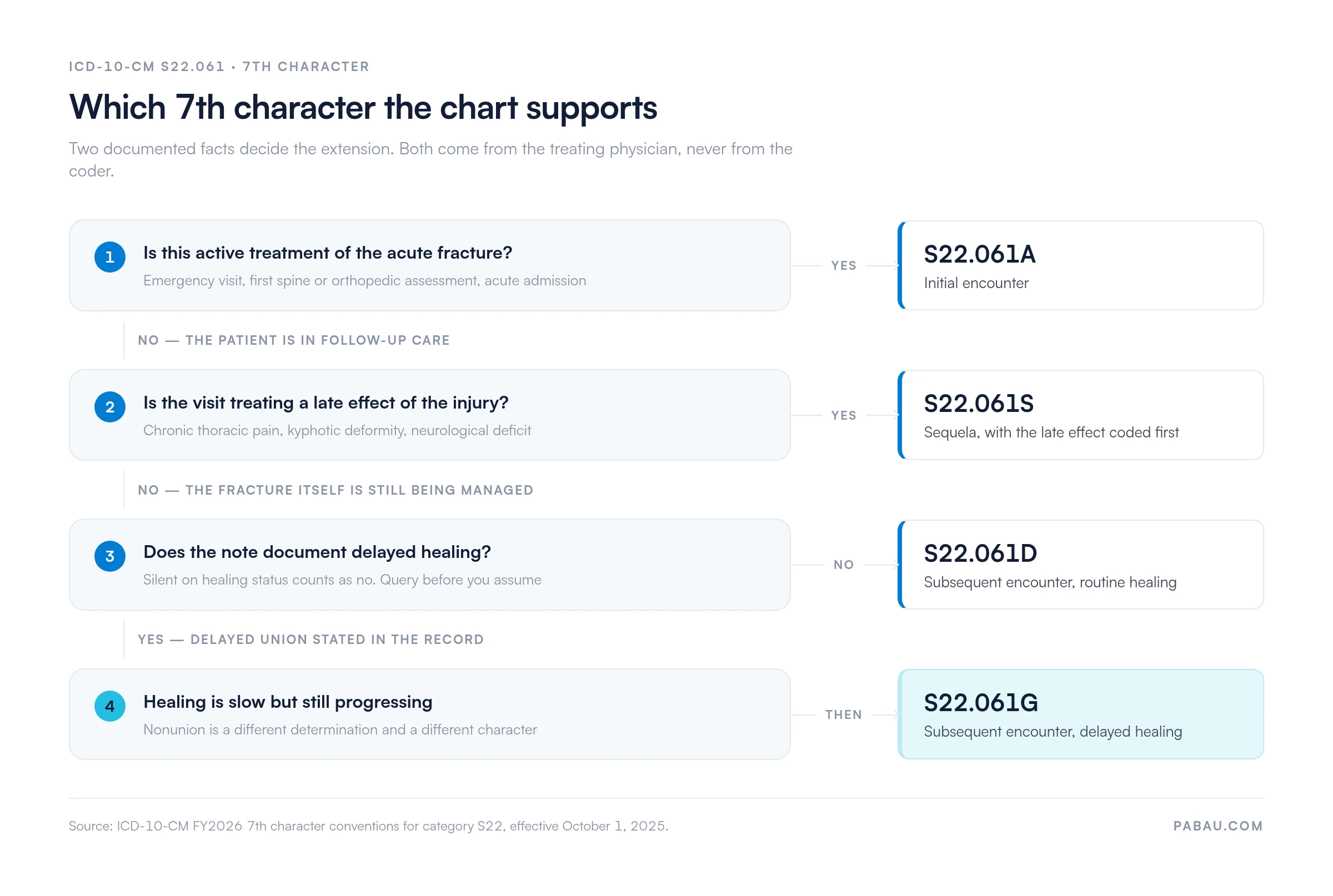
Use S22.061A when the patient is receiving active treatment for the fracture. This covers the emergency department visit, the first orthopedic or spine surgeon assessment, and any hospitalization during the acute phase. Once the fracture moves into follow-up care and monitoring, A no longer applies.
S22.061D covers follow-up visits where the physician’s documentation indicates the fracture is healing normally. If the note is silent on healing status but the visit is a routine check-in, D is typically the appropriate choice. Only switch to G when delayed healing is explicitly documented.
Sequela coding applies when the patient is being treated for a late effect of the original fracture. That includes chronic thoracic pain, kyphotic deformity, or a neurological deficit that developed as a consequence of the injury. The fracture code is used as the cause, with the sequela condition coded first.
S22.061G is specifically for a stable burst fracture. Assigning this code when the physician has documented an unstable burst fracture is an error. It weakens the medical necessity justification and can trigger a payer review.
Fracture stability is a physician determination based on imaging findings and clinical assessment. The coder reads the documentation; they do not interpret imaging independently. If the record does not use the word “stable” or equivalent clinical language, query the physician before assigning S22.061G. Defaulting to whichever code looks closest is what turns an ambiguous note into a denied claim.
Four elements must be present in the physician’s note before S22.061G can be correctly assigned. Missing any one of them means the code is not supported by documentation, which is an audit risk.
These are the four most frequent mistakes on S22.061G claims, based on typical payer edit patterns and clean claim submission practices.
When a claim returns with a coding-related denial, a documented rework workflow shortens the turnaround. It also supports an appeal where the original coding was correct but the documentation explanation was thin.
S22.061G sits within a specific classification path in the CDC’s official ICD-10-CM tool. Understanding this hierarchy helps when cross-referencing related codes or building superbill templates for spine practices.
Diagnosis codes travel with procedure codes on the claim. Knowing which CPT codes are commonly paired with S22.061G helps orthopedic, spine and physical therapy practices build accurate superbills and avoid mismatched code edits. Our CPT code reference covers each of the codes below in full.
CPT code pairings should always reflect documented services. The list above represents procedures commonly performed alongside this diagnosis, not a required combination. Each code on the claim must be individually supported by the visit documentation.
Thoracic burst fractures at T7-T8 frequently present alongside other conditions that require separate coding. These comorbidities affect clinical management and, when documented, should be coded to the highest level of specificity.
When neurological complications such as spinal cord injury are present, those codes are listed alongside S22.061G. Each one carries the encounter character that matches the visit. Code the comorbidities that are documented and are being managed or monitored during that encounter.
Practices migrating historical records, or working with payers who request legacy code mapping, may need the ICD-9-CM equivalent. These crosswalks are approximate by design. ICD-10-CM is far more granular, so one ICD-9 code often maps to several ICD-10 codes depending on specificity, encounter type, and fracture subtype.
According to PGM Billing’s ICD-10 code database, the closest ICD-9-CM equivalent for S22.061G is 805.2. That code read “closed fracture of dorsal (thoracic) vertebra without mention of spinal cord injury”.
805.2 did not distinguish burst type, vertebral level within T7-T8, or encounter healing status. S22.061G captures all three. Use crosswalks for historical reference only, never as a substitute for current-year code selection.
In most spine and orthopedic practices the coder finishes the note, looks the code up in one system, then retypes it into a billing tool. Every hop is a chance to drop the 7th character or attach it to the wrong encounter date.
Practice management software like Pabau closes that hop. Our medical claims management software attaches the ICD-10-CM code you selected in the record to the claim itself. The code that leaves the practice is the code the physician’s note supports.
For US practices, Pabau submits electronically through Claim.MD, a clearinghouse connected to thousands of US payers. That covers CMS-1500 and 837P submissions, real-time eligibility verification, and ERA/835 remittance processing.
This matters for S22.061G claims because delayed healing encounters run longer billing cycles than a single acute admission. Returned ERA data tells the practice whether each G-suffix claim cleared or came back with a denial code. Nobody has to log into a payer portal to find out.
Before each S22.061G follow-up appointment, run an eligibility check. Confirm the patient’s coverage is active and that fracture aftercare visits sit inside their benefit plan. Delayed healing encounters can span months, and insurance changes mid-treatment are a common cause of unexpected denials.
The outcome for a spine practice is a shorter loop between the physician’s note and the payer’s response. That matters most on encounters that stretch across a plan year.

Pabau attaches the ICD-10-CM code from the clinical record straight to the claim, then submits it electronically. Delayed healing encounters reach the payer with the 7th character the note supports.

S22.061G is not a judgment the coder gets to make. Three of its four requirements are physician determinations, and the fourth is a level of detail the note either carries or does not. So the practical work sits upstream of the claim, in how consistently the spine team writes healing status into a follow-up note.
Practices that build that habit stop choosing between undercoding to D and defending a G that the record cannot support. Practices that do not will keep querying the same physicians about the same visits, months after the encounter closed.
When the chart is genuinely unclear, the query costs a day. The denial and appeal cost considerably more. Book a demo to see how Pabau carries the coded diagnosis from the fracture follow-up note through to remittance.

Need a structured framework for medical billing documentation? Medical billing fundamentals covers how documentation supports accurate claim submission across specialties.
Working with US insurance clearinghouses? Claim.MD clearinghouse overview explains how electronic claims routing, ERA processing, and payer enrollment work for US practices.
Want to reduce claim denial rates? Denial codes in medical billing provides a reference guide for the most common payer denial codes and how to respond to each.
ICD-10 Code S22.061G is a billable ICD-10-CM code for a stable burst fracture of the T7-T8 vertebra at a subsequent encounter with delayed healing. It is valid for FY2026, effective October 1, 2025. Use it on HIPAA-covered claims when the treating physician has documented both the fracture characteristics and the delayed healing status.
Yes, S22.061G is a specific, billable ICD-10-CM code valid for claim submission in FY2026. It is not a parent or category code. You can report it directly on HIPAA-covered transactions, with no additional extension or child code needed.
S22.061A is used for the initial encounter, when the patient is receiving active treatment for the acute fracture. S22.061G is used for follow-up encounters where the physician has documented that healing is delayed. Once a patient moves from the acute treatment phase to follow-up care, A is no longer correct regardless of how recent the injury was.
Use S22.061D at a follow-up visit where the physician’s note indicates normal healing. D also applies when the note is silent on healing status. Use S22.061G only when the physician explicitly documents that healing is delayed or not progressing at the expected rate. Assigning G without documented delayed healing is a coding error that can trigger a payer audit.
The physician’s note must document four things. Those are the vertebral level (T7-T8), a burst fracture type, confirmation the fracture is stable, and clinical evidence of delayed healing. If any of these four elements is absent or ambiguous, a physician query is appropriate before assigning the code.
The closest ICD-9-CM crosswalk for S22.061G is 805.2 (Closed fracture of dorsal thoracic vertebra without spinal cord injury). This mapping is approximate: ICD-9-CM 805.2 did not capture fracture stability, exact vertebral level within T7-T8, or encounter healing status. Use the crosswalk for historical record reference only, not for current-year claim submission.



