

ICD-10 Code S42.444P: Medial epicondyle fracture, right humerus
ICD-10 Code S42.444P: full descriptor and code validity ICD-10 Code S42.444P car...

Last Updated: Oct 13, 2026
Billable Code Specific Code
R58 is the billable ICD-10-CM code for hemorrhage, not elsewhere classified.
Let Pabau's smart automation suggest the right codes, reduce claim denials, and keep your practice compliant—effortlessly.
Automate repetitive tasks and focus on what matters most—your patients.
Reduce coding errors and ensure compliance with the latest regulations.
Clean claims, fewer denials, and faster reimbursements.
Powerful insights and reporting to help your practice thrive.
HIPAA compliant SOC 2 certified GDPR-compliant Trusted by 4,000+ clinics worldwide

ICD-10 code R58 (Hemorrhage, not elsewhere classified) is a billable diagnosis code valid for claims dated October 1, 2025 through September 30, 2026.
R58 is a residual code, so it applies only when no more specific hemorrhage code fits the documented site or condition.
R58’s Excludes1 note names only K26.0, K29.01 and K51.01, so those three conditions are never coded with R58.
R58 carries no Excludes2 note in the FY2026 tabular list, despite what several coding references claim.
Postprocedural bleeding takes a body-system complication code such as K91.840 or I97.620, never R58.
ICD-10 Code R58 is the official ICD-10-CM code for Hemorrhage, not elsewhere classified. It belongs to Chapter 18, which covers symptoms, signs and abnormal clinical and laboratory findings not elsewhere classified (R00-R99). Within that chapter it sits in Block R50-R69, General symptoms and signs. The CDC/NCHS ICD-10-CM tool confirms R58 as a billable, valid-for-submission code for FY2026.
The phrase “not elsewhere classified” (NEC) is the operative distinction. R58 applies when hemorrhage is documented but cannot be attributed to a more specific site or condition with its own ICD-10-CM code. It is a symptom-chapter code rather than a definitive diagnosis, so it should never be the default when a more precise code exists.
The table below summarizes every key data point coders need before submitting R58.
Hemorrhage not elsewhere classified describes abnormal bleeding that a treating physician has documented but has not pinned to a source. That source could be an anatomical site, an underlying condition, or a pathophysiology with its own dedicated ICD-10-CM code. The word “classified” carries the weight here. Any ICD-10-CM code that covers a named hemorrhage type takes precedence over R58.
Clinically, this arises in a handful of scenarios. A patient may present to an urgent care practice with active bleeding from an unidentified source. The emergency physician documents “hemorrhage, site undetermined” pending further workup.
In that situation, R58 accurately reflects the documented clinical picture. Once imaging or endoscopy establishes the source, a more specific code replaces it on subsequent claims.
Common clinical contexts where R58 is legitimately applied include:
Before selecting ICD-10 Code R58, run through this three-question test. Each question rules out one family of codes that outranks R58.
R58 is appropriate only when all three answers are no. The note documents hemorrhage, no site is specified, the bleeding is not integral to another coded diagnosis, and no complication code fits. The map below shows where each yes sends the claim instead.
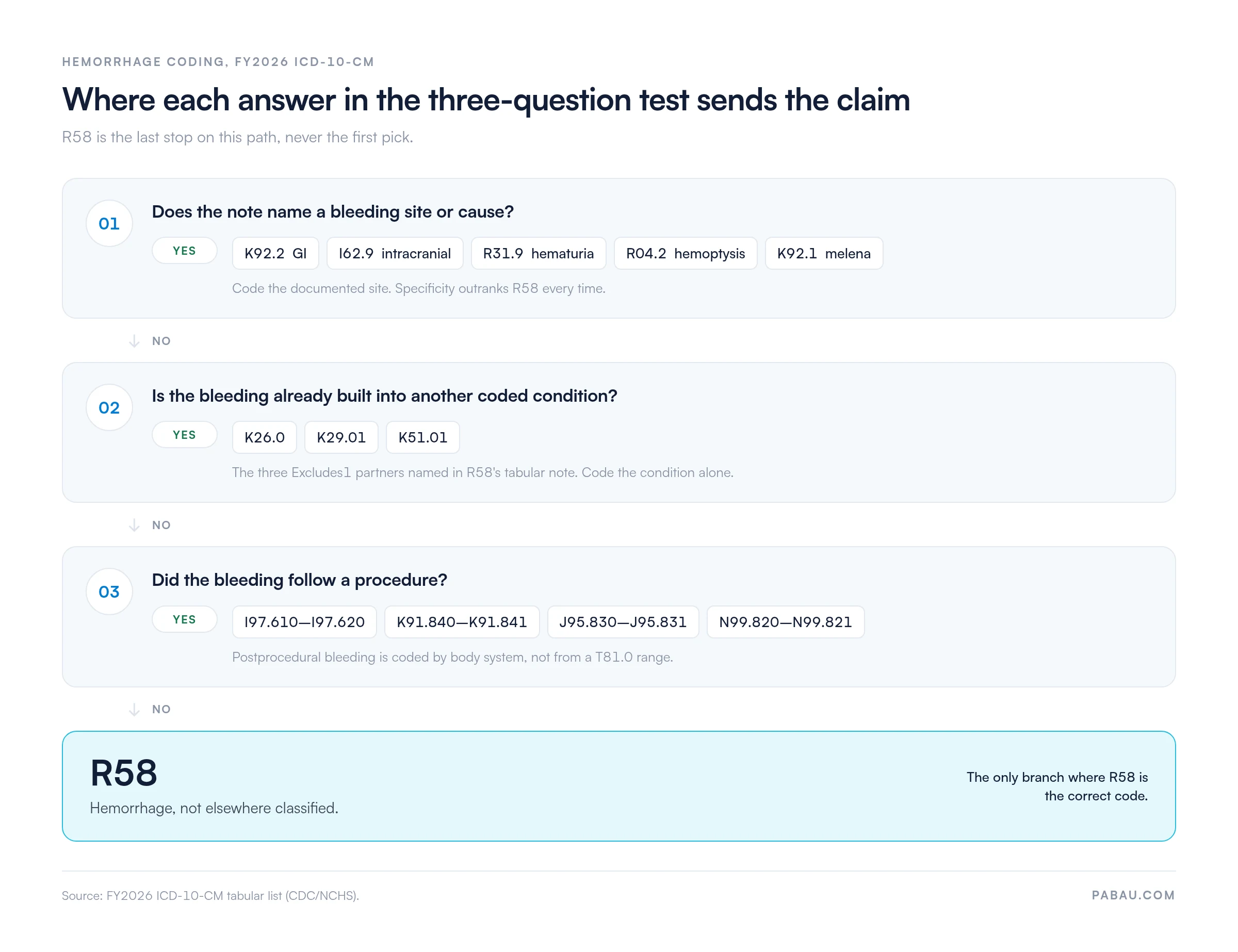
The excludes notes for R58 are a common source of claim denial. Misapplying them creates duplicate coding that payers flag on audit. Careful denial management starts with reading the tabular note itself rather than a third-party summary.
An Excludes1 note means “not coded here.” These conditions cannot be reported at the same encounter as R58, because hemorrhage is already embedded in their own definition. Coding both would count the bleeding twice.
R58’s tabular note lists exactly three codes under the heading hemorrhage included with conditions classified elsewhere:
Other conditions that include bleeding by definition still outrank R58, even though they are not named here. Disseminated intravascular coagulation (D65) is the usual example. It is not an Excludes1 partner of R58, but its own descriptor already covers the hemorrhage.
R58 carries no Excludes2 note in the FY2026 ICD-10-CM tabular list. Several coding references publish one anyway, usually filling it with site-specific hemorrhage codes. Those codes are not excluded from R58 by any tabular note.
They outrank R58 for a different reason. The Official Guidelines require the most specific code the documentation supports, which is a specificity rule rather than an excludes rule.
The distinction matters at audit. An Excludes1 breach is a coding error a payer can point to in the tabular list. Choosing R58 over a more specific code is a documentation finding, and it is argued differently on appeal.
Most hemorrhage presentations have a more specific code available. The table below maps common clinical scenarios to their preferred codes, so you can see where R58 is genuinely the right choice.
The overarching rule from the ICD-10-CM Official Guidelines is that specificity wins. R58 is appropriate only after ruling out every site-specific option in the tabular list. When documentation is ambiguous, query the physician before defaulting to R58.
Query the physician before assigning R58. One clarification question often does the job. Ask whether the physician can document the anatomical site or the suspected cause. It takes 60 seconds, and it can turn an unspecified R58 into a site-specific code that survives audit.
R58 is defensible at audit only when the note establishes that the hemorrhage site or cause could not be determined at that encounter. Unspecified codes invite scrutiny, and the documentation is the only protection that holds up.
A complete R58 note should include:
The ICD-10-CM Official Guidelines treat symptom codes like R58 as appropriate only until a definitive diagnosis is established. Once the source is confirmed, a more specific code replaces R58 on later claims. Building the physician-query step into the standard coding workflow catches missing detail before the claim is submitted.
The approximate ICD-9-CM predecessor to R58 is 459.0 (Hemorrhage, unspecified). This mapping comes from the CMS General Equivalence Mappings (GEMs) file, a bidirectional translation tool built for the ICD-9 to ICD-10 transition. Billing staff use it to reconcile older records and to appeal denials that turn on prior coding history.
The crosswalk is approximate, not exact. The ResDAC guidance on ICD codes in Medicare files explains that GEMs mappings suit trend analysis and legacy data translation, not live coding decisions.
The codes below are the most clinically relevant alternatives to R58. When the physician’s documentation names any of these conditions, the site-specific code takes precedence. Our wider ICD-10-CM code reference covers the rest of the chapter if the presentation does not match any row here.
The WHO ICD-10 browser shows the full international hierarchy for each of these codes. Checking it confirms whether a site-specific code exists before you default to R58.
Check the ICD-10-CM index under ‘Hemorrhage’ before assigning R58. The index lists dozens of anatomical sub-entries such as gastric, pulmonary and subconjunctival. If the physician’s note matches any sub-entry, that code takes priority. R58 sits at the bottom of the index entry under ‘not elsewhere classified.’
Coding R58 correctly is one job. Getting the claim out, tracking what the payer does with it, and posting the remittance is another. Most practices split that work across a coding worksheet, a payer portal login, and a spreadsheet of outstanding claims.
Pabau is all-in-one practice management software, and its claims management software keeps that sequence in one record. The clinical note, the diagnosis codes attached to the invoice, and the submitted claim all sit against the same patient.
For US practices, Pabau connects to the Claim.MD clearinghouse. That connection handles real-time eligibility checks (270/271), CMS-1500 and 837P claim submission, claim status tracking, and electronic remittance advice returned as 835 files.
None of that decides whether R58 is the right code. That judgment stays with the coder and the physician’s documentation. What the platform gives you is one place to check each claim’s status. You can see that it went out, what the payer returned, and how long it has been open.


Pabau links the clinical note, the diagnosis codes on the invoice, and the submitted claim to one patient record. For US practices, the Claim.MD connection handles eligibility checks, submission, status tracking, and ERA posting.

R58 does one job. It documents hemorrhage when the record genuinely cannot say where the bleeding came from or what caused it. Reach for it after the three-question test, not before, and the code holds up.
The two errors worth guarding against are structural rather than clinical. Do not treat site-specific hemorrhage codes as Excludes2 partners, because R58 has no Excludes2 note. And do not reach for a T81.0 postprocedural code, because that family does not exist in FY2026.
Practices rarely lose money on the code choice itself. They lose it on the claim that goes out and never gets chased. Book a demo to see how Pabau tracks each submitted claim from the note through to the remittance.

Need to understand how clearinghouse submissions work? Pabau’s Claim.MD clearinghouse guide explains how 837P claims are submitted, tracked, and returned with ERA data.
Want to cut denials on symptom-chapter codes? Denial codes in medical billing covers the most common CARC reasons and how to resolve them before resubmission.
Chasing fewer rejections on unspecified codes? Clean claim requirements sets out the fields a payer checks before it accepts a claim.
ICD-10 Code R58 (Hemorrhage, not elsewhere classified) documents hemorrhage when the physician’s record identifies no specific anatomical site. It also applies only when no underlying condition carries its own ICD-10-CM code for the bleeding. It is a residual, symptom-chapter code, assigned after ruling out all site-specific alternatives.
The approximate ICD-9-CM equivalent is 459.0 (Hemorrhage, unspecified). This mapping comes from the CMS General Equivalence Mappings file and is approximate rather than exact. It is useful for legacy record translation and trend analysis but should not be used to guide live coding decisions.
Postprocedural hemorrhage is coded by body system, not from a T81.0 range, which does not exist in FY2026 ICD-10-CM. Use I97.610 to I97.620 for circulatory, K91.840 to K91.841 for digestive, J95.830 to J95.831 for respiratory, and N99.820 to N99.821 for genitourinary bleeding.
Documentation supporting R58 should include the presenting complaint and objective clinical findings consistent with hemorrhage. It also needs a record of the diagnostic workup ordered, an explanation of why the site could not be identified, and a follow-up plan. Auditors look for all five elements when reviewing unspecified symptom-chapter codes.




