ICD-10 Code S66.308A: Extensor muscle injury, other finger
ICD-10 Code S66.308A: Definition and code hierarchy ICD-10 Code S66.308A is the ...

Last Updated: Oct 14, 2026
Billable Code Specific Code
H73.92 is the billable ICD-10-CM code for unspecified disorder of tympanic membrane, left ear.
Its parent, H73.9, is not billable on its own. Payers require the full four-character child code so the claim records which ear was examined. Use H73.92 when the chart notes a left-ear eardrum abnormality without enough detail for a named diagnosis such as myringitis or perforation.
Let Pabau's smart automation suggest the right codes, reduce claim denials, and keep your practice compliant—effortlessly.
Automate repetitive tasks and focus on what matters most—your patients.
Reduce coding errors and ensure compliance with the latest regulations.
Clean claims, fewer denials, and faster reimbursements.
Powerful insights and reporting to help your practice thrive.
HIPAA compliant SOC 2 certified GDPR-compliant Trusted by 4,000+ clinics worldwide

H73.92 is a billable ICD-10-CM code for the left ear; its parent H73.9 is non-billable and cannot be submitted for reimbursement
Laterality is mandatory: H73.90 covers unspecified ear, H73.91 right ear, H73.92 left ear, and H73.93 bilateral
Use H73.92 only when documentation does not support a more specific tympanic membrane diagnosis such as myringitis (H73.0x) or perforation (H72.x)
Pabau’s claims management software integrates ICD-10 code entry with electronic claim submission, reducing laterality-related denials at the source
ICD-10 Code H73.92 carries full billable status under the CDC/NCHS ICD-10-CM web tool for fiscal year 2026, effective October 1, 2025.
It is valid for submission on CMS-1500 claims and 837P electronic transactions, and it satisfies HIPAA’s requirement for standardized code sets in electronic healthcare transactions.
The code was not revised for FY2026. Its description, validity, and placement within the H73 category remain unchanged from FY2025. Coders verifying annual code updates can confirm current status through the CMS ICD-10 codes page, which publishes the full tabular list each fiscal year.
H73.92 sits at the fourth character of the H73 category, three levels beneath the chapter root. Reading that hierarchy correctly heads off the most common error on ear claims. That error is billing the non-billable parent H73.9. The same parent-child pattern runs through the rest of the ICD-10-CM codes index, so the four-character rule is not specific to ear disorders.
Billing H73.9 instead of H73.92 is one of the most common coding mistakes on ear-related claims. Payers reject H73.9 automatically because it lacks the required laterality specificity. Always select the four-character child code.
Tympanic membrane disorder ICD-10 codes in the H73.9x family differ only in laterality. Each is a separate, billable code. The choice between them is determined entirely by which ear is documented in the clinical note. Picking the wrong side is a transcription slip rather than a judgment call. It still triggers the same denial as billing the non-billable parent.
H73.90 (unspecified ear) should be used sparingly. It is billable, but many payers and auditors flag it because documentation for most ear examinations specifies which ear was involved. Defaulting to H73.90 when the chart clearly states “left ear” is a documentation-to-code mismatch that creates audit risk.
H73.92 captures left-ear tympanic membrane findings that are clinically significant but not documented with enough specificity to support a more precise code. In many other ICD-10-CM chapters, an “unspecified” code usually means the record is thin. Here it more often means the eardrum was examined and the finding has no name yet.
Common conditions coded under H73.92 when documentation is incomplete include:
The key clinical test is whether the provider has documented enough to assign a more specific code. If they have, H73.92 is not the right choice. If the note says “left eardrum appears abnormal, follow-up in six weeks,” H73.92 is appropriate for that encounter.
Three documentation elements must be present in the clinical note before H73.92 can be submitted on a claim. Missing any one of them creates either a denial or a medical records request from the payer. The laterality requirement runs across every ear code, and it cannot be satisfied by inference from the procedure billed.
Payers may also request the record itself to confirm the laterality submitted on the claim. Practices that work to a clean claim standard attach diagnosis codes the chart note already supports, before the claim leaves the practice. That closes off most of the back-and-forth.
Two questions settle the code, and the order matters. Ask which ear the note names, then ask whether it names a diagnosis.
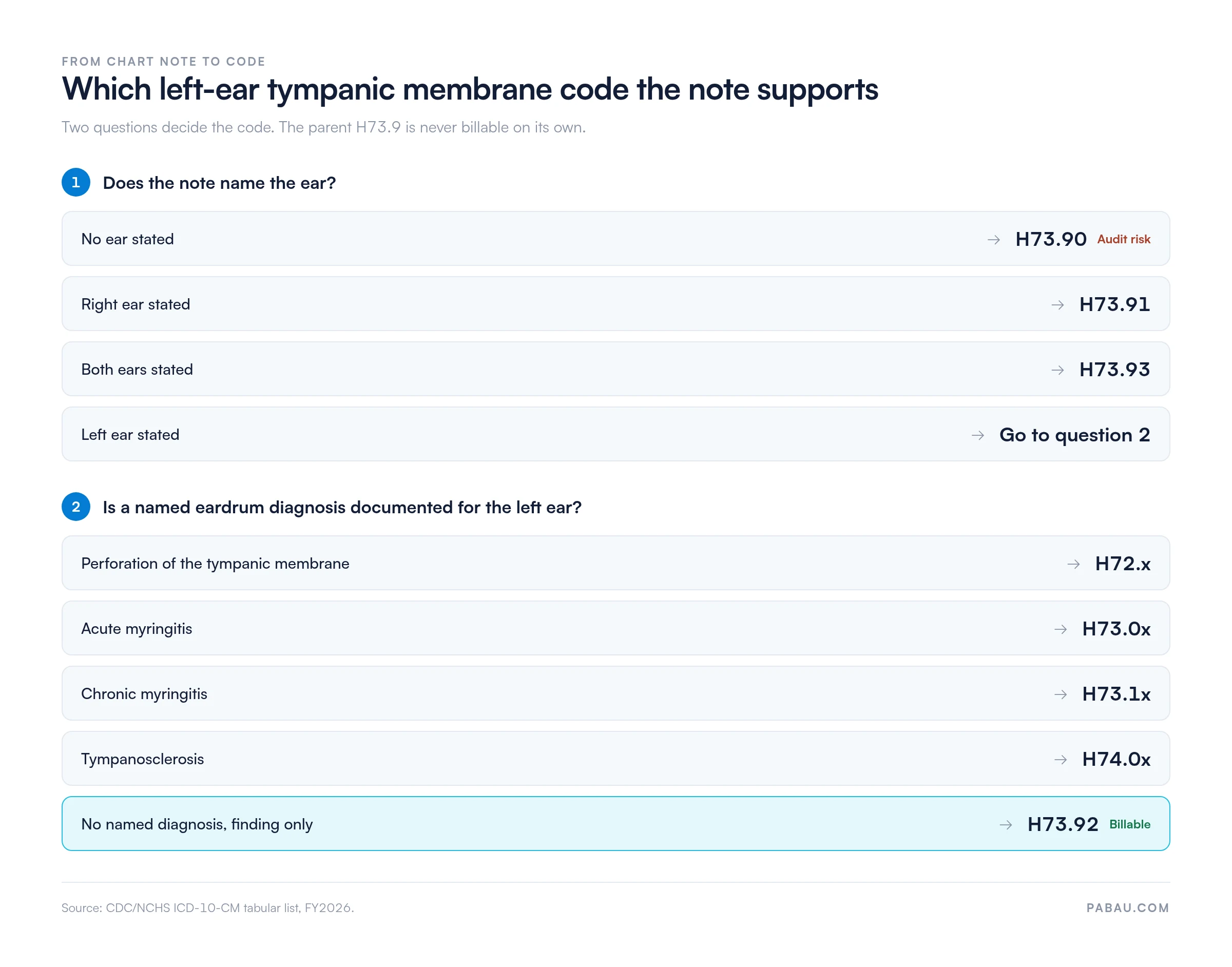
Flag encounters where the provider documents a tympanic membrane finding without naming the ear. Build an EHR prompt that fires when an H73.9x code is selected, asking the provider to confirm the side before the chart closes. A query answered at documentation costs far less than a denial worked after remittance.
CPT codes for tympanic membrane procedures pair with H73.92 when the diagnosis supports the intervention. The diagnosis code alone does not justify the procedure; the clinical note must document medical necessity for the specific service billed. Practices that submit these pairings electronically through the Claim.MD clearinghouse get built-in CPT and ICD-10-CM catalogues. Those catalogues flag a mismatched pairing before it reaches the payer.
Practice management software like Pabau links diagnosis codes to procedure codes at the point of claim creation. Its claims management software lets a coder confirm that H73.92 supports the CPT code billed before submission, rather than after a denial. Remittance advice from the clearinghouse then returns the reason codes that name a CPT-to-diagnosis mismatch.
H73.92 is appropriate only when the clinical documentation does not support a more specific tympanic membrane diagnosis. The ICD-10-CM Official Guidelines for Coding and Reporting instruct coders to assign the code that most precisely reflects the documented condition. Using H73.92 when a more specific code exists is technically a coding error, even if the claim pays. The table below outlines the decision points. Knowing where those thresholds sit keeps the practice out of post-payment audits later.
The column “use H73.92?” requires the coder to read the chart, not just the charge sheet. Practices that accept provider-entered diagnosis codes without a documentation review over-use H73.92 most often. Matching the diagnosis to what the chart records is a standard coder certification expectation under the ICD-10-CM Official Guidelines.
Practices transitioning older records or cross-referencing legacy claims use ICD-9-CM to ICD-10-CM crosswalk data from the General Equivalence Mappings (GEMs) maintained by CMS and NCHS. H73.92 maps from the ICD-9 category for tympanic membrane disorders.
ICD-9 code 384.9 did not require laterality documentation. The move to ICD-10-CM introduced it. Practices that carried records across without changing how clinicians document the ear still file the most H73.90 claims today. The AAPC ICD-10-CM code lookup searches in both directions between the two code sets. CMS publishes the official GEM files alongside the annual tabular list. A crosswalk validation step is worth building into any claim that references a legacy record.
ENT and audiology practices see a high volume of tympanic membrane encounters, and most of them still code these in two places. The clinician writes the note, and a biller assigns the code later from a charge sheet. That second step is where the ear gets lost.
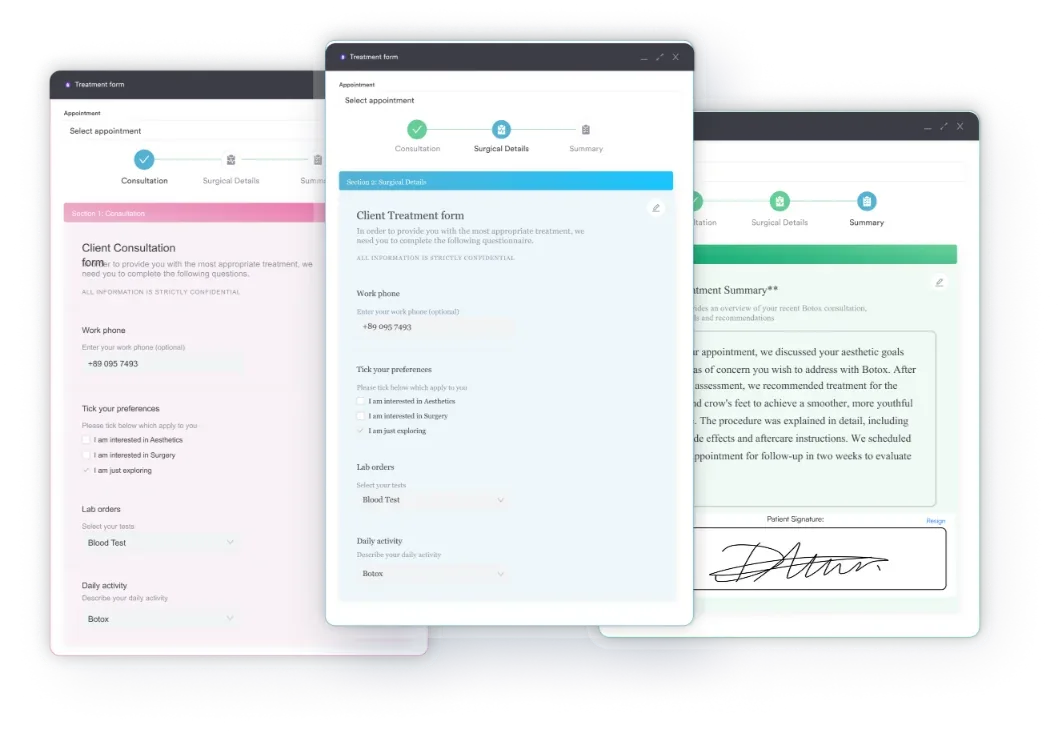
Pabau’s digital intake and clinical forms capture the examined ear as a structured field during the encounter. The code entry that follows reads from the patient record instead of a biller’s reconstruction of it. The Claim.MD integration then routes the finished claim through a clearinghouse with built-in CPT and ICD-10-CM catalogues. A laterality problem surfaces there, before the payer sees the claim.
The reporting layer also lets a practice audit its own H73.9x history. It can pick out the clinicians or encounter types where H73.90 turns up more often than expected. A run of unspecified-ear codes usually points to a documentation habit worth retraining.

Pabau ties ICD-10 code entry to electronic claim submission through Claim.MD. The examined ear is captured in the clinical note and carried straight onto the claim. See how it works for ENT and audiology practices.

H73.92 is a straightforward code when documentation supports it, and a denial risk when it does not. The discipline is confirming left-ear laterality in the note before the code is assigned. Where the provider has documented a named diagnosis, a more specific H72 or H73.x code takes its place.
Pabau’s integrated claims workflow captures laterality at the clinical documentation stage, links it to the correct ICD-10-CM code, and submits through Claim.MD with pre-submission validation. To see how Pabau handles ENT and audiology billing, book a demo with the team.

Need a structured approach to clean claim submission? Clean claim submission guide covers the documentation and coding elements that reduce first-pass denial rates.
Want to understand how clearinghouse billing works? Claim.MD clearinghouse overview explains how electronic claim routing reduces manual resubmission for ENT and audiology practices.
Looking to reduce denials across your practice? Denial management in healthcare outlines how to build a systematic denial prevention and recovery workflow.
ICD-10 Code H73.92 is the billable ICD-10-CM diagnosis code for an unspecified disorder of the tympanic membrane affecting the left ear. It applies when a left-ear eardrum abnormality is documented. The finding must not be specific enough to support a named diagnosis such as myringitis or perforation.
Yes, H73.92 is billable and valid for reimbursement in fiscal year 2026, effective October 1, 2025. Its parent code H73.9 is non-billable; claims submitted with H73.9 are automatically rejected for insufficient laterality specificity.
The four codes differ only in laterality: H73.90 covers an unspecified ear, H73.91 the right ear, H73.92 the left ear, and H73.93 bilateral involvement. All four are billable; the selection is determined entirely by which ear is documented in the clinical note.
CPT codes 69420 and 69421 cover myringotomy, with and without general anesthesia. CPT codes 69433 and 69436 cover tympanostomy with a ventilating tube. All four pair with H73.92 when the tympanic membrane diagnosis supports the procedure. Clinical documentation must establish medical necessity for each procedure independently.
Use H73.92 when the provider documents a left-ear tympanic membrane finding but does not establish a specific diagnosis. If the note records a named condition such as myringitis, perforation, or tympanosclerosis, use the more specific code within H72 or H73.0x-H73.8x instead.
Yes. The clinical note must explicitly state “left ear” to support H73.92. A general reference to a tympanic membrane finding without naming the affected ear does not satisfy the laterality requirement. H73.90 (unspecified ear) would apply instead. That code carries greater audit risk when the exam record would logically indicate which ear was involved.