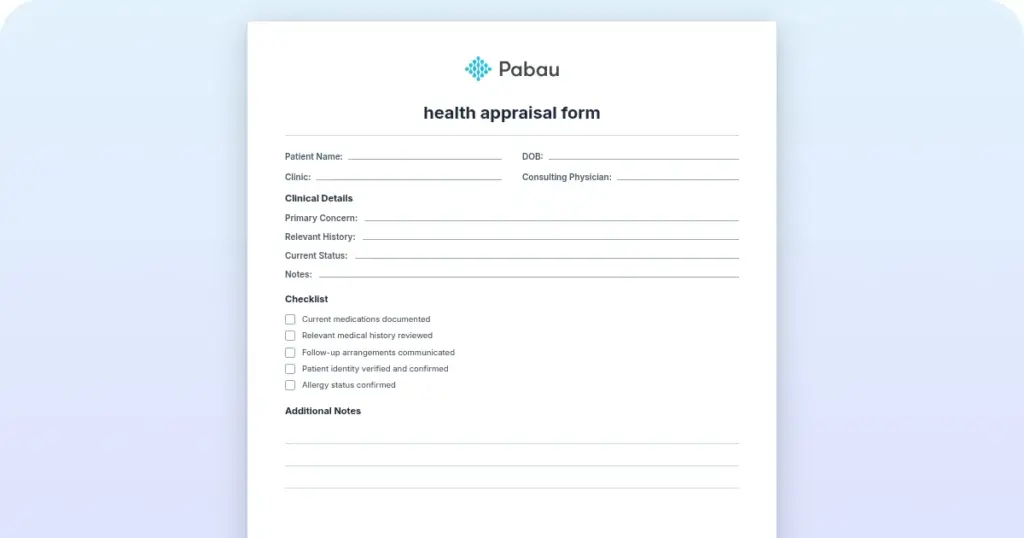
Health appraisal form
A health appraisal form is a record a licensed provider signs to document someon...

2
Last Updated: Oct 13, 2026

Software covered: 1. Cliniko, 2. Pabau, 3. Jane App, 4. Power Diary (now Zanda), 5. EasyPractice
Cliniko is the best overall WriteUpp alternative for allied health practices, and reviewers rate its support above every other platform here
Pabau is the pick for growing multi-discipline practices, particularly therapy practices adding aesthetics, and it integrates with Healthcode for private insurer billing
WriteUpp suits solo therapists well, but reporting, multi-location scheduling, and integration depth all tighten once a second clinician joins
Jane App and Power Diary include video consultations natively, while Cliniko needs a third-party tool for telehealth
GDPR posture varies by platform: WriteUpp stores data in the UK, and Jane App’s UK position needs checking before you migrate records
WriteUpp holds a loyal following among UK therapists. It’s clean, focused, and purpose-built for allied health. But “good enough for now” stops holding up once a practice adds a second clinician. The same happens when it expands into aesthetics, or needs invoicing beyond basic per-session billing. That’s when WriteUpp users start looking for something with more headroom.
This guide compares five of the strongest WriteUpp alternatives available to UK therapists and private practices. We assessed each platform on scheduling, clinical documentation, online booking, invoicing, GDPR compliance, and pricing. We’ve built the comparison as a ladder of four questions rather than one winner. Stop at the first question that describes your practice.
WriteUpp earns high marks for usability. Its interface is straightforward, the SOAP note builder is solid, and onboarding is quick for a solo practitioner. According to G2 reviewers, it carries a 4.5/5 rating and is consistently praised for being UK-focused and easy to learn.
The friction shows up later. Practices that grow beyond one or two clinicians hit the ceiling on reporting, multi-location scheduling, and integration depth. Three patterns keep appearing in WriteUpp exit reviews:
Healthcode integration is a genuine WriteUpp strength for UK private practice billing. Assess any alternative against that capability if you bill through BUPA, AXA Health, or Vitality. Of the five platforms below, Pabau is the one that also integrates with Healthcode.
The table below compares all five WriteUpp alternatives across the dimensions that matter most to UK therapists and allied health professionals.
The closest like-for-like replacement for WriteUpp, with support reviewers rate noticeably higher.
Cliniko is one of the most widely used practice management platforms among physiotherapists, osteopaths, and allied health professionals in English-speaking markets. Its 4.7/5 Capterra rating reflects strong customer sentiment, particularly around the support team and the scheduling interface.
For WriteUpp users, Cliniko is a lateral move with meaningfully better customer support. The clinical notes builder is comparable in structure, but Cliniko’s scheduling is more polished for group practices. If you want the two products side by side, our practice software comparisons break each platform down feature by feature.
Cliniko scores 4.7/5 across 23 reviews on Capterra and 4.6/5 on G2. Reviewers frequently name the support team as the main reason they recommend the platform.
| Plan / Tier | Price | Details |
|---|---|---|
| Single practitioner | $45/month | Annual pay gives one month free per year; SMS add-on 10c per message |
| 2-5 practitioners | $95/month | Per tier, not per user |
| 6-8 practitioners | $145/month | Per tier |
| 9-12 practitioners | $195/month | Per tier |
| 13-25 practitioners | $295/month | Per tier |
| 26-200 practitioners | $395/month | Per tier |
Cliniko charges by practitioner band rather than per seat, so a five-person practice pays the same as a two-person one. Figures are from cliniko.com.
The step up for a WriteUpp practice adding clinicians, rooms, or a second service line.
Pabau is practice management software built for practices that need more than a therapy scheduling tool. It supports therapy practice management alongside aesthetics, physiotherapy, wellness, and multi-disciplinary workflows. That makes it the natural step up for WriteUpp users whose practice has outgrown a single-discipline tool.
Where WriteUpp is optimized for the solo allied health professional, Pabau scales across multiple clinicians, rooms, and locations. Automated reminders, digital forms and consent management, and customizable treatment records all ship with the core subscription. Every subscription includes every feature, so no capability sits behind a higher tier.
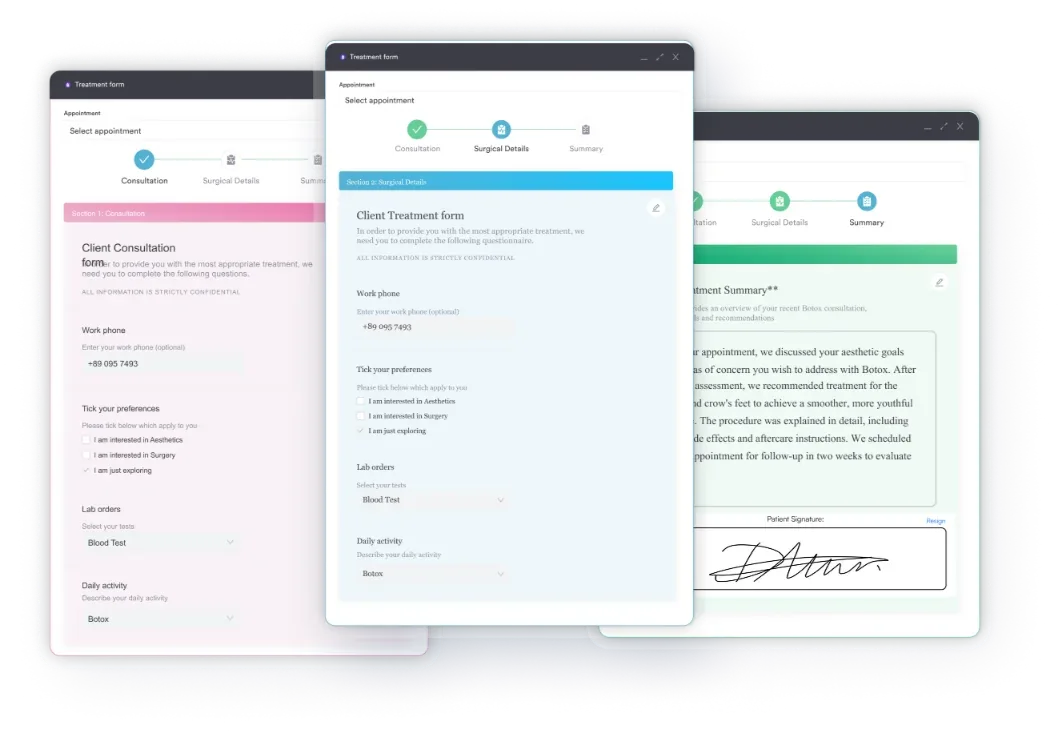
Pabau carries a 4.7/5 rating across 647 verified reviews on Capterra. Reviewers consistently cite the breadth of the feature set and the strength of the clinical documentation. Common criticisms focus on the initial learning curve and occasional support response times.
| Plan / Tier | Price | Details |
|---|---|---|
| Single location, one user | From $62/month | Full platform; every subscription includes every feature |
| Growing practice | Scales with users and locations | Add clinicians or sites; the feature set stays the same |
| Multi-location group | Custom quote | Structured onboarding included; contact sales |
Pabau prices on locations and users rather than feature tiers, so the platform doesn’t change shape as you grow. Figures are from pabau.com.
The smoothest built-in video consultation experience here, with North American roots to check.
Jane App is a Canadian-built practice management platform that has expanded into UK and international markets. It earns the highest Capterra rating in this comparison at 4.8/5, driven largely by its interface and its built-in telehealth.
The main caveat for UK therapists is that Jane App is designed around North American workflows. UK GDPR compliance and data residency should be verified directly with the vendor before you commit. Pricing is published in Canadian dollars, which adds a currency step to UK budgeting. Our roundup of Jane App alternatives covers the platforms UK practices weigh against it.
Jane App scores 4.8/5 across roughly 490 reviews on Capterra and 4.8/5 on G2. Positive reviews focus on the interface and the telehealth experience. UK-based reviewers sometimes name the North American focus as a limitation.
| Plan / Tier | Price | Details |
|---|---|---|
| Balance | CAD $54/month | Single practitioner; up to 20 appointments per month |
| Practice | CAD $79/month | Includes one full-time practitioner |
| Thrive | CAD $99/month | Includes one full-time practitioner |
| Add-on: AI scribe | CAD $15/month | Per opted-in practitioner |
| Add-on: group telehealth | CAD $15/month | Per opted-in practitioner |
| Add-on: insurance billing | CAD $20/month | Plus CAD $5 per extra full-time practitioner |
| Add-on: Jane websites | CAD $59/month | Per practice |
Jane publishes every plan in Canadian dollars, so a UK practice pays whatever the exchange rate is on the billing date. Figures are from jane.app.
A simpler, cheaper WriteUpp swap with video consultations included from the start.
Power Diary rebranded as Zanda in late 2024, and the product still runs under both names during the transition. It has a long track record as a straightforward, affordable tool for small allied health and therapy practices. Setup is fast, the interface is uncomplicated, and telehealth is included natively.
For WriteUpp users frustrated by scalability limits, Power Diary offers similar simplicity with telehealth added. It doesn’t meaningfully raise the feature ceiling. For a solo or two-practitioner practice, that may not be what’s needed.
Power Diary, now Zanda, holds a 4.6/5 rating across roughly 205 reviews on Capterra. Reviewers highlight ease of setup and appointment reminders as standout positives. Common criticisms point to limited reporting and customization.
| Plan / Tier | Price | Details |
|---|---|---|
| Starter | $19/month | One practitioner, one user; 1,000-appointment limit |
| Growth (solo) | $49/month | One practitioner base; unlimited appointments and users |
| Growth (group) | $49/month plus $19 per extra practitioner | Two practitioners works out at $68/month |
| Add-on: telehealth pro | $9/month per practitioner | Unlimited telehealth calls |
Zanda’s entry tier caps appointments rather than features, so a low-volume practice pays very little. Figures are from zanda.health.
Before committing to any WriteUpp alternative, export your full client list, appointment history, and clinical notes from WriteUpp as CSV files. Every platform on this list accepts CSV imports, but the column mapping and field structure vary. Running a test import with a small data sample before you migrate the full dataset saves significant rework.
The cheapest way off WriteUpp, as long as your clinical notes stay simple.
EasyPractice is a European-built practice management platform aimed at solo therapists and small health practices. It is EU GDPR compliant, stores data within Europe, and is available to UK therapists. The interface is genuinely easy: booking, invoicing, and basic clinical notes without the feature overhead of larger platforms.
The trade-off is feature depth. EasyPractice wins on simplicity and affordability. It loses quickly once a practice needs richer clinical notes, more than one or two practitioners, or any meaningful workflow automation.
EasyPractice holds a 4.7/5 rating on Capterra and 4.6/5 on Trustpilot. Reviewers highlight ease of use and the clean booking interface as the main reasons they recommend it.
| Plan / Tier | Price | Details |
|---|---|---|
| Free | £0/month | Up to 2 clients; booking, invoicing and basic notes |
| Unlimited | £19/month | Unlimited clients for a solo practitioner |
| Enterprise | From £270/month | Larger teams; contact sales for a quote |
The jump from Unlimited to Enterprise is steep, so EasyPractice suits a practice that stays at one or two practitioners. Figures are from easypractice.net.
For UK therapists and allied health professionals, GDPR compliance is not a checkbox. Clinical records hold sensitive personal data under Article 9 of the UK GDPR. The Information Commissioner’s Office holds practices responsible for how that data is stored and processed, whichever vendor handles it. The platform you choose must be a data processor you can hold accountable under a Data Processing Agreement.
Here is how each WriteUpp alternative positions itself on compliance. Always verify current status directly with the vendor before committing. Compliance tools built for practices are worth reviewing as part of that evaluation.
The practical takeaway is that WriteUpp’s UK data residency remains the clearest compliance story in this group. Pabau sits close behind, with verified GDPR compliance and a UK data option. Cliniko and Power Diary are likely compliant but need direct verification. Jane App carries the most uncertainty for UK users, so verify it thoroughly before you onboard patient data.
The right choice depends on where your practice sits today and where it is heading. Work down the four questions below and stop at the first one that describes you.
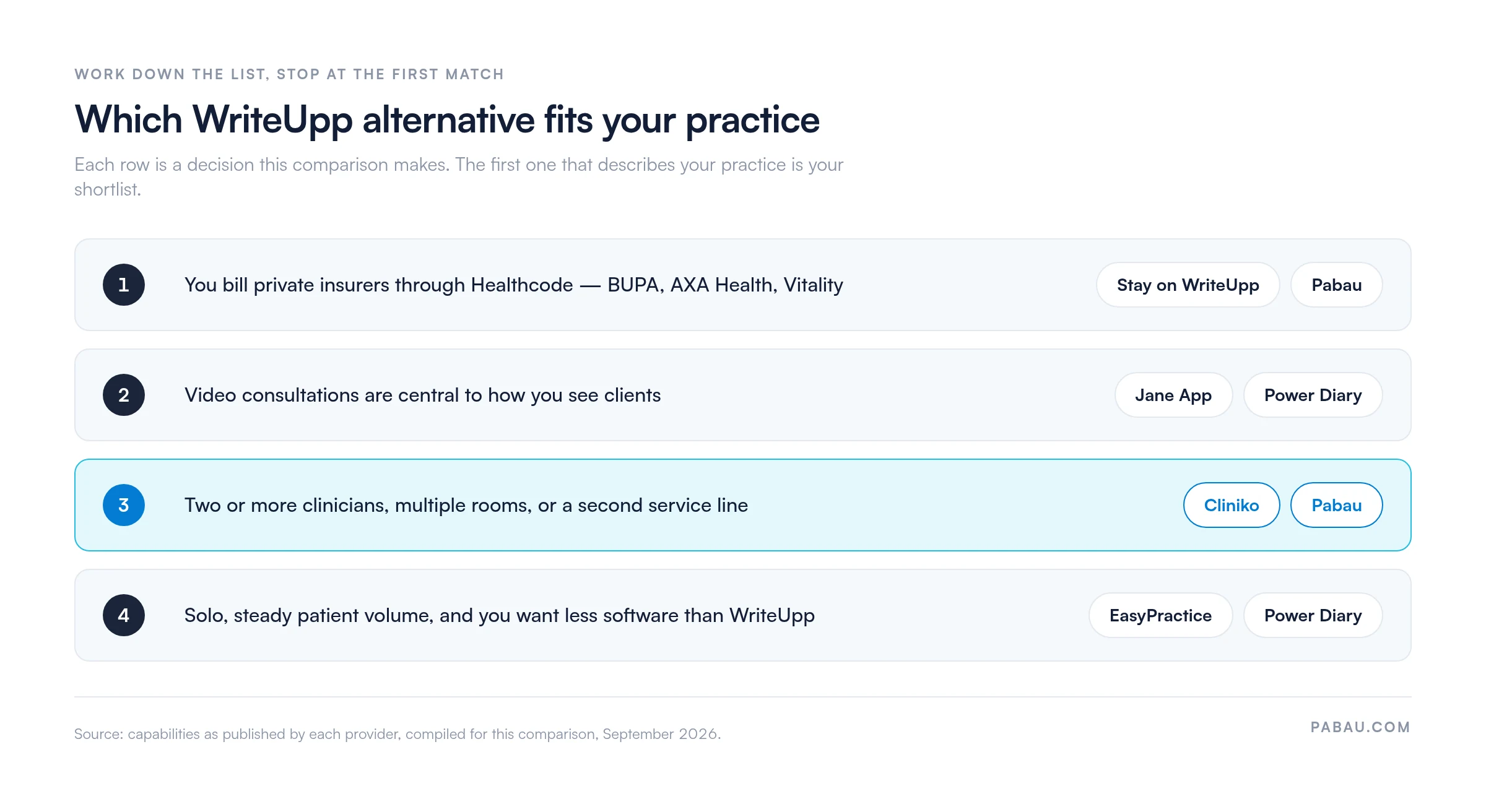
The ladder below assumes a UK practice. Therapists comparing US behavioral health platforms should start with our TherapyNotes alternatives roundup instead.
Healthcode is the first question because it rules platforms out fastest. WriteUpp’s Healthcode integration connects directly with BUPA, AXA Health, and Vitality for private practice billing. Among the alternatives here, Pabau also integrates with Healthcode, so that workflow survives the move. Jane App does not, and you should confirm the current position of the others with each vendor.
If video consultations are central to your practice model, Jane App and Power Diary both include telehealth natively. Cliniko does not, and needs a third-party tool. Pabau includes video consultations too, billed through credit top-ups rather than a flat monthly fee.
Solo practitioners with stable patient volumes and no near-term growth plans are well served by EasyPractice or Power Diary. Both are simpler than WriteUpp, so the switch reduces overhead rather than adding it. Practices with two or more clinicians need Cliniko or Pabau. The same applies if you plan a second service line, such as a physiotherapy practice adding aesthetic consultations.
If SOAP notes are your primary documentation format, WriteUpp, Cliniko, and Jane App all handle them well. Some practices need more than SOAP: consent forms with digital signatures, pre and post-care documents, injection mapping, and before-and-after photo workflows. Pabau is the only platform in this comparison that covers that full range without third-party tools.
WriteUpp charges per user per month, which is cost-effective at one or two clinicians. Per-user models compound as headcount grows. Cliniko’s practitioner bands and Pabau’s location-and-user model both flatten that curve for a larger team. EasyPractice and Power Diary remain the cheapest entry points for a solo practitioner.
A practice leaving WriteUpp usually leaves because the admin has spread out. Four jobs end up in four places:
Every new clinician makes that spread harder to hold together.
Pabau puts those pieces in one record. The multi-location calendar covers rooms, practitioners, and sites in a single view. Consent forms and intake questionnaires are signed digitally and filed against the client record, which is what a CQC inspector asks to see. Healthcode claims run from the same place, so BUPA, AXA Health, and Vitality billing stays where the appointment already lives.
The outcome for a growing practice is fewer handoffs. Recalls, follow-ups, and review requests run on their own schedule instead of a reception to-do list. Adding aesthetics or a second discipline means new templates, not new software. And every subscription includes every feature, so growth changes your bill rather than your toolkit.

Scheduling, clinical notes, consent forms, Healthcode claims, and automated client follow-ups all connect in Pabau. Book a demo to see how it handles your specific practice type.

WriteUpp does what it was built for: straightforward practice management for solo and small allied health practitioners in the UK. Its compliance story is clear and its SOAP note workflow is well designed. It was not built for practices that scale, add service lines, or move past per-session invoicing into packages, deposits, and multi-location management.
Cliniko is the safest switch for most WriteUpp users. It asks little of you on day one, the support is better, and the daily workflow will still feel familiar. That is why it leads this list.
The trade-off worth remembering is that a safe switch buys you a few years, not a decade. If you already know a second clinician or an aesthetics room is coming, moving twice costs more than moving once. Pabau is the option built for that second move, with Healthcode billing, consent capture, and multi-location scheduling in one subscription. Book a demo to see how it handles a growing UK therapy practice before you commit to a migration.

Weighing Cliniko against the wider market? Cliniko alternatives compares the platforms allied health practices move to when Cliniko stops fitting.
Shortlisting Jane App for telehealth? Jane App alternatives sets out the options UK practices weigh against a Canadian-built platform.
Looking at UK-built clinical software? Semble alternatives covers the systems private UK practices compare when they outgrow their current one.
Coming from a therapy-focused platform? SimplePractice competitors reviews the tools therapists switch to and what each one does better.
Want to see how Pabau is judged? Pabau competitors and alternatives lays out where Pabau wins and where another platform fits better.
Cliniko is the best overall WriteUpp alternative for allied health practices, followed by Pabau for growing multi-discipline practices. Jane App suits therapists who need built-in telehealth. Power Diary fits solo practitioners who want simplicity, and EasyPractice is the budget option. Your practice size, Healthcode needs, and growth plans decide which one fits.
Pabau covers more ground than WriteUpp. It adds multi-location scheduling, customizable clinical documentation, automated workflows, and consent management on top of scheduling and invoicing. Both platforms integrate with Healthcode for UK private insurer billing. WriteUpp is simpler and cheaper for a solo practitioner, while Pabau gives a growing practice far more headroom.
Yes. WriteUpp is GDPR compliant and stores data in the UK, which it lists as a core selling point for UK therapists. Pabau is also verified as GDPR compliant, with UK data storage options. Cliniko and Power Diary are likely compliant but need direct verification. Jane App is Canadian-built, so run thorough UK GDPR checks before you onboard patient data.
EasyPractice and Power Diary offer the lowest entry pricing for solo practitioners. EasyPractice starts free for two clients and moves to £19 a month for unlimited clients. Power Diary, now Zanda, starts at $19 a month. For practices with several clinicians, Pabau’s location-and-user pricing can work out better than a per-user model.