Ethical consent form: free template and what to add
An ethical consent form is a written record that a patient or participant agreed...

2
Last Updated: Oct 26, 2026

Telehealth is the umbrella term covering all remote healthcare services, both clinical and non-clinical.
Telemedicine is a subset of telehealth focused only on remote clinical care between patient and provider.
Telecare is the third category, covering sensor-based remote monitoring for chronic condition management.
The category a service falls into decides the billing modifier, the HIPAA obligation, and the platform you need.
Practice management software like Pabau runs video consults, scheduling, and HIPAA-compliant documentation in one place.
Most clinicians use telehealth and telemedicine interchangeably. Payers, regulators, and software vendors do not. That difference costs practices money. A misclassified service line can trigger a claim denial, and the wrong platform can create a HIPAA exposure you never planned for.
Federal guidance from HHS treats telehealth as the broader category, with telemedicine sitting inside it as the clinical subset. Where one ends and the other begins decides which CPT codes you bill. It also decides which platforms qualify for HIPAA safe harbor and how CMS reimburses the encounter.
This guide covers the full spectrum, from definitions through to software selection, with the operational detail practice owners need.
Telehealth covers every remote healthcare service delivered through technology, clinical or otherwise. The FCC’s official definition describes it as “a wide variety of remote healthcare services beyond the doctor-patient relationship.” So telehealth is the container rather than the service itself.
Non-clinical services under telehealth include provider training, continuing medical education, health informatics, patient education programs, and administrative meetings between care teams. None of them involve direct clinical care, but all of them count as telehealth under federal definitions.
So if your practice delivers any service remotely through technology, you are operating in the telehealth space. That holds whether or not a clinician and a patient are on the same call.
Telemedicine refers specifically to remote clinical services. A licensed clinician diagnoses, treats, or manages a patient’s condition without being in the same room. The AAFP’s telemedicine policy frames it as “the practice of medicine using technology to deliver care at a distance.” The operative word is practice, because telemedicine involves clinical judgment, documentation, and medical decision-making.
Where telehealth can involve any healthcare professional in any role, telemedicine requires a licensed clinician. A family physician running a video consult for a patient with a skin rash is practicing telemedicine. That same physician recording a dermatology lecture for nursing students is doing telehealth, but not telemedicine.
Every telemedicine encounter is a telehealth encounter, and the reverse does not hold. That is the distinction regulators care about, and the one that drives billing classification. What a clinician can safely assess on camera has limits, which the telemedicine physical exam guide works through in detail.
A third term shows up in clinical and regulatory literature. The FCC describes telecare as technology that keeps people safe and independent at home. That covers health and fitness apps, sensors, medication reminders, and early-warning devices. That layer underpins chronic disease management and post-acute care at home.
Practices running chronic disease programs increasingly use all three layers at once. A telehealth platform handles staff training, telemedicine video consults cover the clinical encounters, and telecare devices monitor patients between sessions. The software infrastructure for each layer differs, which is why the terminology matters operationally.
The distinction has practical consequences across four domains. Clinical scope, billing, compliance obligations, and platform selection all follow from it. Here is how the two compare side by side.
Billing is where the confusion creates operational risk. A telemedicine claim submitted without the correct modifier gets denied, and so does a non-clinical telehealth service billed under a clinical code. Practices delivering therapy by video are especially exposed, since a therapy session is unambiguously telemedicine.
One question about the encounter settles the classification for most services. The diagram below traces that question through to the billing modifier and the HIPAA obligation on the other side.
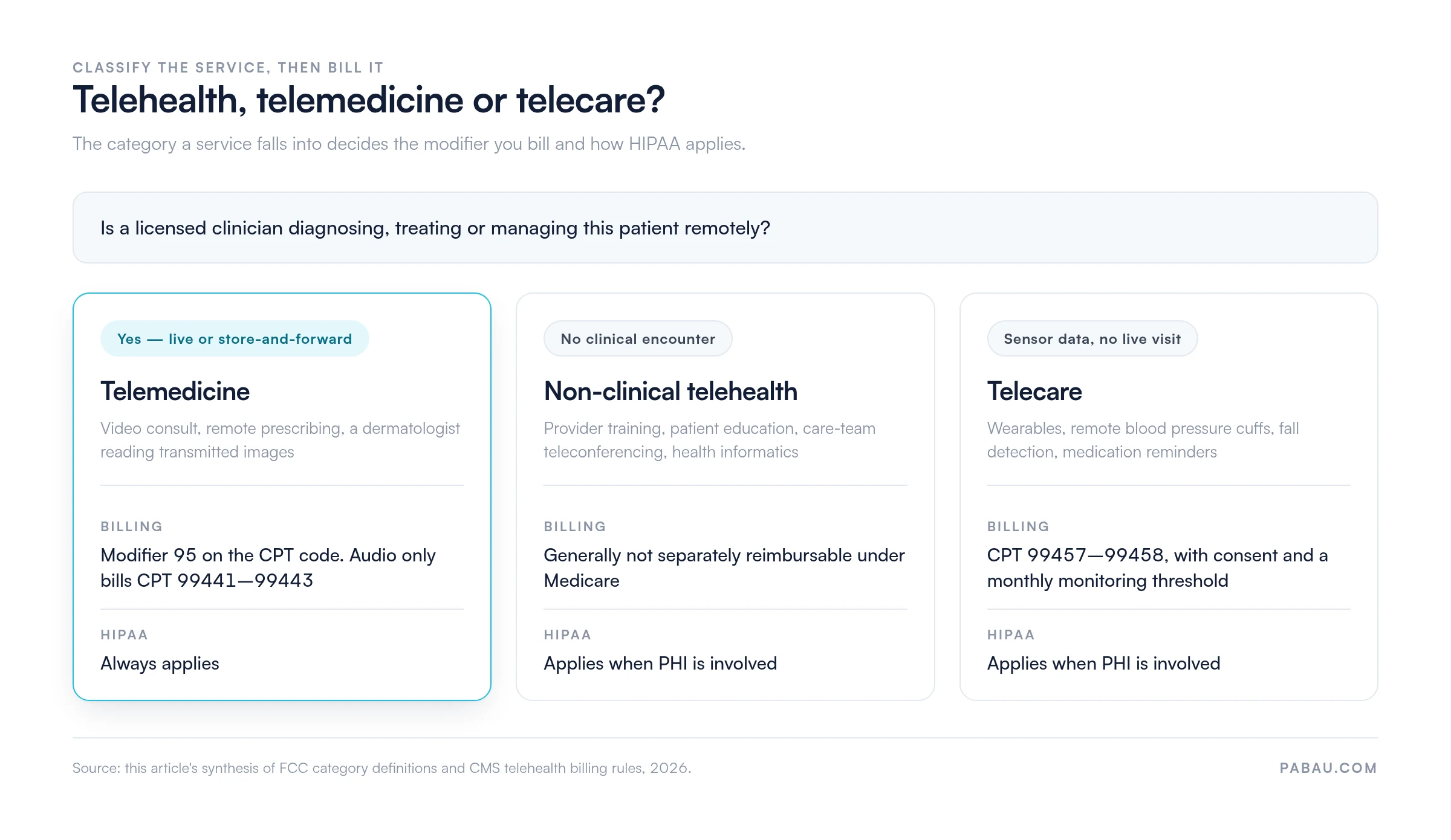
Before you onboard a telehealth platform, sit down with your billing team. Work out which of your services count as clinical telemedicine and which are non-clinical telehealth. That split decides the CPT modifiers you apply and whether CMS reimburses the encounter, and it is expensive to fix after go-live.
The business case for remote care is well established. A 2020 report from McKinsey & Company estimated that up to $250 billion of US healthcare spend could be virtualized. For practice owners, the benefits are operational as much as clinical.
For patients: Less travel time and cost, faster access to a specialist opinion, and continuity of care during illness or limited mobility. Patients managing a chronic condition can check in through telecare devices between appointments, which cuts the number of trips to the office.
For practice owners: Telehealth and telemedicine open capacity without a matching rise in overhead. A practice running 20 in-person appointments a day can add telemedicine slots without adding exam room space.
No-show rates for video appointments tend to run lower than for in-person visits, because attending takes less effort. Follow-up matters more after a video consult than after an office visit, since the patient leaves the call without printed aftercare in hand.
Functional and integrative practices adopted virtual care fastest. Their patients are often spread out geographically, and their longer, data-rich consultations translate well to video.
Medicare’s telehealth coverage expanded sharply during the COVID-19 public health emergency, and CMS has extended much of it since. The Consolidated Appropriations Act, 2026 runs those flexibilities through December 31, 2027, with the geographic and originating-site restrictions largely waived for that period.
So CMS covers a broad list of telemedicine services for Medicare beneficiaries. That list includes office visits, mental health services, and certain remote patient monitoring encounters. The rules still change from one Congress to the next, so check the current status before you build a service line around them.
The billing distinction for practices is straightforward. Telemedicine encounters are reimbursable under specific CPT codes with modifiers. Non-clinical telehealth, such as provider training or patient education, is generally not separately reimbursable under Medicare fee schedules.
Private payers vary. Most major commercial insurers cover synchronous video visits at parity with in-person visits, following state telehealth parity laws. Coverage for asynchronous store-and-forward and remote monitoring differs by plan.
Practices running weight loss or metabolic health programs should watch RPM billing closely. CMS reimburses remote physiologic monitoring separately from the clinical consultation. It also requires documented consent and a minimum monthly monitoring threshold, and missing either one triggers a denial.
Any telehealth or telemedicine platform that transmits protected health information, known as PHI, is subject to HIPAA. That covers video consultation tools, patient messaging systems, RPM data aggregators, and the practice management software that stores the clinical documentation.
Under HHS HIPAA guidance, any vendor handling PHI on your behalf must sign a Business Associate Agreement, or BAA. Using a non-compliant video tool, even temporarily, creates liability. The HHS Office for Civil Rights has fined practices over telehealth violations, including cases where consumer video tools were used without a BAA.
What to look for in a compliant telehealth platform:
A telehealth layer adds another surface for compliance risk on top of your existing obligations. Every new communication channel needs its own BAA and technical safeguards before a patient uses it. Our roundup of HIPAA-compliant telehealth platforms works through what to check in each vendor’s paperwork.
The platform decision is far cheaper to get right before launch than after the first denied claim. Evaluate platforms against your own service mix rather than against a generic feature list.
Telehealth is one workflow inside the larger job of running a practice. So the platform question is really about fit with the software your practice runs on. Five criteria decide that fit.
Once your criteria are straight, compare named platforms against them. Our review of telemedicine software covers the tools built for remote clinical visits, and the kind of practice each one suits.
Practices in psychiatry and psychology carry extra documentation duties for telemedicine encounters. Mental health telemedicine needs specific consent language, session notes that meet clinical standards, and audit trails that satisfy both HIPAA and state licensing rules. An integrated platform handles those inside the clinical workflow instead of leaving them as separate admin tasks.
Most practices bolt a video tool onto a calendar that lives somewhere else. The clinician takes the call in one tab and writes the note in another, then someone re-keys the outcome afterwards. Every hop is a chance for PHI to land outside the secure environment.
Practice management software like Pabau keeps the consult and the record in the same place. Pabau’s telehealth software starts the video call from the appointment itself. The clinical note, the consent, and the invoice attach to the patient record as you work.
Pre- and aftercare messages go out around the call without anyone chasing them. That matters when the patient is not in the room to be handed instructions. Patients complete intake forms and read their notes in our online booking portal, so you are not running a second communication channel.
The outcome is one audit trail per encounter, with no export step between the consult and the chart. When a payer asks what happened on a video visit, the answer sits on the record.

Pabau combines video consultations, scheduling, HIPAA-compliant clinical notes, and automated patient follow-up in a single practice management system. See how it works for your practice.

The classification work pays for itself the first time a claim clears without a resubmission. Sort your service lines into clinical telemedicine, non-clinical telehealth, and telecare monitoring before you shop for software, not after you have signed.
The trade-off worth remembering is that a cheap standalone video tool moves cost rather than removing it. What you save on licensing comes back as re-keyed notes, missing consents, and BAAs nobody can produce during an audit.
Book a demo to see how Pabau keeps a video consult, its clinical note, and its billing on one patient record.

Wondering how a remote visit lands in the chart? Telemedicine EHR explains how consult notes and patient records stay together.
Ready to compare the platforms themselves? Telemedicine software reviews the tools built for remote clinical visits and who each one suits.
Running remote consultations in the UK? Telehealth platforms in the UK covers the options and the rules that apply there.
Telehealth is the broader category that includes all remote healthcare services, both clinical and non-clinical. Telemedicine is a subset of telehealth. It refers specifically to remote clinical care delivered by a licensed clinician, such as a video consult, a remote diagnosis, or a virtual prescribing encounter.
Yes. Every telemedicine encounter is a telehealth service, but not every telehealth service is telemedicine. Provider training, patient education, and administrative teleconferencing are all telehealth but not telemedicine, because they do not involve direct clinical care.
Telecare uses digital sensors and connected devices to monitor patients remotely, usually for chronic condition management. It differs from telehealth in that it is primarily passive and technology-driven rather than interaction-based. Examples include wearable heart rate monitors, fall detection devices, and remote blood pressure cuffs that transmit data to a clinical team.
Telehealth platforms are not inherently HIPAA compliant. Compliance depends on the platform’s technical safeguards and on whether the vendor signs a Business Associate Agreement. It also depends on how the practice configures and uses the system. Practices must verify HIPAA compliance for every vendor that touches protected health information, including video tools and messaging platforms.
Medicare covers a defined list of telemedicine services with appropriate CPT codes and modifiers. Most major commercial insurers now cover synchronous video visits under telehealth parity laws, though coverage for asynchronous and RPM services varies by plan. Non-clinical telehealth services, such as provider training, are generally not separately reimbursable.
Most telemedicine appointments are booked through the practice’s online booking system, the same way in-person appointments are scheduled. Patients typically receive a secure video link by email or through a patient portal before the appointment. Practices using integrated practice management software can automate the whole workflow, from booking confirmation to intake forms to post-visit follow-up.