GLP-1 diet plan
A GLP-1 diet plan is a structured eating framework for patients taking semagluti...

2
Last Updated: Oct 13, 2026

The pressure provocation test screens for cubital tunnel syndrome by compressing the ulnar nerve at the elbow for up to 60 seconds.
A positive result is tingling or numbness in the ring and little fingers within the hold period.
Reported sensitivity is about 89% and specificity about 98%, which puts the positive likelihood ratio near 44.5.
The three bedside tests differ far more on sensitivity than on specificity, so running them in sequence beats picking one.
Practice management software like Pabau records laterality, hold duration, and symptom grading the same way at every visit.
The pressure provocation test is a bedside maneuver for cubital tunnel syndrome.
The clinician presses directly on the ulnar nerve behind the medial epicondyle and holds for up to 60 seconds. A positive result is tingling or numbness in the ring and little fingers.
Novak, Lee, Mackinnon, and Lay described the test in 1994 in the Journal of Hand Surgery. Their data put sensitivity near 89% and specificity near 98%. A positive finding is therefore hard to dismiss, and a negative one still has to be read against the patient’s history.
Below you will find the technique step by step and how to read the result. The last section sets it against the elbow flexion test and Tinel sign.
The pressure provocation test is a compression-based examination for ulnar nerve entrapment at the cubital tunnel. The clinician applies direct digital pressure over the nerve in the retrocondylar groove, just behind the medial epicondyle. The pressure is held for up to 60 seconds while the patient reports any paresthesias in an ulnar nerve distribution.
A positive result raises the probability of cubital tunnel syndrome and justifies further investigation. Where clinical suspicion is high, that means electrodiagnostic studies rather than a second round of bedside testing.
Physical therapists, orthopedic surgeons, hand surgeons, and sports medicine practitioners all use it. Practices carrying heavy musculoskeletal caseloads get more out of an EMR for physical therapy with structured assessment fields. A finding like this is then faster to capture and easier to compare at the next visit.
The cubital tunnel is a fibro-osseous channel at the medial elbow through which the ulnar nerve passes. It is bounded by the medial epicondyle anteriorly, the olecranon posteriorly, and the arcuate ligament superiorly. That gives the nerve a narrow passage where it is both superficial and mechanically vulnerable.
Three factors make this site prone to compression injury:
When the nerve is irritated at this site, the symptom pattern follows its distal distribution. That means sensory symptoms in the ring and little fingers, and in advanced cases weakness or wasting of the intrinsic hand muscles.
This anatomy is what makes the test clinically logical. Focused compression at the site of entrapment reproduces the irritation on demand, which gives the clinician a bedside proxy for the underlying pathology.
Reach for it when a patient presents with one or more of the following:
The test belongs in a first-line physical examination. It does not work as a standalone confirmatory tool. A positive result raises the probability of cubital tunnel syndrome, but nerve conduction studies and EMG still decide severity when the clinical picture warrants them.
The procedure follows a consistent sequence across the published literature. Novak and colleagues’ original 1994 description in the Journal of Hand Surgery remains the most widely cited reference for technique and interpretation.
A positive result is tingling or numbness in the ulnar nerve distribution, meaning the ring and little fingers, within the 60-second hold. Onset inside the first 30 seconds suggests a more irritable nerve. Medial elbow pain without distal paresthesias does not count, since it points to local soft tissue tenderness instead.
Interpretation depends on the clinical context around the finding. A positive result raises the probability of cubital tunnel syndrome considerably. A negative result lowers it, but will not exclude the diagnosis in a patient with a compelling history.
Three factors affect how much weight the result deserves:
When the test is positive in a patient with matching history and symptom distribution, referral for nerve conduction studies is the next step. Electrodiagnostic confirmation clarifies severity and guides surgical decision-making. Precise documentation at each visit matters here, because symptom progression between assessments sets the urgency of that referral.
The published accuracy data comes primarily from Novak et al. (1994), the seminal study on this test. The figures below reflect that study and subsequent corroborating reviews.
Those figures put the pressure provocation test among the more accurate individual provocative tests for this condition. The high specificity is what makes it useful at the bedside. A positive result in a patient with matching history can drive a referral on its own.
The sensitivity figure is the caveat. Roughly one in nine true cases will still test negative, which is why a compelling history outranks a single negative result.
Three bedside tests are routinely used together to evaluate suspected cubital tunnel syndrome. None of them is definitive on its own, and combining them raises overall diagnostic sensitivity. The American Association of Neuromuscular and Electrodiagnostic Medicine publishes the electrodiagnostic criteria that follow on from a positive finding.
Read down the two accuracy columns and the pattern is easy to miss in prose. Specificity sits between 98% and 99% for all three tests, so none of them is meaningfully better at ruling the condition in. Sensitivity spans 70% to 89%, which is a 19-point spread.
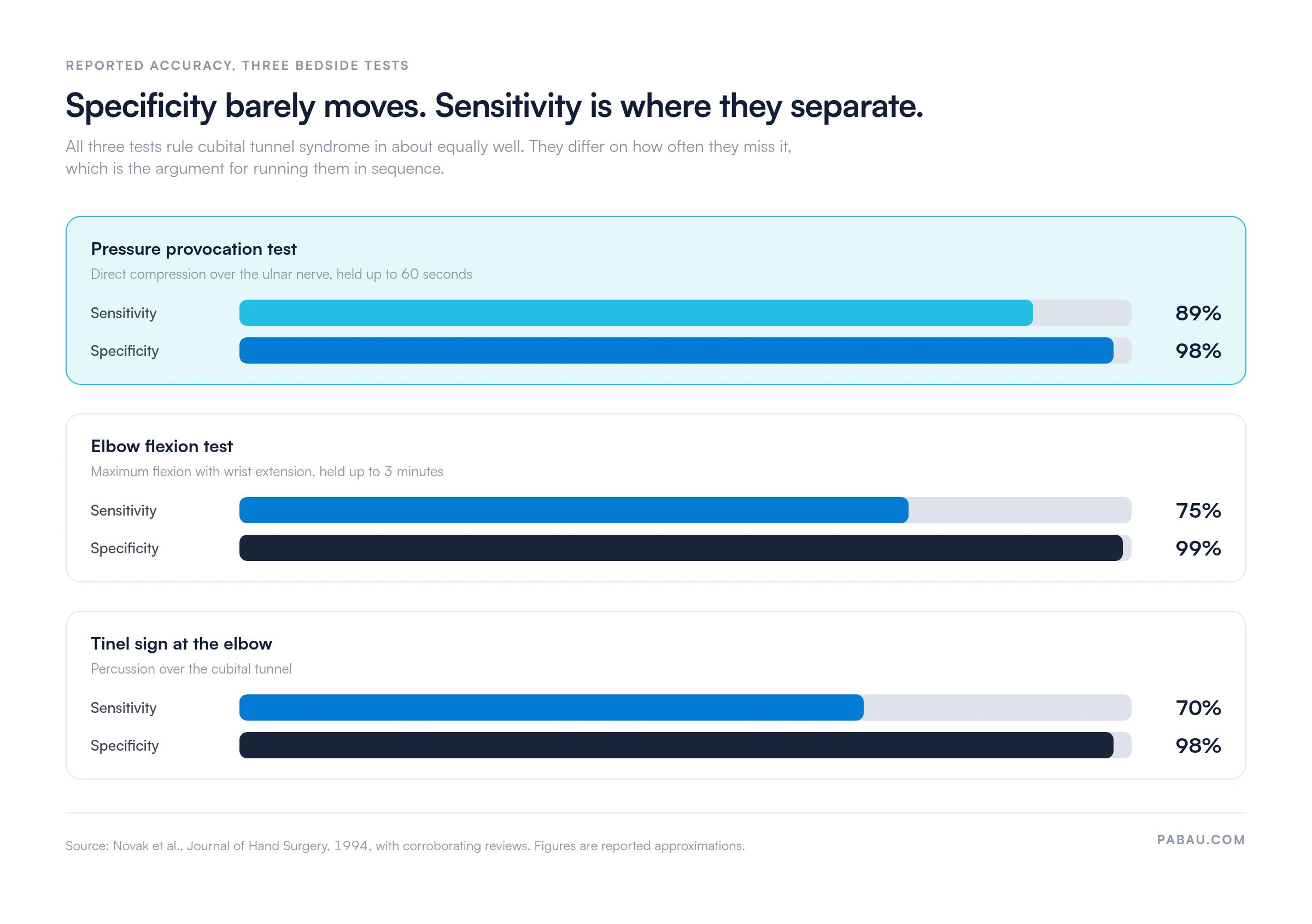
That has a practical consequence. Choosing between the three tests buys you very little. Running all three in one session raises the chance of catching a case that any single test would miss. Structured decision rules work the same way elsewhere in musculoskeletal practice, as the Ottawa ankle rules show for acute ankle injury.
The elbow flexion test provokes ulnar symptoms through a different mechanism. Maximal flexion raises tension on the nerve and shrinks tunnel volume indirectly, rather than applying external compression. It also needs a longer hold, up to 3 minutes against 60 seconds, and some patients find sustained full flexion uncomfortable.
The pressure provocation test reports higher sensitivity, while the flexion test edges it on specificity in some studies. Most clinicians run both in sequence. A positive on either raises suspicion, and a positive on both is a strong indicator.
Tinel sign is a percussion test. The examiner taps over the cubital tunnel, and a positive result is an electric shock sensation or paresthesias radiating into the ring and little fingers.
The two tests differ in mechanism and in what they reflect. Tinel positivity points to axonal regeneration or an irritable nerve membrane. Compression testing shows how an already-compromised nerve behaves under load.
In practice, Tinel sign earns its place for anatomical localization, confirming the lesion sits at the elbow rather than further distally. The pressure provocation test carries more weight when you need confirmation.
The test has limitations that affect its reliability in day-to-day practice. Knowing them prevents over-reliance on a single positive finding.
Documentation matters beyond the single consultation. It supports serial comparison across appointments, gives an audit trail for referral decisions, and hands a covering clinician the full picture.
A well-structured note for this test should include:
Standardizing that across a practice takes a consistent template rather than free text. Hand-written notes drift, and two clinicians will grade the same response differently within a month. A shared physiotherapy practice management software setup keeps the same fields in front of everyone who runs the assessment.
Most practices record a provocative test as a line of free text in the visit note. That works until someone wants to compare today’s response with the one from six weeks ago. Or until a referral letter needs the onset time and nobody wrote it down.

Practice management software like Pabau takes a different route. You build the assessment once as a set of digital clinical forms, with laterality, hold duration, symptom character, distribution, and grading as their own fields. The result lands in the patient record attached to that appointment.
From there the findings behave like data rather than prose. You can pull the previous result side by side at the next visit, and set an automated follow-up reminder when a positive test warrants review. Nobody retypes anything, so you get home on time and the referral letter writes itself.

Pabau turns your assessment forms into structured fields that save straight to the patient record. Serial comparison and referral letters stop depending on someone’s free-text note.

Treat a positive pressure provocation test as a decision point rather than a diagnosis. With specificity near 98%, it carries enough weight in a patient with matching history to justify referral for nerve conduction studies without further bedside testing.
A negative result deserves less confidence than its numbers suggest. Run the elbow flexion test and Tinel sign in the same session, because the three tests are separated by sensitivity rather than specificity. The trade-off is a few extra minutes per assessment against a case you would otherwise have sent home.
Whatever you find, the value of the finding depends on whether the next clinician can read it. Book a demo to see how Pabau turns provocative test results into structured fields your whole team records the same way.

Need to rule out a cervical source for ulnar symptoms? Spurling’s test walks through the maneuver that separates cervical radiculopathy from a peripheral entrapment.
Looking for another upper-limb provocative test? Finkelstein test covers the technique and interpretation for suspected de Quervain’s tenosynovitis at the wrist.
Assessing the shoulder in the same appointment? Drop arm test sets out how to screen for a rotator cuff tear and what a positive result should trigger.
Want to know what your notes have to cover? Mandatory compliance for physiotherapy clinics outlines the documentation and reporting obligations that apply to musculoskeletal practices.
The pressure provocation test screens for cubital tunnel syndrome. The clinician compresses the ulnar nerve at the elbow to reproduce tingling or numbness in the ring and little fingers. It is a bedside tool rather than a definitive diagnostic instrument. Most clinicians run it alongside the elbow flexion test and Tinel sign before referring for electrodiagnostic studies.
Seat the patient with the elbow in slight flexion and locate the ulnar nerve in the retrocondylar groove behind the medial epicondyle. Apply sustained direct digital pressure over the nerve and hold for up to 60 seconds. Record whether tingling or numbness appears in the ring and little fingers, and note the onset time.
Based on Novak et al. (1994), sensitivity is approximately 89% and specificity approximately 98%. That gives a positive likelihood ratio around 44.5. Those figures make it one of the more accurate individual provocative tests for cubital tunnel syndrome. A positive result is especially useful for ruling the diagnosis in.
The pressure provocation test uses direct compression over the ulnar nerve for 60 seconds. The elbow flexion test uses sustained maximum flexion for up to 3 minutes to raise nerve tension indirectly. The pressure provocation test reports higher sensitivity, while the flexion test edges it on specificity in some studies. Both are normally performed together.
The three main tests are the pressure provocation test, the elbow flexion test, and Tinel sign at the elbow. The first compresses the ulnar nerve directly. The second uses sustained maximum flexion, and the third uses percussion over the cubital tunnel. Each targets a different mechanism of nerve irritation, so running all three gives the strongest picture before electrodiagnostic referral.
It is reliable as a screening tool, and its high specificity means a positive result carries clinical weight. It is not a standalone diagnostic test, since nerve conduction studies and EMG remain the standard for confirming severity. A negative result does not exclude cubital tunnel syndrome where the clinical history is compelling.