Health appraisal form
A health appraisal form is a record a licensed provider signs to document someon...

2
Last Updated: Oct 13, 2026

Power Diary became Zanda in November 2024, so Zanda alternatives and Power Diary alternatives are the same shortlist.
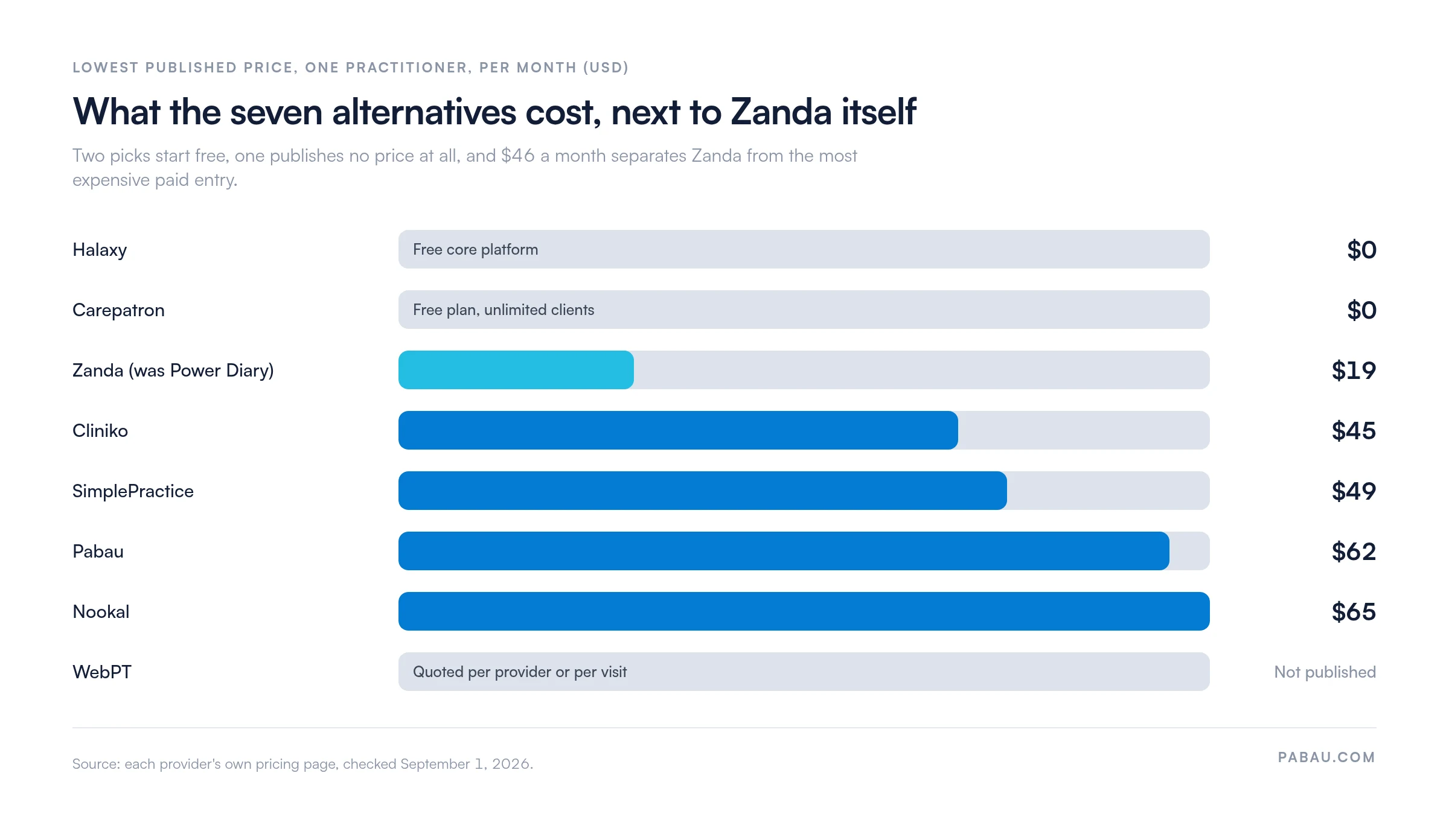
Zanda now publishes US$19 a month for one practitioner, billed monthly rather than weekly.
Halaxy and Carepatron each publish a free plan, and WebPT publishes no pricing at all.
Cliniko charges $45 a month for a single practitioner, not the £29 or $49 that older roundups repeat.
Every price in this article comes from the provider’s own website, checked on September 1, 2026.
Power Diary alternatives worth a trial in 2026 are Cliniko, Nookal, Halaxy, Carepatron, Pabau, SimplePractice and WebPT. Each one below carries a price taken from the provider’s own website, plus separate HIPAA and GDPR columns.
Start with the name, because the search results are behind on it. Power Diary rebranded to Zanda in November 2024, and powerdiary.com now redirects to zandahealth.com. The platform, the ownership and the feature set stayed the same.
One disclosure before the list. Pabau is our own practice management system, so pick five is ours. Every figure below still comes from each vendor’s own pricing page, gathered on the same day.
Below you get a price table normalized to one currency, seven reviews with pricing, a decision rule by practice type, and a migration walkthrough.
Power Diary rebranded to Zanda in November 2024, so a list of Zanda alternatives and a list of Power Diary alternatives is the same list.
Zanda published the change on its own blog. The new logo appeared in the app on November 6, 2024, and the website moved to zandahealth.com on November 21, 2024. The company’s press announcement followed on November 27, 2024.
Zanda’s own wording was blunt about scope. Its leadership said the ownership, management, team and feature set were not changing, only the name and the look. Existing accounts, plans and data carried across untouched.
You can check the rename yourself in one step. Request powerdiary.com and the server answers with a 301 redirect to zandahealth.com. The same thing happened on our side, where the old Power Diary entry in our software comparisons now resolves to the Zanda page.
The rename also dates the figures other roundups repeat. Zanda’s pricing page now lists monthly plans in US dollars, not the weekly billing described across older comparison articles. Anyone checking Power Diary pricing in Australia will find A$29 and A$59 a month, excluding GST, on Zanda’s Australian page.
The seven alternatives below start between $0 and $65 per practitioner per month, and two of them publish a free plan.
The order runs by fit for an allied health practice leaving Zanda, because that is who Power Diary was built for. Cliniko takes the top spot as the closest like-for-like swap. Price is a separate axis, so read the ranking and the table together.
| Provider | Starting price (per month) | Free plan or trial | HIPAA | GDPR | Best for |
|---|---|---|---|---|---|
| Zanda (was Power Diary) | US$19 (A$29) | 14-day trial | Yes | Yes | The platform you are comparing against |
| 1. Cliniko | US$45 | 30-day trial | Yes | Yes | Allied health solos in Australia, New Zealand and the UK |
| 2. Nookal | US$65 (A$49) | Free trial, length not published | Yes | Yes | Physiotherapy and multi-site allied health |
| 3. Halaxy | Free | Free core platform | Not stated | Yes | Practices that want to pay only for extras |
| 4. Carepatron | Free | Free plan, plus a 14-day paid trial | Yes | Yes | Solo practitioners watching every dollar |
| 5. Pabau | US$62 | Demo and structured onboarding | Yes | Yes | Practices running several services from one system |
| 6. SimplePractice | US$49 | 30-day trial | Yes | Not stated | US mental health practices |
| 7. WebPT | Not published | Demo only | Yes | Not stated | US physical therapy specialists |
Two columns need a note. HIPAA and GDPR sit apart here because they are separate regimes, and most roundups collapse them into one label. Not stated means the vendor makes no compliance claim on its own site, which is different from failing one.
Neither regime covers Australian practices. HIPAA is US-only and GDPR is EU/UK, so an Australian practice should check a vendor’s stance on the Privacy Act 1988 and the Australian Privacy Principles instead — that’s the framework that actually governs patient data here.
Zanda, Nookal and Halaxy all publish Australian dollar pricing, shown alongside the US figure above and in each review below. Cliniko, Carepatron, Pabau and SimplePractice publish US dollars only, so an Australian practice should factor in the exchange rate and any card FX fee before comparing those four.
Cliniko charges one flat price per practitioner band, which keeps a growing team predictable.
Cliniko is practice management software for allied health, priced by how many practitioners a practice has.
Cliniko is the closest like-for-like swap for a Zanda practice, which is why it heads this list. Both grew out of the Australian allied health market, and both centre on the calendar. Clinical notes and invoicing sit beside it in each one.
Cliniko’s price is worth checking before you rely on a roundup. Older articles quote £29 or $49 for a single practitioner. Cliniko’s own pricing page lists $45 a month, and every tier carries the same feature set.
Compliance is unusually well documented here. Cliniko states HIPAA compliance, UK GDPR compliance and EU GDPR compliance on its security page, and names a Data Protection Officer. If you want the head-to-head, our Cliniko vs Power Diary comparison goes feature by feature.
| Plan | Price | Applies to | Notes |
|---|---|---|---|
| Single practitioner | $45 / month | 1 practitioner | Same feature set as every tier |
| Small team | $95 / month | 2 to 5 practitioners | Flat price across the band |
| Growing team | $145 / month | 6 to 8 practitioners | Flat price across the band |
| Established team | $195 / month | 9 to 12 practitioners | Flat price across the band |
| Large team | $295 / month | 13 to 25 practitioners | Flat price across the band |
| Group | $395 / month | 26 to 200 practitioners | Flat price across the band |
Cliniko bills in US dollars and gives one free month a year to practices paying annually. The trial runs 30 days without a card. SMS credits cost 10 cents each on top of the subscription.
Nookal prices per practitioner and stores data in Sydney, Ireland or Ohio depending on the account.
Nookal is Australian practice management software for allied health, sold per practitioner across two published plans.
Nookal leans harder into multi-site operations than most tools at this price. Unlimited staff and unlimited locations come with every plan, so a second site does not trigger a new subscription.
Data residency is the detail that decides it for some practices. Nookal holds Australian accounts in Sydney, EU and UK accounts in Ireland, and US and Canadian accounts in Ohio. SOC 2 Type 2 and HIPAA verification back that up.
Watch the currency, because Nookal’s regional list prices are not conversions of each other. An Australian practice pays A$49 per practitioner on Essentials, while the published US price is $65.
| Plan | Price | Applies to | Notes |
|---|---|---|---|
| Essentials | $65 / month | Per practitioner | A$49 or £29 on the local price lists |
| Professional | $89 / month | Per practitioner | A$59 or £39 on the local price lists |
| Enterprise | Contact sales | Larger organizations | Scope agreed case by case |
Several capabilities sit outside the plan price. Nookal charges $25 a month per licence for AI and voice. The patient portal starts at $10 a month per location, and outbound SMS starts at 7 cents.
Halaxy gives away the core platform and charges for extras through prepaid credits.
Halaxy is free practice management software for any practitioner, with paid extras bought as prepaid credits.
Halaxy’s own description sets the terms plainly. The core platform is free for any practitioner and any practice size, covering appointments, patient management, invoicing and financial reporting.
The trade is that the running costs arrive in pieces. SMS, e-scripts and the AI scribe draw on credits priced between A$0.15 and A$0.22 including GST. Calendar sync, white labeling and the API cost credits too.
Compliance is where Halaxy narrows the field. Halaxy states that EU users’ data is stored in the EU in line with GDPR. It publishes no HIPAA claim, which rules it out for a US practice handling insurance work.
| Plan | Price | Applies to | Notes |
|---|---|---|---|
| Core platform | Free | Any practitioner, any practice size | Appointments, records, invoicing, reporting |
| Subscription features | From 25 credits / month | Per practice | Calendar sync, white label, API access |
| Credits | A$0.15 to A$0.22 each | Pay as you go | SMS, e-scripts, AI scribe |
| Payment processing | 1.5% to 1.9% plus a fee | Per transaction | Plus 75c to $1 on Silver and Bronze bands |
Halaxy quotes in Australian dollars, so a UK or US practice should model the exchange rate before comparing. Work out a monthly credit burn from your reminder volume first, because that is where the free plan stops being free.
Carepatron runs a free plan with no client limit, telehealth and a client portal included.
Carepatron is a practice management platform whose free plan carries no limit on client numbers.
That free plan is the reason Carepatron appears on every list of Power Diary alternatives. Unlimited clients, 1 GB of storage, telehealth, a client portal, online payments and an AI scribe all sit inside it at $0.
The storage cap is the ceiling that bites first, not the client count. A practice storing photos, scanned referrals or session recordings will pass 1 GB quickly. Unlimited storage starts on the Plus plan.
Carepatron states HIPAA and GDPR compliance as standard and includes a Business Associate Agreement rather than charging for one. For a US solo clinician on a tight budget, that combination is hard to beat.
| Plan | Price | Applies to | Notes |
|---|---|---|---|
| Free | $0 | Per user | Unlimited clients, 1 GB storage, telehealth |
| Plus | US$39 / month | Per user | Unlimited storage, group telehealth, branding |
| Advanced | US$49 / month | Per user | Roles and permissions, white labeling, onboarding |
Annual billing brings the two paid plans down to US$31 and US$39 per user per month on carepatron.com. Carepatron publishes no Australian dollar price, so budget for the exchange rate on top. A 14-day trial opens the paid features, and e-prescribing costs a further $39 per user per month. Our breakdown of Carepatron pricing walks through what each tier adds.
Pabau keeps the booking, the note, the invoice and the marketing on one client record.
Pabau is an all-in-one practice management system for aesthetics, wellness and private practice teams.
Pabau sits fifth because its core market is aesthetics and wellness rather than allied health. For a physiotherapy practice that only needs a calendar and notes, the four picks above land closer to home.
Pabau covers the ground a scheduling-first tool leaves to other software. Clinical records, digital consent, before-and-after photos, inventory, payments, marketing and reporting all sit on the same client record as the appointment.
That breadth matters most when a practice adds a service line. A wellness practice that starts offering injectables needs consent forms, batch tracking and photo capture, not just another appointment type in the calendar.
Pabau’s pricing model differs from the rest of this list in one way worth knowing. Every subscription includes every feature, so the price moves with users and locations instead of unlocking functionality tier by tier.
Pabau also has no free trial, and that is deliberate. Setup shapes what the platform can do for a specific practice, so new customers get structured onboarding and a dedicated coordinator instead.
| Plan | Price | Applies to | Notes |
|---|---|---|---|
| Starter | US$62 / month | 1 user, up to 100 clients | Full platform, no feature gating |
| Solo | Quoted on a demo | 1 user, unlimited clients | Full platform, no feature gating |
| Team, Medium, Group | Quoted on a demo | 2 to 15 users | Priced per location |
| Enterprise | Quoted on a demo | 16+ users | Covers multiple sites |
Pabau publishes the Solo figure on pabau.com and quotes the larger tiers on a demo. Prepaying saves 10% on 12 months and up to 20% on 36, and SMS, telehealth and Pabau Scribe usage draw on a credit balance. Pabau’s pricing page has an Australia region selector; book a demo for the local AUD figure.
SimplePractice is built around US mental health billing, from intake through to insurance claims.
SimplePractice is US-focused practice management software and an EHR, built mainly for mental health and wellness practitioners.
The Power Diary vs SimplePractice question usually comes down to where a practice bills. SimplePractice submits electronic claims to US insurers, and that machinery is the reason most US therapists pick it.
Outside the United States, the same machinery stops earning its keep. SimplePractice’s support documentation confirms electronic claim submission works only with US insurance companies, so an Australian practice loses the main advantage.
Older comparisons list $29, $69 and $99 tiers plus a $10 telehealth add-on. SimplePractice’s pricing page now shows $49, $79 and $99, and lists no separate telehealth fee.
| Plan | Price | Applies to | Notes |
|---|---|---|---|
| Starter | US$49 / month | 1 clinician | Lowest published tier |
| Essential | US$79 / month | 1 clinician | Middle tier |
| Plus | US$99 / month | 1 clinician | The trial starts on this plan |
SimplePractice runs a 30-day free trial that begins on the Plus plan. New accounts can only be opened from certain countries, and Australia is one of them.
WebPT is a rehab therapy EHR, and the only pick here that publishes no price.
WebPT is an EHR built specifically for physical therapy, occupational therapy and speech therapy practices.
WebPT is the specialist on this list. Documentation, scheduling and billing are shaped around rehab therapy workflows rather than adapted from a general calendar, which suits a US physical therapy group well.
Pricing is the sticking point for anyone comparing options in a spreadsheet. WebPT publishes no figures, and says the price depends on the plan and the customization a practice needs.
WebPT does offer one billing model nobody else here does. Its pricing page says the subscription can be set up per provider per month or per visit, which suits practices with uneven caseloads.
| Plan | Price | Applies to | Notes |
|---|---|---|---|
| Starter | Contact sales / no published pricing | Startups and smaller practices | Quoted after a demo |
| Enhanced | Contact sales / no published pricing | Growing practices | Quoted after a demo |
| Ultimate | Contact sales / no published pricing | Larger practices | Quoted after a demo |
WebPT is the one provider here that publishes no prices at all. Budget for a sales call before you can compare it against the rest of this table.
Practice type and country narrow this list faster than any feature matrix. Use the rule below, then trial two picks rather than five.
Two of these picks come with their own comparison sets. If Cliniko is emerging as your front-runner, our roundup of Cliniko alternatives covers the tools it competes with directly.
And if Pabau is on your shortlist, read the other side of that argument too. Our list of Pabau competitors sets out where other platforms fit better.
Export your Zanda data as a zipped set of CSV files first, then expect to rebuild templates, booking rules and automations by hand.
Zanda’s support documentation describes a Data Export tool that produces a zip archive of CSV files. The export covers clients, client notes and forms, diagnoses, appointments, invoices, payments, services and session packs.
Uploaded client files come out too, sorted into folders named by client number and name. Files attached to session notes are included in that export, which is the part practices most often assume they will lose.
Plan around the export window rather than the click. Zanda says preparation takes minutes on a new account and several hours on an established one. The task cancels after 24 hours, and the download stays live for 72 hours.
A Power Diary API migration is not an option today. Zanda documents its public API as a closed beta, with registration handled through the Beta Program menu inside an account. A CSV export is the practical route.
The Power Diary mobile app question resolves the same way. Zanda publishes no app in the App Store or Play Store, and instead runs as a responsive site you save to a home screen.
In practices we onboard, the export is rarely the hard part. Rebuilding note templates, form logic, booking rules and reminder sequences is what eats the week, because a CSV carries data and not configuration.
So budget two weeks, not two days. Run both systems in parallel for one billing cycle, keep the old export archived, and move the calendar last once forms and templates are working.
Practices leaving Zanda rarely leave only the calendar behind. They also leave the four or five tools that grew around it. That usually means a separate forms tool, a card terminal, an email platform and a photo folder on someone’s phone.
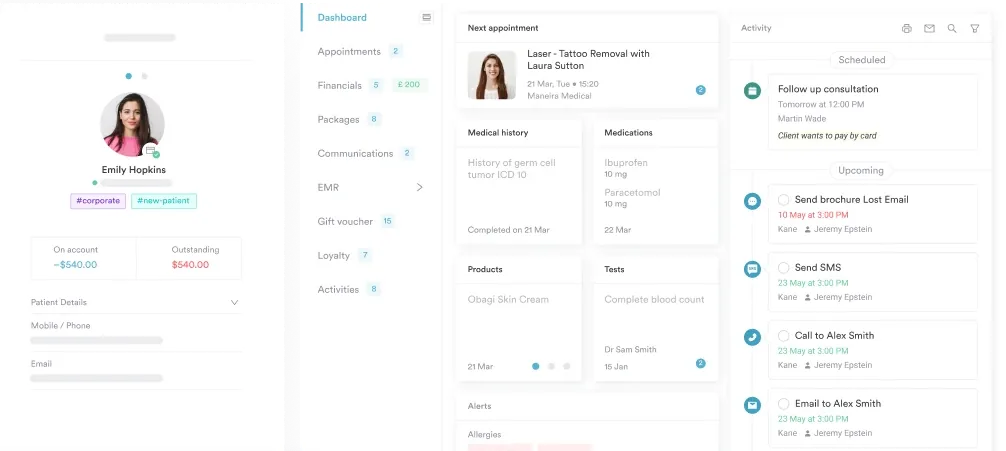
Pabau replaces that spread with one client record. The appointment, the consent form, the treatment note, the before-and-after photos, the invoice and the marketing history all attach to the same patient file.
Migration is run for you rather than left as homework. Pabau’s onboarding team moves client records, appointment history and inventory across, and a dedicated Client Coordinator stays with the practice through the setup.
Pricing works differently too, which matters when you have just been repriced by a vendor. Every Pabau subscription includes every feature, so the bill tracks users and locations instead of unlocking tools tier by tier.

Pabau brings scheduling, client records, consent forms, payments and marketing onto one client record, and our onboarding team migrates your existing data for you. Practices leaving Power Diary get a structured setup rather than a blank calendar.

Check the price yourself before you shortlist a vendor. Three of the eight figures in this article contradict what the ranking roundups still publish, and pricing pages change more often than blog posts do.
Then decide what you are replacing. Cliniko heads the list because it is the closest like-for-like swap, and that is the safest move. Trading one calendar-first tool for another buys a fresh interface, roughly the same monthly bill and two weeks of migration work.
That is the trade worth remembering. A cheaper platform saves money each month, while a broader one removes the tools stacked around it. Book a demo to see how Pabau would hold your records, payments and marketing on one client file.

Narrowed it down to these two already? Cliniko vs Power Diary takes the head-to-head further, feature by feature, than a roundup entry can.
Is Cliniko becoming your front-runner? Cliniko alternatives covers the tools it loses deals to, with pricing for each one.
Booking software rather than a full platform? Acuity Scheduling alternatives compares the scheduling-first tools a smaller practice can run on.
Want the case against us as well? Pabau competitors and alternatives sets out where other platforms fit a practice better than we do.
Zanda publishes US$19 a month for the Starter plan, covering one practitioner and 1,000 appointments. The Growth plan is US$49 a month for the first practitioner, then US$19 for each additional one. Australian practices see A$29 and A$59 a month, excluding GST, on the Australian pricing page. Both plans include a 14-day free trial with no card required.
Yes, two of them. Halaxy publishes a free core platform for any practitioner and any practice size, and charges for extras through prepaid credits. Carepatron publishes a free plan with unlimited clients, 1 GB of storage, telehealth and a client portal. Both figures come from each vendor’s own pricing page.
Yes. Zanda’s support documentation describes a Data Export tool that produces a zipped set of CSV files. The export covers clients, notes and forms, appointments, invoices, payments, services and uploaded client files. Preparation takes minutes on a new account and several hours on an established one, and the download stays available for 72 hours.
For a mental health practice in Australia, New Zealand or the UK, Carepatron and Halaxy are the safer picks, since both work without depending on US insurance billing. SimplePractice fits best only inside the United States, because its electronic claims machinery works exclusively with US insurers.
No. Zanda’s pricing page lists monthly plans in US dollars, and its Australian page lists monthly plans in Australian dollars. Several comparison articles still describe a weekly subscription, which no longer matches what the vendor publishes.