How to ask patients for reviews: Timing, channels and scripts
Knowing how to ask patients for reviews comes down to four habits. Ask every pat...

Last Updated: Oct 8, 2026
The med spa branding tips that move bookings are about your purpose, your voice, and the messages patients get between booking and follow-up. Whichever voice you settle on, those messages reach patients through the marketing and retention tools compared in our ranking of med spa management software.
Ask a med spa owner what branding means and you’ll usually hear about a logo, some colors, and a nice font. If branding stopped there, we’d hand you a Canva link and call it a day.
Branding for medical aesthetics is more layered. It’s the feeling a patient gets when they discover you, the way your team answers the phone, even the music in your waiting room.
So this guide skips the mood-board advice. You’ll get concrete branding ideas for each element of your brand, plus a touchpoint audit. The audit maps every stage of the patient journey to one on-brand action, and to where you set that action up.

Med spa branding is the consistent feeling a patient gets at every touchpoint, from the first Instagram scroll to the post-care text.
A logo is only your visual identity. Your brand also covers voice, values, service quality, and how you answer a complaint.
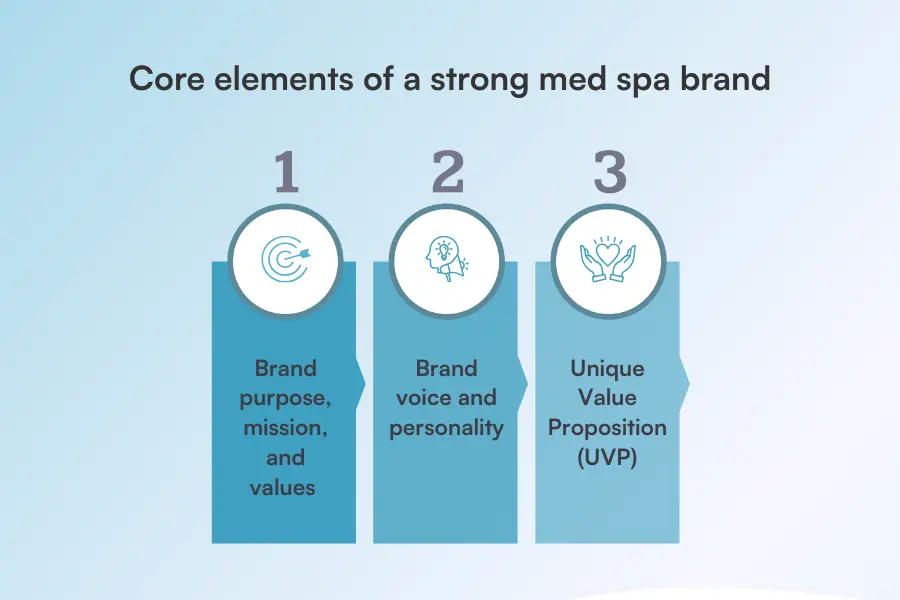
Three elements carry most of the weight: brand purpose and values, brand voice, and a unique value proposition.
Run a touchpoint audit. List every message a patient receives, then check each one against the voice and visuals you claim.
The most common mistake is treating branding as a logo project and leaving the patient experience exactly as it was.
Med spa branding is the consistent impression your practice leaves at every point of contact, from your website copy to a post-care text. It matters because patients decide whether to trust you long before they meet you.
You’ll see the same work spelled three ways: med spa branding, medical spa branding, and medspa branding. Patients search all three, and they describe the same positioning. The longer “medical spa” reads more clinical, while “med spa” feels more casual. Pick the spelling that fits your voice, then use it on your site, your listings, and your signage.
Four things make up that impression:
New med spas open down the street every other month. Branding is what stops price from being the only reason someone picks you. That’s where branding and pricing meet. A med spa pricing strategy holds up better when the brand has already justified the number. A patient who felt looked after at every touchpoint is less likely to question a premium.
Plenty of people hear “branding” and picture a logo, a font, and a color palette. That’s your visual identity. It’s one piece of the brand, and the piece patients notice first.
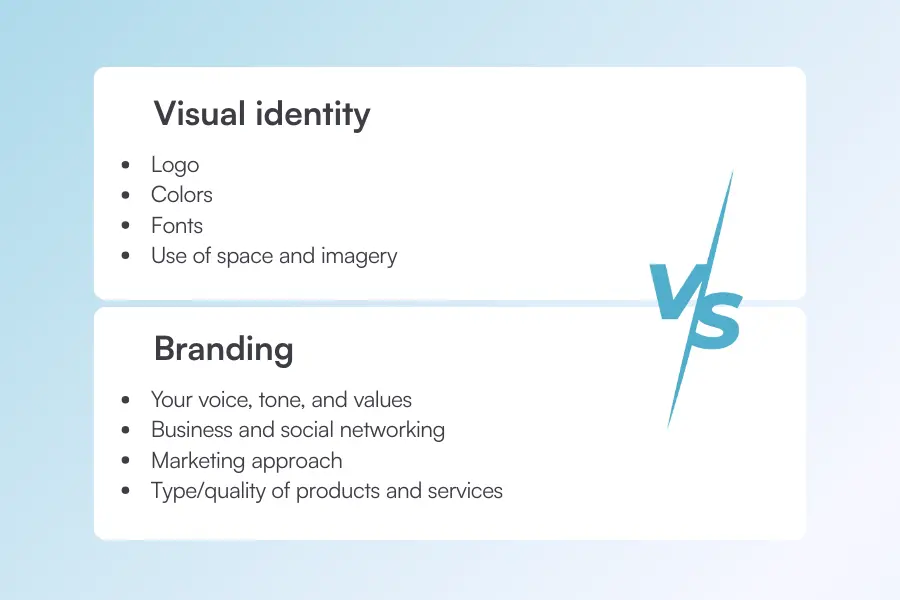
Branding is the full experience. It’s the voice on your website and the tone in your emails. Is that tone warm and welcoming, or cool and clinical? It also covers your core values, and the experience you want every patient to have.
On top of that, it includes:
When all of that lines up, a patient works out who you are and why they should trust you within seconds. When it doesn’t, they keep scrolling.
Branding is the perception people hold of your med spa, and marketing is the work that puts you in front of them. The branding vs marketing distinction matters because the two fail in completely different ways.
Say you spend $2,000 on an Instagram campaign for a lip filler promotion. That spend is marketing. Whether the landing page, the booking confirmation, and your front desk all sound like the same practice is branding.
Marketing without branding buys attention you have to keep re-buying. Branding without marketing builds something nobody sees. Most practices need med spa marketing strategies to fill next month, and branding to make next year cheaper to fill.
Branding builds trust by answering a patient’s unspoken questions before they ever reach your booking form. Those questions are usually the same three:
81% of consumers say they need to trust a brand before they’ll consider buying from it. Strong branding is the shortcut to that trust, which is why a well-branded practice feels like a friend’s recommendation.
A strong med spa brand rests on three things: a clear purpose, a consistent voice, and a unique value proposition. Get those right and your marketing, your team, and your patient experience all tell the same story.
Your brand purpose is your reason for existing beyond offering treatments. It might sound like one of these:
A useful purpose also names who the practice is for. “First-time injectable patients in their 30s” gives your team a filter for every decision, while “everyone” gives them no direction at all.
Your mission turns that purpose into action. It’s how you plan to make the purpose happen this year, with the team and the rooms you already have.
Your values are the non-negotiables that shape your culture. They decide what your team does when a patient asks for a treatment you don’t think suits them.
That clarity pays off in three places. It attracts patients who want what you offer. It makes day-to-day decisions faster. And it gives your team a reason to say no to the wrong request.
Your brand voice is the tone and word choice a patient meets in every email, text, and caption you send. Here’s the same promise in three different voices:
Can’t choose between them? Brand archetypes offer a shortcut. The framework sorts brands into 12 personality types, drawing on psychologist Carl Jung’s work. The three voices above map roughly to the Sage, the Caregiver, and the Jester, and a luxury practice often reads as the Ruler.
Pick one and hold it everywhere. In a brand consistency report by Marq, 68% of respondents credited brand consistency with revenue growth of 10–20%.
Your unique value proposition is the one-line reason a patient picks you over the med spa two blocks away. It answers a blunt question: why you?
It usually comes from one of these:
Your UVP has to be obvious to anyone landing on your website, not just to you. If your team describes it three different ways, it isn’t written down clearly enough yet.
Build your purpose, voice, and touchpoint copy yourself, and hire a designer for your visual identity once the budget allows.
The DIY-or-hire table below splits the four core brand elements by who should own each one, and why.
| Brand element | DIY or hire out | Why |
|---|---|---|
| Purpose, mission and values | DIY | Only you know why the practice exists and what it refuses to do. A consultant can run the workshop, but the answers have to come from you. |
| Brand voice | DIY, with an optional copy edit | Your team speaks it every day. A voice they had no hand in shaping tends to get dropped at the front desk. |
| Visual identity | Hire out, unless budget is tight | A designer builds a logo and type system that works from storefront sign to favicon. On a tight budget, a clean wordmark in one typeface holds you over. |
| Patient-journey touchpoints | DIY-drafted, then template-locked | You know what each treatment needs in its prep and aftercare. Write each message once and save it as the template, so it sends the same way every time. |
Treat the table as a branding tool you already own. Every DIY row costs time rather than money, so start there while you collect design quotes.
When we onboard new practices, the touchpoint row is often the one still running on default wording, even after a paid rebrand. The logo got an agency, but the reminder text never got an owner.
Here are three branding ideas you can finish in an afternoon, one for each core element above. None of them need a designer or a budget.
Most purpose statements fail because they could belong to anyone. “We empower patients to look and feel their best” fits every med spa in the country.
Try this instead: “We help women over 40 in Sacramento look rested, not done.” Now your treatment menu, your photography, and your consult script all have a filter to run through.
Test it by reading it to your front desk. If nobody can repeat it back an hour later, it’s still too vague to be useful.
Start with your appointment reminder, because every patient gets it. Most read like a utility bill: “This is a reminder of your appointment on 12/04 at 2:00 PM.”
A warm brand sends: “Hi Sara, you’re booked for Thursday at 2. Skip the wine tonight and we’ll see you then.”
A clinical brand sends: “Sara, your consult is confirmed for Thursday at 2 PM. Please avoid blood thinners for the next 48 hours.”
Same information, two different practices. Rewrite one message a week and your whole sequence sounds like you within a quarter.
UVPs go vague when they compare you to nobody. Name the alternative you’re beating and the claim gets sharp.
“The only practice in town where your injector, not a coordinator, runs your consultation.” A patient can check that one, which is exactly why it works.
Then put it in the three places patients look first. Your homepage headline, your Google Business profile description, and the first line of your booking page.
Your brand has to carry through every touchpoint, from the moment someone finds you online to the post-care message a week later. When those touchpoints agree with each other, trust builds. When they don’t, it leaks.
Here’s how your brand should show up across the journey. Pabau, our practice management software for med spas, can hold it together.
Your website is usually where someone meets your brand first, so it needs to say who you are in one screen. That means copy in your brand voice, and photography that matches your tone rather than a stock library’s.
The booking step is where most brands fall over. A polished homepage that hands off to a plain third-party booking page tells the patient the polish was borrowed.
Keep booking on your own site, in your own colors, with your own treatment names. No redirects, and no form fields nobody explained.
Every message between booking and arrival is a chance to prove you’re organized. Confirmation emails, pre-care instructions, and digital intake forms all count.
Write the pre-care instructions in the same voice as your consult. A patient told to skip retinoids for five days in warm, plain language is far likelier to do it.
Once a patient walks in, your brand stops being a design decision and becomes your team’s behavior. The room, the greeting, and the way a practitioner explains a result all have to match what the website promised.
You don’t need a 40-page brand book for this. Three agreed lines will do more work:
Write those three down, rehearse them once a month, and your in-room experience stops depending on who happens to be on shift.
What happens after a visit can matter more than what happened during it. That’s when a patient is quietly deciding whether the result was worth the money.
Follow-up messages, feedback requests, review prompts, and marketing emails all carry your brand forward. Each one should read like it came from the person who treated them, not from a system.
Good med spa reputation management starts here, because the wording of a review request decides whether anyone answers it.
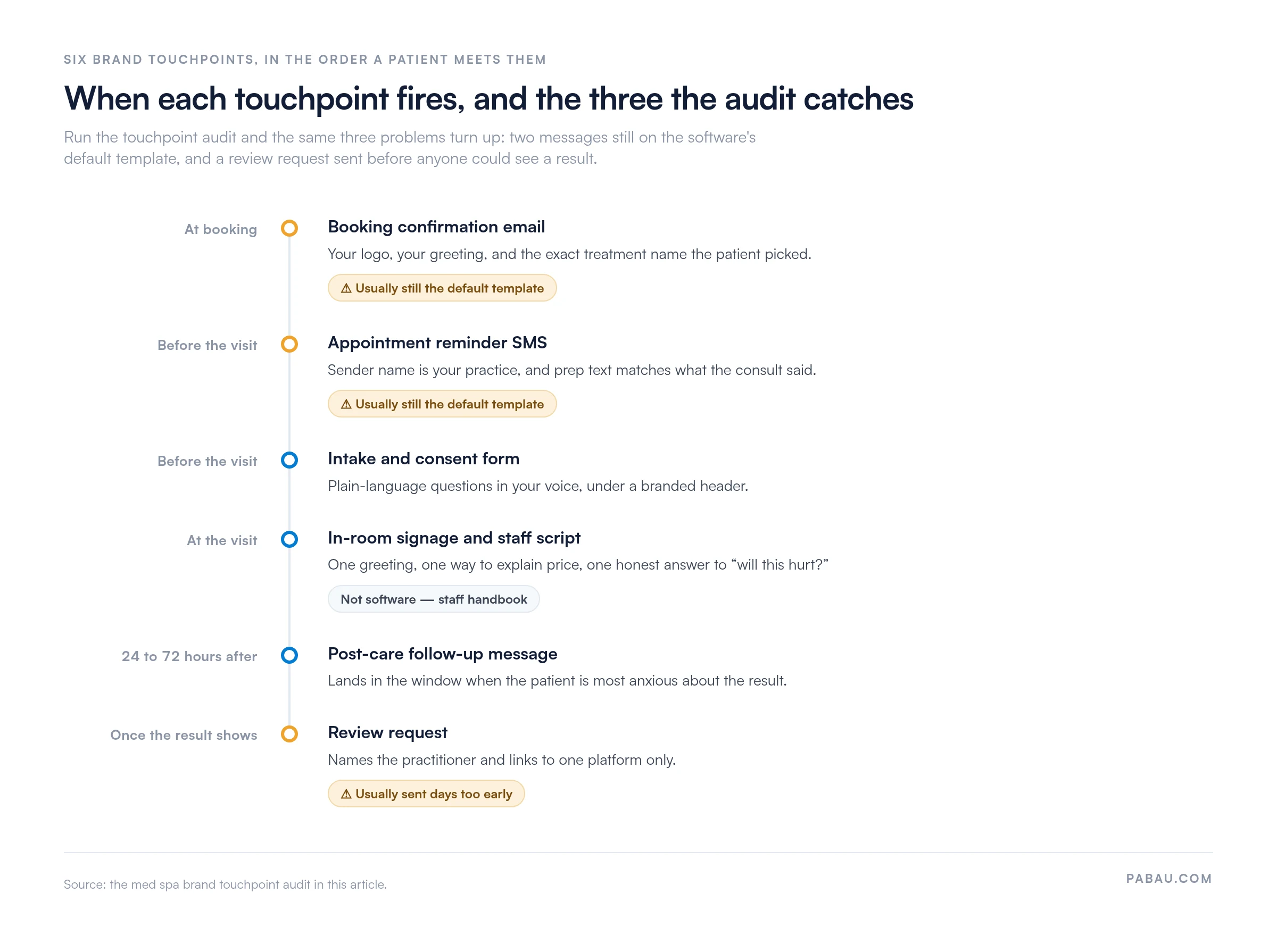
Run this audit once and you’ll know exactly which touchpoints are off-brand. Take each row, open the thing it names, and compare it with what you claim to be.
| Touchpoint | What “on-brand” looks like | Where you set it up in your practice software |
|---|---|---|
| Booking confirmation email | Your logo, your greeting, and the exact treatment name the patient picked. Not “your appointment is confirmed”. | Email template editor, triggered on booking. Build one template per treatment type. |
| Appointment reminder SMS | Sender name is your practice, not a five-digit number. Prep instructions match what the consult said. | Automated reminder settings. Set the timing, the sender name, and per-treatment prep text. |
| Intake and consent form | Plain-language questions in your voice, with a branded header. Not a photocopied PDF from a template site. | Digital forms builder, attached to the treatment so it sends before the visit. |
| In-room signage and staff script | One greeting, one way to explain price, one honest answer to “will this hurt?” | Not software. This one lives in your staff handbook and needs rehearsing. |
| Post-care follow-up message | Arrives when the patient is most anxious, usually 24 to 72 hours after treatment. | Post-care automation, triggered by the treatment recorded on the patient record. |
| Review request | Asks once the result is visible, names the practitioner, and links to one platform only. | Review request automation, delayed to match your treatment’s result window. |
Two problems usually fall out of this audit, and between them they cover three of the six touchpoints. The confirmation and reminder messages are still sitting on the software’s default template. And the review request goes out days before anyone could see a result.
Both are one-time setup jobs, the same as any other practice automation. Fix them once and they stay fixed for the next 400 patients.
Nobody gets this right the first time, and branding is something you refine as you grow. Three missteps show up often enough to be worth naming.
Focusing only on visuals is the most expensive branding mistake, because a new logo can’t fix a message that contradicts it.
Most owners start with a logo package. You save a folder of medical spa logo ideas, then brief a designer on the two you keep coming back to.
What you end up with looks the part while your reminder texts still read like a parking ticket. Patients register that mismatch long before they register the typeface.
Luxury styling makes the point well. Gold serif type promises an unhurried, high-touch visit. If your front desk is rushed and your consult runs 12 minutes, the logo is writing a check the experience can’t cash.
So settle your name and logo, then spend the next month on the words. Most med spa logos are perfectly fine. The copy underneath them is what costs you bookings.
If your Instagram is chatty and your in-room manner is cool and clinical, patients feel the switch and read it as a bait and switch. Your brand should feel the same wherever someone meets it.
The usual culprit is ownership. The owner writes the social posts, the receptionist writes the emails, and the software writes the reminders. Three authors, three voices.
Every interaction shapes how a patient feels about your practice, including the ones nobody designed. A 20-minute wait with no explanation undoes a lot of careful brand work.
Walk your own journey once a quarter. Book yourself in, read every message you receive, and sit in your own waiting room for 10 minutes.
Building a strong brand doesn’t need a full rebrand or an agency budget. A bit of clarity, consistency, and intention goes a long way.
Four steps, in this order:
The touchpoint audit above has one practical problem. Those messages usually live in different tools, so holding one voice means editing the same copy in four places and remembering all four.
Keeping them in one medical spa software system solves that. Pabau runs booking confirmations, reminder texts, digital intake and consent forms, and post-care messages off templates you write once, in your own voice.
Each template is attached to the treatment rather than to a person. So a receptionist on their second day sends the same on-brand message as your longest-serving one. Your online booking sits on your own site, in your own colors.
The daily win is smaller than it sounds and worth more than it looks. Nobody is rewriting a reminder at 8 PM, and no patient gets a message that reads like it came from a different practice.

Pabau runs your booking confirmations, reminders, forms, and post-care messages from templates you write once. Your brand voice stays consistent across the whole patient journey.

Branding for a med spa is the sum of about 20 small moments, and you already own every one of them. That’s the useful part. Nothing in the touchpoint audit needs permission or a budget.
A rebrand is rarely the fix. The work is making your confirmation email, reminder text, consent form, and follow-up message all sound like the same practice.
There’s a trade-off worth knowing about. Once your voice is written down, you stop improvising every message, and some of the fun of improvising goes with it. Consistency is what patients trust.
Start with the two touchpoints every single patient receives, your booking confirmation and your reminder. Book a demo to see how Pabau keeps those messages on brand without anyone rewriting them.

Want your emails to sound like you? Med spa email marketing templates gives you copy to adapt to your own voice in an afternoon.
Is your booking step off-brand? Medical spa scheduling software compares the tools that keep booking on your own site instead of redirecting patients away.
Asking for reviews at the wrong moment? Review management software explains how to time and word a request so patients actually answer it.
Need to fill the slot a no-show leaves? Med spa waitlist marketing shows how a waitlist protects your calendar and your patient experience.
Running more than one location? Multi-location med spa management covers holding one brand and one standard across several sites.
Medical spa branding is the consistent impression a patient forms across every interaction with your practice. It’s the same work as med spa or medspa branding, just spelled in full. It covers your visual identity, voice, values, and the patient experience from booking through follow-up. Pick one spelling for your site and listings, and use it everywhere.
Branding is the perception patients hold of your practice, and marketing is the activity that puts you in front of them. Marketing brings someone to your booking page. Branding decides whether they trust the page enough to finish. You need both, and you measure them differently.
You can build most of it yourself. Purpose, voice, and touchpoint copy are DIY work, because only you can define them. Hire a designer or branding agency for your visual identity, such as a logo, type system, and photography style. The DIY-or-hire table above splits all four elements.
There’s no fixed schedule, so tie it to changes in the business instead. Refresh your photography when your team, your rooms, or your treatment menu change, because dated images cost you credibility fastest. Leave the logo alone unless it no longer fits what you sell.