HD Brows consultation form: Free template and guide
HD Brows is a seven-step brow treatment that combines consultation, tinting, wax...

2
Last Updated: Oct 13, 2026

Mangomint suits established multi-staff salons and spas, while Vagaro suits independent operators and budget-focused businesses.
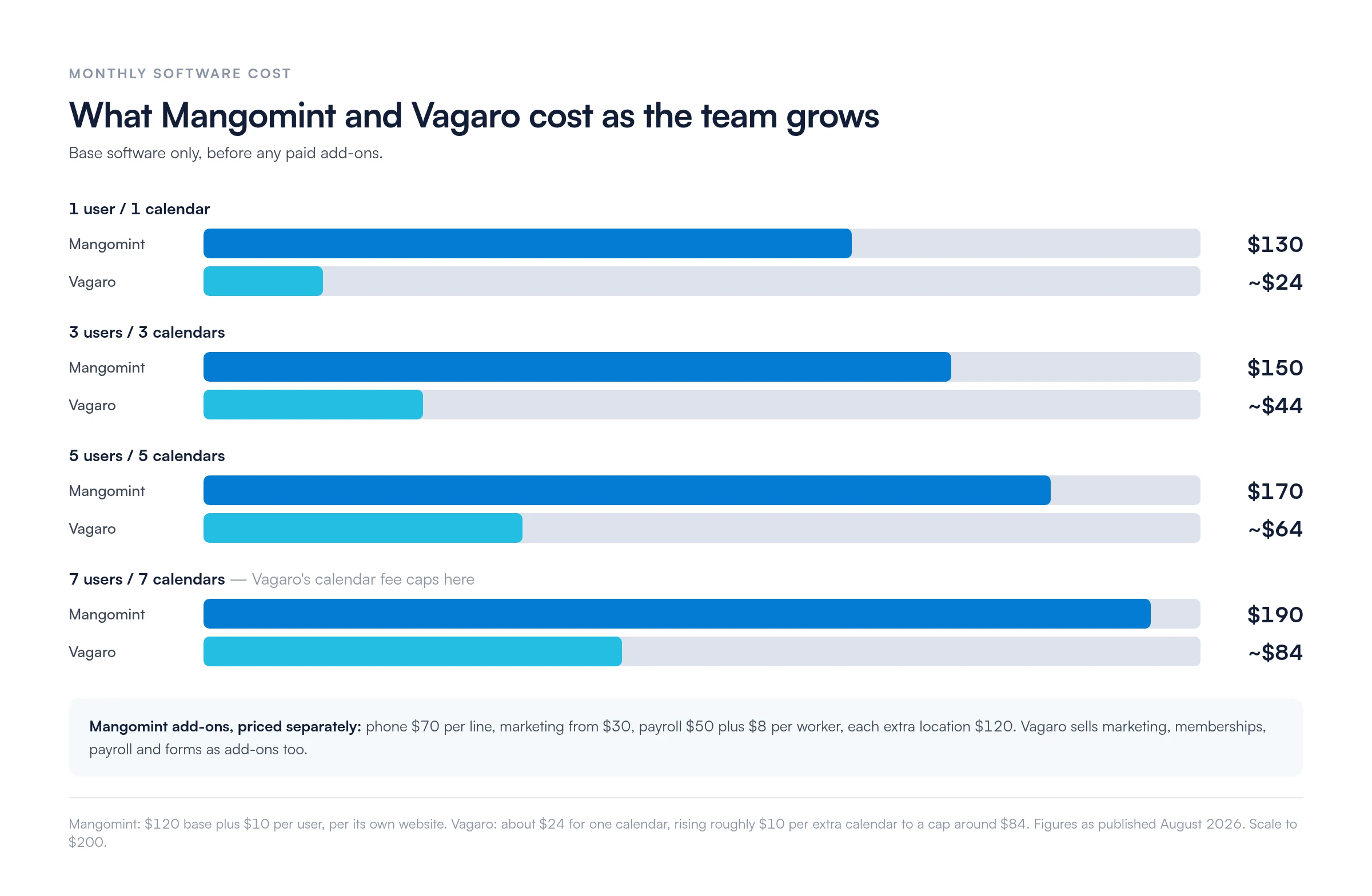
Pricing differs sharply. Vagaro starts around $24/month but add-ons push costs up, while Mangomint runs one plan at $120/month plus $10 per user.
Vagaro’s built-in consumer marketplace drives new client discovery; Mangomint has no marketplace but earns top UX ratings.
Medspas and aesthetic clinics needing clinical documentation and compliance tools should look beyond both platforms to Pabau.
The Mangomint vs Vagaro question comes up constantly in salon and spa owner communities, and for good reason. Both platforms handle scheduling, payments, and client management, but they serve genuinely different business types. Choosing the wrong one costs you time, money, and the goodwill of staff who have to use it every day.
This guide breaks down pricing, features, ease of use, and who each platform actually suits, including a look at where neither fits well. If you run or are considering a medspa with clinical treatments, there’s also a third option worth knowing about.
Vagaro’s base price starts around $24/month for a single calendar. Each additional calendar adds roughly $10/month, with a cap around $84/month for seven or more. That figure sounds affordable until you start adding the features most businesses actually need.
Email and SMS marketing, forms, membership management, and payroll are all sold as separate add-ons. A fully-loaded Vagaro account for a multi-staff salon can run considerably higher than the entry price suggests. For a detailed breakdown, see our Vagaro pricing breakdown.
Mangomint pricing takes a different approach. It has retired its old tiers in favor of a single plan, priced at $120/month for the base plus $10/month per user. Mangomint’s website headlines that as starting at $130 per month, covering the base and one user. Your bill grows with headcount, not with the tier you picked.
A few tools sit outside that plan. Mangomint’s website prices phone service at $70/month per line, including in-app calls and texting. Marketing starts at $30/month, payroll runs $50/month plus $8 per worker, and each additional location adds $120/month. There are no contracts, and onboarding and data transfer are free.
On sticker price, a solo operator pays roughly five times more for Mangomint than for Vagaro’s single-calendar plan. That multiple shrinks as you add staff, since Mangomint’s $120 base is fixed and each extra user adds only $10. Reviewers switching from Vagaro often report paying more each month, then canceling third-party subscriptions they had bought to cover what Vagaro left out.
Both platforms charge processing fees on card payments, which adds up at volume. Mangomint’s website lists 2.45% plus 15 cents per in-person transaction, and 2.90% plus 30 cents for virtual payments. Vagaro offers a free Bluetooth credit card reader for new accounts using its payment processing, according to its own comparison page.
One wrinkle shows up at scale. Past seven calendars, Vagaro’s calendar fee stops climbing, while Mangomint keeps adding $10 for every user you onboard. Verify current terms with each provider before committing, since these offers change.
Mangomint’s booking interface is consistently praised across review platforms for its speed and visual clarity. Staff can navigate appointments quickly and clients report a smooth booking experience from the front end. The platform handles multi-staff scheduling well, with clear calendar views that work at pace during a busy front desk.
Vagaro’s booking covers similar ground but has received criticism for loading speed, particularly at the front desk. According to Software Advice reviewer feedback, slow screen loads caused queues at check-in. Vagaro also requires clients to create an account before booking or buying a gift card. Independent reviewers flag that friction repeatedly as a drag on conversion.
One meaningful difference: Mangomint does not currently support booking packages that require multiple providers across different service types. If your business frequently bundles services across staff members, verify this limitation is resolved before switching.
Booking gets clients in the door, but the daily grind happens at checkout. Both platforms include a point-of-sale (POS) system for ringing up services, retail, and tips, and both behave differently under pressure. Mangomint’s low-click checkout is built to move a busy front desk along fast, which is a big reason staff rate it so highly. Vagaro’s POS covers more ground, including retail and class check-ins. The loading delays reviewers flag at booking also surface at the register during peak hours.
Memberships are where the pricing models diverge again. Mangomint includes membership management in its single plan, so recurring packages and automatic billing need no upgrade. Vagaro sells membership management as a paid add-on, so a studio running monthly memberships pays on top of the base price to switch it on. If recurring revenue is central to how you operate, factor that add-on into the true monthly cost before comparing sticker prices.
Vagaro’s built-in consumer marketplace is a genuine differentiator. Clients searching for services in their area can discover your business directly through Vagaro’s platform, without any additional advertising spend. For a new salon or a solo practitioner building a client base, this passive acquisition channel is genuinely valuable. Vagaro also includes broad marketing tools covering email campaigns, promotions, and social media tools.
Mangomint keeps marketing in the same system as the calendar, but prices it on the side. Its website lists marketing from $30/month, and texting arrives with the $70/month phone line. There is no marketplace either, so client acquisition rests on your own channels.
Reviewers switching from Vagaro still describe the tradeoff as worth it. You give up marketplace discovery, and you get campaigns that already know your client list and booking history.
The honest summary: if you’re building a client base and want passive discovery, Vagaro’s marketplace is hard to replicate. If you already have a loyal book and want a cleaner all-in-one marketing setup, Mangomint’s integrated approach works well.
Mangomint earns a 4.9/5 on both Capterra and G2, with reviewers consistently highlighting its intuitive interface, fast performance, and responsive customer support. Positive reviews name three themes. New staff face no steep learning curve, uptime holds up, and the client-facing booking experience feels premium for the price.
Vagaro’s Capterra rating of 4.7/5 reflects a solid but more varied experience. Positive themes cover its broad feature set, flexible pricing, and the value of the marketplace. Negative themes cluster around interface speed, a steeper learning curve for new team members, and the account-creation requirement that affects clients. G2 reviewers rate Vagaro at 4.5/5.
Customer support is another dividing line. Mangomint reviews frequently praise fast, responsive support, while Vagaro users report longer wait times during busy periods. For a small team onboarding quickly, Mangomint tends to reduce the training burden. For a business prioritizing lowest entry cost and marketplace visibility, Vagaro’s added complexity is a tradeoff many owners accept.

Pabau handles clinical documentation, consent forms, treatment records, and automated recall alongside scheduling and payments, built specifically for medical aesthetic and medspa businesses.

The table below covers the core feature categories relevant to the Mangomint vs Vagaro decision for salons, spas, and medspas.
Mangomint has built a reputation as the highest-rated salon and spa software on major review platforms, and the positive themes from users are consistent.
Vagaro’s strength is breadth. It covers a wide range of business types and keeps the entry cost low. The consumer marketplace drives genuine discovery on top of that.
Vagaro also shows up in other salon software matchups — our Meevo vs Vagaro comparison tests it against a stronger enterprise contender.
Both platforms are built for traditional beauty and wellness businesses. Neither Mangomint nor Vagaro is designed for medspas and aesthetic clinics. Those businesses run on clinical documentation, regulated consent, and treatment records they must store and reference over time.
Pabau, an all-in-one practice management platform built for medical aesthetics, is designed specifically for this kind of business. It covers the scheduling, payments, marketing, and client management you would expect from a modern salon platform. On top of that sits the clinical layer medspas need. That includes digital intake forms built into the booking flow, treatment record management, and injection plotting. Prescription workflows and compliance tools aligned with HIPAA and GDPR come as standard.
For businesses offering injectables, skin treatments, IV therapy, or any regulated aesthetic procedure, this makes a meaningful operational difference.

Pabau is rated 4.7/5 from 600+ verified reviews on Capterra, with pricing starting from $65/month. For medspas specifically, the medical spa software page covers how it fits that workflow in detail. You can also compare the platforms side-by-side through our dedicated Pabau vs Mangomint comparison.
For spas, the Mangomint vs Vagaro choice comes down to your business stage, budget, and whether your services stay beauty-only or cross into medical aesthetics.
The Mangomint vs Vagaro comparison is not a close call once you know your business type. Mangomint wins on user experience and feature depth for established multi-staff operations. Vagaro wins on entry pricing and marketplace-driven client acquisition for independent operators and growing studios.
If your business has moved into medical aesthetics, neither platform serves the clinical and compliance requirements that define that category. Pabau’s automated recall campaigns, treatment record management, and built-in consent workflows are designed for exactly that transition. Book a demo to see how it handles your medspa workflow end to end.

Comparing your options more broadly? Pabau vs Mangomint breaks down how the platforms differ for medical aesthetic and medspa businesses specifically.
Frustrated with Tebra’s pricing and support? Tebra alternatives for practices covers options for those facing high fees, unclear pricing, or slow support.
Running a spa and thinking about software costs? Vagaro pricing breakdown details exactly what you pay at each tier and which add-ons are worth it.
Mangomint is a premium, all-in-one platform targeting established multi-staff salons and spas with a polished interface and one per-user plan. Vagaro is a more affordable, modular platform targeting independent operators and small studios, with a consumer marketplace that drives new client discovery. The Mangomint vs Vagaro choice depends primarily on business size, budget, and whether marketplace exposure matters to your growth strategy.
Mangomint charges $120/month plus $10 per user, which its website headlines as $130/month for one user. Vagaro starts around $24/month for a single calendar but charges separately for marketing, memberships, payroll, and forms. Mangomint prices phone service, marketing, and payroll separately too, so compare the add-ons your team actually needs.
Yes. Vagaro operates a consumer-facing marketplace where clients searching for local services can discover and book businesses directly. This is one of Vagaro’s most distinctive advantages over Mangomint, which does not offer a marketplace.
Neither Mangomint nor Vagaro is built for medical aesthetics. Both platforms lack clinical documentation, regulated consent forms, and treatment record management. Medspas and aesthetic clinics that need these features are better served by a purpose-built platform like Pabau. It combines medspa scheduling and payments with clinical compliance tools.
Mangomint is generally considered easier to use, earning a 4.9/5 rating on Capterra and G2. Reviewers highlight its intuitive interface, fast performance, and low training burden for new staff. Vagaro has a steeper learning curve and has received complaints about interface loading speeds during busy periods.
It depends on the spa’s size and budget. Mangomint suits established multi-staff spas that want a fast, polished all-in-one system. Vagaro fits independent and growing spas that need a low entry price and marketplace exposure. Spas offering medical aesthetic treatments outgrow both and are better served by a clinical platform like Pabau.
Mangomint runs one plan at $120/month plus $10 per user, so a solo operator pays about $130. Vagaro starts around $24/month but charges extra for marketing, memberships, payroll, and forms. The difference narrows once you add the paid extras a multi-staff Vagaro account usually needs.
GlossGenius, Boulevard, Square, and Booksy all compete in the same salon and spa space, each with a different mix of pricing and marketplace features. GlossGenius bundles most tools into a flat rate, while Booksy and Square lean on marketplace exposure like Vagaro. For medspas needing clinical documentation, none of these match a purpose-built platform such as Pabau.
Both include a built-in point-of-sale for checkout, retail, and tips, so day-to-day selling is covered either way. The difference is recurring revenue. Mangomint includes membership management in its single plan, while Vagaro charges for it as a paid add-on. Monthly membership billing therefore costs extra on top of Vagaro’s base price.