Healthcare workforce planning: a practical guide for practice leaders
Healthcare workforce planning is the structured process of matching clinical cap...

Last Updated: Oct 13, 2026

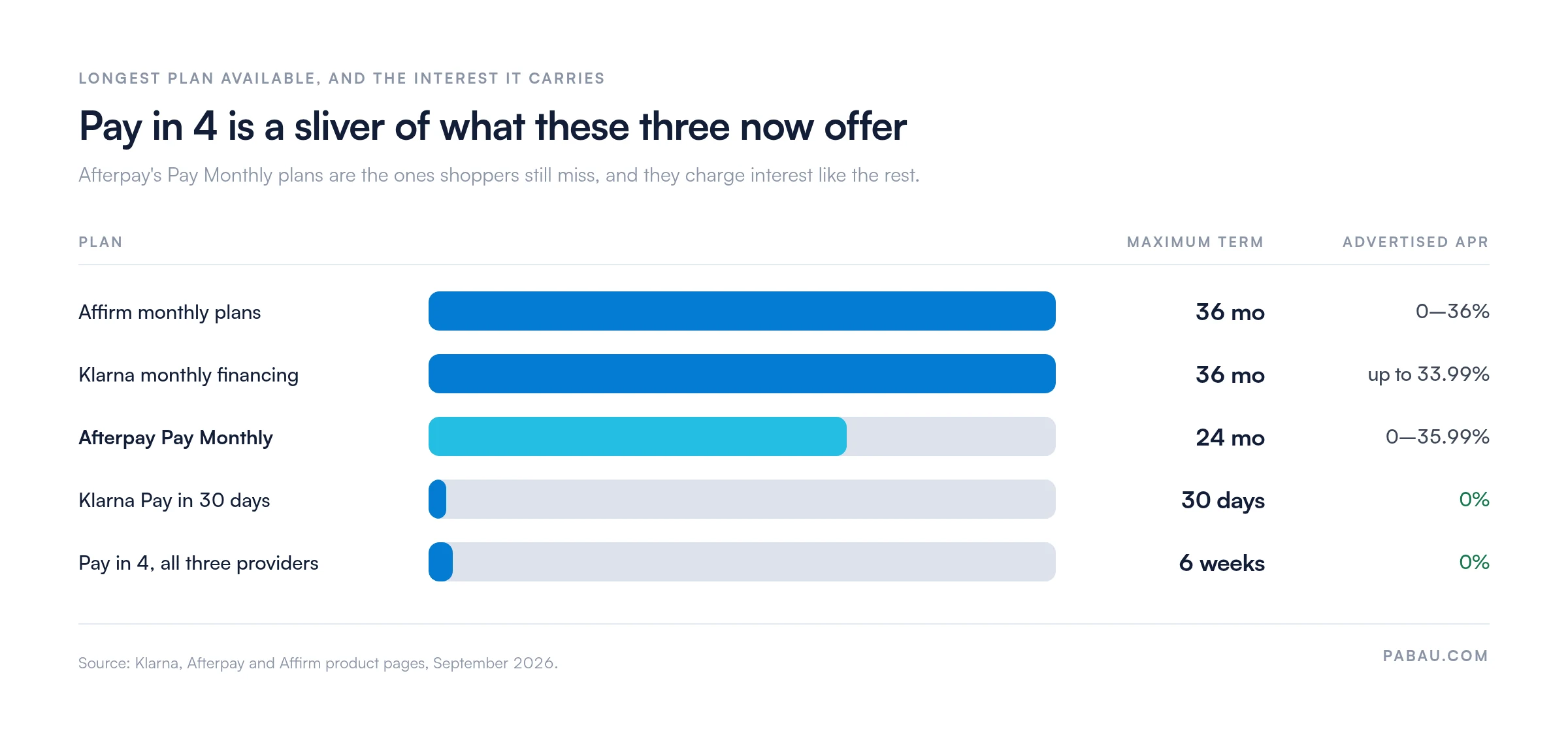
Klarna, Afterpay, and Affirm all split a purchase into four payments, and all three now sell longer plans that charge interest.
Afterpay added Pay Monthly in 2022, with terms of 3 to 24 months and APRs running from 0% to 35.99%.
Affirm charges no late fees, but it reports every loan to the credit bureaus, so a missed payment shows up on your file.
Afterpay’s Pay in 4 is the gentlest on credit, because those loans are generally not reported to the bureaus.
Practices can run deposits and payment plans inside practice management software like Pabau, without opening a second merchant account.
Klarna vs Afterpay vs Affirm is the choice millions of shoppers now make at checkout. In 2023, six buy now, pay later lenders wrote 335.8 million loans worth $45.2 billion, according to the Consumer Financial Protection Bureau.
All three split a purchase into four interest-free payments, so that part is settled. What separates them is late fees, credit reporting, and how long you can stretch a bill.
This guide compares the three on plans, cost, and credit impact. Then it looks at what each one asks of a practice at checkout.
Here is the full comparison in one table. Start with the late fees and credit reporting rows, because those two settle most decisions.
Each provider now sells two things: a short interest-free plan, and a longer plan that charges interest. The short plans are close to identical. The long plans are where the money goes, and they stretch much further than most shoppers realize.
Klarna offers four routes to the same purchase, which is more variety than either rival. Pick by the size of the bill and how soon you can clear it.
Afterpay is no longer a pay-in-4 company. Alongside the original four payments every two weeks, it has offered Pay Monthly since 2022. Those loans run 3, 6, 12, or 24 months, start at $100, and reach $20,000 at some merchants. APRs range from 0% to 35.99%, and interest is charged on the principal only.
The two products behave differently when a payment slips. Pay in 4 charges late fees. Pay Monthly does not, because First Electronic Bank underwrites it as a regular installment loan.
Afterpay also raises your Pay in 4 spending limit as you build a repayment history. A first order may be capped lower than you expect.
Affirm sits between the other two. It offers pay-in-4 for smaller baskets at 0%, then monthly plans of 3 to 36 months for larger ones. Rates run from 0% at select merchant partners up to 36% APR, set by your credit profile.
Its headline promise is simple: Affirm never charges a late fee. The trade-off is visibility. Every Affirm loan goes to the credit bureaus, so the record of how you paid follows you.
If you always pay on time, all three interest-free plans cost you nothing, and the choice barely matters. If you sometimes miss a date, the fee model decides the winner. Some providers front-load cost into APR, while others collect it through late fees.
Interest on a long plan adds up quietly. Afterpay publishes a worked example: a $1,000 loan over 12 months at 21% APR costs $1,117.40 in total. That is $117 for the convenience of paying monthly. On a $3,000 course of treatment, the same rate would add roughly $350.
So the fee models split three ways. Affirm removes the penalty for slipping but charges interest on longer plans. Klarna gives you 10 days of grace before a fee lands. Afterpay caps total Pay in 4 late fees at a quarter of the order value, which keeps the worst case predictable.
If protecting your credit score is the priority, Afterpay’s Pay in 4 is the safest of the three. It runs a soft check and generally keeps those loans off your credit file. Here is how each provider handles it.
The CFPB’s market report makes the same point from the industry side. Reporting practices differ from lender to lender, so shoppers assume all these loans behave alike. They do not.
Pull your free credit report at AnnualCreditReport.com before you apply for any plan that might trigger a hard inquiry. Affirm can run a hard pull on monthly financing, and that inquiry stays on your report for up to two years.
Klarna has the widest reach of the three, mostly because of one feature. A great fee structure will not help you if the option never appears at checkout, so acceptance deserves a look before you commit.
In practice, the three overlap heavily. Fashion, electronics, and home goods are covered by all of them, and health and wellness services are catching up fast. Which brings us to the side of this comparison that shoppers never see.
None of the three publishes a standard US merchant rate on its website. Each one quotes you after an application, based on your volume, your category, and where you trade. So the only figure you can trust is the one in your own contract, and you have to ask for it.
The mechanics are consistent across all three. The provider pays you in full, keeps a commission on each transaction, and takes on the collection risk. Affirm tends to price longer plans higher, because it carries the financing risk rather than the merchant.
The admin is where practices get caught out. Every provider needs its own merchant account, its own approval process, and its own checkout integration. Run two of them and you are reconciling two settlement reports against one appointment calendar.
Six questions save most of the pain later. Work through them with the provider before you sign.
All three offer some form of dispute resolution, but the depth varies, and none of it matches a credit card. Here is what each one gives you when an order goes wrong.
The Federal Trade Commission puts it plainly. Plans advertised as interest-free still charge fees, and refunds do not always flow back through the plan the way a card chargeback would. Before you buy, check that a return will actually credit the installments.
All three work at healthcare providers, but only where that provider has set up a merchant account first. The patient experience is the same as buying shoes. Split the invoice at checkout, then pay it down.
What the patient does not see is the disconnect behind the desk. None of these platforms talks to appointment booking, treatment records, consent forms, or clinical notes. The practice ends up running payment in one system and care in another.
Cherry is worth knowing about here. It was built for elective healthcare and aesthetics, with higher approval rates and underwriting tuned to treatment plans. It still sits outside your practice software, so the reconciliation problem stays.
There is also a quieter question underneath all of this. Would better collections solve the problem instead? Deposits, clear payment terms, and prompt invoicing recover a lot of revenue that practices assume needs financing. Our guide to patient collections walks through that math. If you do want card payments taken in the room, a clinic POS terminal handles the balance at the end of the appointment.
Every one of the three asks for something in return for the flexibility. Here is the deal each one offers.
Three questions decide it. How big is the purchase, how reliably do you pay, and does your credit file need protecting right now?
Right now, a practice offering flexible payment usually bolts a third-party app onto checkout. Someone applies for a merchant account, waits for approval, and adds a widget to the booking page. From then on, payment data lives in one place and patient records live in another.
Practice management software like Pabau takes a different route. Deposits, installment schedules, and invoices all sit next to the appointment and the treatment note that created them, in one practice management app. Payments run through Stripe, so you keep one settlement report and one set of numbers to reconcile.
The result is a shorter workflow for your front desk. Staff can see what a patient has paid, what is still scheduled, and what to chase, without opening a second dashboard. Patients get the flexibility they came for, and you keep the whole picture in one system.

Pabau lets your practice take deposits, run installment schedules, and issue invoices inside the same platform that manages appointments, records, and patient messages. One settlement report, one place to look.

There is no single winner here, and anyone who names one is selling something. Afterpay’s Pay in 4 does the least to your credit file. Affirm is the most honest about cost, because the APR is on the screen before you commit. Klarna gives you the most ways to structure the same purchase.
The part worth remembering is that “interest-free” now describes only part of each provider’s range. Once you cross into monthly plans, all three charge close to the same rate. So read the plan, not the logo.
If you are on the practice side of that checkout, the decision looks different again. Every provider you add is another account to reconcile, and patients often just need a deposit and a clear schedule.
Book a demo to see how Pabau handles deposits and payment plans alongside your bookings and patient records.

Wondering whether better collections beat financing? Patient collections: how to improve your collection rate covers deposits, payment terms, and chasing balances without awkward calls.
Taking card payments for treatment in the US? HIPAA compliant payment processing: a practice guide explains what your payment stack has to keep separate, and why.
Need permission on file before you charge a card? Credit card authorization form is a free PDF with a field checklist you can hand to patients at intake.
Yes. All three let you clear the balance ahead of schedule with no prepayment penalty. On an interest-bearing plan that also cuts what you owe, because interest is charged on the principal you still hold.
Yes, all three take debit cards for the installments, and Klarna and Affirm can also pull from a linked bank account. Prepaid cards are generally declined, so check your payment method before you reach checkout.
It depends on the plan and the merchant. Afterpay’s Pay Monthly starts at $100, while pay-in-4 plans usually work on much smaller baskets. Merchants can set their own floor, so the same app may behave differently at two stores.
You still owe the lender, so raise a dispute with the provider straight away. Keep the order confirmation and any cancellation notice. If the seller never delivered, the provider can pause payments while it investigates.