Anemia nursing care plan
An anemia nursing care plan is a structured document that guides a nurse from as...

2
Last Updated: Oct 9, 2026
The Ipswich touch test is a no-equipment bedside screen for loss of protective sensation in the feet of people with diabetes. You lightly touch the tips of the first, third, and fifth toes on both feet, six sites in all. Two or more sites the patient cannot feel means protective sensation is lost, which triggers podiatry referral and closer follow-up.
The test was developed at Ipswich Hospital NHS Trust and validated in Diabetes Care (Rayman et al., 2011). It takes under a minute and needs nothing but your index fingertip. That is why it holds up on home visits and in community settings where a monofilament is nowhere to be found.

The Ipswich touch test screens six toe-tip sites using only the examiner’s index fingertip, with no equipment at all.
Two or more insensate sites is the validated threshold for loss of protective sensation, and it should trigger clinical follow-up.
The original 2011 study measured the test against a vibration perception threshold, not against the 10g monofilament.
A 2022 Canadian study found the result held up across nurses, dietitians, chiropodists, a physiotherapist and other non-specialists.
Pabau’s structured patient records and automated recalls help practices document and schedule annual diabetic foot reviews.
The Ipswich touch test is a validated screen for loss of protective sensation (LOPS) in patients with diabetes mellitus. The examiner lightly touches six toe-tip sites with an index fingertip and records which ones the patient cannot feel. It was designed as a cost-free alternative to the Semmes-Weinstein 10g monofilament, for settings where that equipment is not to hand.
The test takes its name from Ipswich Hospital NHS Trust, where it was developed and first validated. Its appeal is simplicity. Any trained clinician can perform it without ordering supplies, calibrating equipment, or training beyond a brief procedural orientation.
Loss of protective sensation is one of the most dangerous and underdiagnosed complications of diabetic peripheral neuropathy. Patients with LOPS cannot feel minor trauma, pressure injuries, or heat. Foot wounds therefore go unnoticed until they become infected or ulcerated.
Diabetic foot ulcers are among the most costly complications of diabetes, clinically and economically. The International Working Group on the Diabetic Foot estimates that up to 85% of diabetes-related amputations are preceded by a foot ulcer. Most of those ulcers start with neuropathy nobody has detected yet, which is what routine screening is there to catch.
Screening early changes what happens next. A clinician who picks up LOPS can refer the patient for podiatry review and advise on protective footwear. Raising the monitoring frequency at that point catches damage while it is still reversible. A test that needs no equipment and takes under a minute removes most of the friction from doing that at every review.
Any trained healthcare professional can perform the test, which is one of its clearest advantages over screens that need a calibrated instrument. A 2022 Canadian interprofessional study looked at how well the result held up across different professions. Chiropodists, dietitians, nurses, an occupational therapist, a physiotherapist and an endocrinology resident all took part.
General practitioners were not among the professions that study tested, so the published evidence speaks to the wider team rather than to the physician specifically. In practice that is the useful finding. A validated neuropathy screen can be delegated to a practice nurse or a healthcare assistant. That widens the reach of diabetic foot screening inside the team a practice already has.
The test carries no prescribing requirement, so it sits inside the scope of almost every member of a multidisciplinary team. That is unusual among validated neuropathy screens, and it is the main reason the test spread beyond specialist diabetes services.
The procedure is straightforward, but technique decides whether the result can be trusted. The test needs a light, brief fingertip touch rather than pressure. Too much force produces a proprioceptive response instead of a protective-sensation one, which reads as a false negative.
The procedure uses the tips of the first, third, and fifth toes on both feet. It does not use the dorsum of the foot or the plantar surface. The original validation study chose these sites to sample the medial, central, and lateral forefoot, which reflects how peripheral neuropathy distributes in patients with diabetes.
The hallux and the fifth toe mark the medial and lateral sensory borders, and the third toe gives a central reference point. Testing both feet doubles the data points and picks up asymmetric neuropathy, which is common in diabetes. The map below sets out the six sites and what the resulting count means.
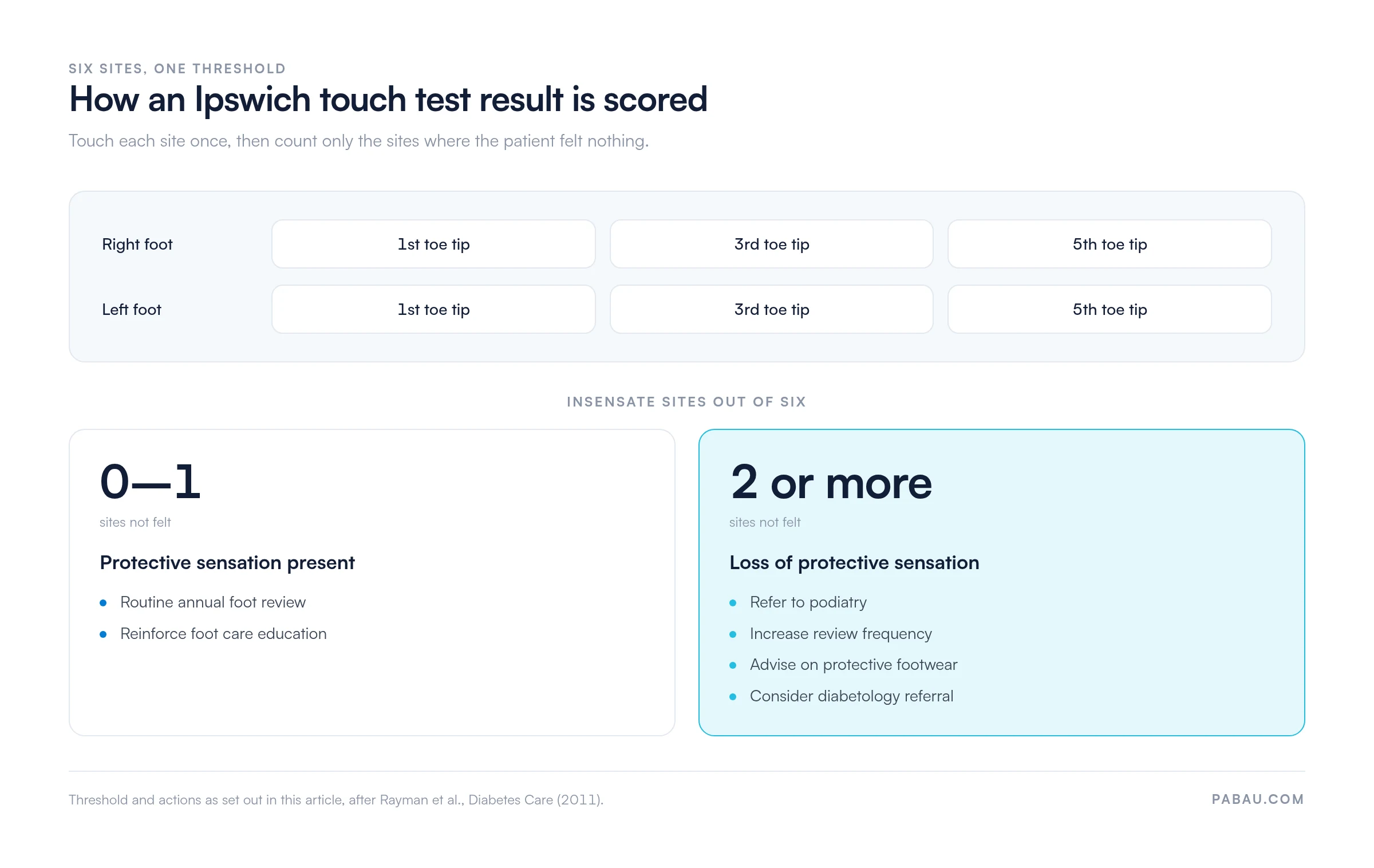
Interpretation rests on a simple count of insensate sites. A site counts as insensate when the patient does not report feeling the touch there. The validated threshold is two or more insensate sites out of the six tested, which indicates clinically significant loss of protective sensation.
A positive result does not diagnose diabetic peripheral neuropathy on its own. It identifies patients at elevated risk who need further assessment. Read it alongside the other findings: foot deformity, callus, skin condition, vascular status, and any history of previous ulceration.
The original study by Rayman et al. appeared in Diabetes Care. Its reference standard for loss of protective sensation was a vibration perception threshold of 25V or above.
The 10g Semmes-Weinstein monofilament was compared alongside the touch test rather than used as the benchmark. Plenty of secondary summaries get this the wrong way round, and it is worth checking before you quote the figures in a governance document.
A later systematic review and meta-analysis in BMJ Open pooled the published evidence on the test. Accuracy held up across the studies it covered, which supports using the test outside specialist diabetes services.
These figures come from the original validation cohort, which reported combined values rather than a breakdown by foot. Exact numbers shift with the study population, neuropathy prevalence, and examiner technique. Cite the primary study whenever you quote specific values in a clinical audit or a governance paper.
The 10g Semmes-Weinstein monofilament is the most widely cited reference standard for LOPS detection in diabetes. The touch test was developed for settings where the monofilament is unavailable. Choosing between them is a practical question for most practice teams. Equipment, time, and who is in the room decide it.
Diabetes UK’s “Touch the toes” page credits the test to Gerry Rayman and his team at Ipswich Hospital and explains how to run it. It draws no comparison with the monofilament, so treat any equivalence claim you see attributed to it with caution. The two tests do share an endpoint, loss of protective sensation, and both count insensate sites against a set threshold.
If a calibrated monofilament is available in your practice, use it as the primary screen. Keep the Ipswich touch test for home visits, community services, and urgent reviews where no equipment is to hand. Record which test you used in every note, so audit and continuity of care both hold up.
NICE guideline NG19 and NHS England’s diabetes care standards both require an annual structured foot review for every patient with diabetes. The touch test is one component of that assessment rather than a substitute for it. Practices building the wider review from scratch can start from an annual physical exam checklist and add the diabetes-specific elements to it.
The annual diabetic foot review typically covers:
Circulation matters as much as sensation at this review. A foot that cannot feel pressure and is poorly perfused carries a far higher ulcer risk than either finding alone. That is why the ankle brachial index belongs alongside the touch test rather than in a separate appointment.
Two or more insensate sites should trigger a structured referral aligned with the patient’s overall risk category. On its own, LOPS places the patient in the moderate-risk group under NICE NG19. Combined with deformity, previous ulceration, or absent pulses, it raises the patient to high risk.
A screening test only helps if it gets done, recorded clearly, and followed up. Those are operational problems rather than clinical ones, and they are where practice management software like Pabau earns its place in a diabetes service.
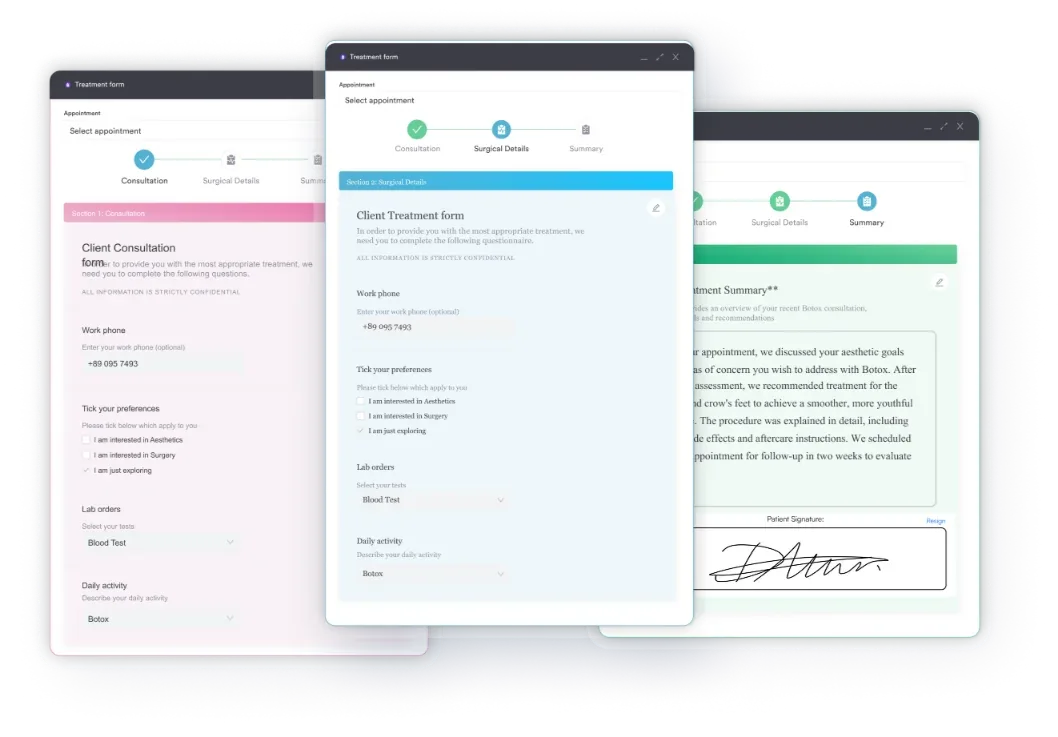
Pabau’s digital intake forms can be set up to capture a touch test result as structured data instead of free-text notes. Each of the six sites gets its own field, the insensate count totals automatically, and the result flags against the threshold. If a patient later develops an ulcer, the record shows what was screened and when.
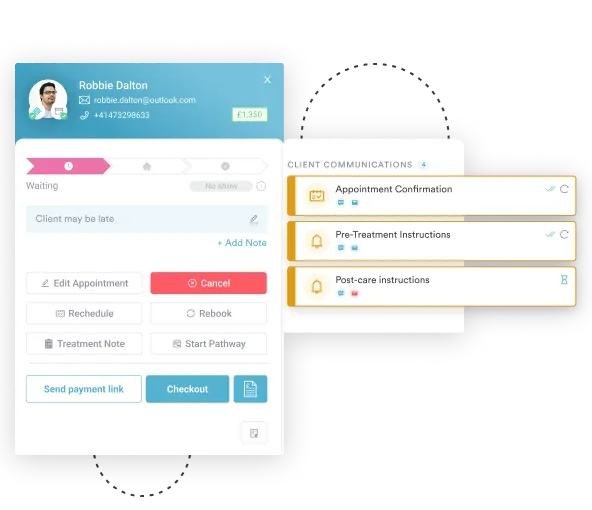
Recall is the other half of the job. Automated reminders reach the patients due for an annual foot review, so the list never depends on someone remembering to build it. The whole screening history sits in one patient record. The next clinician sees the previous result, any referral made, and any change in risk status.
GP clinic software handles this alongside the rest of chronic disease management. Writing safer clinical notes protects continuity too. A patient seen by a locum or a duty doctor still gets the right follow-up from their screening result.
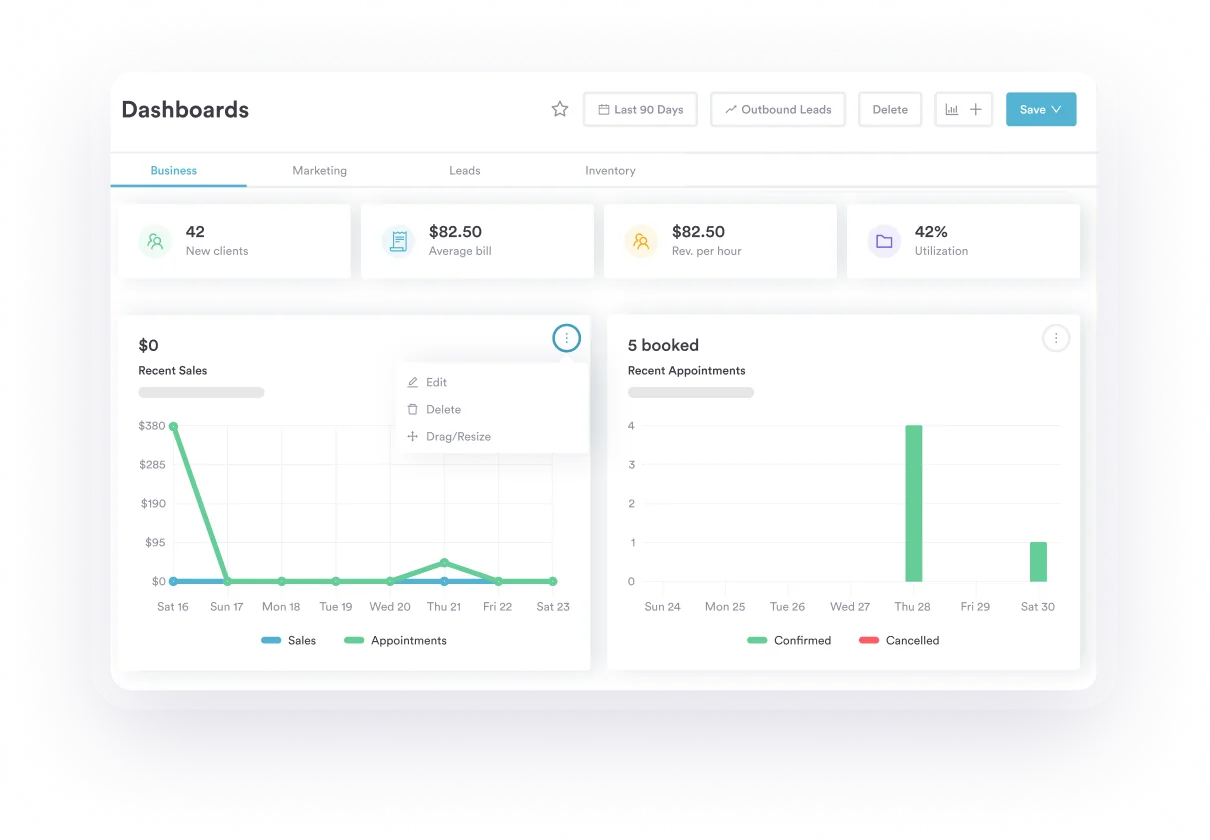

Pabau lets primary care teams record structured screening results and automate annual review recalls. The full neuropathy screening history sits in one patient record. See how it works for your team.

The case for the Ipswich touch test is practical. It removes the two usual reasons a neuropathy screen gets skipped, which are missing equipment and a short appointment slot. Six touches take under a minute, and the threshold is easy enough that any trained member of the team can apply it consistently.
The trade-off worth remembering is what a negative result buys you. It gives reassurance rather than a clearance, and it does not rule out neuropathy that is still developing. Where a calibrated monofilament is available in a specialist setting, that remains the established choice.
Consistency is what turns this into a screening program rather than an occasional check. Every eligible patient screened, every result recorded in a form an auditor can read, and every positive result acted on. Book a demo to see how Pabau records structured screening results and schedules the reviews that follow.

Building the wider review from scratch? Annual physical exam checklist gives you a structure to adapt for a diabetes cohort.
Documenting screening results for audit? Safer clinical notes sets out note-writing principles for multi-clinician primary care teams.
Tracking chronic disease numbers between reviews? Blood pressure monitoring explains how to keep readings usable over time.
The Ipswich touch test is a validated bedside screen for loss of protective sensation in the feet of patients with diabetes. The examiner lightly touches the tips of the 1st, 3rd, and 5th toes on both feet with an index fingertip. No equipment is needed. Two or more insensate sites out of six indicates clinically significant LOPS and should trigger clinical follow-up.
Ask the patient to close their eyes. Then lightly touch the tip of the first, third, and fifth toes on both feet with your index fingertip. Hold each touch for one to two seconds without stroking or pressing. The patient says “yes” when they feel a touch. Record how many of the six sites the patient could not detect.
A positive result is two or more insensate sites out of the six tested. That threshold comes from the original Rayman et al. study, which measured the test against a vibration perception threshold of 25V or above. A positive result indicates loss of protective sensation and should prompt podiatry referral, more frequent review, and protective footwear advice.
Both tests detect loss of protective sensation and both count insensate sites against a set threshold. The practical difference is that the touch test needs no equipment and takes under a minute, which suits primary care, community services, and home visits. The 10g monofilament remains the reference standard in specialist diabetes and podiatry settings.
Yes. A 2022 Canadian interprofessional study tested it across several professions. Nurses, dietitians, chiropodists, an occupational therapist, a physiotherapist, and an endocrinology resident all produced reliable results. The test carries no prescribing requirement, so a trained practice nurse or healthcare assistant can perform it under normal clinical oversight.
Perform it as part of the annual structured diabetic foot review that NICE guideline NG19 recommends for every patient with diabetes. It can also be used at any diabetes review appointment where no monofilament is available. It is particularly useful in community services and on home visits.