Referral management software: Track and close every referral
Referral management software in healthcare sends, tracks, and follows up patient...

Last Updated: Oct 26, 2026

Healthcare benchmarking compares your practice’s performance against peers, national standards, or your own earlier results.
Five types apply in healthcare: internal, external, competitive, functional, and strategic. Most private practices start with internal.
Published benchmark databases are built around hospitals and large physician groups, so an independent practice rarely finds a matching peer set.
Start with three metrics from your own records and 12 months of history before you compare against outside data.
Software that keeps scheduling, billing, and patient records in one system removes most of the data collection work.
Healthcare benchmarking is the process of comparing your practice’s clinical and operational performance against a reference point.
That point can be a national standard, a peer group, or your own results from last year. The Agency for Healthcare Research and Quality (AHRQ) makes the case for benchmarking regularly. Practices that do are better placed to spot quality problems before patients feel them.
This guide covers the five types of benchmarking and the clinical and operational KPIs worth tracking. It closes with a seven-step program you can run without a data analyst. It is written for independent practices rather than hospital systems. Most published material on the subject assumes a scale that a three-room aesthetic practice or a two-physician primary care practice will never reach.
Benchmarking measures your performance on a set of clinical or operational metrics, then holds those results against a reference point. The peer-reviewed definition in PubMed Central describes it as measuring internal processes, then identifying, understanding, and adapting best practices from other organizations to improve performance.
Benchmarking gets talked about as hospital work, done by administrators with access to huge datasets. A practice measuring its no-show rate against its own 12-month average is already benchmarking. So is a practice holding its patient satisfaction scores against a national survey baseline.
What separates benchmarking from reporting is the response. The comparison earns its keep only when you find where performance sits below the reference point, work out why, and change something.
Five types of benchmarking apply in healthcare, each with a different comparison group and a different job. Picking the right one prevents the most common mistake, which is measuring your practice against a reference group too different to mean anything.
Most private practices start with internal benchmarking, because the data already exists and the comparison always fits. Competitive and external benchmarking tend to come later, once you want to know how your pricing and satisfaction scores sit against other practices nearby.
Internal benchmarking compares performance across your own time periods, practitioners, or locations. A two-room practice can measure Room A against Room B on utilization rate. A practice tracking quarterly figures can hold Q1 no-show rates against Q4 to see whether new reminder protocols changed attendance.
This is the most accessible form. It needs no external data submission and no third-party database access, because the figures already sit inside your practice management system.
External benchmarking compares your metrics against national datasets, published clinical registries, or industry surveys. The Medical Group Management Association (MGMA) publishes annual data for medical practices covering revenue per visit, overhead ratios, and staffing levels. AHRQ publishes quality indicators that let practices compare clinical performance against national standards.
The limitation is scale. Most external datasets are designed for larger practices or hospital systems. Private practices usually have to adapt a published benchmark to their own size and service mix.
Clinical benchmarking measures patient care quality and safety outcomes. Operational benchmarking measures efficiency and financial performance. Both matter, and they draw on different data sources to answer different questions.
A rule of thumb for practice managers: clinical benchmarking tells you whether patients are getting better care. Operational benchmarking tells you whether the practice runs efficiently enough to keep delivering it.
The most useful metrics are the ones you can measure and change from inside the practice. Broad national statistics give you context. The KPIs below give a practice manager something to act on week to week.
Most of these figures come straight out of standard reporting, which our guide to practice management reports walks through in detail.
Benchmarking improves operational efficiency and patient outcomes when it runs as a loop rather than a one-off exercise. That finding is documented across sources including the World Bank’s healthcare benchmarking research and MGMA’s practice management data. For a practice owner, the value shows up in three places.
Surfacing problems that have no internal reference point. A practice can run for years at an 18% no-show rate without treating it as a problem, because no reference point says otherwise. Held against a peer average of 9%, the lost revenue becomes a number you can calculate and act on.
Supporting evidence-based decisions. Adding a practitioner, extending opening hours, or dropping a service line are expensive calls. Benchmarking gives you figures to back them instead of instinct.
Meeting regulatory expectations. CMS uses benchmarks in alternative payment models to set performance targets and reward high quality at lower cost. In England, Care Quality Commission (CQC) inspections look for evidence that a practice monitors its own performance. A standing benchmarking routine produces that documentation as a by-product.
A benchmarking program needs no data analyst and no specialist platform to start. The seven steps below are built for practice managers at independent practices who want a process they can run on a Monday morning.
The cycle below shows how each step feeds the next, and where the loop closes.
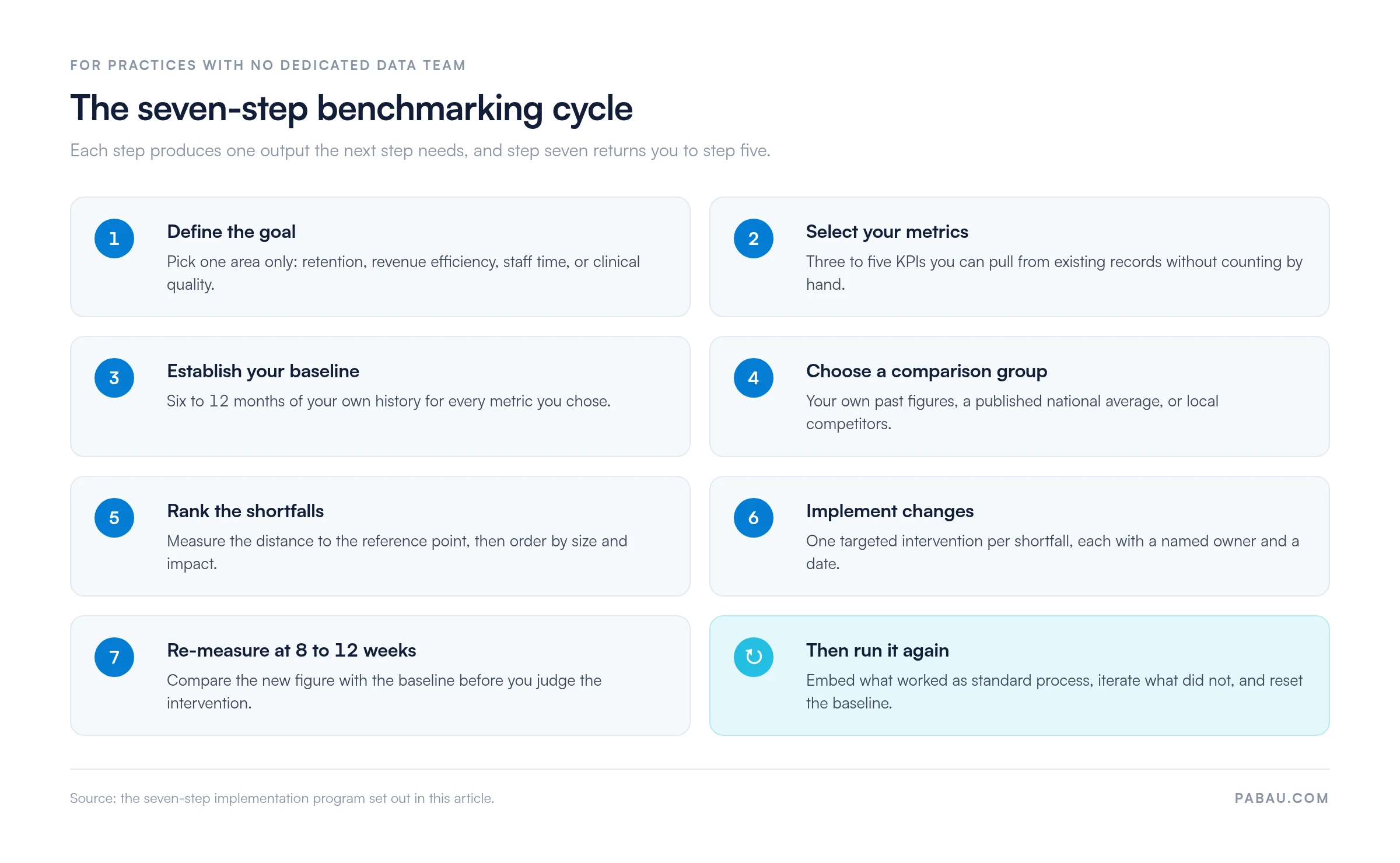
Frameworks are easy to describe and hard to apply. These three examples show what benchmarking looks like in the practice types that make up most of the independent market.
A two-practitioner aesthetic practice finds that 40% of consultation bookings never convert into a treatment booking. Internal benchmarking against the previous 12 months puts the earlier figure at 28%. The change lines up with a longer consultation wait, which grew from 3 days to 12. Automated follow-up 48 hours after each consultation brings non-conversion back to 30% within six weeks.
A private GP practice compares its average wait for a routine appointment, 6.2 days, against the NHS England baseline. The external comparison is flattering. Benchmarking internally across practitioners is less so, because one clinician spends 40% of scheduled hours on administrative work. Moving those tasks to a practice coordinator cuts that clinician’s wait time to 3.8 days within a quarter.
A wellness practice on a membership model tracks monthly churn at 8.2%. External benchmarking against published subscription data suggests sustainable membership businesses sit below 5%. Churn concentrates in month three, just before the scheduled check-in call. Moving a check-in forward to week six brings churn to 5.8% over one quarter.
Most published benchmarking tools are built for scale. MGMA’s annual data reports, AHRQ quality indicators, and CMS payment model benchmarks share one assumption. They expect physician groups with 10 or more practitioners, hospital systems, or large health networks. A single-location aesthetic practice or a three-practitioner primary care practice has no matching peer group in any of them.
Independent practices make up the majority of clinical settings in both the US and the UK, and enterprise benchmarking infrastructure serves them poorly. The consequence is predictable. Owners either skip benchmarking altogether, or they borrow hospital-derived figures that do not match their cost structures, patient volumes, or service mix.
The workable alternative is a practice-level program built on your own operational data, topped up with specialty surveys where they exist. The American Med Spa Association’s annual benchmarking survey is one example for aesthetic practices. Practice management software that holds clinical and operational records in one system makes this possible without an analytics function.
It is worth comparing systems on what they report before you commit to one. Our rundown of the best practice management software covers how the main options handle scheduling, billing, and reporting data.
Start with three internal metrics and nothing else: no-show rate, revenue per appointment, and patient satisfaction score. Pull 12 months of baseline data before you compare against any outside reference. Ninety days of consistent internal tracking will tell you more than a single comparison against a hospital-grade database.
Benchmarking programs fail on implementation more often than on analysis. These four problems come up most in independent practices, each with a response that works.
Every metric is only as good as the records under it. Inconsistent appointment coding, no-shows logged differently by each receptionist, or billing data that never gets reconciled will all distort the result. Fix data entry standards first. Agree how status codes are applied at booking and at discharge, then write that down. Collecting patient feedback through digital forms rather than paper surveys also improves the quality of your satisfaction data.
Comparing a single-practitioner aesthetic practice against a multi-specialty physician group tells you nothing useful. The practice looks worse on metrics that differ structurally, such as overhead ratios and staff-to-patient ratios. It looks better on others that simply reflect a different service model. Define the comparison group before you choose metrics, not after.
Plenty of practices run the exercise once, list what needs fixing, then go back to routine operations. The improvement cycle is where the value sits. Assign each finding to a named person with a deadline, and review progress every eight weeks rather than once a year.
Introduced as a performance management tool, benchmarking invites resistance and creative data entry. Frame it from the start as a practice-level initiative rather than an individual assessment. Aggregate metrics by team or location before anyone sees individual-level figures, and bring clinical leads into the choice of what gets tracked.
The hardest part of benchmarking in a private practice is assembling the data, not analyzing it. Scheduling lives in one system, billing in another, and clinical notes in a third. Building one picture of performance then takes hours of manual extraction every month. Every extraction introduces errors.
Practice management software like Pabau keeps those records in one place, which removes that work. Pabau’s reporting and analytics surfaces appointment utilization, revenue per practitioner, no-show rates, and retention from live operational data. There are no exports to reconcile, so a practice manager can check benchmark metrics weekly instead of quarterly.
The data is captured as work happens, at booking, treatment, billing, and feedback. An operational change therefore shows up in your figures as soon as it takes effect. The same records support patient lifecycle metrics: acquisition cost per patient, lifetime value by treatment category, and retention by cohort. Hospital-focused platforms rarely cover those, and they drive growth decisions for an independent owner.
Every subscription includes the full reporting suite, so none of this sits behind a higher tier. Insights Plus, an additional analytics product, is still in development and currently open for waitlist signups.
The point of software for independent practices is that benchmark figures arrive as a by-product of running the practice. You are not standing up a monthly reporting project on the side.

Pabau keeps scheduling, billing, treatment records, and patient feedback in one system. Track your benchmark KPIs without spreadsheets or manual exports.

Healthcare benchmarking moves a practice from instinct-led management to evidence-led improvement. The arithmetic is simple enough for a spreadsheet. Getting clean, centralized data to compare is where most independent practices stall.
Start small and internal. Three metrics, 12 months of your own history, and one intervention per cycle will teach you more in a quarter than any hospital-grade database can.
Pabau keeps scheduling, billing, treatment, and patient satisfaction data in one system, so your benchmark metrics are collected while you work. Book a demo and we’ll walk you through the KPI dashboards for your practice type.

Want the reports these metrics come from? Medical practice management reports covers the standard reports a practice should pull, and how often.
Still deciding what a practice management system should do? What practice management software does explains how one connected system supports data-driven decisions.
Comparing systems on reporting depth? Best practice management software weighs the main options on scheduling, billing, and reporting.
Healthcare benchmarking compares a practice’s performance metrics against a reference point. That point can be a national standard, a peer group, or the practice’s own historical data. The comparison shows where performance falls short and what to change. It applies to clinical outcomes, including patient safety and complication rates, and to operational performance, including no-show rates and revenue per appointment.
There are five types. Internal compares your own data across time periods or locations. External compares against national averages or published datasets. Competitive compares against direct competitors. Functional compares one process against best practice in any industry. Strategic compares against best-in-class organizations to inform long-term planning. Most independent practices start with internal benchmarking.
The most commonly tracked operational metrics are no-show rate, appointment utilization rate, revenue per appointment, and staff utilization. Clinical metrics include patient satisfaction scores, treatment completion rates, and follow-up adherence. Which ones you choose depends on the goal: financial performance, care quality, or patient retention.
Internal benchmarking compares a practice’s current performance against its own history, or across its own locations and practitioners. External benchmarking compares against published national standards, peer organizations, or clinical registry data. Internal is more immediately actionable. External gives you market context and regulatory framing.
Larger health systems use specialist platforms such as ArborMetrix and MGMA’s data reporting tools. For independent private practices, practice management software that keeps scheduling, billing, and clinical data in one system is the most practical starting point. It removes the data collection overhead that puts benchmarking out of reach for teams without analytics staff.