Newborn head circumference chart
A newborn head circumference chart plots a baby’s head measurement against...

1
Last Updated: Oct 14, 2026

The fortin finger test asks the patient to point with one finger to the site of their worst pain, near the PSIS.
A positive result means the finger lands within 1 cm inferomedial to the posterior superior iliac spine on two separate occasions.
The often-quoted sensitivity and specificity figures are not established. The original 1997 series enrolled only pre-selected positive patients and never assessed specificity.
Treat the result as one finding inside a provocation battery. Fluoroscopically-guided injection remains the confirmatory test.
Structured digital forms turn the test into consistent, auditable data instead of a one-line free-text note.
A comprehensive review in Anesthesia and Analgesia puts the sacroiliac joint behind 15% to 30% of mechanical low back pain. Despite that prevalence, isolating the SI joint as the pain source remains one of the harder tasks in musculoskeletal practice. The fortin finger test offers a fast, non-invasive starting point. It needs no equipment, takes under two minutes, and produces a finding you can act on inside a broader provocation battery.
This guide covers the anatomy behind the test, the step-by-step procedure, and how to read a positive result. It also sets out what the original 1997 research does and does not support. The accuracy figures circulating for this test are not traceable to it. The last section covers how to record the finding so it survives an audit.
The fortin finger test is a physical examination maneuver designed to identify sacroiliac joint (SIJ) pain as a source of low back pain. Fortin and Falco described it in the American Journal of Orthopedics in 1997. The test relies on one simple action. The patient uses a single finger to point to the precise location of their maximum pain. When that point falls within a specific zone near the posterior superior iliac spine (PSIS), the test is positive.
What makes the maneuver clinically useful is its reproducibility requirement. A single pointing episode is not sufficient. The patient must localize to the same spot on two separate occasions. That criterion filters out inconsistent pain reporting and gives you more confidence that the SIJ is implicated.
The test does not stress or load the joint mechanically. It is a pain localization tool rather than a provocation maneuver. The distinction matters when you build a diagnostic battery. The fortin finger test tells you where the pain sits. FABER and Gaenslen’s tests tell you whether mechanical loading reproduces it.
Understanding the PSIS is essential before performing the test. The posterior superior iliac spine is the bony prominence at the back of the pelvis. In people with low body fat it is visible as the “dimple of Venus”. It marks the superior attachment of the sacroiliac joint and anchors the positive zone.
The SIJ connects the sacrum to the ilium on each side of the pelvis. It transfers load between the spine and lower limbs, and absorbs rotational forces during gait. Some of the strongest ligaments in the body stabilize it. It also sits deep, surrounded by overlapping pain-generating structures such as the lumbar facets, piriformis, and gluteal musculature. That is what makes it hard to isolate clinically.
The positive zone sits approximately 1 cm inferomedial to the PSIS. That is roughly a finger-width below the bony prominence and toward the midline. Pain localization outside this zone does not meet the positive criterion, even when it lands nearby. Palpate the PSIS reliably before you use the test in practice.
The procedure is straightforward, but the instruction you give the patient matters. Asking someone to point at their “back pain” broadly will produce inaccurate localization. Standardized language produces better reproducibility.
Record the exact location the patient described, the number of trials performed, and whether consistency was achieved. Vague documentation such as “patient pointed to SI region” will not support a defensible clinical record.
The positive criterion is specific. Both of the following must be present:
Two criteria give four possible outcomes, and only one of them counts as positive. The grid below shows how each combination reads at the bedside.
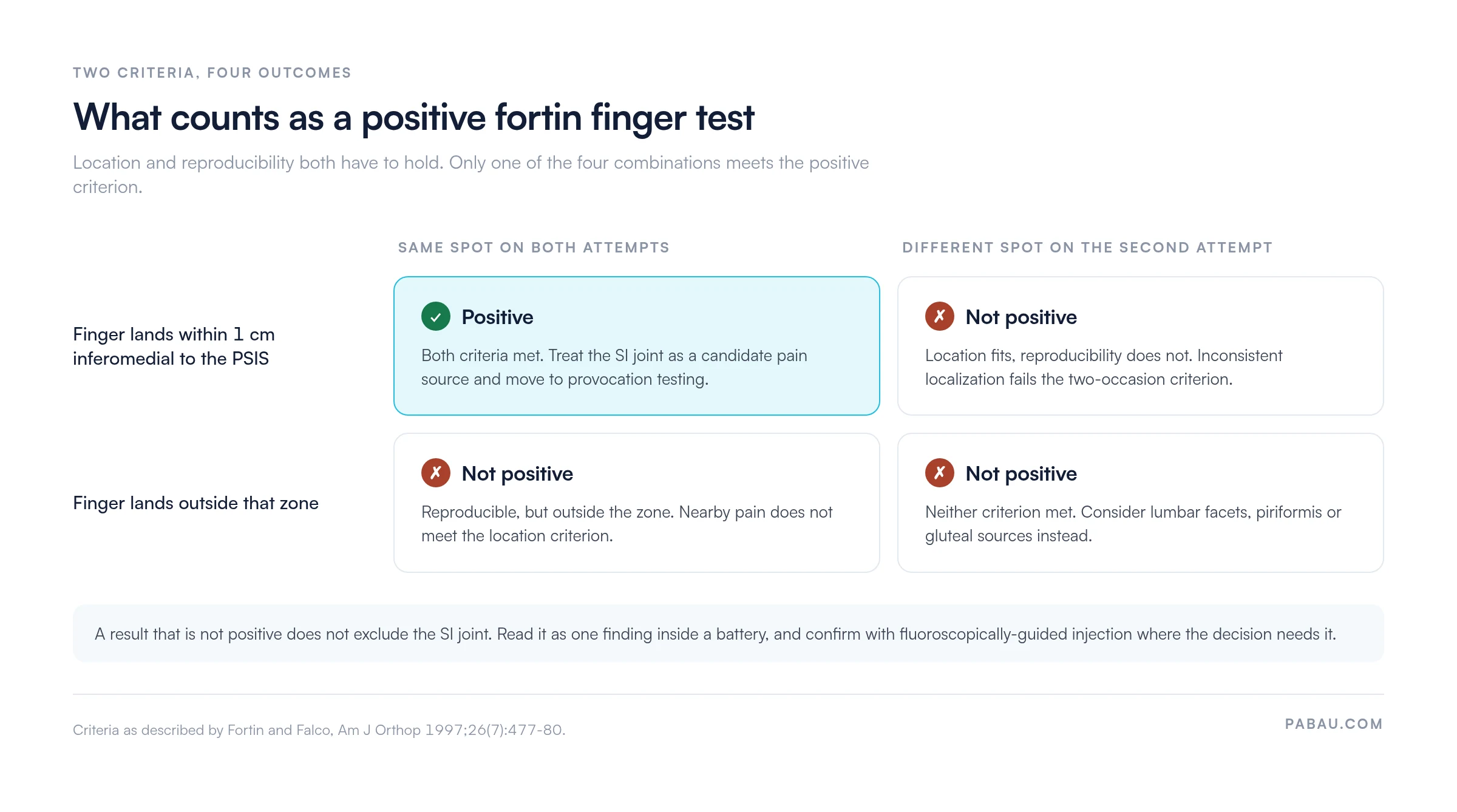
A positive result suggests the SI joint is the primary pain generator. It does not confirm SIJ pathology on its own. Confirmation still needs clinical correlation or a fluoroscopically-guided diagnostic injection. What the test gives you is a fast, reproducible signal that the SIJ is worth investigating.
A negative result does not rule the SIJ out. Some patients with genuine SIJ pain point outside the zone, or point somewhere different on the second attempt. Treat it as one piece of evidence rather than an exclusion. It helps to record the finding alongside the rest of the assessment, which is where structured back pain location charts earn their place.
Document both localization attempts separately, including whether the patient was redirected between them. “Consistent localization on two uncoached occasions” is a different clinical statement from “patient pointed to SI area”. The first supports a defensible diagnosis in audit or medico-legal review. The second does not.
The fortin finger test is widely quoted with sensitivity and specificity figures attached. Those numbers do not trace back to the original research. Fortin and Falco published their series in 1997, and its design cannot support an accuracy estimate in either direction.
Of the 54 patients screened, 16 were enrolled, and all of them had already pointed to the zone. The series carried no control group and made no assessment of specificity. What it did report was strong agreement between examiners on where the patient pointed. That is a reliability finding rather than an accuracy finding.
So the honest reading is a localizer with good interrater reliability and unestablished accuracy. Controlled research against a reference standard would be needed before any percentage is quoted. Until that exists, a positive result earns further provocation testing rather than a diagnosis.
No single test is sufficient for an SI joint diagnosis. Guidelines and research consistently recommend at least three positive provocation tests before you attribute chronic low back pain to the SIJ. The fortin finger test works best beside maneuvers that load the joint directly. The passive lumbar extension test is a useful companion where the lumbar spine is also in question.
The FABER test (flexion, abduction, external rotation, also called Patrick’s test) is a provocation maneuver. The patient lies supine. You place the test leg in a figure-four position and press the knee gently toward the table while stabilizing the opposite ASIS. Pain reproduction at the SI joint or groin is a positive finding.
Where the fortin finger test localizes pain by asking the patient to point, FABER reproduces it by loading the hip and SIJ together. A positive FABER in the posterior pelvis, rather than the groin or hip, supports SIJ involvement. Used together the two build a stronger case. One identifies the pain location, the other confirms the joint can be mechanically provoked. Both are routine in sports medicine practices triaging low back pain.
Gaenslen’s test applies torsional stress to the SIJ. The patient lies supine with one hip and knee flexed toward the chest, while the other leg extends off the edge of the table. You then apply downward pressure to the extended leg, creating a shearing force across the joint. Ipsilateral posterior pelvic pain is a positive result.
Gaenslen’s produces pain through rotation, which makes it complementary to FABER and to the fortin finger test. FABER loads in a different plane, and the fortin finger test does not load the joint at all. Many clinicians run the localizer first, then move to FABER and Gaenslen’s for mechanical confirmation. The North American Spine Society publishes clinical guidance on test batteries in SIJ assessment.
The test has clinical value, but it also has boundaries that matter before you build it into a protocol.
Documentation is where the fortin finger test most often breaks down. The two-occasion requirement is easy to perform and much harder to record well. Free-text notes tend to compress the whole assessment into a single line. That loses which test was run, what the patient pointed to, and whether the localization repeated.
Practice management software like Pabau replaces that free text with structured clinical forms. Predefined fields capture the localization zone, the number of attempts, the provocation tests applied, and the clinical impression. Every clinician records the same data points, so a note reads the same way whoever wrote it.

That consistency is what makes audit possible. If six clinicians run the test and record it six different ways, the outcome data will never aggregate into anything useful. A single structured patient record removes the variability across the whole practice.

The same records carry into the referral. A patient may escalate to a pain specialist for diagnostic injection. A record showing three positive provocation tests gives that clinician something to act on immediately. Pabau’s software for physical therapists covers that whole path, from intake through clinical notes to the referral letter.

Pabau helps physical therapy and musculoskeletal practices build standardized intake forms, document provocation test findings, and keep structured patient records. Clinical findings get captured the same way at every encounter.

Use the fortin finger test as the first move in an SI joint workup, not as the finding that settles it. Its value is the reproducibility requirement. That turns a vague complaint of back pain into a specific observation you can hand to the next clinician.
The trade-off worth remembering is that its accuracy has never been established. Anyone quoting a sensitivity or specificity percentage for this test is going beyond the evidence. Pair it with FABER and Gaenslen’s, apply the three-positive threshold, and let the injection settle the cases that stay unclear.
Where that pathway usually fails is the record rather than the exam. Book a demo to see how Pabau captures both localization attempts in a structured form your whole team fills in the same way.

Need a structured intake form for musculoskeletal patients? Chiropractic intake form template gives you a ready-made format for history and presenting complaint before the first assessment.
Need a second lumbar test alongside the SI joint battery? Passive lumbar extension test covers a maneuver that helps separate segmental instability from sacroiliac pain.
Seeing posterior pelvic pain with a postural pattern behind it? Anterior pelvic tilt explains how pelvic position loads the SI joint and what to assess alongside it.
Managing a growing physical therapy or chiropractic practice? Chiropractic clinic software covers how practice management tools hold workflows steady across multiple clinicians.
The fortin finger test is a physical examination maneuver used to identify sacroiliac joint pain as a source of low back pain. The patient uses one finger to point to the site of maximum pain. A positive result requires consistent localization within 1 cm inferomedial to the posterior superior iliac spine, on two separate occasions.
A positive fortin finger test suggests the sacroiliac joint is the primary pain generator. It does not confirm SI joint pathology definitively. It warrants further investigation, including additional provocation tests such as FABER and Gaenslen’s and, where appropriate, a fluoroscopically-guided diagnostic injection.
No. Clinical consensus holds that no single provocation test is sufficient for diagnosing SI joint dysfunction. A positive result should be one component of a broader battery. Aim for at least three positive provocation tests before any treatment decision. Fluoroscopically-guided injection remains the reference standard for confirmation.
Neither figure has been established. The 1997 study did not assess specificity at all, and its 16 pre-selected participants cannot support a sensitivity estimate. Any percentage quoted for this test is not traceable to controlled research. Record the finding itself and read it alongside the rest of your provocation battery.