How to become a nurse injector in Ontario: The 5 legal steps
Becoming a nurse injector in Ontario takes three steps. You register with the Co...

Last Updated: Sep 22, 2026

Practice management software like Pabau leads for multi-specialty practices mixing aesthetics, wellness and medical services under one system.
Accuro EMR and TELUS Health carry direct provincial billing across Canada, which matters most for fee-for-service family medicine.
Jane App is the only platform here that publishes Canadian dollar pricing, starting at CAD $54 a month for one practitioner.
Juno EMR fits small Ontario primary care practices and quotes OHIP-focused pricing on request instead of publishing a rate.
OSCAR Pro is free and open source, but your practice pays for hosting, updates and technical support.
The Two-Check Rule shortlists any vendor: a compliance check on your province, then a friction check on daily use.
The best EMR software in Canada balances provincial billing, PHIPA and PIPEDA duties, and how fast your day runs on it. This guide compares the six platforms Canadian practices shortlist most in 2026, and names which one suits which kind of practice. The private-pay aesthetic side of a practice has its own shortlist in our eight-platform ranking of the best med spa software.
One distinction saves a lot of reading. Hospital EHR procurement runs on Epic, MEDITECH, Oracle Health and Altera, and health authorities make those decisions. Community practices buy clinic EMRs, and every EHR/EMR software option below is built for that side of the market.
Canada Health Infoway and the Canadian Medical Association report that 95% of Canadian physicians now use electronic tools in clinical practice. Adoption is close to universal, but fit is not. Urban practices in Toronto and Vancouver run integrated platforms, while rural practices in Northern Ontario and the Prairies still stitch systems together.
The market also splits by province. Each health ministry runs its own billing system, Quebec expects French-language service, and PIPEDA sets a federal privacy floor that provinces build on. Most electronic medical record programs sold here are provincial specialists rather than national all-rounders. A system that works in Ontario may miss integrations a British Columbia practice needs.
Every platform below gets the same treatment: clinical documentation, provincial billing, privacy compliance and pricing in Canadian dollars. Then we apply the Two-Check Rule, a two-part shortlist test written for Canadian practices rather than American ones.
Six electronic medical record systems cover most of the Canadian market: Pabau, Accuro EMR, Jane App, Juno EMR, OSCAR EMR and TELUS Health. The table below is the skim version. Every price comes from the vendor’s own website and is stated in Canadian dollars.
| Name | Best for | Standout feature | OntarioMD certified | Starting price (CAD) | Rating |
|---|---|---|---|---|---|
| Pabau | Multi-specialty practices mixing aesthetics, wellness and medical care | Pabau Scribe, our AI scribe, writes the note into the client record | No | Custom CAD quote | 4.5/5 (370+) |
| Accuro EMR | Primary care and specialist practices billing a provincial plan | PrescribeIT e-prescribing plus provincial billing | Yes | Custom CAD quote | 4.6/5 (10+) |
| Jane App | Allied health and wellness practices | Canadian-built online booking and charting | No | From CAD $54/month | 4.8/5 (5,500+) |
| Juno EMR | Small primary care practices in Ontario | OHIP billing built into the chart | Yes | Custom CAD quote | No published rating |
| OSCAR EMR | Practices with technical staff and a tight software budget | Open-source code you can host and modify | Yes | Free (open source) | 3.5/5 (8) |
| TELUS Health | Large group practices and hospital-affiliated networks | National health information exchange across provinces | Yes | Custom CAD quote | No published rating |
Ratings come from verified Capterra reviews. Juno EMR and TELUS Health sell through direct sales rather than self-serve signup, so neither carries enough public reviews to publish a score. Our fuller Canadian practice management software comparison covers the wider market.
This guide covers clinic EMRs rather than hospital EHRs, because hospital systems like Epic, MEDITECH and Oracle Health are bought by health authorities. A family physician or an aesthetics practice never runs that procurement.
Medical EMR systems hold one practice’s chart and connect outward to labs, pharmacies and the provincial billing plan. A hospital EHR holds the record for a whole region and coordinates inpatient care. Alberta is the exception worth knowing: community practices there do meet Epic through Alberta Health Services’ Connect Care rollout.
If you searched for EHR systems and landed here, you are in the right place for a practice-sized system. If you are specifying an inpatient record for a hospital network, this shortlist is the wrong altitude.
Pabau runs aesthetics, wellness and general medical services on one chart, one calendar and one invoice.
Pabau is an all-in-one practice management system for practices that mix medical aesthetics, wellness and general medical services under one roof. Most Canadian EMRs were built for family medicine or hospital-affiliated care. Pabau was built for the practice that treats a patient clinically in the morning and sells a treatment package in the afternoon.
Canadian deployments include aesthetic practices in Toronto, wellness practices in Vancouver and multi-location med spas across Alberta. The cloud architecture removes the server maintenance that legacy Canadian EMRs still ask for. Pabau holds a 4.7 out of 5 rating from more than 370 verified Capterra reviews.

Pabau does not submit claims to a provincial health insurance plan the way TELUS Health and Accuro EMR do. It handles private-pay invoicing, card and online payments, and financial reporting, and exports billing data for practices that submit provincially through another channel.
Pabau holds a 4.7 out of 5 rating on Capterra from more than 650 verified reviews. Reviewers most often praise the breadth of the platform and the interface. Recurring criticism concerns the learning curve for practices adopting the whole system at once.
| Plan | Price (CAD) | Users | Key inclusions |
|---|---|---|---|
| Solo | Custom CAD quote | 1 | Full platform, unlimited patients |
| Team | Custom CAD quote | 2 to 3 | Full platform, unlimited patients |
| Medium | Custom CAD quote | 4 to 5 | Full platform, unlimited patients |
| Group | Custom CAD quote | 6 to 15 | Full platform, unlimited patients |
| Enterprise | Custom CAD quote | 16+ | Full platform plus multi-location support |
Pabau prices by location and user count and quotes Canadian practices in Canadian dollars, so the rate on Pabau’s pricing page depends on your region. Every plan includes every feature, so a solo injector gets the same platform as a 20-user group.
Accuro EMR bills a provincial plan directly in every province and territory, which is the whole reason practices choose it.
Accuro EMR fits primary care and specialist practices that bill a provincial plan directly, in any province or territory. QHR Technologies built it as a single platform rather than a family of acquired products. That is why practices with sites in two provinces keep landing on it.
In August 2025 Accuro completed its integration with PrescribeIT, Canada Health Infoway’s national e-prescribing service. Prescriptions now travel electronically to participating pharmacies instead of by fax. Accuro has also partnered with Heidi Health to add an AI scribe that drafts structured notes from dictation during the visit.
Accuro EMR holds a 4.6 out of 5 rating on Capterra from verified reviews. Users single out billing reliability and a support team based in Canada. The common complaints are the training curve for new staff and limited template customization.
| Plan | Price (CAD) | Users | Key inclusions |
|---|---|---|---|
| Custom quote | Contact sales, no published pricing | All practice sizes | Full EMR with provincial billing, PrescribeIT and AI scribe |
QHR Technologies publishes no rate card for Accuro EMR, so every practice gets a quote. Ask for the figure in Canadian dollars per provider per month. Ask separately about data migration, since that is usually the line item that moves.
Jane App is the one platform here you can price, sign up for and start using without talking to a salesperson.
Jane App fits allied health practices in physiotherapy, chiropractic, massage therapy, naturopathy and counseling, and it publishes prices in Canadian dollars. The company was founded in North Vancouver, British Columbia, and Canadian data residency comes as standard.
Jane App covers online booking, charting, scheduling, private insurance billing and PIPEDA-compliant records. A telehealth module handles video consultations alongside in-person visits. It holds a 4.8 out of 5 rating from more than 5,500 verified Capterra reviews, the highest score in this comparison.
Jane App holds a 4.8 out of 5 rating on Capterra from more than 5,500 verified reviews. Reviewers praise the interface, the Canadian support team and the booking experience. The recurring note is that multi-location and advanced reporting need the top plan.
| Plan | Price (CAD) | Users | Key inclusions |
|---|---|---|---|
| Balance | CAD $54 / month | 1 practitioner | Scheduling, charting and online booking |
| Practice | CAD $79 / month | Growing practices | Balance features plus insurance billing and claims |
| Thrive | CAD $99 / month | Multi-location and larger practices | Practice features plus multi-location and fuller reporting |
Jane App publishes all three rates in Canadian dollars on its own site. That makes it the only platform here you can budget for without a sales call. The plans scale by capability rather than by seat count.
Juno EMR does OHIP billing and clinical notes well, and deliberately does not try to do much else.
Juno EMR fits small Ontario primary care practices that bill OHIP and want a short training curve. WELLSTAR holds an active OntarioMD certificate for it, so the connections Ontario practices depend on are available.
The Ontario focus is the product decision. OHIP fee codes, provincial lab connectivity and documentation shaped by CPSO expectations all get attention, and little effort goes into serving other provinces equally. Practices in Quebec should confirm French-language support with the vendor directly.
Public review data for Juno EMR is thin, and there is no verified score worth publishing. The platform sells mainly into Ontario primary care networks, where word of mouth and OntarioMD peer advice do the work reviews do elsewhere.
| Plan | Price (CAD) | Users | Key inclusions |
|---|---|---|---|
| Custom quote | Contact sales, no published pricing | All practice sizes | EMR with OHIP billing and e-prescribing |
Juno EMR publishes no per-seat rate on its own site, so the only honest answer on cost is that you have to ask. For a Canadian dollar benchmark while you wait for the quote, Jane App’s published plans run from CAD $54 to CAD $99 a month.
OSCAR EMR costs nothing to license, and the money you save goes into hosting, updates and someone to run them.
OSCAR EMR fits practices with technical staff who would rather pay for hosting and support than a per-seat license. The system came out of the OSCAR McMaster project, and the Professional Edition distributed by WELLSTAR holds an active OntarioMD certificate.
Open source shifts the work rather than removing it. Your practice handles hosting, security updates, backups and troubleshooting, in-house or through an IT contract. The software is free, but the total cost depends entirely on how you resource that.
OSCAR EMR carries a 3.5 out of 5 rating from a small pool of eight Capterra reviews. Read it as a signal rather than a verdict. The platform runs mainly in academic centers and community health organizations with technical support behind it.
| Plan | Price (CAD) | Users | Key inclusions |
|---|---|---|---|
| Open source | CAD $0 license fee | Unlimited | Core EMR, self-hosted |
| Hosted or supported | Contact sales, no published pricing | All practice sizes | Hosting, updates and support from a service provider |
The software itself is free, and no Canadian dollar figure is published for hosting or support because those come from third-party providers. Budget for a server or hosting contract, backups, and someone accountable for security patching.
TELUS Health has the widest reach in Canadian primary care, spread across three separate EMR products.
TELUS Health fits large group practices, hospital-affiliated clinics and networks that need provincial billing plus health information exchange. Over 40,000 physicians and roughly 110,000 clinicians use its EMR platforms, which makes it the largest healthcare IT provider in the country.
The portfolio is three products acquired over the past decade: Med Access, PS Suite and the Collaborative Health Record, known as CHR. OntarioMD lists all three as separately certified offerings. Med Access is the most widely deployed, serving multi-physician groups with scheduling, provincial billing and clinical documentation.
Public review data for TELUS Health EMR products is limited, because the company sells through enterprise channels rather than self-serve signup. Med Access and PS Suite users in Canadian physician forums report dependable provincial billing and interfaces that feel dated next to newer cloud platforms.
| Plan | Price (CAD) | Users | Key inclusions |
|---|---|---|---|
| Enterprise quote | Contact sales, no published pricing | Group practices, hospitals and networks | Med Access, PS Suite or CHR with provincial billing |
TELUS Health publishes no rate card, and pricing depends on which of the three products you take and how many providers you have. Ask for the Canadian dollar figure per provider per month, and ask which product the quote covers before you compare it with anything.
Run every shortlisted vendor through the Two-Check Rule: a compliance check on your province’s rules, then a friction check on daily use. Most guides comparing EMR systems do one check or the other. Doing both is what stops a practice signing a system that is legal but miserable, or pleasant but unusable in your province.
Your province decides three things: which college’s documentation standards apply, which privacy law governs your EMR medical records, and whether the vendor needs provincial certification. Get those three right and the rest is preference.
The college depends on who is charting, not on where the software is hosted. Naming the wrong body is the most common error in EMR buying advice written outside Canada.
That mapping matters in practice. Take an Ontario aesthetics practice where a nurse injector treats under a medical directive. The directive, the delegation and the countersigning arrangement all belong on the chart. The nurse’s notes are judged against College of Nurses of Ontario standards, and the physician’s against CPSO standards, from the same record.
Privacy law splits the same way. Ontario’s Personal Health Information Protection Act, known as PHIPA, governs health information custodians there. Alberta has its Health Information Act, and Quebec has Law 25. PIPEDA is the federal baseline and applies wherever a province has no substantially similar law of its own.
Certification is the third piece, and Ontario is the province where it bites. As of August 2026, OntarioMD lists 14 certified EMR offerings from 12 vendors, 13 of them with active certificates. Only a certified offering may connect to provincial assets such as OLIS, Health Report Manager and the Digital Health Drug Repository.
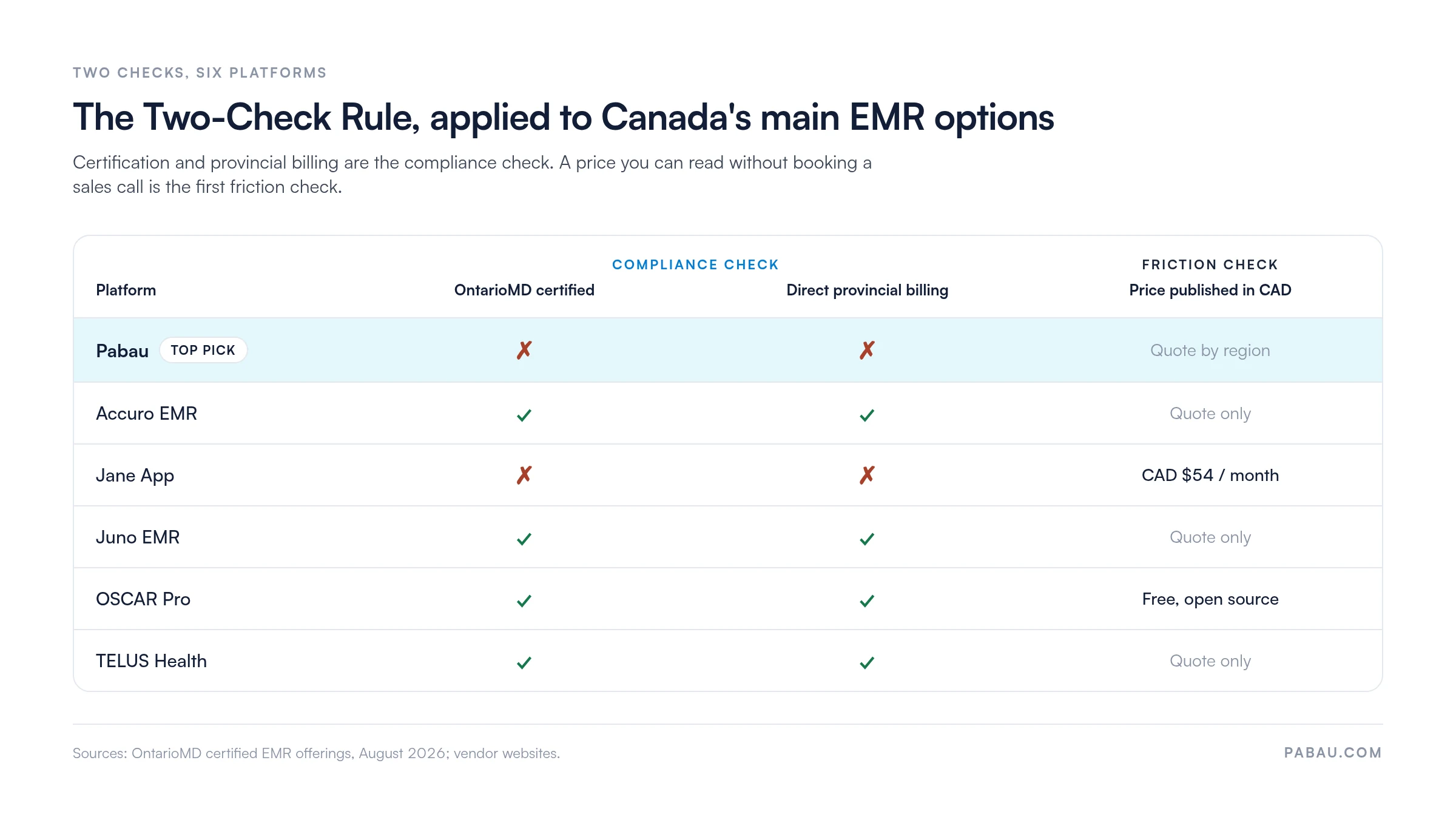
Among the six platforms here, Accuro EMR, Juno EMR, OSCAR Pro and all three TELUS Health products hold active certificates. Pabau and Jane App do not. That is fine for private-pay practices, and disqualifying for an Ontario family practice that needs OLIS results in the chart. Our guide to OntarioMD certified EMR offerings lists all 14.
Set against the two checks, the six platforms sort quickly.
Canadian physicians comparing EMRs rarely rank by feature count, and instead ask which system will slow them down least on a full clinic day. Feature matrices are how vendors compete. Minutes per patient is how physicians choose.
Physicians discussing EMR choices in Canadian family medicine forums keep returning to the same points, and they rarely appear in vendor comparisons:
That last point is the cheapest research available and almost nobody mentions it. Peer bodies see the same migrations repeatedly, and they have no commission riding on the answer.
In practices we onboard, the switch usually stalls on two things: who re-keys the historical chart, and who owns billing codes. Ask both questions during the demo. Also map the full electronic medical records software cost before you sign, because migration and training rarely appear on the quote.
When practices shop for medical software, EMR capability is usually the first filter and the last thing they test properly. Book a working session on your own charts rather than a scripted demo, and time a full patient encounter in each system.
Four more Canadian EMRs are worth a look, though each is concentrated in one or two provinces rather than sold nationally.
None of the four publishes a Canadian dollar rate on its own site, so we have not ranked them here. Run each one through the Two-Check Rule before you take a demo.
Multi-specialty practices in Canada usually end up with three systems. There is an EMR for clinical notes, a booking tool, and a spreadsheet holding whatever the other two cannot. Consent forms get printed and scanned. Before-and-after photos sit on a phone. Nobody can answer a simple revenue question without exporting something.
Pabau replaces that arrangement with one record. The appointment, the consent form, the treatment note, the photos and the invoice attach to the same patient timeline. Pabau Scribe, our AI scribe, drafts the note during the appointment, so charting finishes when the patient leaves rather than at nine in the evening.
For a practice running sites in Toronto and Calgary, multi-location management keeps one client list and reports per site. Every subscription includes every feature, so adding a location or a service line does not mean a tier upgrade. Practices that also bill a provincial plan pair Pabau with their provincial billing route and export the data they need.

Pabau keeps consent, treatment notes, before-and-after photos and payments on a single patient timeline, with PIPEDA-ready record keeping for Canadian practices. See how a multi-specialty practice runs a full day in one system.

There is no single best EMR in Canada, because provincial billing splits the market before anything else does. If your revenue comes through OHIP, MSP or Alberta Health, Accuro EMR and TELUS Health are the serious candidates. Juno EMR is the lighter option for a small Ontario practice.
If your revenue is private-pay, that constraint disappears and the question becomes what the software does for the rest of your day. Jane App suits allied health and publishes its Canadian prices. Pabau suits practices mixing aesthetics, wellness and medical care that need consent, photos, payments and marketing on one record. OSCAR EMR suits anyone with the technical capacity to run it.
Whichever way you lean, run the shortlist through the Two-Check Rule before you sign. The compliance check tells you what is possible in your province. The friction check tells you what you can live with. The trade-off between them is the decision. Book a demo to see how Pabau handles a Canadian multi-specialty practice on one patient record.

Buying an EMR in Ontario? OntarioMD certified EMR offerings lists every certified product and explains which practices need one.
Comparing the wider Canadian market? Best practice management software in Canada covers booking, payments and marketing alongside clinical records.
Buying for another market too? Best EHR systems in Ireland breaks down the accredited and private-practice options there.
Evaluating multi-specialty practice software? Medical spa software shows how Pabau supports aesthetic and wellness work alongside medical services.
An EMR holds patient data inside one practice. An EHR shares data across organizations, provinces and care settings. Canadian usage treats the terms interchangeably, though only systems with health information exchange, such as TELUS Health, are EHRs in the strict sense. Most practice-sized systems sold here are EMRs.
TELUS Health is the most widely used EMR provider in Canada. Over 40,000 physicians and roughly 110,000 clinicians work across its Med Access, PS Suite and CHR products. Accuro EMR from QHR Technologies is the largest single-platform EMR, deployed in every province and territory.
Canada runs two separate markets. Hospitals and health authorities use Epic, MEDITECH, Oracle Health and Altera. Community practices use clinic EMRs such as Accuro EMR, TELUS Med Access, PS Suite, CHR, Juno EMR, OSCAR EMR, Jane App and Pabau. Which one applies depends on whether you are buying for a hospital network or a practice.
Ontario practices choose from 14 OntarioMD certified EMR offerings supplied by 12 vendors, 13 of them with active certificates as of August 2026. Certified products include Accuro EMR, Juno EMR, OSCAR Pro and the three TELUS Health products. Only a certified offering can connect to OLIS, Health Report Manager and the Digital Health Drug Repository.
Juno EMR publishes no per-seat rate on its own website, so pricing is quoted per practice on request. For a Canadian dollar benchmark, Jane App publishes CAD $54 a month for one practitioner. Its other two plans run at CAD $79 and CAD $99. Accuro EMR, TELUS Health and Pabau also quote rather than publish.
No. Accuro EMR, TELUS Health and Juno EMR submit claims to provincial plans directly. Pabau and Jane App handle private-pay invoicing and private insurance instead, without native provincial submission. Practices billing OHIP, MSP or Alberta Health should confirm direct integration for their own province before shortlisting.
PIPEDA sets the federal privacy baseline and applies wherever a province has no substantially similar law of its own. Ontario is the clearest exception, where PHIPA governs health information custodians. Alberta applies its Health Information Act, and Quebec applies Law 25. Confirm which law governs your record before you compare vendor privacy claims.
American platforms lack provincial billing, Canadian certification and provincial lab connections, which rules them out for fee-for-service practices. Private-pay and aesthetic practices can use some of them, but PIPEDA compliance, data residency and provincial college documentation standards remain the practice’s responsibility. Canadian-built platforms handle provincial workflows that American vendors do not.
Quebec practices operating under provincial language law must deliver service in French. EMR systems serving Quebec should support a French interface, though the exact obligation depends on your location and patient population. MEDFAR’s MYLE is the main supplier to Quebec’s public health network. Confirm language support with any vendor before deployment.