Medicare charting cheat sheet
A Medicare charting cheat sheet is a one-page reference that lists what Medicare...

4
Last Updated: Oct 21, 2026

eClinicalWorks is one of the largest US ambulatory EHR vendors, built for revenue cycle depth, multi-specialty workflows, and AI-assisted documentation.
athenahealth (athenaOne) uses a cloud-native, no-install architecture and a managed billing service, so it is easier to deploy but harder to budget at scale.
Both platforms now offer ambient AI documentation. eClinicalWorks has Scribe AI, and athenahealth added athenaAmbient plus its Ambient Notes vendor marketplace.
Neither vendor publishes rates. eClinicalWorks quotes module-based flat fees, and athenahealth charges a percentage of collections you have to get quoted.
For aesthetic practices, med spas, and wellness providers, practice management software like Pabau is purpose-built, with flat-rate pricing from $104/month.
An EHR migration costs a practice months of staff retraining, data mapping, and slower patient throughput before the new system pays for itself. That is why practices searching “eClinicalWorks vs athenahealth” are doing serious due diligence rather than casual browsing.
Both platforms serve US ambulatory care, but they make very different architectural and pricing bets. This guide compares them on revenue cycle depth, clinical documentation, pricing models, AI features, and support. It also covers eClinicalWorks’ False Claims Act settlement, which belongs in any multi-year vendor assessment.
Here is how the two platforms compare on the dimensions that decide most ambulatory software purchases.
Clinical documentation is where practices spend the most time inside their EHR, so the charting experience often decides the purchase. Both platforms cover the fundamentals, but they take different approaches to workflow design and AI assistance.
eClinicalWorks: eClinicalWorks offers highly customizable SOAP note templates and a specialty-specific charting library that scales well for multi-provider practices. Its standout feature is eCW Scribe AI, an ambient documentation tool that listens to patient encounters and drafts clinical notes automatically.
Reviewers on Capterra praise Scribe AI for cutting documentation time, though they note the interface carries a learning curve. Any ambient scribe moves clinician effort from typing to reviewing, and our AI medical scribe page explains where that review step fits the visit.
athenahealth: athenahealth’s documentation approach prioritizes usability. Its structured templates and guided workflows help clinicians chart faster without deep configuration. The platform now offers ambient AI documentation as well.
athenahealth announced athenaAmbient in November 2025, with general availability rolling out through 2026. Since late 2024 it has also run an Ambient Notes marketplace, which connects athenaOne to Suki AI, iScribe AI, Abridge, and Dragon Copilot. Reviewers on Capterra consistently highlight ease of learning as a strength, particularly for practices migrating from paper-based workflows.
Revenue cycle management is where this comparison hits practice finances hardest. The two platforms take fundamentally different approaches to the billing workflow.
eClinicalWorks gives practices direct control over their billing pipeline. The platform includes claim scrubbing, denial management workflows, and collections reporting built into its core modules.
Practices that want to run in-house billing with visibility into each claim’s lifecycle will find eClinicalWorks well-equipped. The tradeoff is that running it effectively requires trained billing staff who know the system.
athenahealth takes a managed service approach. Its billing team works denials and follows up on outstanding claims on the practice’s behalf. That lightens the load on front-office staff, but it ties the practice to athenahealth’s billing processes and timelines.
athenahealth charges a percentage of collections rather than a flat subscription. It publishes no rates on its own site, so the only citable figure is contact sales for a quote. Third-party software directories circulate a 4-7% range, but athenahealth has not confirmed it, so treat that number as an unverified estimate. What matters structurally is that the fee tracks revenue: double your collections and the platform bill roughly doubles.
Billing automation changes cash flow as much as the fee model does. Our claims management software page sets out the workflow questions worth asking before you commit to either model.
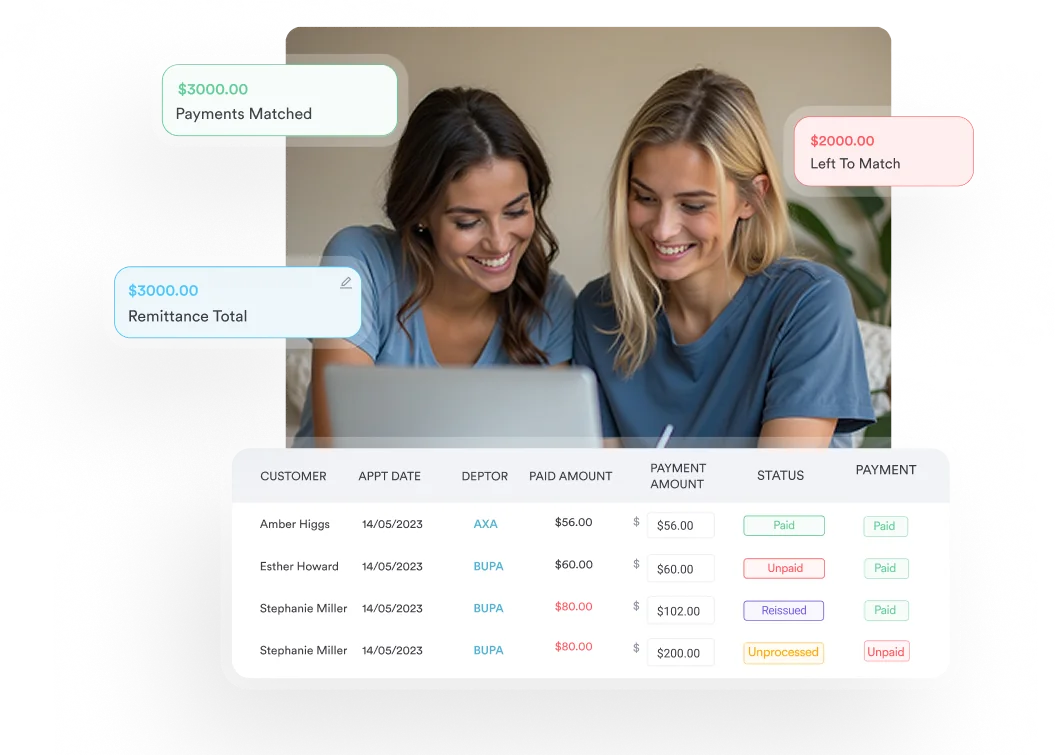
Both platforms cover scheduling, patient intake, and front-office workflows. Differences show up in flexibility and integration depth.
eClinicalWorks provides a multi-provider scheduling grid, patient portal, and intake forms that can be customized by specialty. Its practice management suite also covers population health tools, care management, and recalls, which suits value-based care arrangements.
athenahealth’s scheduling is tightly integrated with its billing and documentation layers. New patient intake, eligibility verification, and appointment reminders work inside one flow rather than several screens. Smaller practices with limited administrative headcount often find that reduces friction.
Both vendors list secure messaging, but the detail that matters is what it logs. Our guide to secure clinical messaging covers read receipts, audit trails, and business associate agreements.
Both eClinicalWorks and athenahealth hold ONC certification for FHIR-compliant data exchange under the 21st Century Cures Act. In practice, their interoperability strengths differ by ecosystem.
eClinicalWorks participates in the CommonWell Health Alliance and Carequality networks, which gives it broad health information exchange reach. Its lab integration library is extensive, covering major national and regional reference labs.
athenahealth operates the athenaNet network, connecting practices to shared data across its large installed base. Its Marketplace program gives practices access to vetted third-party applications, though the integration catalog is curated rather than open. FHIR R4 support is now a baseline requirement for certified EHR technology, and both platforms meet it.
Telehealth is a secondary differentiator here rather than a primary decision driver. It still matters for practices carrying significant virtual visit volume.
eClinicalWorks includes a native telehealth module called healow TeleVisit, which sits inside its scheduling and documentation workflow. Patients join through the healow app without a separate platform login.
athenahealth supports telehealth through integrations with third-party video platforms rather than a proprietary tool. That works for practices already committed to a video vendor, but it adds a workflow step. Practices running heavy virtual care volume may prefer the native eClinicalWorks experience.
Pricing is the starkest structural difference between the two platforms. Neither one publishes a price list you can budget from.
eClinicalWorks is reported to use a module-based pricing structure. The base EHR is typically quoted per provider per month. Population health, revenue cycle tools, and telehealth are each sold as separate add-ons. Module costs stack quickly for a practice that wants the full suite. Always request an itemized quote directly from eClinicalWorks.
athenahealth charges a percentage of collections rather than a flat fee. It publishes no rates on its own site. The only citable figure is contact sales for a quote, and percentages reportedly vary by practice size, specialty, and negotiation.
A 4-7% range circulates in third-party software directories, but athenahealth has neither published nor confirmed it. Budget from a written quote rather than from a range you read in a listing.
Go-live timelines for both platforms run from weeks to months. Practice size, data migration complexity, and the amount of upfront customization drive the difference.
eClinicalWorks deployments typically involve a dedicated implementation team and phased training by role. Reviewers describe the implementation phase as manageable when experienced eCW trainers run it. They also report that support responsiveness drops after go-live. Themes from G2 reviews include slow ticket resolution and inconsistent follow-through.
athenahealth provides implementation support through its own services team. Reviewers on G2 report smoother onboarding for smaller practices, partly because cloud-native architecture removes server configuration and local installs. Post-go-live support quality is a recurring theme in negative reviews, with some practices struggling to escalate complex issues.
Request references from practices of your size and specialty before signing with either platform. Implementation quality varies by regional partner and account team assignment, not just by platform. Ask specifically for references from practices that went live in the past 12 months.
KLAS Research, the independent healthcare IT ratings firm, has published data on both platforms in ambulatory settings. It indicates athenahealth scores higher on overall user satisfaction and ease of use, while eClinicalWorks leads on revenue cycle depth and feature breadth. Neither platform earns strong ratings on support quality, a consistent theme across both review sites.
Any practice weighing eClinicalWorks for a multi-year contract should understand its legal history.
On May 31, 2017, the Department of Justice announced that eClinicalWorks would pay $155 million to settle False Claims Act allegations. According to the DOJ press release, the allegations centered on eClinicalWorks falsely claiming its software met Meaningful Use certification requirements. The DOJ also alleged the company paid kickbacks to certain customers. The settlement did not constitute an admission of liability.
What this means for practices today:
None of this rules eClinicalWorks out. It is a risk signal worth an hour of diligence before you sign a multi-year contract.
Practice managers overseeing value-based care contracts single out the reporting and population health features in Capterra reviews.
Capterra reviewers frequently note how quickly new staff become productive in athenahealth, compared with platforms that need heavier configuration.
Three questions decide this for most practices. How does the practice get paid, who works the denials, and what kind of care does it deliver? The grid below routes those answers to a shortlist.
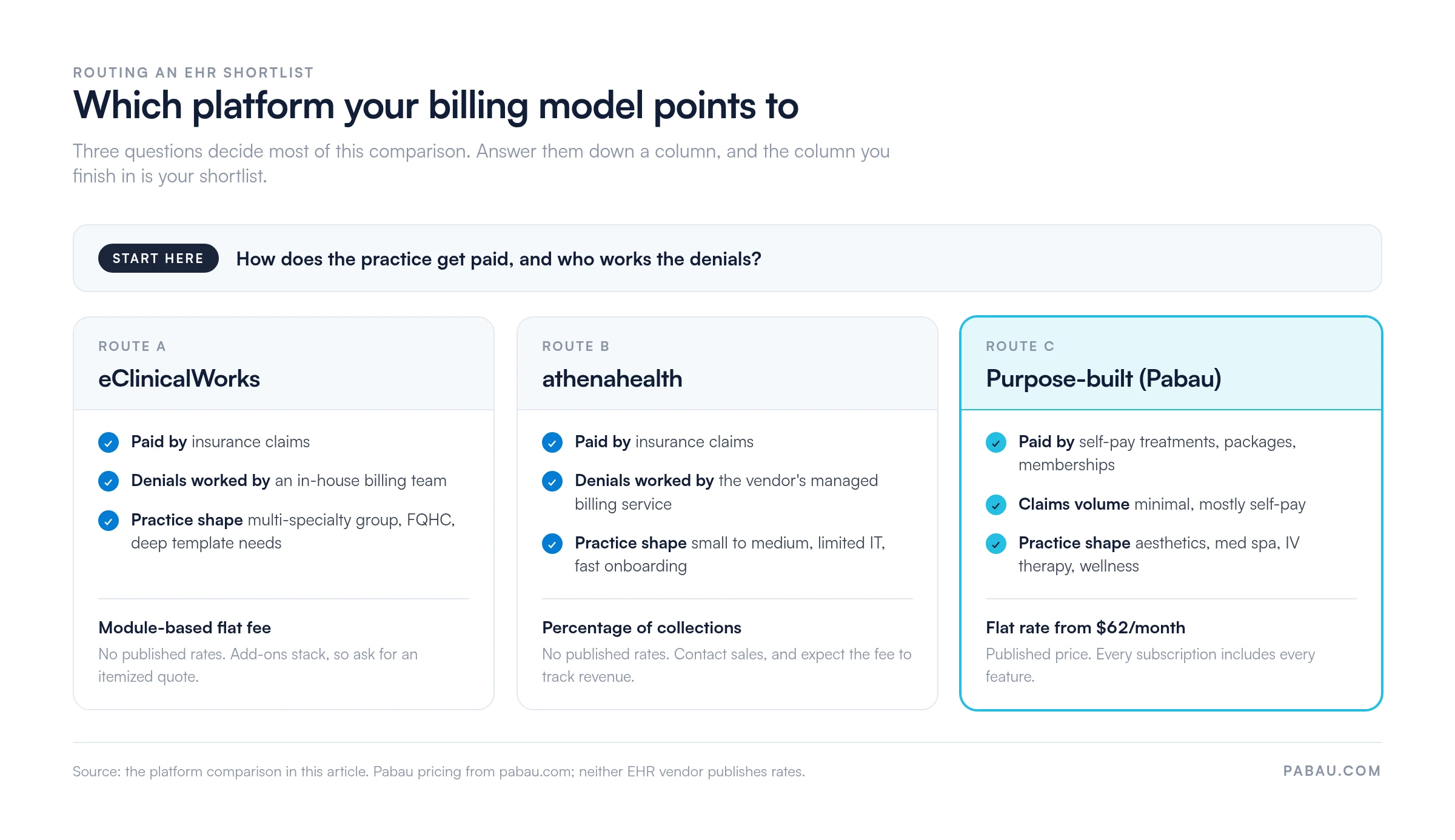
Choose eClinicalWorks if your practice looks like this:
Choose athenahealth if your practice looks like this:
Ambient AI documentation is no longer the tiebreaker it was a year ago. eClinicalWorks ships Scribe AI, and athenahealth now offers athenaAmbient alongside partner scribes through Ambient Notes. Compare the two on note accuracy in your own specialty rather than on availability.
A third option worth considering: neither eClinicalWorks nor athenahealth is designed for aesthetic practices, med spas, IV therapy centers, or wellness providers. Both are physician-focused ambulatory EHRs built for insurance-heavy billing, diagnostic coding, and multi-system data exchange.
If your practice sits in the aesthetic or wellness space, you pay for capabilities you will never use. You also go without the workflow tools built for treatment-based care. That is the job medical spa software does instead, and it is where Pabau fits.
Pabau is practice management software built for aesthetic practices, skin clinics, med spas, IV therapy centers, and wellness providers. It covers the day-to-day work an ambulatory EHR was never designed for:
The commercial difference is just as sharp. Pricing starts from $62/month on flat-rate subscription tiers, with no percentage of collections attached. Every subscription includes every feature, so a single-room practice gets the same tools as a multi-location group.
For practices weighing Pabau against other platforms, our practice software comparisons put them side by side. If you want to check the fit against your own setup, you can book a demo and walk through a normal treatment day.

Pabau covers injection plotting, before-and-after photos, automated recalls, and flat-rate billing in one platform. Book a demo to see how it runs an aesthetic practice’s day.

This decision comes down to revenue cycle control versus managed simplicity. eClinicalWorks hands billing-heavy practices deeper tools, at the cost of a steeper learning curve and opaque module pricing. athenahealth offers a more accessible cloud-native experience with a managed billing team behind it.
Ambient AI no longer separates them, so weight the pricing structure more heavily than you would have last year. A module-based flat fee stays predictable once the modules are fixed. A percentage of collections rises with every good year, and neither vendor publishes rates, so get both quotes in writing.
For aesthetic, wellness, and med spa practices, neither platform is the right fit. Treatment-first workflows and flat-rate pricing matter more here than diagnostic coding depth. Book a demo to see how Pabau keeps injectable records, consent, and billing in one place.

Comparing two other US ambulatory EHRs? DrChrono vs Practice Fusion runs the same head-to-head on two platforms aimed at smaller independent practices.
Weighing a specialty-specific EHR instead? ModMed vs DrChrono compares built-in specialty workflows against a more configurable general platform.
Leaving Kareo or Tebra behind? Best Kareo alternatives covers the platforms practices move to, and what each one changes about billing.
Want to compare Pabau against specific clinic software options? Pabau competitors and alternatives gives a side-by-side overview across the clinic management software market.
eClinicalWorks is a feature-rich, module-based EHR with deep revenue cycle tools, suited to in-house billing operations and multi-specialty groups. athenahealth is a cloud-native platform with a managed billing service and easier onboarding, better suited to smaller practices that want to outsource billing complexity. The biggest structural difference is pricing. eClinicalWorks charges flat module fees, while athenahealth charges a percentage of collections.
eClinicalWorks uses a module-based flat fee per provider, with population health, telehealth, and revenue cycle tools costing extra. athenahealth charges a percentage of collections. Neither vendor publishes rates on its own site, so the citable figure for both is contact sales for a quote. A 4-7% range for athenahealth circulates in third-party directories, but athenahealth has not confirmed it, so treat it as an unverified estimate.
On May 31, 2017, the Department of Justice announced that eClinicalWorks would pay $155 million to settle False Claims Act allegations. The DOJ alleged eClinicalWorks falsely certified that its software met Meaningful Use requirements, and that it paid kickbacks to certain customers. The settlement was not an admission of liability, and eClinicalWorks continues to hold current ONC certification. Practices with audit exposure from the Meaningful Use period should consult compliance counsel.
Both now offer ambient AI documentation, so this is no longer a clean win for either side. eClinicalWorks has the longer-running native option in eCW Scribe AI, which listens to the encounter and drafts the note. athenahealth launched athenaAmbient in November 2025, with general availability rolling out through 2026, and has run its Ambient Notes marketplace since late 2024. That marketplace connects athenaOne to Suki AI, iScribe AI, Abridge, and Dragon Copilot. Judge them on note accuracy in your specialty.
athenahealth is generally the better fit for small practices. Its cloud-native architecture removes IT infrastructure requirements, and its managed billing service reduces the need for trained in-house billing staff. Its interface is also consistently praised for ease of learning. eClinicalWorks offers more power, but it takes more administrative investment to configure and maintain, which smaller teams may find hard to sustain.
Both platforms hold ONC certification for FHIR R4-compliant data exchange under 21st Century Cures Act requirements. eClinicalWorks participates in CommonWell and Carequality health information exchange networks. athenahealth uses its own athenaNet network plus a curated Marketplace for third-party integrations. For practices exchanging data across many independent health systems, the broader eClinicalWorks network participation may be an advantage.