Free model waiver form + what it is and when your practice needs one
A model waiver form is a signed document that lets a healthcare practice use a p...

5
Last Updated: Sep 29, 2026

Software covered: 1. Pabau, 2. GlowdayPRO, 3. e-clinic, 4. MERIDIQ, 5. Faces, 6. Consentz, 7. Phorest
Pabau is our own product and our top pick on clinical records. The POM batch number, the consent form and the photos sit in one client record.
GlowdayPRO is the closest like-for-like swap at £10 to £39 per practitioner per month plus VAT, and Faces is free to use.
Aesthetic Nurse Software publishes £25 and £50 per month plus VAT, so the reason to move is capability rather than price.
Work through the Handover Ledger before you cancel, because six record types can still be requested after your subscription ends.
Aesthetic nurse software alternatives worth a UK clinic’s time in 2026 are Pabau, GlowdayPRO and e-clinic, chosen on sterling price, prescriber records and data export. Those three cover the three reasons UK injectors actually leave.
Aesthetic Nurse Software is a specific product, not a category, and a cheap and simple one. For a solo injector under 150 patients it does the job. Clinics outgrow it for narrow reasons rather than broad ones.
This comparison is built for the practitioner who has already decided to look. So it leads with the shortlist and the prices. Then it covers the export work. You have to get six categories of regulated record out before the subscription stops.
The strongest aesthetic nurse software alternatives for UK clinics are Pabau for clinical records, GlowdayPRO for solo injectors, and e-clinic for prescribing integrations. The table below ranks them on the four axes that decide a switch.
Column four is the one that decides a switch. UK aesthetic practice runs on prescription-only medicines. A system that cannot hold the prescriber, the assessment and the batch number is missing what an investigation asks about first.
| Software | Best for | UK price from | Prescriber and POM batch record | Photos and consent storage | Data export on exit |
|---|---|---|---|---|---|
| Pabau | Clinics wanting records, payments and marketing in one place | Quoted per user and per location, confirmed on a demo call | Batch number, lot number and expiry against the injection site and units | Before-and-after photos and digital consent in the client record | Open API, data connector, and a migration team on the way in |
| GlowdayPRO | Solo injectors billing by patient volume | £10 per practitioner per month, plus VAT | Treatment notes and treatment mapping. Batch capture not stated | Before-and-afters, plus a consent form library you can add to | Not stated on their site |
| e-clinic | Clinics needing prescribing and lab integrations | £65 per user per month | Prescribing integrations on the £85 plan. Batch capture not stated | Photo and document management with clinical templates | Migration packages named at Enterprise only |
| MERIDIQ | Documentation-first clinics buying modules separately | £22 per user per month for records | Not stated on their site | Before-and-after images and unlimited record storage | No lock-in contract. Export format not stated |
| Faces | Nurses who need consent forms and a prescriber route | Free to use, no card needed | Prescriber finder and pharmacy ordering. Batch capture not stated | Over 200 consent forms and unlimited form storage | Not stated on their site |
| Consentz | Clinics wanting tablet-first consent and photo mark-up | No published pricing | Stock and billing module. Batch capture not stated | Photo mark-up sits inside the medical record | Not stated on their site |
| Phorest | Larger medi-aesthetic clinics with retail and marketing | No published pricing, quote on request | Consultation forms and charting. Batch capture not stated | Consultation forms and charting against the client | Not stated on their site |
Pabau is our own product, so here is how the order was set. Each tool was ranked on the prescriber and POM batch record, setup time, how it scales past one practitioner, and data export.
Pabau leads on three of those four and loses on the fourth, which is setup time. GlowdayPRO and e-clinic sit close behind for different readers. GlowdayPRO wins on price and a same-week start, e-clinic on prescribing depth.
Read the last three columns as a set. Price is the easiest axis to compare and the least likely to matter after year one. The £25 a month you save is one dermal filler appointment.
On the CRM question, treat it as the same question. UK aesthetic practices rarely need a separate customer database, because the marketing list and the clinical record describe the same person. A platform that splits them creates two versions of the truth. If you want the broader category view, our guide to software for aesthetic clinics sets out what an all-in-one system covers.
What separates good aesthetic software from a repurposed salon booking tool is the treatment record. The screenshot below shows the field set that column four asks about.

Every price below comes from the provider’s own website, read in September 2026. Where a vendor does not publish a figure, the table says so rather than repeating a number from a review site.
Pabau records the batch number, the units and the injection site inside the same client record that holds the consent form.
Pabau is the pick for a UK practice whose records have outgrown a lightweight diary. Practice management software like Pabau brings the clinical record, the calendar, payments and marketing into one system. A treatment note and the invoice for it then live in the same place.
The part that matters for injectables is injection plotting. You mark the site on a face chart, then select the product and the units. Pabau records the batch number, lot number and expiry against that treatment. If a product recall lands, you can name the affected patients from the record rather than a paper sticker sheet.
Consent is handled as digital forms tied to the client, and before-and-after photos are captured against the record rather than a phone camera roll. Stock deducts automatically when a treatment is logged, so your inventory and your notes stay in step.
Be honest about the trade-off. There is no free trial, because a platform this configurable set up badly is worse than the tool you left. Onboarding is structured instead. The onboarding team handles the data migration, a client coordinator owns your setup, and a documented portal covers the rest. Expect weeks, not an afternoon.
Pricing scales with users and locations rather than features. Every subscription includes the whole platform, so no feature you shortlist today sits behind a higher tier later. Ranking our own product first deserves a counterweight, so our list of Pabau competitors and alternatives names who else to see.
| Plan | Price | Users | Key inclusions |
|---|---|---|---|
| Starter | Published on the pricing page | 1 | Full platform, up to 100 clients |
| Solo | Published on the pricing page | 1 | Full platform, unlimited patients |
| Team | Quoted | 2 to 3 | Full platform, unlimited patients |
| Medium | Quoted | 4 to 5 | Full platform, unlimited patients |
| Group | Quoted | 6 to 15 | Full platform, unlimited patients |
| Enterprise | Quoted | 16 or more | Full platform across multiple sites |
Pricing is set by region and by user count, so the sterling figure for your team is confirmed on a demo call. Annual billing saves up to 20%. The plan structure is published on the Pabau pricing page.
GlowdayPRO prices by patient count in the same way Aesthetic Nurse Software does, which makes it the easiest swap to model.
GlowdayPRO is the closest structural match to the system you are leaving. GlowdayPRO prices by patient count, exactly as Aesthetic Nurse Software does, so you can compare the two bills directly.
The product is built only for UK aesthetics, and it shows in the feature list. Automated medical questionnaires and consent forms, treatment mapping, before-and-afters, courses of treatment, and late cancellation and no-show protection are all in every tier.
Text and email reminders carry no extra charge, which is unusual. Most systems at this price meter SMS separately, so a busy month quietly costs more than the headline. GlowdayPRO also feeds the Glowday consumer directory, where reviews are invite-only.
The catch is the per-practitioner charge. A solo injector on the Growing tier pays £24 plus VAT. Add three colleagues at £15 each and the sums change quickly. Their site does not describe batch or lot number capture, so ask about it directly before you commit.
| Plan | Price | Users | Key inclusions |
|---|---|---|---|
| Starter | £10 per month, plus VAT | Per practitioner | All features, up to 10 patients |
| Growing | £24 per month, plus VAT | Per practitioner | All features, 11 to 100 patients |
| Established | £39 per month, plus VAT | Per practitioner | All features, unlimited patients |
| Extra practitioner | £15 per month, plus VAT | Each additional | Added to any tier above |
The tiers gate patient volume, not features, so a growing list moves you up rather than unlocking tools. A 30-day free trial gives full access, and card readers are sold separately at £82.80.
e-clinic is the only shortlisted system that names its prescribing and pathology integrations on its own pricing page.
e-clinic earns its place if your service list has grown past injectables. Weight loss, hormone therapy and anything requiring bloods need results and prescriptions inside the record. Only e-clinic names those integrations openly on its own pricing page.
The £65 plan covers appointments, reminders, online bookings, clinical notes and templates, treatment courses, photo and document management, and reporting. Role-based access controls and secure hosting are included, and email sending carries no charge.
The £85 plan is where the clinical depth sits. It adds pathology integrations, prescription integrations with providers such as CloudRX and SignatureRX, and accounting links to Xero. The £85 plan is a meaningful jump for a practitioner working with an independent prescriber.
Two constraints are worth knowing. You cannot mix plans across your team, so one clinician needing prescribing moves everyone to £85. Automations are billed per execution, which is fair at low volume and needs watching at high volume.
| Plan | Price | Users | Key inclusions |
|---|---|---|---|
| Core | £65 per user per month | Per user | Bookings, notes, photos, reporting, payments |
| Connected | £85 per user per month | Per user | Adds labs, e-prescribing, Xero and CRM links |
| Enterprise | Custom quote | 40 or more | Migration, training, advanced permissions and audit |
e-clinic does not state on its pricing page whether these figures include VAT, so confirm that before you budget. Card processing, video calls, SMS bundles and automations are billed on usage.
MERIDIQ sells the patient record as one module and the diary as another, so you only pay for the parts you use.
MERIDIQ takes the opposite approach to an all-in-one platform. You buy the patient record on its own, then add booking, payments or a quality management module only if you want them.
The modular approach suits a specific reader. Say your diary works and your bookings arrive through a channel you like. Replacing the record alone is then a much smaller project than replacing a whole system.
The records module includes unlimited storage and unlimited records, with before-and-after images as a named feature. MERIDIQ also markets a CQC compliance module covering policies, audits and document control, which is a rare thing to see priced separately.
Add the modules up and the picture changes. Records, booking, payments and the management system together come to £50 a month for one user before VAT. At that point you are paying all-in-one money for a stack you assembled yourself.
| Plan | Price | Users | Key inclusions |
|---|---|---|---|
| Patient records | £22 per month | Per user | Unlimited records and storage, free onboarding |
| Booking | £4 per month | Per user | Unlimited bookings, email and SMS reminders |
| Payments | £16 per month | Per clinic | Point of sale, Stripe, product library |
| Management system | £8 per month | Per clinic | Templates, policies, document management |
MERIDIQ states no setup fee and no lock-in contract, with a 14-day free trial. Their pricing page does not say whether these figures include VAT, so check before you commit.
Faces is free to use and puts a prescriber route and a pharmacy order screen next to the consent forms.
Faces answers a problem the other six mostly ignore. A registered nurse without an independent prescribing qualification has to work to another prescriber’s directions, and finding that prescriber is a real operational task.
The platform combines appointment management, client records and unlimited form storage with a library of over 200 insurance-verified consent forms. A prescriber finder and ordering from more than 100 pharmacies sit alongside them.
Faces is free to use, with no card required. A free platform makes the switching decision unusually cheap to test. You can run Faces alongside your current system for a month without a second subscription.
Read the commercial model carefully all the same. Free platforms make their money elsewhere, usually on the marketplace or the product ordering. Work out what a normal month of stock costs you.
| Plan | Price | Users | Key inclusions |
|---|---|---|---|
| Faces | Free to use, no card needed | Not stated | Booking, records, consent forms, prescriber finder |
| Marketplace and stock | No published subscription price | Not stated | Product ordering from over 100 pharmacies |
Faces publishes no monthly subscription figure, because the platform itself is free at the point of use. Treat the marketplace and stock ordering as the cost to model rather than a licence fee.
Consentz was built around the consultation itself, so photo mark-up and dictation sit inside the medical record rather than beside it.
Consentz positions itself around the clinician and patient relationship rather than the diary. Its feature set leads with medical record creation, photo mark-up and dictation, then adds patient engagement, analytics, stock and billing.
That ordering tells you who it suits. Say your frustration is what happens during the ten minutes you spend with the patient. Consentz is then the closest fit on the list.
Consentz publishes no pricing. Its pricing URL redirects to the homepage, and there is no plan sheet to read. A missing price is not a criticism of the product. Comparing Consentz on cost simply needs a sales conversation first.
| Plan | Price | Users | Key inclusions |
|---|---|---|---|
| All plans | Contact sales, no published pricing | Not stated | Records, photo mark-up, engagement, stock, billing |
Consentz does not publish a price on its own website, so no figure is quoted here. Ask for the per-user rate and the minimum term in the same email.
Phorest brings salon-grade marketing and retail to a medi-aesthetic clinic, which matters more as the treatment menu widens.
Phorest started in salons and moved into medi-aesthetics, which explains both its strengths and its limits. The marketing suite, loyalty programme, review collection and retail tools are more developed than anything else on this list.
For a clinic where skincare retail and rebooking drive a real share of revenue, that matters. Consultation forms, charting, video consultations and a self check-in app cover the clinical side well enough for most non-surgical work.
The trade-off is depth on the injectables record. Phorest does not describe batch or lot capture on its site. A solo injector will also pay for retail and marketing machinery they may never switch on.
If Phorest is the system you are leaving rather than joining, our roundup of Phorest alternatives covers the wider field.
| Plan | Price | Users | Key inclusions |
|---|---|---|---|
| All plans | Contact sales, no published pricing | Not stated | Scheduling, marketing suite, retail, charting, payments |
Phorest asks you to request a quote rather than publishing plan prices. Ask for the figure including any payment processing minimums, because those are where salon platforms often make their margin.
Aesthetic Nurse Software costs £25 or £50 a month plus VAT, and covers booking, records, deposits and reminders well for one practitioner. Clinics outgrow it on team size and clinical depth.
Start with what the incumbent gets right, because other round-ups cannot even agree on its price. The vendor publishes both figures on its own price plans page, on a slider set by practitioner count.
Foundation is £25 plus VAT a month and caps you at 150 patients. Advanced is £50 plus VAT with unlimited patients, and adds gift vouchers, a customised booking page, stock management, low stock alerts and staff access restrictions. Above 15 practitioners the price is quoted.
The commercial terms are strong. Aesthetic Nurse Software runs a rolling monthly subscription with no minimum term. There is a 14-day free trial with no card. The vendor also imports your existing patient data from your old system at no charge.
So where does it run out? It runs out in three places, in the order practices usually hit them.
None of that makes Aesthetic Nurse Software a bad product. The pricing and the feature set are built for one practitioner, doing exactly what one practitioner needs. The moment you add a second person or a second site, the fit changes.
For a field-by-field view, our software comparison hub sets Pabau beside Aesthetic Nurse Software and each rival here.
Cancel only after you have exported six records: Clinical notes, signed consent forms, photographs, POM batch numbers, the prescriber’s assessment and the access audit trail. We call that set the Handover Ledger.
The reason to work through it in that order is regulatory, not technical. A UK aesthetic clinic can be asked to produce any of these after the subscription has stopped. “The software company deleted it” has never been an answer.
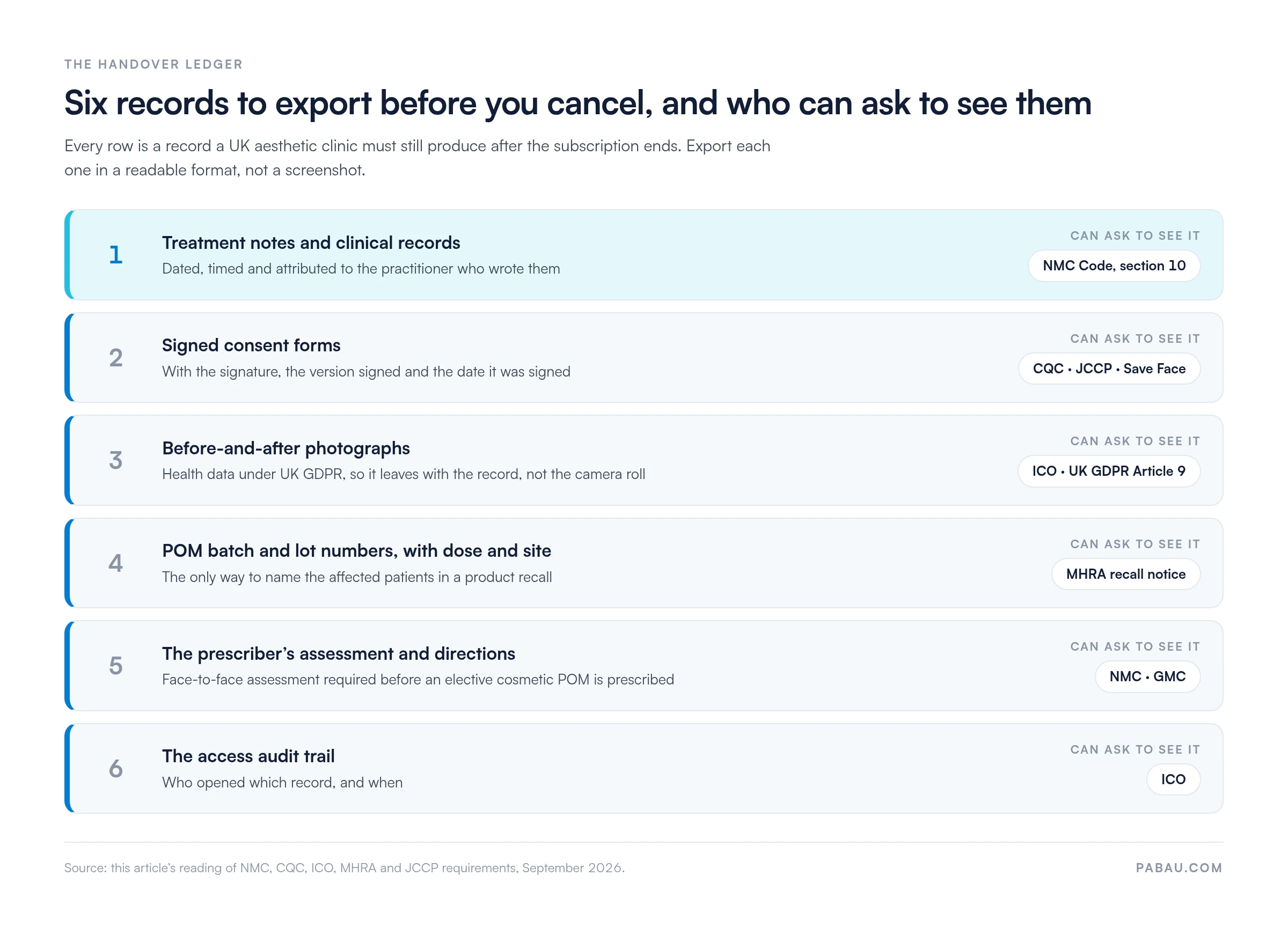
In practices we onboard, the batch numbers are the record that goes missing. They were written on a sticker sheet and photographed, never typed into a field.
Send these by email, not on a phone call, so the answers are on record before you give notice.
The fourth question is not a favour you are asking. Your clinic is the data controller and the software vendor is your processor, so your contract already has to say this.
The ICO is explicit on this point. A controller-processor contract must require the processor to delete or return all personal data at the controller’s choice. Quote that when you ask.
Judge nurse aesthetic software on four axes: The prescriber and POM batch record, setup time, how it scales past one practitioner, and data export.
The rest is preference. The features shortlists usually lead with, such as online booking and reminders, are now table stakes across every system here.
UK regulation of aesthetics is patchier than most software marketing suggests. The shortlists of aesthetic clinic software UK buyers work from rarely explain which rules bite. Four points are worth getting straight.
What follows for your shortlist is narrow but concrete. Any system you buy must let you record a prescriber against a treatment, store the assessment, and produce both later without a support ticket.
Setup time splits the market cleanly, and the vendors are open about it. Self-serve systems get you booking the same day. Configurable platforms take weeks and then work harder for you.
Neither end of that range is wrong. A solo injector should be suspicious of a system needing a month of configuration. A three-site group should be equally suspicious of one needing none.
A solo injector should buy on patient volume and cost, while a multi-site clinic buys on role-based access and per-site stock. Reporting across locations belongs on the second list too.
The distinction shows up in pricing models. Per-practitioner pricing is generous to a single user and punishing to a team of six. Per-location pricing works the other way. Model your headcount 18 months out, not today.
Choosing software for aesthetic clinic teams also means asking who signs off a note. Any nurse software you shortlist should let a non-prescriber record that they worked to another practitioner’s directions, with that practitioner named.
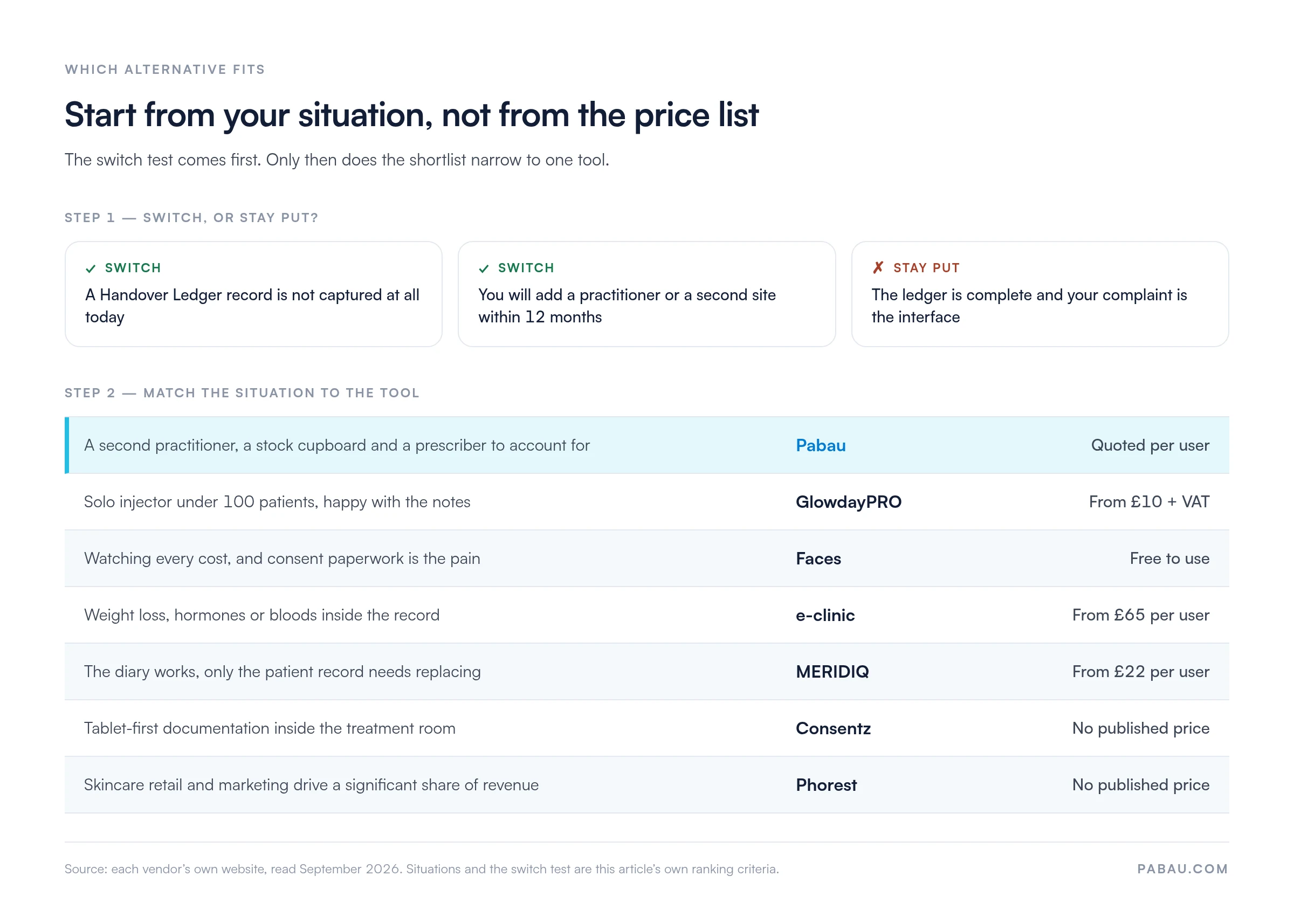
Here is the rule we would apply. Switch when a Handover Ledger item is not captured at all today. Switch too when you will add a practitioner or a site within 12 months.
Stay put when the ledger is complete and your complaints are about the interface. A migration costs you a fortnight of admin and a month of small errors, and a £25 monthly saving does not repay that.
Test yourself against one question before you decide. If an inspector asked today for the batch number of a filler you injected six months ago, could you produce it in five minutes? If not, that is your answer.
The chart below runs that test, then points you at the tool your situation fits.
Most practices do not switch in January. They switch when something breaks, which means moving a live diary and a live patient list without dropping either. Pabau’s onboarding is built for that.
The onboarding team runs the data migration. Client records, appointment history and stock come across as a project, not a weekend of copy and paste. A dedicated client coordinator owns your setup, and a documented portal answers the questions that come up at 9pm.
Once you are in, the Handover Ledger stops being a task and becomes the default. Consent forms are signed digitally against the client. Before-and-after photos attach to the treatment. Injection plotting captures the product, the units, the site, the batch number and the expiry date in one screen.
Role-based access controls decide who can open which record, and the audit trail is kept for you rather than assembled later. The outcome is simple. The next time somebody asks for a record, you look it up instead of hunting for it.

Pabau’s onboarding team migrates client records, appointment history and photos, then configures consent forms and batch capture for your treatments. See the switch mapped to your own clinic in a 30-minute demo.

Pick on what your record has to prove, not on the monthly fee. A solo injector under 100 patients who is happy with their notes should look hardest at GlowdayPRO or Faces. The sums are small and the swap is quick.
A clinic with a second practitioner, a stock cupboard and a prescriber to account for has a different problem. There the answer is a platform that holds the batch number and the consent form in the same record as the appointment.
Whichever way you go, do the Handover Ledger first. The cost of switching is a fortnight of admin, and the cost of switching badly is a record you cannot produce three years later.
Working out whether your notes would survive the move is the fastest way to decide. Book a demo to see how Pabau records batch numbers, consent and photos against every treatment in your clinic.

Comparing another aesthetics platform? PatientNow alternatives ranks the systems aesthetic practices move to, and what each one records.
Shopping the US aesthetics market too? AestheticsPro alternatives covers the platforms medical spas shortlist against it.
Running a wider UK private practice? Semble alternatives compares the UK systems built for clinical notes and prescribing.
Want a worked pricing example? Aesthetic Record pricing breaks one aesthetics platform down to plans, fees and total cost.
Also weighing your booking tool? Treatwell alternatives looks at the UK options for salons and practices that take online bookings.
Pabau, because it records the batch number, the units and the injection site in the same client record as the consent form and the photos. GlowdayPRO suits a solo injector on a tighter budget, and e-clinic wins where prescribing and pathology integrations matter.
Foundation is £25 a month plus VAT for one practitioner and 150 patients. Advanced is £50 a month plus VAT with unlimited patients. Both figures come from the vendor’s own price plans page, read in September 2026. Above 15 practitioners the price is quoted.
The same system that holds your clinical notes. Splitting the marketing database from the patient record gives you two versions of one person. The one you email is rarely the one you treated. Every platform compared here keeps both in a single client file.
It depends on how configurable the system is, and the vendors are open about the difference. GlowdayPRO and MERIDIQ run self-serve trials you can start today. Pabau replaces the trial with a structured migration and a dedicated client coordinator, which takes weeks.
The vendor describes a rolling monthly subscription you can end at any time, and says you can export your data when you go. Do the export first. Work through the six Handover Ledger records above, then confirm the notice date and the deletion date in writing.