Waist-to-hip ratio chart: Risk bands for women & men (free PDF)
A waist-to-hip ratio chart sorts a patient’s waist-to-hip ratio (WHR) into...

1
Last Updated: Oct 14, 2026

The WIC food list names the exact foods, brands, and package sizes you can buy with WIC benefits, and it varies by state.
Every state list covers dairy, eggs, grains, fruits, vegetables, protein foods, juice, and infant formula.
The cash value benefit for produce runs $26 a month for children and $52 for breastfeeding participants.
Dried fruits and vegetables became cash value benefit eligible under USDA’s 2022 final rule.
Practice management software like Pabau lets dietitians record dietary intake, preferences, and barriers in the client record.
A ready-made structure for dietary planning, covering intake patterns, portion detail, adherence barriers, and practical substitutions. Download it as a PDF and adapt the fields to your practice.
Download templateWIC, the Special Supplemental Nutrition Program for Women, Infants, and Children, is a federal nutrition program. It serves low-income pregnant, postpartum, and breastfeeding participants, infants, and children under age 5.
The food list is the document that says which foods, brands, and package sizes those benefits cover. Unlike the Supplemental Nutrition Assistance Program, which allows broad grocery purchases, WIC covers a short and specific set of foods. Each state runs its own program, so approved items and quantities differ by geography.
Below you will find the core food categories, how packages change by participant type, and the cash value benefit amounts for fiscal year 2026.
The WIC food list is the catalog of WIC-approved foods, published by each state agency under federal rules. The federal Food and Nutrition Administration (FNA), renamed from the Food and Nutrition Service in June 2026, sets the categories and eligibility criteria.
Each state WIC agency then publishes its own list of approved brands, sizes, and quantities for authorized stores. WIC supplements a family’s grocery budget rather than replacing it. The list covers foods that support prenatal health, infant development, and childhood nutrition, so prepared meals and household goods are not eligible.
The list also reflects nutrition science. WIC prioritizes whole grain breads and cereals over refined grains, requires low-fat or fat-free milk for most participants, and mandates unsweetened juice.
Every state list covers the same core categories, even though the approved brands and package sizes differ. These are the six that appear everywhere:
Each category carries brand, size, and quantity limits. In most states, milk must be low-fat or fat-free. Cereal cannot exceed 6 grams of sugar per serving, and peanut butter is usually one 16 oz or 18 oz jar per month.
Benefit amounts change with the participant’s life stage. A pregnant participant, a breastfeeding participant, and a 3-year-old are all on different packages.
Each state publishes package guidelines by participant category in its own downloadable list. The differences follow nutrition science. Pregnant participants need more iron-rich foods, breastfeeding participants need more calories and calcium, and infants need age-specific feeding.
The cash value benefit is a monthly dollar amount for produce, and it is the most flexible part of the package. For fiscal year 2026, the USDA sets it at $26 a month for children, $48 for pregnant and postpartum participants, and $52 while breastfeeding. The spread matters when one card feeds a whole household.
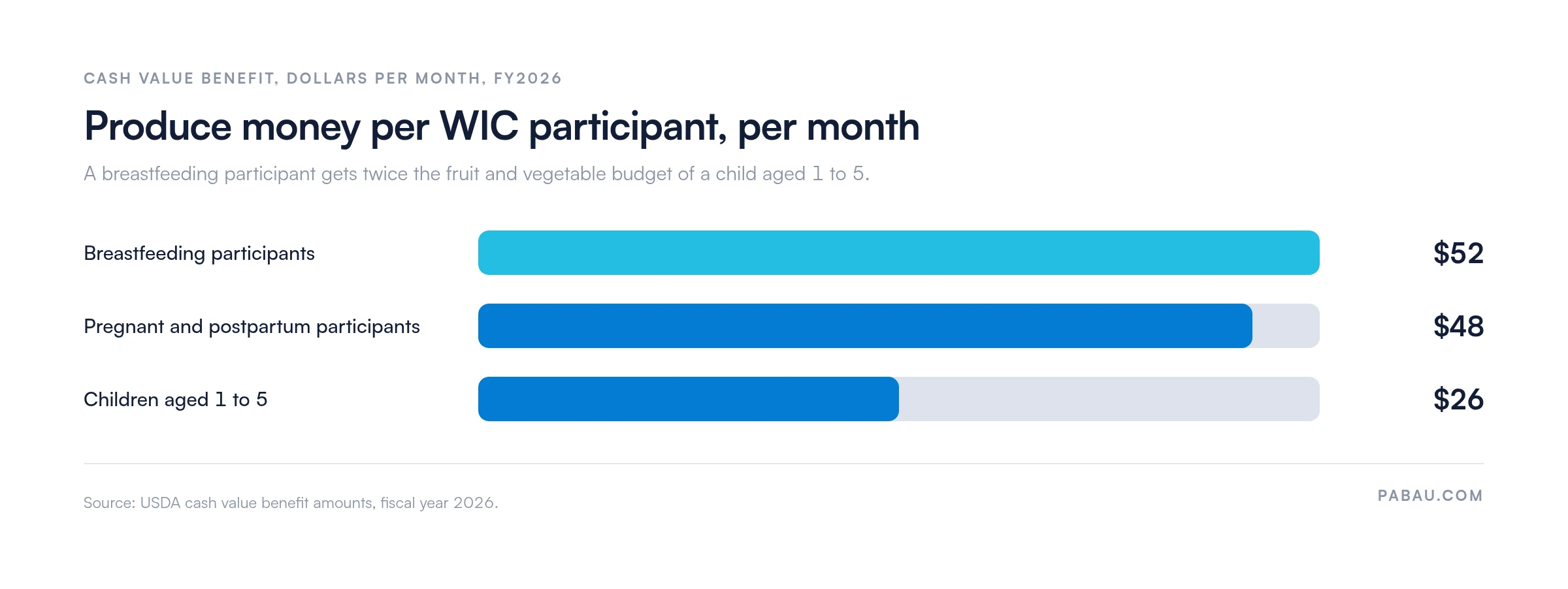
Instead of a list of approved produce, the benefit works like cash inside the produce aisle. Fresh, frozen, canned, and dried fruits and vegetables all qualify, after USDA’s 2022 final rule added dried produce. Participants can spend it at any authorized WIC retailer, including farmers markets.
That flexibility lets families buy produce that fits their cooking and their cultural food patterns. It is the one part of the package that does not specify a brand or a package size.
State WIC agencies publish their approved foods on their own health department websites. Search for your state’s name plus “WIC approved foods,” or start from a state page like the Georgia Department of Public Health WIC list. Most states offer a printable PDF for in-store reference.
Lists are updated at least once a year as products are added and benefit amounts change. Check your state agency’s current version before shopping, because an outdated list can send you home with ineligible items.
WIC benefits load onto an Electronic Benefit Transfer (EBT) card, much like SNAP. Five habits keep the trip short:
Many states now run a WIC app that shows approved products, authorized stores, and your remaining balance as you shop. That cuts the risk of picking up an item the register will refuse.
A little planning gets more nutrition out of the same benefit. Four habits do most of the work:
Children who help prepare approved foods are also more likely to eat them, which makes the produce benefit go further.
For dietitians and WIC-certified counselors, the food list sets the boundary of any advice you give. A substitution the family cannot buy with their benefits will not survive the shopping trip.
So the counseling record has to hold three pieces: current intake, what the package allows, and where the two disagree. A structured nutrition assessment form captures intake patterns and preferences in one place.
Barriers matter as much as the food. Transportation, a store that stopped accepting WIC, or a formula shortage all change what the family buys. Record the plan and the barrier in a nutrition SOAP note, so the next visit starts from what happened.
In most practices, WIC nutrition counseling still runs on paper. The intake form goes in a folder, the plan goes in a separate note, and the next counselor starts over.
Practice management software like Pabau keeps them together. Patients complete digital intake forms before the visit, so dietary preferences, allergies, and barriers land in the client record instead of a filing cabinet. Custom fields hold the WIC category and the package the family is on.
That matters for a program built on repeat visits. Because the record travels with the patient, any counselor can open the last plan, the last barrier, and what changed since. Teams running weight and metabolic programs use the same setup, and practice software for dietitians holds both caseloads in one calendar.

Pabau’s digital intake forms and client records capture dietary intake, preferences, and barriers before the visit starts. Counselors open the last plan in seconds, so follow-up appointments pick up where the previous one ended.

The food list is restrictive by design. A short, predictable set of foods is easier for a family to learn and easier for a counselor to plan against.
So start with your own state’s list rather than the federal categories, because the brands and sizes are where purchases fail at the register. Then check the cash value benefit amount for each participant in the household, since that number changed for fiscal year 2026.
If you counsel WIC families for a living, the harder part is keeping that detail in one place across visits. Book a demo to see how Pabau records dietary intake, preferences, and barriers in the client record.

Need a structured intake for nutrition visits? Nutrition assessment form captures dietary intake, preferences, and barriers in one place.
Documenting a counseling session? Nutrition SOAP note gives you one format for assessment, plan, and follow-up.
Want a quick reference at the desk? Nutrition cheat sheet collects portion sizes and macronutrient basics for fast lookups.
Working in nursing or long-term care? Nursing nutrition assessment covers screening, risk factors, and intake documentation.
WIC covers six categories: dairy and eggs, whole grains, fruits and vegetables, protein foods, 100% unsweetened juice, and infant formula and baby foods. Fresh, frozen, canned, and dried produce all count. Your state’s list names the approved brands and package sizes.
Yes. Every state WIC agency publishes a printable food list on its website, and most also carry it in a state WIC app.
Yes. Federal rules set the food categories, but each state picks the approved brands, package sizes, and benefit amounts. Always shop from your own state’s list.
WIC covers contract-approved infant formula, stage-appropriate jarred baby food, and infant cereal. The approved brands and quantities sit in the infant section of your state’s list.
The cash value benefit is a monthly dollar amount on your WIC EBT card for fruits and vegetables. For fiscal year 2026 it is $26 for children, $48 for pregnant and postpartum participants, and $52 while breastfeeding. Fresh, frozen, canned, and dried produce all qualify at any authorized WIC retailer.
Mostly no. State lists name conventional brands for milk, cereal, juice, and other staples, so organic versions are usually not approved. Organic fruits and vegetables are the exception, because you can buy them with the cash value benefit at any authorized WIC retailer.