Anja Dodevska

Pabau vs Hyland OnBase: Healthcare document management software compared
Healthcare document management software captures, stores, and retrieves patient ...

Last Updated: Nov 2, 2026
Free PDF 2 pages, print-ready Clinician-reviewed
A sugar-free diet food list is a checklist of whole foods with no added sugar, grouped by food type. Patients use it to plan meals and shop without reading every label. Vegetables, whole fruit, lean proteins, plain dairy, eggs, oats and legumes stay on it, because their natural sugars don't count as added sugars. Soda, candy, sweetened cereals, flavored yogurts and sugary sauces come off. The 2025-2030 Dietary Guidelines for Americans limit added sugar to 10g per meal. Patients taking insulin or other glucose-lowering medication should agree any diet change with their clinician first.
A two-page checklist of sugar-free foods in five groups: vegetables, fruits, meat, dairy and eggs, and other staples such as legumes and oats. Each item has a tick box so patients can mark what they plan to buy.
Start from scratch, or upload this PDF or any form you already use, and Pabau's AI Form rebuilds it with tick boxes, text fields and a signature. Attach it to the treatment once, and every patient gets it on time.
AI Form rebuilds the consent, history and aftercare forms you already use. You review each one, then publish.
Patients complete forms on their phone before they arrive, so the front desk stops retyping paper.
Every signed form is versioned and attached to the treatment record, ready when you need it.
Set how long a consent stays valid. Returning patients skip forms they have already signed.
Supports HIPAA and GDPR compliance AES-256 encryption 4.8 on G2 4.7 on Capterra Trusted by 4,000+ practices worldwide

A sugar-free diet food list sorts whole foods with no added sugar into groups, so patients can shop and plan meals quickly.
Whole fruit, vegetables and plain milk stay on the list, because their natural sugars do not count as added sugars.
The 2025-2030 Dietary Guidelines for Americans limit added sugar to 10g per meal, replacing the old cap of 10% of daily calories.
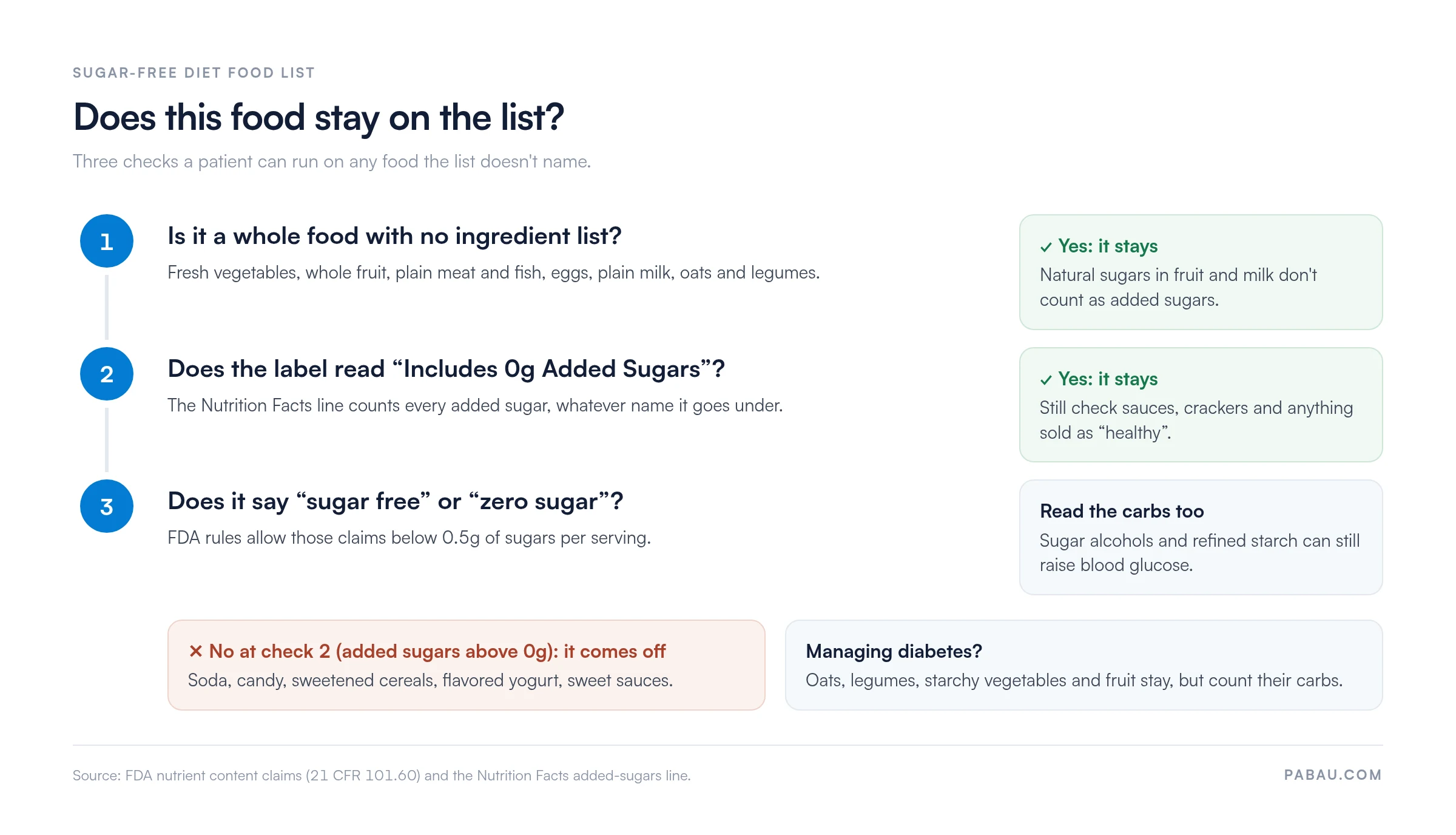
FDA rules let “sugar free” and “zero sugar” labels apply only below 0.5g of sugars per serving.
Pabau, the practice software we build, lets teams send this list as a digital form and store each patient’s choices in their record.
A sugar-free diet food list is a short printable reference of whole foods that carry no added sugar, sorted by food group. Patients use it to plan meals and shop without checking every label from scratch.
“Sugar-free” in this sense means cutting added sugars, not every gram of sugar. Whole fruit, vegetables and plain milk contain natural sugars, and they stay on the list. Sweets, sugary drinks and sweetened packaged foods come off it.
The PDF is a two-page checklist. Each food group has its own section with a tick box beside every item. A patient can mark what they already buy and what they plan to try.
The safest foods on a sugar-free plan are the ones with no ingredient list at all. Fresh produce, plain proteins and whole grains carry no added sugar unless someone adds it during cooking.
Non-starchy vegetables such as broccoli, cauliflower, spinach, cabbage, celery and cucumber can fill half the plate at most meals. Starchier picks like sweet potato, peas and pumpkin still fit. They simply carry more carbohydrate per portion.
Whole fruit stays on the list because its sugar comes packed with fiber and water. Berries, apples, citrus and peaches are good everyday choices. Dates are much sweeter per bite, so a patient may want to keep them to a small portion.
Plain chicken, turkey, lean beef, pork, fish and shellfish contain no sugar. The risk sits in what goes on them. Marinades, glazes and barbecue sauces are common sources of added sugar.
Plain milk, eggs and unsweetened yogurt all qualify. Milk’s natural sugar is lactose, which does not count as added sugar. Flavored yogurts and milk drinks are a different story, and they belong on the avoid list.
Rolled oats, beans, lentils, chickpeas and butter beans add fiber and keep meals filling. For snacks, the template points to savory options such as olives, hummus, seaweed and wholegrain crackers. Check cracker labels, since some brands add sugar.
These foods supply most of the added sugar in a typical diet. Some are obvious, while others hide sugar behind a savory or “healthy” label.
A product can contain added sugar without the word “sugar” appearing anywhere in its ingredients. Teach patients to scan for these names as well:
The quickest check is the Nutrition Facts panel. The “Includes Xg Added Sugars” line shows exactly how much was added, whatever name it goes under.
For a food the list doesn’t name, three quick checks settle whether it stays.
Packaging claims sound alike but follow different FDA rules. This table sets out what each one guarantees, based on 21 CFR 101.60.
Under the 2025-2030 Dietary Guidelines for Americans, more than 10g of added sugar in a single meal is too much. The guidelines also say no amount of added sugar is part of a healthy diet.
The per-meal cap replaces the previous limit of 10% of daily calories. On a 2,000-calorie diet, that older rule allowed about 50g a day.
The American Heart Association sets a daily limit of about 25g for women and 36g for men. On food labels, the Daily Value for added sugars is 50g. A 12-ounce can of regular cola already uses most of that.
A sugar-free list helps people with diabetes or prediabetes, but it does not replace carbohydrate counting. Oats, legumes, starchy vegetables and fruit all raise blood glucose, even with no added sugar. A food carbohydrate chart gives the carb count for each, so patients can plan portions.
“Sugar-free” products can also carry refined starch or sugar alcohols. Sugar alcohols can still nudge blood glucose and may upset digestion in larger amounts. Patients on insulin or other glucose-lowering medication should agree any diet change with their clinician first.
The template gives practice teams a consistent handout for patients starting a sugar-free plan. Print it, or share it digitally after a consultation. It pairs well with a nutrition intake form, which records current eating habits before you agree any swaps.
Between visits, a food diary shows whether the planned swaps made it onto the plate.
A paper diet sheet goes home, gets lost, and the clinician only finds out which foods the patient chose at the next visit.
Pabau’s weight loss clinic software turns the list into a digital form. Send it before or after a consultation, and the patient ticks their foods on their own phone. Their answers land in their patient record, ready for the clinician at follow-up.
Automated reminders then bring the patient back for review, so the conversation starts from the foods they ticked.

Pabau’s digital forms let patients complete their sugar-free food list online and save it to their record. Follow-up reminders keep every nutrition review on schedule.

Cutting added sugar works best when patients know exactly what to buy, not only what to avoid. A ticked food list gives them that, and it gives the clinician a record to build on at the next visit.
Start with the foods a patient already eats, and add new ones slowly. For anyone with diabetes, keep carbohydrates in view as well as sugar. Book a demo to see how Pabau sends diet handouts digitally and keeps nutrition follow-ups on track.

Want a ready-made plan? 2 week no sugar meal plan turns these foods into two weeks of meals.
Supporting a patient with diabetes? Diabetic food grocery list organizes a carb-aware shop by aisle.
Need snack ideas? Snacks for diabetics list offers low-sugar snacks that keep blood glucose steady.
Cutting carbs as well as sugar? Low carb food list adds net carb counts for common foods.
Tracking glucose alongside diet? Blood sugar chart sets out the ranges to review at each visit.
A sugar-free diet food list is a checklist of foods with no added sugar, grouped by food type. It helps people shop and plan meals without reading every label from scratch.
Yes, whole fruit is generally permitted in measured portions, since its natural sugars are not counted as added sugars. Dried fruit and juice are easier to over-eat, so they are usually limited.
Yes, on a US food label they mean the same thing. FDA rules treat “zero sugar” as a synonym for “sugar free”, so both require less than 0.5g of sugars per serving.
The American Heart Association suggests no more than about 25g a day for women and 36g for men. The 2025-2030 Dietary Guidelines for Americans go further, capping added sugar at 10g per meal and recommending none.