Healthcare risk management: A practical guide for private practices
Healthcare risk management is the process of finding, assessing, and controlling...

Last Updated: Oct 5, 2026
A serenity prayer worksheet asks a client to name what they keep trying to control and what they can genuinely change. It turns a 25-word prayer into nine open questions across two parts. Therapists use it in individual sessions, group work, and 12-step meetings.
Grab the file below, then read on for the prayer itself and what each of its three themes asks a client to do.
Two reflection sections with nine open questions, plus name, age, and date fields. Part 1 covers what a client tries to control or accept. Part 2 applies the same split to one current problem and its first step.
Download template
A serenity prayer worksheet asks clients to separate what they can control from what they cannot, the core move in both CBT and ACT.
Each of the prayer’s three themes trains a different skill: acceptance, behavioral activation, and the judgment to tell those two apart.
The downloadable file runs to two parts and nine open questions, and it leaves the prayer text itself to you.
The worksheet suits individual sessions, group therapy, 12-step facilitation, and intake packets, so one file covers several parts of a caseload.
Practice management software like Pabau sends the worksheet from the client record, then files the completed copy back against it.
Almost everyone who walks into a 12-step meeting knows the short form of the prayer. It reads:
God, grant me the serenity to accept the things I cannot change, courage to change the things I can, and wisdom to know the difference.
Commonly attributed to the American theologian Reinhold Niebuhr.
The worksheet takes that sentence apart and hands each clause back as a question. The client writes their own answers, turning a familiar line into clinical material you can review with them next week.
The download leaves the prayer off the page, so the client gets a clean sheet of questions. Consequently, you should read the text aloud at the start of the session, or print this section alongside the form.
SAMHSA lists 12-step facilitation and acceptance-based interventions among the evidence-supported treatments for substance use disorder. Acceptance is also a core skill in cognitive behavioral therapy (CBT) and acceptance and commitment therapy (ACT).
That shared root is why the exercise travels between a mental health practice and a church hall so easily.
The prayer names three themes, and each one does a separate job in the room:
The map below shows which questions belong to which theme, and the skill each group trains.
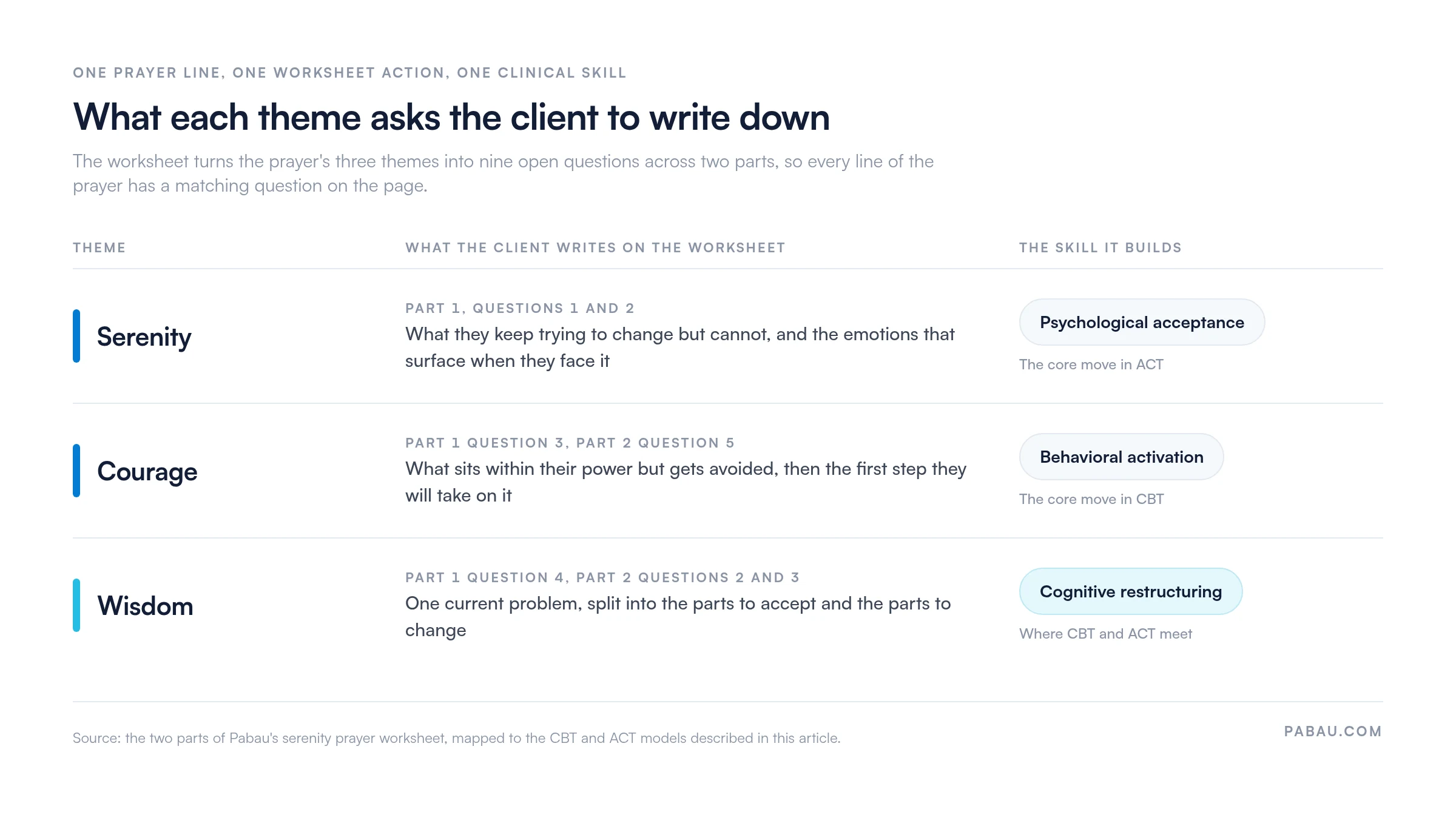
The fastest way into the exercise is a two-column sort on a whiteboard. Clients write a worry on the left if they can influence it, and on the right if they cannot. Most people put far too much in the left column on the first pass, which is the discussion you want to have.
A worked example helps anyone who freezes at a blank page.
The sort is cognitive restructuring in plain clothes, which the American Psychological Association describes as testing a thought against the evidence and rebuilding it.
A client moves from catastrophizing about the right-hand column to problem-solving on the left. Part 2 of the download runs the same move on one problem they bring in.
Written prompts do the work the two-column sort cannot, because they ask for feeling and reasoning rather than a category. Keep them open, and keep them short.
Use them as in-session discussion starters, or send them home. Sending them through a client portal means the answers come back attached to the record instead of buried in an email thread.
Where the worksheet lands in a week is a question of routine more than clinical model. Sound therapy practice management is the difference between a form clients complete and one that sits in a drawer.
Four slots work well:
The exercise has roots in two evidence-based models, which is why it holds up well outside a faith setting. Both models arrive at the same split from different directions.
In CBT, the control sort is cognitive restructuring. A client surfaces an automatic thought, tests the evidence behind it, then rewrites it as something they can act on. The worksheet gives each of those steps a line to fill in, so the sequence survives outside the room.
In ACT, acceptance does the heavy lifting. ACT asks clients to stop wrestling with thoughts, feelings, and sensations they cannot control, then to spend that effort on action they value. The prayer draws the same line, so the worksheet slots into ACT-informed work with no adaptation.
The last two questions on the form ask for a first step: one toward acceptance, one toward action. That pair is where a reflection exercise turns into behavior change, and it is the part clients skip if you let them.
Keep each step small enough to finish before the next appointment. “Call the doctor’s office to book the scan” beats “sort out my health” every time. Then ask two follow-ups out loud, and write the answers on the sheet: who can support this, and when will it happen?
What if a client cannot name a step at all? Go back to question 3 in Part 1 and ask what they have been avoiding. The answer is almost always the step.
The usual route is an email attachment and a hope that it comes back. The completed copy lands in an inbox, gets renamed, and reaches the client file only if somebody remembers. Practice management software like Pabau removes those steps by holding the form and the record in one system.
You send the worksheet from the client’s record as a digital form, and they open it on their phone. Their answers save straight back to that record with a date stamp. When you open the file before the next session, last week’s answers are already sitting there.
Follow-up is the other half of the job. Workflow automation can send a reminder two days before the appointment, so your front desk stops chasing homework by text. Assign the same form to a whole therapy group in one action, and the group turns up having done the reading.
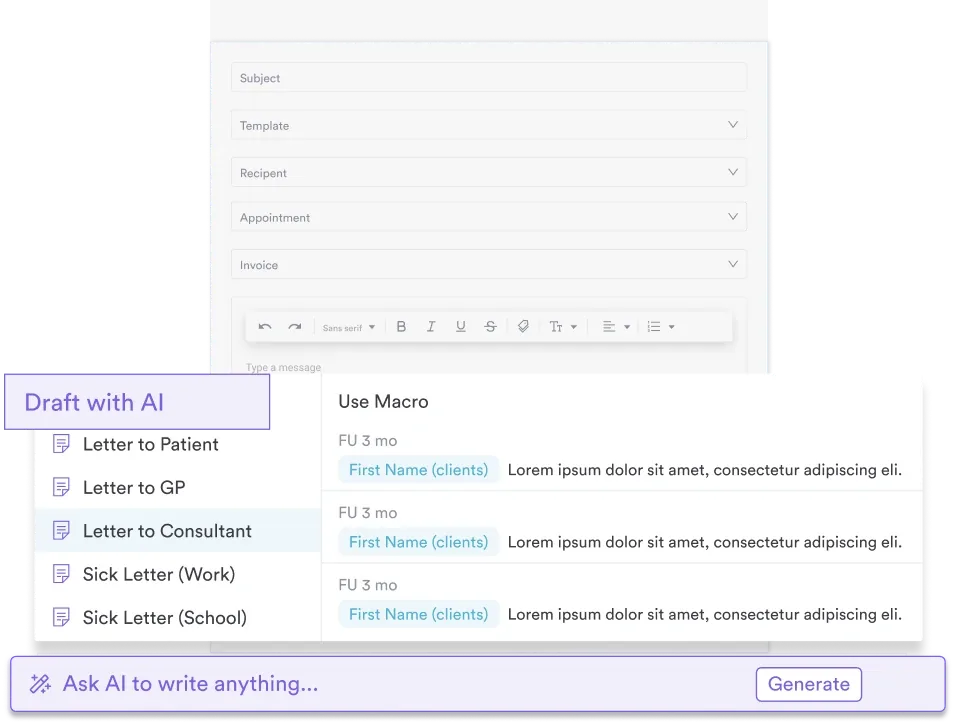

Pabau’s digital forms send the serenity prayer worksheet from the client’s record, then save the completed answers straight back to it. Reminders go out on schedule, so homework stops depending on anyone’s memory.

The worksheet earns its place because it makes a client commit something to paper. A conversation about control has evaporated by Thursday. Nine written answers have not, and they give you material to read back in the next session.
One caution is worth carrying into that session. Clients early in recovery sometimes read acceptance as permission to stop trying, so watch the second column closely. If almost every item lands under what cannot be changed, the sort has gone wrong and needs a conversation before the sheet goes home.
Download the file above, run Part 1 in session, and send Part 2 home. If the returning half keeps going missing, look at how you are sending it. Book a demo to see how Pabau delivers client forms and files the answers back against the record.

Want the ACT version of the same control question? Choice point worksheet maps a moment of choice onto moves toward or away from what a client values.
Teaching the full ACT model to a client? ACT hexaflex template lays out all six processes on one page you can annotate in session.
Need the step to become a plan? Change plan worksheet takes a single intention and turns it into timings, supports, and an obstacle list.
Working with a client’s family as well? Family roles in addiction worksheet helps relatives see the part they play in the pattern.
Yes. Drop the opening word and the exercise still works, because the three themes are psychological rather than doctrinal. Many clinicians introduce it as a control sort and mention where it comes from only if the client asks.
Yes. A longer text circulates in recovery literature, adding lines about living one day at a time and accepting hardship as a path to peace. Its authorship is less settled than the short form’s, and most meetings use the short one.
Once as an early assessment, then again at a sticking point. Weekly repetition tends to produce shorter answers each time. For a weekly rhythm, reuse Part 2 on its own against whatever problem is live that week.
Teenagers manage it well once the wording is simplified. Younger children rarely have the abstract vocabulary for the control question. A sorting activity with pictures or cards usually lands better than the written form.