Free model waiver form + what it is and when your practice needs one
A model waiver form is a signed document that lets a healthcare practice use a p...

2
Last Updated: Sep 29, 2026

The Rejeunesse aftercare guidelines are a one-page leaflet plus a confirmation page, not a consent form.
The leaflet is organized by time frame: the first 24 to 48 hours, the first week, the first month, and long-term care.
It names the side effects patients should expect and the warning signs that need a call to their provider.
A single patient confirmation checkbox records that the patient read the guidance and had the chance to ask questions.
Practice management software like Pabau can send the leaflet, capture that confirmation, and file it in the patient record.
A one-page patient leaflet covering immediate post-treatment care, first-week and first-month instructions, common side effects, warning signs, and long-term skin care. A second confirmation page carries the checkbox you file in the record.
Download templateRejeunesse is a non-animal, cross-linked hyaluronic acid dermal filler used to restore volume, smooth wrinkles, and refine facial contours. Most of what determines a patient’s result happens after they leave the treatment room.
This downloadable leaflet is the patient-facing half of that. It tells the patient what is normal, what to avoid, and when to pick up the phone. Hand it over at discharge or send it with the post-treatment message.
Be clear on the boundary before you download it. This is aftercare guidance, not informed consent. It carries no signature block, no contraindication screening, and no product-selection fields, so it sits alongside your consent form rather than replacing it.
This guide walks through what the leaflet contains, how to use it in your post-treatment workflow, and where you still need separate documentation.
The download runs to two pages, written for the patient rather than the practitioner. Page one holds all of the aftercare content, while page two holds only the confirmation.
It opens with a short explanation of what Rejeunesse is, then works forward through recovery in time order. Six sections follow:
Page two carries a single patient confirmation checkbox and nothing else. The patient confirms they read and understood the information, and had the chance to ask questions.
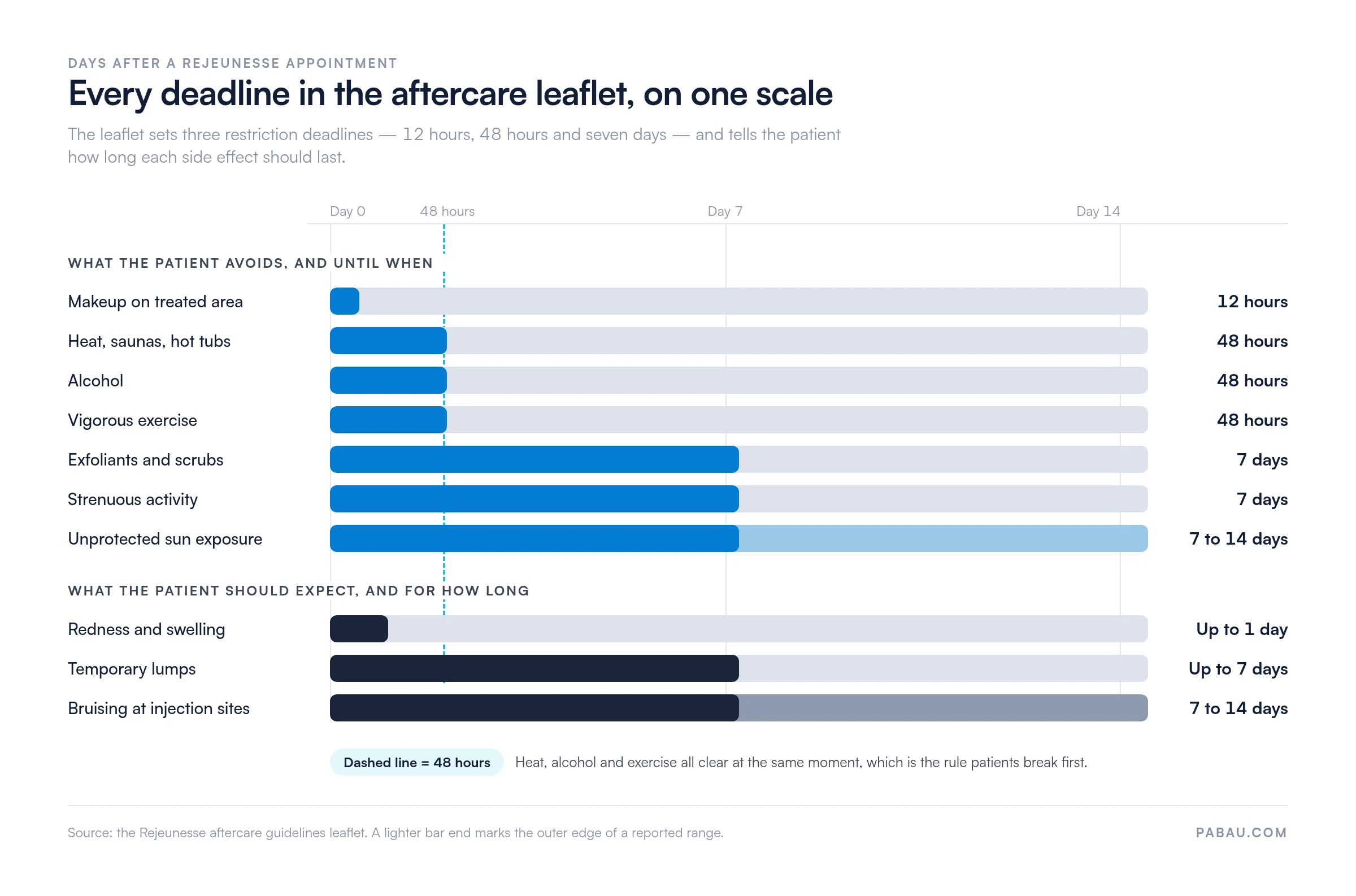
Read across those six sections and the instructions collapse into three deadlines: 12 hours, 48 hours, and seven days. The chart below plots each one against the recovery window it belongs to.
The leaflet is ready to hand out as it stands. These five steps turn it into a repeatable post-treatment routine your whole team follows the same way:
Add your own house rules to the leaflet where they differ. Practices vary on makeup timing, lip-filler eating advice, and how soon they want a patient back for a review.
The leaflet is written for any practitioner injecting Rejeunesse and for the patient going home afterward. In practice that means aesthetic practices offering facial rejuvenation and lip augmentation. It also covers dermatology practices running filler lists and medical spas where nurses inject under supervision.
Rejeunesse is CE marked for the UK and EU. It has no FDA premarket approval. US practices will use this leaflet as a model for their own approved filler instead. The product-neutral dermal filler aftercare form is the easier starting point there.
It earns its place fastest in multi-practitioner teams. When five injectors each give their own version of the aftercare talk, patients compare notes and lose confidence in all of it. One leaflet fixes that without extra admin.
Front-desk and reception staff benefit too. Most aftercare calls are questions the leaflet already answers. A receptionist can point the patient to the right section instead of interrupting a clinical list.
Fewer avoidable complications: swelling and bruising respond to cold compresses, rest, and sun protection. Patients who leave with written instructions follow them more closely than patients working from memory.
Earlier escalation of the cases that matter: the warning-signs section tells the patient which symptoms need a phone call. That shortens the delay between a problem starting and your team hearing about it.
Lower call volume on the routine questions: “is this bruise normal” is the most common post-filler question. A leaflet that says bruising resolves in one to two weeks answers it before the patient dials.
A record that the advice was given: the confirmation checkbox, filed in the patient record, evidences that you provided aftercare guidance. That matters in any complaint about a post-treatment outcome.
Consistency across the team: everyone gives the same advice, so training a new injector on aftercare takes one document rather than one shadowed shift. Purpose-built software for medical spas keeps that one document in front of every injector.
Rejeunesse comes in four cross-linked hyaluronic acid formulations. The aftercare advice in the leaflet applies across all of them, but injection depth and treated area change how long swelling and bruising stay visible.
Note which variant and which area you treated in the patient’s record, then set the follow-up expectation to match. Lip work bruises more visibly than cheek work, and patients plan around events.
The download is aftercare only. Its single confirmation checkbox has no name field, no date, and no signature line, so it cannot function as informed consent for an injectable treatment.
Your dermal filler consent form still has to carry the material this leaflet leaves out. That means patient identification and medical history, current medications such as anticoagulants and NSAIDs, and screening for contraindications.
It also means the variant and treatment areas injected, plus the batch or lot number. Add disclosure of rare but serious risks, including vascular occlusion, and dated patient and practitioner signatures.
You can confirm a filler’s regulatory status before you write either document. Check the FDA PMA database for the US, since hyaluronic acid fillers are Class III devices approved through premarket approval rather than 510(k) clearance. UK and EU practitioners can check the MHRA and the product’s CE marking.
Have your indemnity provider review both documents before you use them. In the UK that is the MDU, MPS, or MDDUS, and in the US your malpractice insurer.
Log any reported complication in the patient record within 24 hours of the patient telling you. Record onset (same day or delayed), severity, duration, and how it responded to aftercare. That log does two jobs. It evidences your standard of care if the outcome is ever disputed. Over a year it also shows whether particular batches or techniques track with higher complication rates. Standardize the fields across the team so the data is comparable.
In most practices the aftercare leaflet is printed at reception and handed over in the last 30 seconds of the appointment. The patient loses it, calls on day four, and no record shows that the advice was ever given.
Practice management software like Pabau attaches the leaflet to the treatment instead of the appointment. It sends automatically after checkout, the patient confirms it on their phone, and the confirmation lands in their clinical record with a timestamp.
From there the follow-up runs itself. Automated messages check in during the swelling window and prompt the review appointment. Anyone who has not confirmed gets flagged so a coordinator can call them.
The result is one aftercare standard across every injector, and a record you can produce in seconds if a post-treatment outcome is ever questioned.


Pabau sends your aftercare leaflet as soon as the patient checks out and records their confirmation against the treatment. Follow-up messages then catch problems early, so your team holds one aftercare standard without chasing paper.

Download the leaflet, add your practice contact details, and make handing it over part of checkout rather than a favor the injector remembers. That single change removes most avoidable post-filler calls.
Keep the boundary clear while you do it. This document manages recovery, and your consent form manages the decision to treat. Neither one covers for the other, and a practice that conflates them has a documentation problem waiting to surface.
The trade-off worth remembering is speed against evidence. Printing is faster today, but only a captured confirmation proves the advice was given. Book a demo to see how Pabau sends aftercare and files every confirmation for you.

Need a version that is not tied to one brand of filler? The dermal filler aftercare form carries the same recovery instructions without naming a product, so it fits whichever filler you stock.
Still need the consent half of the paperwork? The dermal filler consent form template covers the screening, risk disclosure, and signatures this leaflet deliberately leaves out.
Injecting more than one hyaluronic acid brand? The Belotero aftercare instructions follow the same time-ordered structure, so your leaflets read consistently across the range.
Need follow-up to happen without someone remembering? Automated workflows can check in during the swelling window, book the review appointment, and flag patients who never confirmed.
Running injectables across several practitioners? Skin clinic management software keeps one aftercare standard in place and shows who sent what, when, and from which device.
For the first 48 hours, patients should avoid hot showers, saunas, hot tubs, alcohol, and vigorous exercise. Makeup stays off the treated area for at least 12 hours. Exfoliants, scrubs, and harsh products wait a full seven days. Direct sun exposure should be avoided for one to two weeks, with broad-spectrum SPF 30 or higher whenever they are outdoors.
Mild redness and swelling usually settle within a few hours to a day. Tenderness or a feeling of tightness tends to ease over a few days. Bruising at the injection sites commonly takes one to two weeks to clear. Temporary lumps or bumps normally smooth out within a few days to a week. Anything that persists or worsens beyond that warrants a call.
Immediately, if they have severe pain that over-the-counter relief does not touch. Also if they see signs of infection such as increased redness, warmth, or pus at an injection site. Allergic symptoms including itching, hives, or difficulty breathing need urgent contact. Any side effect that lasts longer than expected or gets worse over time should be reported rather than watched.
No. The leaflet ends with one patient confirmation checkbox. It only records that the patient read the aftercare information and had the chance to ask questions. It has no name, date, or signature line, and it does not screen contraindications or disclose treatment risks. Keep a separate consent form for those, completed and signed before you inject.
No. Rejeunesse is CE marked for use in the UK and EU, but it holds no FDA premarket approval for the US market. Hyaluronic acid dermal fillers are Class III devices in the US, so they reach the market through the premarket approval pathway rather than 510(k) clearance. US practices should use this leaflet as a model for an approved filler instead.